SDR Outsourcing for Insurtech Companies
What an outsourced SDR team must be able to say for an insurtech: the buyer function, the enrollment and trade-press calendar, the licence question, the security review.
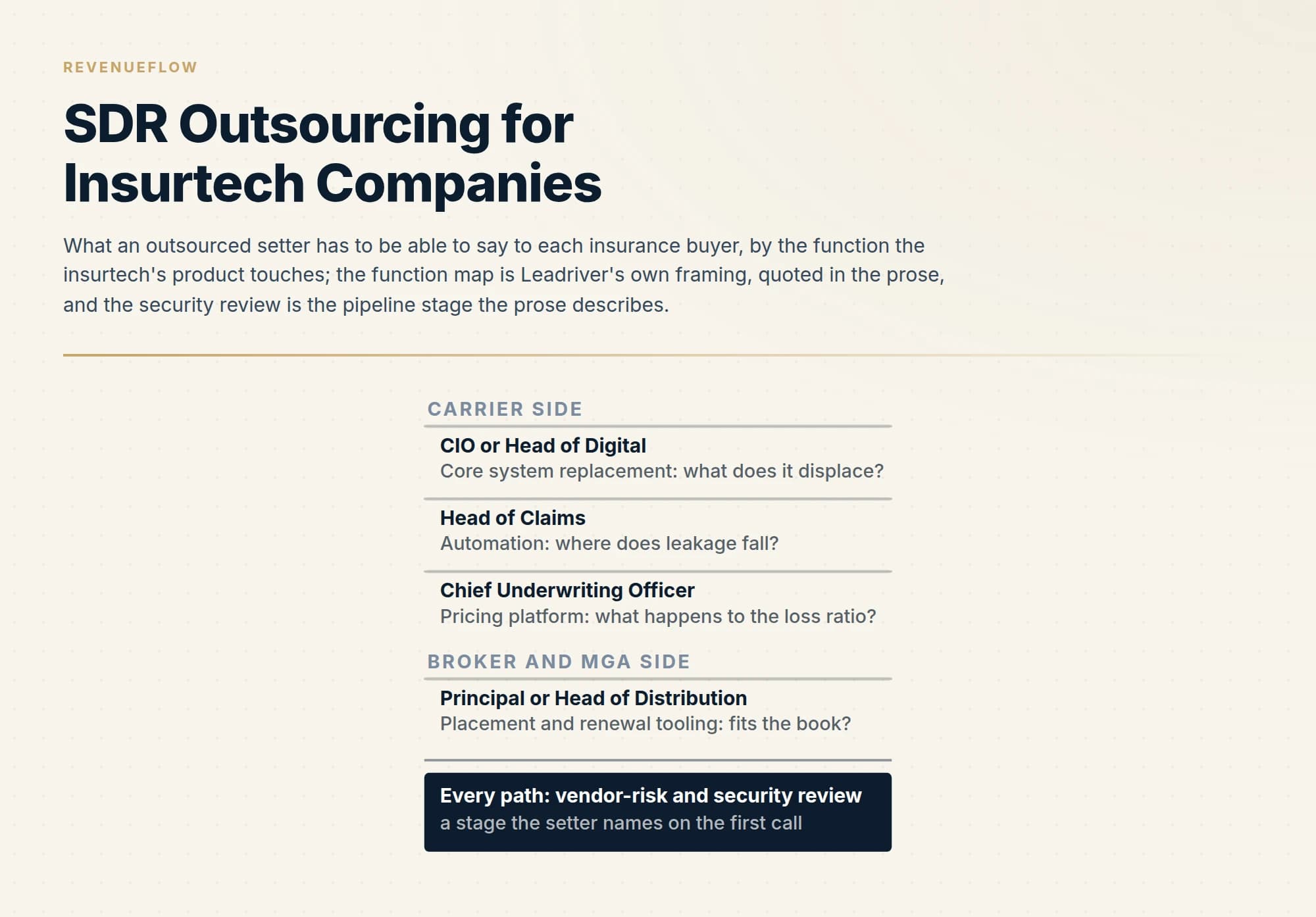
An insurtech outsources SDR well when the setter can name the carrier or broker function its product touches, read the trade press and the open enrollment calendar for the window, send one message by a person, surface the security review on the first call, and hand over a meeting defined in writing before launch.
Key takeaways
- Insurance Journal's 17 September 2026 stories, Beazley confirming affirmative AI cyber cover and the TRIA reauthorisation moving to the Senate floor, are the kind of dated events an outsourced setter must be able to read and route to the right underwriting or claims function.
- HealthCare.gov puts open enrollment from 1 November to 15 January with 15 December the last day for 1 January coverage, and Insurtech Insights lists Hong Kong in December 2026, London in March 2027 and New York in June 2027; ITC Vegas is named without dates because its pages did not serve.
- The FTC says most business-to-business calls are exempt from the Telemarketing Sales Rule, the FCC says AI-generated voice calls are illegal without consent, and CAN-SPAM makes no exception for B2B email; producer licensing is a state matter run through NIPR and checkable on any state department page.
- A per-meeting model fits an insurance cycle only when the meeting is defined in writing before launch by function, line of business and attendance, with budget, timing and authority excluded; a multi-touch sequence into regulated buyers spends the sender's reputation in a small market.
Reviewed and updated September 18, 2026
On 17 September 2026 Insurance Journal's insurtech desk led with Beazley confirming "affirmative artificial intelligence cover in its cyber and tech E&O policies", and the day after, its national desk carried the Senate committee sending the Terrorism Risk Insurance Act reauthorisation to the floor and a new president at PIA National (insurancejournal.com, insurancejournal.com, both read 18 September 2026). Every one of those headlines is a reason for some insurtech to write to some carrier or broker this week, and none of them will still be a reason in November. That is the problem an insurtech founder is really solving when they ask whether to outsource sales development: not whether someone else can send email, but whether someone else can read the insurance trade press and know which line to write to whom.
This page is for an insurtech company deciding whether to hire an outside SDR team, and what that team must be able to say to survive a conversation with an underwriter, a claims leader or a broker principal. It is not the persona-and-message page: cold email for insurtech covers the two buyer worlds, carrier-facing and broker-facing, the buying cycle and the list, and nothing there is repeated here. The four staffing shapes behind the phrase are in SDR outsourcing, the billing units that sit on top of them in outsourced SDR pricing, and the vendor-risk review that sits in every financial-services pipeline is worked through in fintech lead generation. Every fact on this page comes from a source fetched on 18 September 2026, cited where it appears.
What a setter has to be able to say
An insurance buyer decides whether to keep listening in the first two sentences, and what they listen for is the function. Leadriver, one of the two independent insurtech pages on the first page of results for this phrase, puts it in the language its own service sells: the right buyer is "CIO for core system replacements, Head of Claims for automation tools, Chief Underwriting Officer for pricing platforms", and outreach "that does not demonstrate an understanding of underwriting, claims, or distribution realities is dismissed immediately" (leadriver.io, read 18 September 2026). That is a vendor describing what it sells, and it is quoted here as such, but the function map is right, and it is the first test of any team you might hire: ask them which of your target titles owns the loss ratio and which owns the claims cycle, and listen for a pause.
The second thing a setter must be able to say is what happens after the meeting. In an insurance-adjacent sale the stage that kills deals is the vendor-risk and security review, and a setter who books a meeting without naming it hands your account executive a prospect who will go quiet the moment procurement asks for the questionnaire. The fintech page linked above works through that stage; for an insurtech the addition is that carriers and large brokers are regulated entities whose third-party risk teams treat a claims or underwriting tool as core, and the setter's job is to surface who owns that review before the first call ends.
The third is the calendar, which is the section below, and the fourth is the licence question, which is the one after it.
The calendar a setter must read
Insurance buys on dated windows, and the ones below are public. For an insurtech selling into health plans or benefits brokers, the federal Marketplace's own dates are the anchor: open enrollment starts on 1 November, 15 December is the last day to enrol for coverage starting 1 January, and open enrollment ends on 15 January (healthcare.gov, read 18 September 2026). Any tooling that touches enrolment is bought before that window or not until the next one. For a cyber or specialty insurtech, the trade press is the calendar: Beazley's 17 September confirmation of affirmative AI cover, and Insurance Journal's same-week piece on cyber insurers adapting policies "As AI Agents Go Rogue", mark a quarter in which cyber underwriters are rewriting wordings (insurancejournal.com). For anyone selling into commercial property or terrorism-exposed lines, the TRIA reauthorisation moving to the Senate floor on 17 September is a dated policy event (insurancejournal.com).
The conference calendar is public too. Insurtech Insights, which describes itself as connecting "more than 13,000 people yearly from more than 80 countries", lists its Asia event in Hong Kong on 2 to 3 December 2026, Europe in London on 3 to 4 March 2027 and USA in New York on 2 to 3 June 2027 (insurtechinsights.com, read 18 September 2026). ITC Vegas is the other large gathering and is named here without dates, because its site served a thin page and its parent domain refused the request on 18 September 2026; a setter who quotes it should have read it that day. Reinsurance treaty renewal dates are widely discussed in the trade and are deliberately not stated here, because no regulator or association page fetched for this article carries them.
The rules that touch a third party calling for you
Three rule sets reach an outsourced setter, and each asks something different of whoever sends. On the phone, the FTC's guide to the Telemarketing Sales Rule says "Most phone calls between a telemarketer and a business are exempt from the TSR" (ftc.gov, read 18 September 2026), which describes federal coverage of a business-to-business call and nothing more; the FCC's telemarketing page separately states that robocalls, meaning calls made with an autodialer or a prerecorded or artificial voice, require the called party's prior written consent, and that "AI-generated voice calls are illegal unless the consumer has agreed to receive them or the caller is exempt" (fcc.gov, read 18 September 2026). A setter that dials by hand, with a live person, is the shape those pages describe; one that proposes an AI voice agent to warm your list is proposing something the regulator's page names as illegal without consent. By email, the FTC's CAN-SPAM guide "makes no exception for business-to-business email" (ftc.gov, read 18 September 2026), so every message the setter sends in your name carries your obligations: honest headers, an address, an honoured opt-out.
The third rule set applies only where the insurtech is itself a licensed producer, agency or MGA. Producer licensing is a state matter, run through the National Insurance Producer Registry, which describes itself as "the centralized licensing and compliance resource for insurance professionals" handling licence applications and renewals across states (nipr.com, read 18 September 2026), and enforced by each state's department. California's is typical in one respect that matters to a setter: its Agents and Brokers page lets anyone "verify the status and discipline history of an agent, broker, adjuster, bail agent, business entity or another licensee" by name or licence number (insurance.ca.gov, read 18 September 2026). The consequence is simple. If your setter says or implies to a broker that your company is licensed in a state, that claim is checkable in a minute, so the setter must know exactly what licences you hold and must never hold your company out as an agent or broker where it is not one. Where the insurtech is pure software sold to carriers, none of this applies to its outreach, and a setter should not pretend it does. None of this is legal advice; it is what the regulators publish, and a contract with a setter should say who is responsible for each obligation.
Which model fits an insurance cycle
The SDR outsourcing head separates four staffing shapes, a dedicated agency team, a fractional SDR, offshore staffing and outcome-based meeting buying, from the unit you are billed on, per seat, per meeting or a hybrid of retainer and commission, and it is the unit that lands differently here, because the insurance cycle is long and the security review sits in the middle of it. A per-seat or retainer unit bills through the months in which a carrier's third-party risk team is reviewing your questionnaire and no meeting is happening, which is fine if the seat is genuinely working the next account and expensive if it is waiting. A per-meeting unit shifts that risk to the vendor, and it only works if the definition of a meeting is written before launch and names the function, the line of business and attendance, with budget, timing and authority deliberately excluded, because an underwriter who agrees to a relevant conversation is a qualified meeting whether or not the budget line exists yet. Our own position is the per-meeting one, on those terms, run by email and LinkedIn, on Email Bison and in-house tooling for email and HeyReach for LinkedIn, one message per campaign.
What the first page of results sells is mostly the other shape. Leadriver's page describes "multi-touch email and LinkedIn sequences" with "domain warm-up, inbox rotation, and deliverability monitoring", and Salesforce Europe's insurtech page lists cold calling, email campaigns and social media as the three outbound channels and frames outsourcing as "expertise, cost-effectiveness, scalability" (salesforceeurope.com, read 18 September 2026). Read both as what those vendors sell. A multi-touch sequence into a regulated buyer produces the second and third messages that land under the ignored first one, and in a small market where underwriters move between carriers, the reputation cost follows the sender's domain into the next account.
Three openers with the source beside them
Each opener is grounded in a page read on 18 September 2026, names no real recipient, carries no contact details and makes no claim about results. Brackets are for the insurtech's own facts.
To a cyber underwriting leader, after the Beazley story. Beazley confirmed affirmative AI cover in its cyber and tech E and O forms on 17 September. If your team is deciding how to word AI exposure in the next filing, we built [product] to [what it does for a wording or underwriting decision], and we can show the two carriers' approaches we have seen side by side. Source: Insurance Journal's insurtech desk. Legitimate because the market moved on a dated, public event that the recipient's function owns.
To a benefits broker principal, before open enrollment. Open enrollment starts 1 November and 15 December is the last day to enrol for 1 January coverage, per HealthCare.gov. If your team is still [enrolling by hand / reconciling by spreadsheet] this year, [product] is live in time for the window, and after 15 January there is no point talking until next autumn. Source: HealthCare.gov dates and deadlines. Legitimate because the window is the regulator's own and the honesty about timing is the offer.
To a commercial property underwriter, on TRIA. The Senate committee sent the TRIA reauthorisation to the floor on 17 September. If your terrorism-exposed book is being re-modelled ahead of the vote, [product] does [what it does for that exposure]; worth fifteen minutes before the floor schedule is set? Source: Insurance Journal's national desk. Legitimate because the policy event is dated and the recipient's line is the one it touches.
When outsourcing is the wrong play for an insurtech
It is the wrong play when your target market is a few dozen named carriers, because that is a founder-led, named-account motion and an outside setter adds a layer between you and people you will meet at every conference anyway. It is the wrong play when your product is sold to consumers through your own licensed agency, because the TSR's business exemption and the rest of this page describe business-to-business outreach and consumer rules are different. It is the wrong play when the buyer's process is a formal procurement at a large carrier with a published vendor onboarding path, where a cold message cannot move the sequence. And it is the wrong play if no one on your side can define a qualified meeting in writing before the first send, because every model above depends on that sentence.
The short version
An insurtech outsources SDR successfully when the setter can name the function its product touches at a carrier or broker, read the trade press and the enrollment calendar for the window, send one message by a person under CAN-SPAM and the platform's rules, surface the security review on the first call, and hand over a meeting that meets a definition written before launch. Where the insurtech is itself licensed, the setter must know exactly what it holds, because any state department of insurance page can check. If your list is bigger than your founders can write to and smaller than a sequence should be pointed at, RevenueFlow books qualified meetings on a pay-per-meeting basis.
Regulatory and licensing facts on this page are taken from the regulator's own page, read on 18 September 2026, and summarised rather than reproduced. Rules differ by state and by whether a company is itself a licensed producer; this is not legal advice.
Sources: Insurance Journal insurtech news, Insurance Journal national news, Leadriver, outsourced SDR for insurtech, Sales Force Europe, insurtech outbound, HealthCare.gov dates and deadlines, Insurtech Insights, NIPR, California Department of Insurance, agents and brokers, FTC Telemarketing Sales Rule guide, FCC telemarketing and robocalls, FTC CAN-SPAM guide
Frequently asked questions.
Frequently asked questions- What should an outsourced SDR know before calling insurance carriers for an insurtech?
- Which function the product touches, because that decides who listens: the CIO or head of digital for core systems, the head of claims for automation, the chief underwriting officer for pricing, and a principal or head of distribution on the broker side. The setter must also know the buying window, the vendor-risk and security review that follows every meeting, and exactly which licences, if any, the insurtech holds, since state department of insurance pages let anyone verify a licence claim.
- Do telemarketing rules apply to an outsourced SDR calling insurance companies?
- The FTC's Telemarketing Sales Rule guide states that most phone calls between a telemarketer and a business are exempt from the rule, which describes federal coverage of a business-to-business call and nothing more. The FCC's telemarketing page separately says robocalls made with an autodialer or a prerecorded or artificial voice need prior written consent, and that AI-generated voice calls are illegal unless the called party agreed. State rules sit beside both. None of this is legal advice.
- When is the best time for an insurtech to run outbound?
- Inside a dated window the buyer's function owns. For health and benefits tooling that is before open enrollment, which HealthCare.gov puts at 1 November to 15 January with 15 December the cutoff for 1 January coverage. For cyber and specialty products it is the week the trade press reports a wording change, such as Beazley's affirmative AI cover on 17 September 2026. Insurtech Insights adds Hong Kong in December 2026, London in March 2027 and New York in June 2027.
- Which SDR outsourcing model works for an insurtech sales cycle?
- A per-meeting model, provided the meeting is defined in writing before launch by function, line of business and attendance, with budget, timing and authority excluded, because an underwriter agreeing to a relevant conversation is qualified whether or not a budget line exists yet. Per-seat and retainer models bill through the months a carrier's third-party risk team spends on your questionnaire, which is fine if the seat is working the next account and expensive if it is waiting.
About the author.

B2B cold email experts helping companies generate qualified leads through done-for-you outreach campaigns.
RevenueFlow Team
Explore more.
Ready to scale your outreach?
We build GTM engines that book real meetings. See the receipts.
Related articles.
LinkedIn Outreach for Machine Shops
How a job shop or CNC machine shop uses LinkedIn to win OEM work: the four buyer titles, the RFQ gate, the ISO, AS9100 and ITAR facts, and LinkedIn's own rules.
SDR Outsourcing for Fintech Companies: Assessability Test
For the fintech weighing an outside setter: the three assessability sentences, the promotion rules that bind every message, the sponsor test and which model fits.
SDR Outsourcing for Food and Beverage Companies: Food Layer
For the food or beverage brand weighing an outside setter: the buyer by channel, the broker and distributor map, the review calendar and the traceability rule's dates.
Appointment Setting for Food Distributors
How a foodservice distributor opens accounts its routes do not reach: independents, chains and institutions, the FDA traceability rule as the opener, the DSR handoff.
SDR Outsourcing for Solar Companies: The Commercial Layer
For the solar company weighing an outside setter: which segment a setter fits, the four sentences it must be able to say, and the consumer rules it inherits.
SDR Outsourcing for Biotech Companies: When It Fits
SDR outsourcing for life science sellers: which parts of the job can go outside, what FDA research use only guidance means for the brief, and when it is the wrong play.