SDR Outsourcing for Food and Beverage Companies: Food Layer
For the food or beverage brand weighing an outside setter: the buyer by channel, the broker and distributor map, the review calendar and the traceability rule's dates.
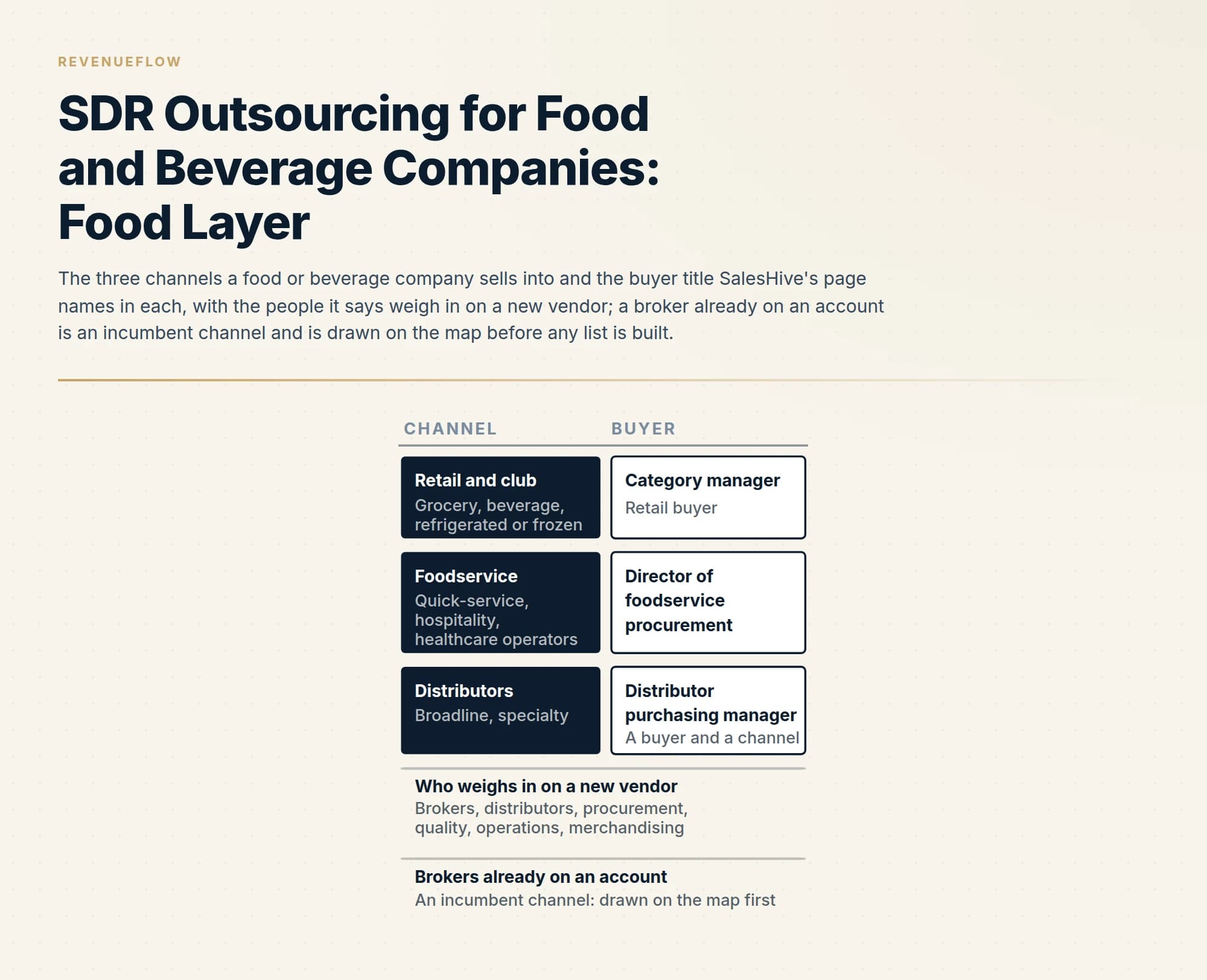
A food or beverage company pays an outside setter only for the accounts left after brokers and distributors are drawn on the map. The setter needs the file, specs, certificates, allergen statement, shelf life and pallet, before the first call, the buyer only acts in review windows, and the meeting that counts is the sample request, not the call.
Key takeaways
- SalesHive's page names the buyer by channel, grocery category managers, retail buyers, directors of foodservice procurement and distributor purchasing managers, and the people who weigh in: brokers, distributors, procurement, quality, operations, merchandising.
- A broker already representing the brand to an account is an incumbent channel, and a distributor's buyer is also a channel, so the setter's list is whatever is left after both are drawn on the map.
- The FDA's traceability rule page, read on 18 September 2026, says the agency intends not to enforce the rule before 20 July 2028, and its list page names the covered foods; a setter may say how lot-level records reach a buyer, never that the product is compliant.
- Expo West, the Winter FancyFaire, the Restaurant Show and IFDA's events are dated on their own pages; the category reset and line review windows are account-specific and go on the list one account at a time.
Reviewed and updated September 18, 2026
A food or beverage company that sells to other businesses sells into windows. SalesHive's food and beverage page, read on 18 September 2026, says "Retail and foodservice buyers often engage only during category resets, line reviews, or contract windows", and the Food and Drug Administration's page on its Food Traceability Rule, read the same day, says Congress "directed FDA not to enforce the Food Traceability Rule" before 20 July 2028. A calendar the buyer keeps and a rule with a date on it are the two things an outside sales development team has to be able to work with before it is worth paying for, and they are what this page is about. It is written for the food or beverage manufacturer, brand, distributor or co-packer selling to other businesses, retail chains, foodservice operators, distributors, ingredient buyers, that is deciding whether to pay an outside team to open doors. If you sell software or services to food companies and want to reach them, the cold email for food and beverage guide covers that direction.
One paragraph on what a search for this phrase returns, because the word is ambiguous. Four of the ten results, read on 18 September 2026, are about a different kind of outsourcing: Solvo sells outsourced accounting and back office, SC Logistics outsourced distribution, Aptean writes about outsourced production, and Food Industry Executive's page is a 2023 press release on a TraceGains survey about outsourced manufacturing. The other six sell sales development to the food or beverage company as the client: Sales Focus, SalesHive, Cold Call Me, MarketJoy, a generated location page and a generic agency list. This page takes that second reading.
The generic questions, what the four outsourcing models are, what a seat, a meeting or a qualified meeting costs, and whether the learning from outbound should live inside the company or at the vendor, are answered in SDR outsourcing, outsourced SDR pricing and outbound sales outsourcing, and are not repeated here. The food layer is below: who the buyer is and how many people sit behind that buyer, the calendar the buyer actually keeps, the paperwork an outside caller must have in hand before the first call, the traceability rule with a date on it, the rules a third-party caller and sender inherits, the objections vendors report, and the cases where an SDR team is the wrong purchase.
The buyer, and the six people behind the buyer
SalesHive's food and beverage page, read on 18 September 2026, says it "books qualified meetings for food and beverage companies with grocery category managers, foodservice procurement directors, and distributor purchasing managers", and lists the four roles its outsourced team calls: grocery category managers at retail and club, retail buyers for grocery, beverage and refrigerated or frozen, directors of foodservice procurement at quick-service, hospitality and healthcare operators, and distributor purchasing managers at broadline and specialty distributors. Cold Call Me's page adds the category detail that decides whether a call is wasted: it says it will "verify that the buyer handles your category before booking the meeting", frozen desserts rather than dry goods. Sales Focus, which says that "Since 1998, we have been quickly building, launching and managing high performing dedicated sales teams", frames the market from above: retail and dining establishments on one side, the suppliers that keep their shelves, freezers and fridges stocked on the other.
The buyer is rarely alone. SalesHive names the people who weigh in on a new vendor, "brokers, distributors, procurement, quality, operations, and merchandising may all weigh in", and says a deal that is not mapped to each of them ends in check back later. Two of those matter before the list is built. A broker who already represents your brand to an account is an incumbent channel, and an outside setter calling that account creates the same conflict a manufacturer's independent rep creates: a commission question and a broker who stops carrying the line. A distributor's purchasing manager is both a buyer and a channel; a brand that sells through a broadline distributor and also lets a setter call the distributor's restaurant customers direct has just competed with its own distributor. The setter's list is whatever is left after brokers and distributors are drawn on the map, and if that is small, so is the programme.
The calendar the buyer keeps
The reason food outbound fails on timing is that the buyer only acts in windows. SalesHive's page ties the buyer's attention to category resets, line reviews and contract windows, as quoted at the top, and Cold Call Me says its timing work is to "understand review cycles and category resets, ensuring we pitch your product when buyers are actually looking". Neither page publishes the windows, which differ by retailer and category; the setter's first job is to learn each target account's review month and write it on the list.
The trade calendar is published, and a setter should be working it. Natural Products Expo West's site says "Save the date for Expo West 2027 | March 2-5, 2027"; the show runs at the Anaheim Convention Center, with exhibit halls open 3 to 5 March and, per its site, a return of buyer-only hours. The Specialty Food Association's (SFA) Winter FancyFaire runs 17 to 19 January 2027 in San Francisco, and the association's Maker Growth Summit runs 8 to 10 December 2026 in Boston. The National Restaurant Association Show runs 22 to 25 May 2027 at McCormick Place in Chicago. On the distribution side, the International Foodservice Distributors Association (IFDA) lists its National Championship on 22 to 24 October 2026 in Orlando and its Partners Executive Forum on 24 to 27 January 2027 in Florida, and it has a manufacturer-partner membership category. Cold Call Me's page names the post-show problem directly: the hundreds of business cards collected at Expo West that never turn into orders. The setter's show job is the fortnight before, booking the buyer from the attendee list, and the fortnight after, converting the sample request.
What the setter must have in hand before the first call
SalesHive's page lists what procurement and quality ask a new vendor for, "specs, COAs, allergen statements, food safety certifications, and traceability details", and says outreach that creates interest with no process to answer those requests loses momentum. Cold Call Me lists what its callers are trained to discuss, "MOQs, pallet configurations, and promotional allowances", and says a sampling request is the first step toward a purchase order. Put together, that is the file the food company hands its setter on day one. A setter who cannot say the case count per pallet, the shelf life, the allergen statement and which certifications the plant holds will lose the buyer on the second question, and the buyer will not take a third call to hear the answer.
That is why the meeting to buy in this vertical is not the meeting but the sample. A booked call with a category manager who has not asked for a sample is a courtesy call; Cold Call Me uses the phrase itself. The qualification bar to agree in writing is that the buyer handles your category, that the account is in or approaching a review window, and that a sample or a spec sheet has been requested.
The rule with a date on it
The Food and Drug Administration's page on its Food Traceability Rule, read on 18 September 2026, states that persons subject to the rule who manufacture, process, pack or hold foods on the list must "maintain records containing Key Data Elements (KDEs) associated with specific Critical Tracking Events (CTEs)" and provide information to the agency "within 24 hours or within some reasonable time to which the FDA has agreed", and that the original compliance date was 20 January 2026. The same page states that "The FDA proposed to extend the compliance date for the rule by 30 months to July 20, 2028" and that the Continuing Appropriations, Agriculture, Legislative Branch, Military Construction and Veterans Affairs, and Extensions Act of 2026 directed it not to enforce the rule before that date. The agency held a public meeting on 15 June 2026 on lot-level tracking and flexibilities. The list itself, on a separate FDA page read the same day, names the covered foods, beginning with soft and fresh cheeses, and the agency notes the requirements extend to foods containing a listed food as an ingredient in the same form.
For outreach this is two things, and neither is legal advice. If your product is on the list, the buyer's quality team will ask how your lot-level records reach them, and a setter who can say so in the first message has removed the objection that stalls onboarding; a setter who says the product is compliant has made a claim only your counsel can make. If your product is not on the list, say nothing about the rule at all.
Two federal rules touch the caller and sender themselves, stated from the Federal Trade Commission's guides read on 18 September 2026. Its Telemarketing Sales Rule guide states that "Most phone calls between a telemarketer and a business are exempt from the TSR", with carve-outs for calls to induce the retail sale of nondurable office or cleaning supplies and for calls soliciting employees to buy for their own use, and it states the rule reaches companies that provide substantial assistance to a seller. Its CAN-SPAM guide states that the law covers all commercial email with no business-to-business exception, requires a valid physical postal address and an opt-out honoured within ten business days, and says that "even if you hire another company to handle your email marketing, you can't contract away your legal responsibility to comply with the law". The food company reads every message before it goes out in its name.
What vendors report hearing
SalesHive's own list of why the work is hard is the objection list a food company should put to any vendor: category cycles move slowly; deals are won and lost on price packs, promo calendars, trade spend expectations and margin targets, so outreach that does not speak to profitability loses to the incumbent or to private label; onboarding is paperwork-heavy; recalls and labelling mistakes carry outsized consequences so buyers are cautious; and retailers are rationalising SKUs while expanding store brands, so new is not automatically welcome. Cold Call Me reports the plainer version: "Category managers are notoriously hard to reach", and buyers are "bombarded with new products daily".
The objection a food company's own sales lead will raise is the right one: an outside caller does not know the trade terms. The answer is the file above and a rule that the setter's message names the person from the company who will be on the call, and that person can quote the promotional allowance. Sales Focus says its agents "are equipped to function as an extension of your company in less than two months"; take that as the minimum ramp any vendor needs to learn a line sheet, and ask what happens to the learning when the contract ends.
When an SDR team is the wrong purchase
Four cases. Your route to market is a broker network and a distributor, and the map above leaves no accounts for a setter to call. Your sale is route-based, a driver-seller restocking accounts, where the relationship is the route. Your target is institutional foodservice bought through a group purchasing contract, where the door is the contract, not the operator. And your constraint is capacity: a co-packer with no open line time, or a brand whose next production run is already sold, gains nothing from a buyer who wants a sample this month.
Three openers, each on a fetched fact
Three illustrative openers follow, each built on a page read on 18 September 2026; each is one message to one person, sent once, on email and LinkedIn, with no follow-up bump, and the sample request or the silence is the answer. They name no real recipient, make no claim about results, and the company that speaks in each is invented.
The first illustrative opener is for a grocery category manager, refrigerated, ahead of a reset. It rests on the Food and Drug Administration's traceability pages quoted above, which put soft and fresh cheeses on the Food Traceability List and give 20 July 2028 as the date before which the agency intends not to enforce.
Our fresh soft cheese is on the federal Food Traceability List, so your quality team will want lot-level records in the key-data-element format the rule requires; ours already reach a retailer's system that way, ahead of the July 2028 enforcement date the agency has published. We are an eight-line creamery in Wisconsin with a 45-day shelf life and a twelve-case pallet. If your refrigerated reset is coming up, would you like a sample and the spec sheet before the review?
The second illustrative opener is for a distributor purchasing manager, and it rests on the International Foodservice Distributors Association's own dates for its Partners Executive Forum, 24 to 27 January 2027.
You are attending the Partners Executive Forum on 24 to 27 January. We are a regional sauce manufacturer with open capacity from February and a broadline-ready case pack. If you are adding Southeastern lines in the first quarter, would a twenty-minute meeting at the forum with our sales director, who can walk through allowances and minimums, be worth a slot?
The third illustrative opener is for a director of foodservice procurement at a hospitality group, and it rests on the National Restaurant Association Show's own dates, 22 to 25 May 2027 at McCormick Place.
The show runs 22 to 25 May at McCormick Place and your group is on the attendee list. We supply the pre-portioned protein programme for two hotel groups of your size and can hold price for a contract year. If your protein contract window falls in the summer, would a floor meeting on the Monday with our foodservice lead be useful before the bids go out?
To: Category Manager, Refrigerated. Subject: lot-level records for the refrigerated reset
Our fresh soft cheese is on the federal Food Traceability List, so your quality team will want lot-level records in the key-data-element format the rule requires; ours already reach a retailer's system that way, ahead of the July 2028 enforcement date the agency has published. 1
We are an eight-line creamery in Wisconsin with a 45-day shelf life and a twelve-case pallet. 2
If your refrigerated reset is coming up, would you like a sample and the spec sheet before the review? 3
- 1Names the rule, the list and the agency's published date. Says what the records do, never that the product is compliant.
- 2Shelf life and pallet, the two numbers a category manager asks first; the setter has them from the file.
- 3Asks for the sample, which is the step that precedes a purchase order, timed to the reset.
What to agree in writing
The broker and distributor exclusions, by account. The review month for each target account, learned before the first send. The file: specs, certificates of analysis, allergen statement, certifications, shelf life, pallet and minimums. The qualification bar: right category, review window near, sample or spec requested. A sight of every message before it goes out, because the responsibility is the company's. One message per campaign, no bumps, with the person who can quote the allowance named as the one who will attend. A brand that wants to see the shape run against its own open accounts before signing a contract can start with a free campaign and count the sample requests.
Frequently asked questions.
Frequently asked questions- Who does an outsourced SDR call for a food or beverage company?
- The buyer for your category in each channel, as SalesHive's food and beverage page lists them: grocery category managers at retail and club, retail buyers for grocery, beverage and refrigerated or frozen, directors of foodservice procurement at quick-service, hospitality and healthcare operators, and distributor purchasing managers at broadline and specialty distributors. Cold Call Me adds that the setter must find who buys your specific category before pitching anyone.
- What must a food company hand its setter before the first call?
- The file that procurement and quality will ask for, as SalesHive lists it: specs, certificates of analysis, allergen statements, food safety certifications and traceability details, plus the trade terms Cold Call Me says its callers discuss, minimum order quantities, pallet configurations and promotional allowances. A setter who cannot state the case count per pallet, the shelf life and the certifications loses the buyer on the second question.
- How does the FDA traceability rule affect food outreach?
- The FDA's page, read on 18 September 2026, states that persons who manufacture, process, pack or hold foods on the Food Traceability List must keep records of key data elements and provide them within 24 hours or an agreed time, and that the agency intends not to enforce before 20 July 2028. If your product is listed, a setter may say how your lot-level records reach a buyer's system; it may never say the product is compliant.
- When is an outsourced SDR team the wrong purchase for a food brand?
- When the route to market is a broker network and a distributor and the map leaves no accounts for a setter to call. When the sale is route-based, a driver-seller restocking accounts, where the relationship is the route. When the target is institutional foodservice bought through a group purchasing contract, where the door is the contract. And when capacity is the constraint, a co-packer with no open line time or a brand whose next run is already sold.
About the author.

B2B cold email experts helping companies generate qualified leads through done-for-you outreach campaigns.
RevenueFlow Team
Explore more.
Ready to scale your outreach?
We build GTM engines that book real meetings. See the receipts.
Related articles.
SDR Outsourcing for Fintech Companies: Assessability Test
For the fintech weighing an outside setter: the three assessability sentences, the promotion rules that bind every message, the sponsor test and which model fits.
SDR Outsourcing for Solar Companies: The Commercial Layer
For the solar company weighing an outside setter: which segment a setter fits, the four sentences it must be able to say, and the consumer rules it inherits.
Appointment Setting for Manufacturers: Who a Setter May Call
For the manufacturer hiring a setter: the ranked titles to hand over, the rep and distributor map that decides which accounts may be called, and the meeting types.
Outbound Sales for Higher Education Vendors: Which Door to Use
Outbound for higher education vendors, built on universities' own purchasing policies: three doors, the ask that fits each one, and a dated accessibility review.
Outbound Sales for Architecture Firms: The Two Roads
For the firm winning its own work: who commissions buildings, the private road and the public qualifications road, the six FAR criteria, and the wrong-play cases.
LinkedIn Outreach for Ecommerce Companies: Who Is Reachable
LinkedIn outreach to ecommerce brands: why the storefront address reaches support, what Shopify's partner agreement says about contacting merchants, and who is reachable.