Appointment Setting for Food Distributors
How a foodservice distributor opens accounts its routes do not reach: independents, chains and institutions, the FDA traceability rule as the opener, the DSR handoff.
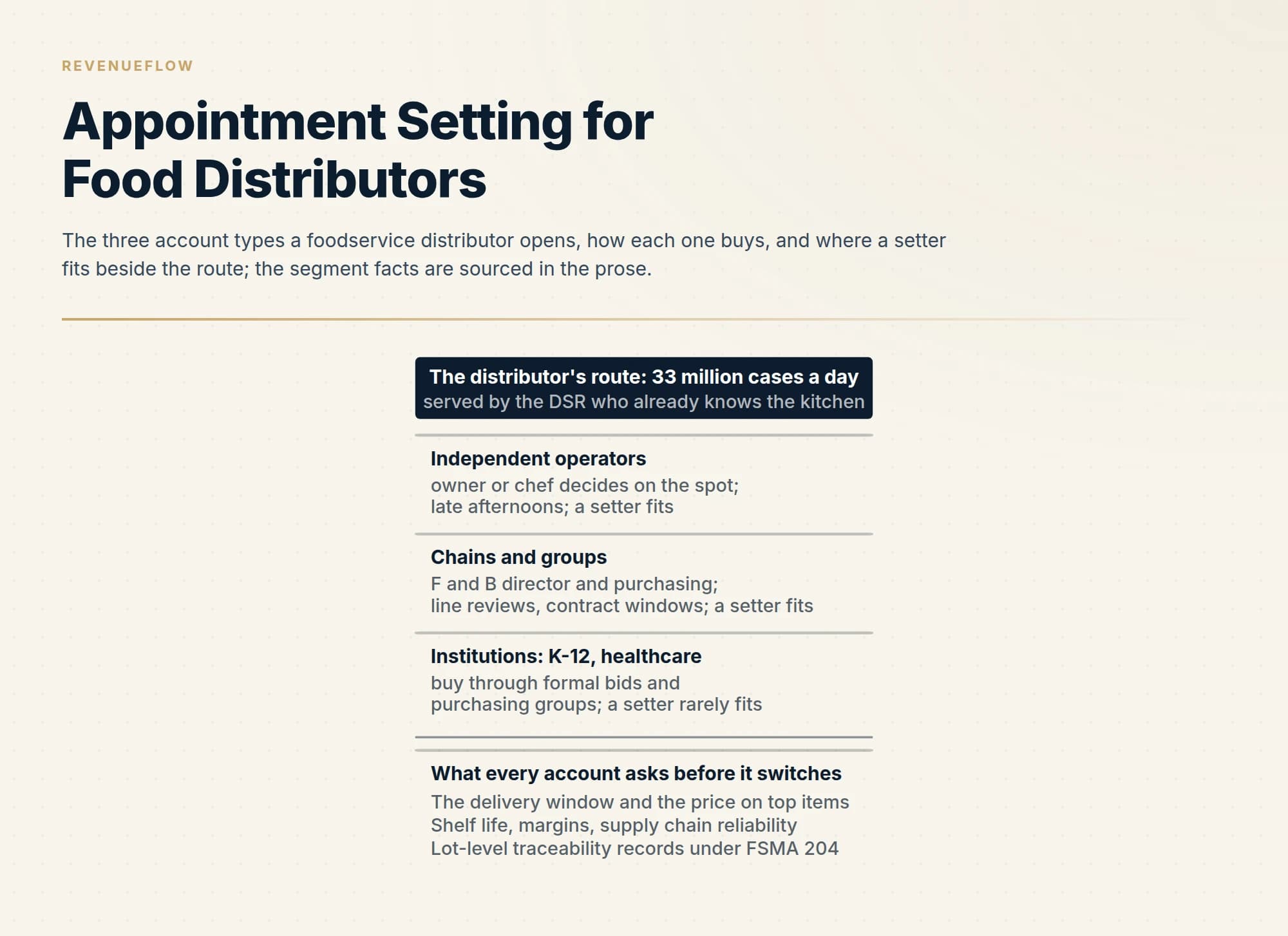
A foodservice distributor uses appointment setting only for accounts a route can serve within the week, and hands each meeting to the DSR who will serve it. Independents decide fast, chains buy on line reviews, institutions on bids. The FDA traceability rule, enforced from 20 July 2028, makes lot-level records the reason to switch. One message per campaign, under CAN-SPAM.
Key takeaways
- IFDA counts the foodservice distribution industry at 12 billion cases a year, 33 million a day, from about 17,100 locations with 168,300 vehicles, and a distributor's growth is new accounts that fit routes the fleet already runs.
- The FDA's Food Traceability Rule requires anyone who holds a listed food to keep Key Data Elements at each Critical Tracking Event and hand records to the FDA within 24 hours, with enforcement not before 20 July 2028; a distributor that keeps those records is selling the record, not the case price.
- The National Restaurant Association Show runs 22 to 25 May 2027 in Chicago, the Summer Fancy Food Show is in its 70th year, and IFDA's own calendar runs from its National Championship in October 2026 to its Solutions Conference in September 2027.
- CAN-SPAM makes no exception for business-to-business email, the FTC says most business-to-business calls are exempt from the Telemarketing Sales Rule while the FCC requires consent for autodialed or recorded calls, and a setter never sends a second message to an operator who ignored the first.
Reviewed and updated September 18, 2026
The International Foodservice Distribution Association calls itself "the ONLY trade association for foodservice distribution" and, on its home page read on 18 September 2026, counts the industry it represents at 12 billion cases a year delivered to professional kitchens, "33 million cases per day, on average", from approximately 17,100 locations with a combined fleet of 168,300 vehicles and 443,500 employees (ifdaonline.org). A case reaches a kitchen on a route sold by a distributor sales representative who already knows the chef, which is why appointment setting for a food distributor is a narrower question than it looks: how to open the accounts the route does not reach in the week.
This page is for a foodservice distributor, broadline, specialty or regional, that wants meetings with operator and institutional accounts it does not yet serve. A manufacturer or brand selling into distributors is a different reader with a different buyer; the sell-to pages cold email for food and beverage and cold email for wholesale distribution are written for that side and are not repeated here. What appointment setting is and how it is priced is in B2B appointment setting, and the case for a held-meeting billing unit rather than a booked one is in call centre appointment setters. Every fact here comes from a page fetched on 18 September 2026, cited where it appears.
The distributor's sale, and where a setter sits beside the DSR
A distributor sales representative sells a route: a set of accounts, visited on a rhythm, that order against a book and expect a truck at a window. IFDA's own peer-meeting programme describes the people who run that machine, "operations, HR, IT and finance" leaders from manager and director "to vice president and head-of-department", and quotes a member, the vice president of transportation and operations at a Nebraska distributor, on what those meetings give him: "a greater sense of how your KPIs line up industry wide" (ifdaonline.org, read 18 September 2026). A new account is only worth opening if it fits a route the fleet already runs.
That is the constraint a setter has to respect. B2B Appointment Setting, whose guide for food and beverage distributors is the one page written from inside this problem on the first page of results, frames the setter's job as mapping "category managers, procurement leads, operations directors" and writing to "their priorities, which are shelf life, margins, and supply chain reliability", and offers a timing observation worth testing: "Weekday morning calls work for chain buyers. Late afternoons are better for independent operators" (b2bappointmentsetting.com, published 27 June 2026, read 18 September 2026). Read that as what a vendor sells; its touch-count claims are not repeated here. The structural point stands: the setter opens the door, the DSR walks through it, and the meeting is only worth booking if the DSR can serve the account within the week.
Three account types buy differently. An independent operator's owner or chef decides on the spot and cares about the window and the price on the ten items they order most. A chain or management group has a food and beverage director and a purchasing function that buys on line reviews and contract windows; SalesHive's food and beverage page, an agency selling to manufacturers, names "Director of Foodservice Procurement (QSR, Hospitality, Healthcare)" and "Distributor Purchasing Managers" among the roles it dials, and says buyers "often engage only during category resets, line reviews, or contract windows" (saleshive.com, read 18 September 2026). Institutions, K-12 districts and healthcare systems, buy through formal bids and purchasing groups; the USDA Food and Nutrition Service pages that describe school meal procurement did not serve on 18 September 2026, so no bid dates are stated here, and a setter should not pretend to know them.
The regulation a setter must be able to answer
The question that decides whether a new account will move its produce, dairy or seafood to you is increasingly a records question. The FDA's Food Traceability Rule, implementing section 204 of the Food Safety Modernization Act, applies to "persons who manufacture, process, pack, or hold foods included on the Food Traceability List", and a distributor holds them. The rule requires those persons to "maintain records containing Key Data Elements (KDEs) associated with specific Critical Tracking Events (CTEs)" and to "provide information to the FDA within 24 hours or within some reasonable time to which the FDA has agreed" (fda.gov, read 18 September 2026). The Food Traceability List itself covers soft cheeses, shell eggs, nut butters, fresh cucumbers, herbs, leafy greens, melons, peppers, sprouts and tomatoes among other foods (fda.gov, read 18 September 2026), which is a large share of what a broadline truck carries.
The date matters as much as the rule. The FDA's page states that the original compliance date was 20 January 2026, that the agency proposed a 30-month extension to 20 July 2028, and that Congress subsequently "directed FDA not to enforce the Food Traceability Rule prior to that same date", which the FDA "intends to comply with"; a public meeting on lot-level tracking flexibilities was held on 15 June 2026. The page's own advice is "Talk with your supply chain partners", because the rule only works if records pass between them. For a distributor writing to a new account, that is the opening: an operator whose current supplier cannot hand over lot-level records for listed foods has a dated reason to take a meeting, and a distributor that can is selling the record, not the case price. What the rule requires of the sender is records, not marketing claims: a setter can say what records the distributor keeps and must not describe anyone as "compliant". State licensing sits beside the federal rule; Texas, for example, regulates food wholesalers and warehouses through a Department of State Health Services programme with its own registration, rules and a sanitary transportation section (dshs.texas.gov, read 18 September 2026), and a setter should know which state registrations the distributor holds before anyone asks. None of this is legal advice.
The calendar
A distributor's year has two kinds of dates. The operator-facing ones are the shows where chefs and chain buyers walk: the National Restaurant Association Show runs 22 to 25 May 2027 at McCormick Place in Chicago (nationalrestaurantshow.com, read 18 September 2026), and the Specialty Food Association's Summer Fancy Food Show, "now in its 70th year", draws "makers, buyers, brokers, distributors" for three days of product discovery, with a Winter FancyFaire returning to San Francisco in 2027 (specialtyfood.com, read 18 September 2026). The distributor-facing ones are IFDA's: the National Championship on 22 to 24 October 2026 in Orlando, the Partners Executive Forum on 24 to 27 January 2027 in Florida, and the Solutions Conference on 26 to 28 September 2027 in Louisville (ifdaonline.org, read 18 September 2026).
Between the shows, the windows belong to the account. Chains review lines and let contracts on their own cycle, and the honest way to time a message is to ask when the next review is. Institutions bid on a rhythm this page does not date, for the reason given above. Independents have no calendar beyond the week's specials, which is why the late-afternoon observation quoted earlier is worth testing on your own route.
What a setter must not do, and what the channel rules ask
Whoever contacts an operator on the distributor's behalf sends under its name and obligations. By email, the FTC's CAN-SPAM guide states the Act "makes no exception for business-to-business email" (ftc.gov, read 18 September 2026), so every message needs honest headers, a physical address and an opt-out that is honoured. On the phone, which is how much of this vertical still gets opened, the FTC's Telemarketing Sales Rule guide says "Most phone calls between a telemarketer and a business are exempt from the TSR" (ftc.gov, read 18 September 2026), a statement about federal coverage of a business call, while the FCC's page adds that calls made with an autodialer or a prerecorded or artificial voice need the called party's prior written consent (fcc.gov, read 18 September 2026). A setter dialling a restaurant's business line by hand is the shape those pages describe; a recorded message to the same line is not.
We run email and LinkedIn, on Email Bison and in-house tooling for email and HeyReach for LinkedIn, one message per campaign, and treat a phone-led setter as a vendor a distributor may add. Whatever the channel, never send a second message to an operator who ignored the first: it lands under the one they passed over and reads as a bump.
To: purchasing manager at a regional restaurant group; Subject: lot-level records on your produce and dairy
The FDA's traceability rule now has an enforcement date of 20 July 2028 for leafy greens, tomatoes, soft cheeses, shell eggs and the rest of its list. 1
If your current distributor cannot hand you lot-level receiving and shipping records for those items today, that gap becomes your problem on that date. 2
We keep those records on every listed case we deliver and can show you what a request for them looks like. Worth twenty minutes with your DSR for the area? 3
- 1Opens on the regulator's own date and list, both checkable on the FDA page, not on the distributor.
- 2Names the recipient's exposure as a records question, without calling anyone non-compliant.
- 3The offer is the record, the ask is a meeting with the DSR who will actually serve the route.
Three openers with the source beside them
Each opener is grounded in a page read on 18 September 2026, names no real recipient, carries no contact details and makes no claim about results; brackets hold the distributor's own facts.
On the traceability date, the email above, sourced to the FDA's rule page. Legitimate because the obligation is the recipient's, the date is the regulator's, and the offer is the record.
Before the Restaurant Show. The Restaurant Show is 22 to 25 May in Chicago and your group usually walks it. If you are going to look at [category] lines there, we already carry [n] of the likely exhibitors and deliver them on the [area] route [days]; happy to send the current list so you can walk the floor knowing what is already a truck away. Source: the National Restaurant Association Show site. Legitimate because the show is dated and public and the offer saves the buyer work at it.
After a specialty show. We picked up [n] new specialty lines at the Summer Fancy Food Show, mostly [category], and they land on the [area] route next month. If any of your menus have been waiting for [item], say the word and the DSR will bring samples on the next stop. Source: the Specialty Food Association's shows page. Legitimate because the show is public, the lines are real and the ask is a sample on a route that already runs.
When appointment setting is the wrong play for a distributor
It is the wrong play for accounts the route already serves: the DSR's visit is the meeting, and a setter calling an existing account is a mistake the chef will mention. It is the wrong play for institutional accounts locked to a purchasing group or a live bid, because the buyer cannot act on a meeting whatever they think of the truck; those accounts are won on the bid calendar, which this page does not date. It is the wrong play for a chain in the middle of a contract term with a formal review process, where the useful message is the one that asks when the review is. And it is the wrong play off-route: an account the fleet cannot serve within the week is a meeting that costs more than it returns. If the goal is a list of prospects rather than booked conversations, appointment setting versus lead generation explains which to buy.
Whatever is booked is only worth paying for if it meets a definition written before the first message: an operator in the route area, a person who owns purchasing or the kitchen, an agreed conversation with the DSR, attended, not already a customer or an open quote. Budget, timing and authority stay out of it, because a chef who orders three months after the meeting was a qualified meeting the day it was held.
The short version
A foodservice distributor opens new accounts through a setter only where the route can serve them within the week, and the meeting is handed to the DSR who will. Independents decide fast, chains buy on line reviews and contract windows, institutions on bids and purchasing groups. The FDA's traceability rule, with enforcement not before 20 July 2028, turns lot-level records into the reason an operator switches, and the setter must know what records the distributor keeps without ever calling anyone compliant. Email under CAN-SPAM, calls by a live person if at all, one message per campaign. If your routes have room and your DSRs have no hours to prospect, RevenueFlow books qualified meetings on a pay-per-meeting basis, against a definition agreed in writing first.
Regulatory facts on this page are taken from the FDA's, FTC's, FCC's and Texas DSHS pages read on 18 September 2026 and summarised rather than reproduced; the USDA school procurement pages did not serve that day and are not quoted. Rules vary by state; this is not legal advice.
Sources: IFDA home, IFDA Learning Exchanges, IFDA events, FDA Food Traceability Final Rule, FDA Food Traceability List, Texas DSHS food wholesalers, National Restaurant Association Show, Specialty Food Association shows, B2B Appointment Setting, food and beverage distributors, SalesHive food and beverage, FTC CAN-SPAM guide, FTC Telemarketing Sales Rule guide, FCC telemarketing and robocalls
Frequently asked questions.
Frequently asked questions- Who should a food distributor's setter contact at a restaurant or chain?
- At an independent, the owner or chef, who decides on the spot and cares about delivery windows and the price of the items they order most. At a chain or management group, the food and beverage director and the purchasing function, who buy on line reviews and contract windows. At institutions such as school districts and healthcare systems, a dietary or nutrition director who buys through formal bids and purchasing groups, where a cold meeting rarely moves the decision.
- How does the FDA traceability rule help a distributor win accounts?
- The rule applies to anyone who manufactures, processes, packs or holds a food on the Food Traceability List, which includes leafy greens, tomatoes, soft cheeses, shell eggs and more. It requires Key Data Elements at each Critical Tracking Event and records to the FDA within 24 hours on request, with enforcement not before 20 July 2028 per the FDA's page. An operator whose supplier cannot hand over lot-level records has a dated reason to meet a distributor that can.
- Should a food distributor use a phone-based appointment setter?
- Many accounts in this vertical still open by phone, and the FTC's Telemarketing Sales Rule guide says most calls between a telemarketer and a business are exempt from that federal rule. The FCC's page separately requires prior written consent for calls made with an autodialer or a recorded voice, so a live caller dialling a business line is the shape the rules describe and a recorded message is not. We run email and LinkedIn ourselves.
- When is appointment setting the wrong play for a foodservice distributor?
- For accounts the route already serves, where the DSR's visit is the meeting. For institutional accounts locked to a purchasing group or a live bid, which are won on the bid calendar. For a chain mid-contract with a formal review, where the only useful message asks when the review is. And for any account the fleet cannot serve within the week, because a meeting off-route costs more than it returns.
About the author.

B2B cold email experts helping companies generate qualified leads through done-for-you outreach campaigns.
RevenueFlow Team
Explore more.
Ready to scale your outreach?
We build GTM engines that book real meetings. See the receipts.
Related articles.
LinkedIn Outreach for Machine Shops
How a job shop or CNC machine shop uses LinkedIn to win OEM work: the four buyer titles, the RFQ gate, the ISO, AS9100 and ITAR facts, and LinkedIn's own rules.
Appointment Setting for Manufacturers: Who a Setter May Call
For the manufacturer hiring a setter: the ranked titles to hand over, the rep and distributor map that decides which accounts may be called, and the meeting types.
Appointment Setting for Material Handling Companies
Appointment setting in material handling starts with whose appointment it is: dealer territories, the ProMat and MODEX calendar, and OSHA's dated duties.
LinkedIn Outreach for Cleantech Companies
How a cleantech vendor reaches developers, utilities, corporate purchasers and credit buyers on LinkedIn inside the windows the IRS, ACORE and ACP pages date.
SDR Outsourcing for Solar Companies: The Commercial Layer
For the solar company weighing an outside setter: which segment a setter fits, the four sentences it must be able to say, and the consumer rules it inherits.
Lead Generation for Material Handling Companies
How a forklift dealer, racking maker or integrator finds plants with a dated reason to talk: OSHA evaluation cycles, dealer consolidation, MHI show rosters.