Call Centre Appointment Setting: Fit and What to Pay For
A volume model suits a large market and a simple offer. The fit test, the incentive problem inside paying per booking, and the terms to settle before the first dial.
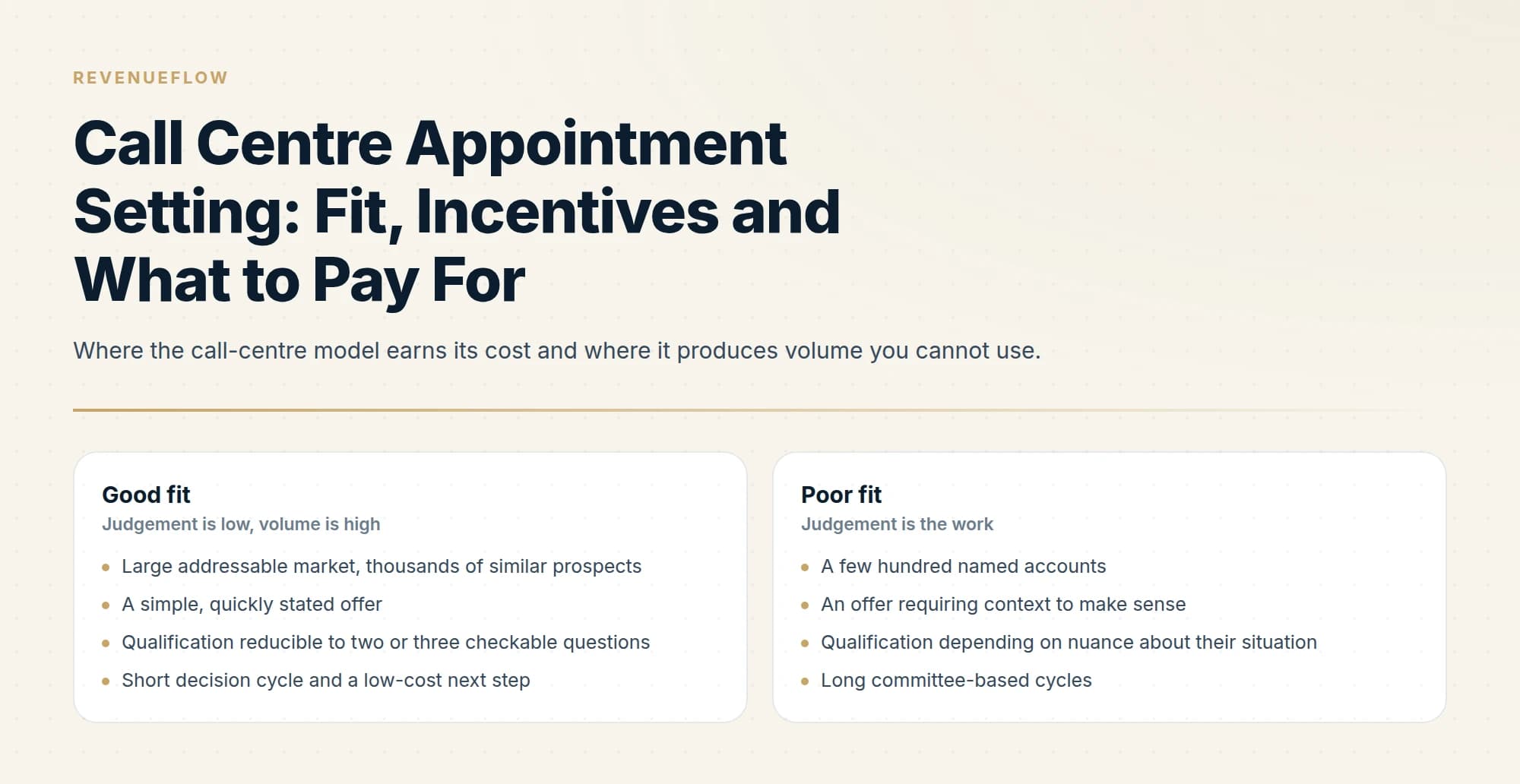
Call centre appointment setting is a volume model that earns its cost through throughput: high dial counts, a defined script and supervision against activity. It fits a large market, a quickly stated offer and qualification that reduces to two or three checkable questions. Pay on held and qualified meetings against written criteria.
Key takeaways
- The volume model removes per-conversation judgement, which is exactly what makes it efficient on a large market and unsuitable for a few hundred named accounts.
- A setter paid per appointment booked will produce appointments booked, so the fix is commercial rather than a search for a more scrupulous vendor.
- Targeting dominates the outcome while the vendor usually controls the script, which makes owning or approving the list the highest-leverage move available to the buyer.
- Held rate against booked rate in the first month exposes the incentive problem faster than any meeting count.
Reviewed and updated September 1, 2026
A call centre can book you a great many appointments. Whether those appointments are worth attending depends almost entirely on one design decision made before anyone dials: what the setter is paid for.
Call-centre appointment setting is a volume model. It suits some businesses very well and produces expensive noise for others, and the difference is predictable enough to work out in advance.
What the model actually is
A call centre supplies a team of dialers working from a script and a list, usually paid on volume, usually managing many accounts across the floor. The economics come from throughput: high dial counts, short calls, a defined script, and supervisors managing to activity metrics. That is a genuinely efficient machine for a specific job, and the fit question comes down to how much judgement each conversation requires.
- Large addressable market, thousands of similar prospects
- A simple, quickly stated offer
- Qualification reducible to two or three checkable questions
- Short decision cycle and a low-cost next step
- Deal value that survives a mediocre conversion rate
- A few hundred named accounts
- An offer requiring context to make sense
- Qualification depending on nuance about their situation
- Long committee-based cycles
- Deals where one bad conversation closes the account
The second column is not a criticism of call centres. It describes work a volume model is structurally unable to do well, because the thing that makes the model efficient is the removal of per-conversation judgement.
What an hour of dialling actually buys
An hour of a caller's time converts into dial attempts, a smaller number of live connections, a smaller number of real conversations, and some fraction of a meeting. The vendor controls the caller's skill and the script. You control three inputs: direct-dial accuracy, the calling window during which your buyers are actually reachable, and the volume of hours you buy. Everything else in the funnel is downstream of those three.
Bought directly, as hours or as seats
Driven by direct-dial accuracy and calling window
Reaching the right person and holding the first thirty seconds
Agreement to a specific date and time
The only stage that produces pipeline
Be sceptical of any proposal that fills those stages with confident percentages. Connect rates move with seniority, industry, region, whether the number is a direct dial or a switchboard, and how heavily that market is already being called. A rate quoted without its sample and its market is decoration.
The billing unit decides which of those inputs you carry. Per dialling hour, you buy activity and hold the list-quality risk yourself. Per seat, you buy capacity, so ask how many other accounts that seat covers. Per appointment, the vendor carries delivery risk and prices it in, which makes the written definition of a meeting the contract's most important clause.
In an hourly model a wrong number bills like a conversation
That is the single most important commercial fact about phone outbound, and it is why a phone programme's data spend should be larger than an email programme's.
Three data defects cost differently. A dead number burns the least time and is the cheapest failure. A switchboard number costs a gatekeeper conversation. A correct direct dial for the wrong person is the expensive one, because it produces a full conversation that cannot convert and often costs the account, since the person you reached now knows they were mistargeted.
Ask a phone vendor where direct dials come from, how recently they were verified, and whether unreachable numbers are credited back against the hours. Some vendors do credit them. Most do not mention it until asked.
The incentive problem, stated plainly

If a setter is paid per appointment booked, you will get appointments booked. Some will be people who agreed to a meeting to end the call.
This is not dishonesty; it is the incentive working exactly as designed. The fix is not to find a more scrupulous vendor but to change what gets counted.
Pay on held, not booked. This alone removes the worst of it, because a meeting that never happens stops paying.
Pay on qualified and held, against written criteria. Better again, and it requires the criteria to exist before dialling starts and to be applied consistently afterwards.
Our own position, since we are paid on attended qualified meetings, is that a meeting counts when the company is in the agreed audience, the participant has responsibility for or influence over the relevant area, they agree to a relevant business conversation, they attend and participate, and they were not already a customer or a live opportunity. Budget, timing and decision authority are deliberately excluded, because making them billing conditions turns every invoice into an argument.
Whatever definition you use, write it down first. A volume vendor and a quality standard can coexist, and only if the standard exists before the first dial. How a loose definition gets exploited is covered in pay per appointment B2B.
- Yes: The billable unit is a held meeting, not a booked one
- Yes: Qualification criteria are written and agreed by both sides
- Yes: A rejection window and valid rejection reasons are defined
- Yes: Your suppression list is loaded before dialling
- Yes: You know how many accounts each setter carries
- No: Payment is per appointment booked
- Depends: Whether recordings are available for you to review
The recordings row is worth pushing on. A sample of actual calls is the only way to know what is being said in your name, and a vendor comfortable with the model will not object. Settle the attempt cap, the voicemail policy and the cooling-off period in the same conversation.
What the script does and does not fix
Call centres run scripts because consistency at volume requires them, and a good script genuinely helps: it keeps the offer accurate, handles the common objections and stops the worst improvisation.
What a script cannot do is make a poorly targeted call land. The dominant variable is whether the person on the other end has the problem you are describing, and the list decides that, not the wording. A vendor whose answer to weak results is a script rewrite is optimising the smaller variable.
The rules, and where business calling genuinely differs

This is the part buyers skip and the part that carries actual liability. What follows is drawn from primary regulator and statutory sources, and it is a starting map rather than legal advice.
The United States exempts most business-to-business calling from the FTC's rule
The Federal Trade Commission's guidance on the Telemarketing Sales Rule states plainly that "Most phone calls between a telemarketer and a business are exempt from the TSR", with a narrow carve-out: "business-to-business calls to induce the retail sale of nondurable office or cleaning supplies are not exempt and must comply with the TSR" (ftc.gov). The same guidance says that "The prohibition on calls to numbers on the Registry does not apply to business-to-business calls".
So the National Do Not Call Registry, which most buyers assume is the governing constraint, does not reach a genuine business-to-business solicitation. The FTC guidance draws one boundary worth holding onto: calls to business lines that solicit individual employees to buy products or services for their own personal use are treated as consumer calls and are not exempt.
The TSR's calling-hours restriction is framed around the home. The FTC states that "it's a violation of the TSR to make outbound telemarketing calls to the person's home outside the hours of 8 a.m. and 9 p.m. local time at the location called" unless the telemarketer has prior consent.
What the exemption does not cover
Exempt from one rule is a long way from unregulated, and this is where an over-confident reading gets expensive.
The Federal Communications Commission's rules sit alongside the FTC's and are drawn differently. Under 47 CFR 64.1200(a)(1), no person may initiate a call using "an automatic telephone dialing system or an artificial or prerecorded voice" to "any telephone number assigned to a paging service, cellular telephone service, specialized mobile radio service, or other radio common carrier service" without the prior express consent of the called party, and 64.1200(a)(2) requires prior express written consent where such a call constitutes telemarketing (ecfr.gov). That provision is written around the line being called and not around whether the subscriber is residential. By contrast, the same section frames the national registry obligation at 64.1200(c)(2) around "A residential telephone subscriber", and the internal do-not-call list requirement at 64.1200(d) around calls "to a residential telephone subscriber".
The practical reading for a business calling programme: mobile numbers plus automated dialling or recorded voice is the combination that attracts the rules, and manual dialling of business landlines is the least exposed shape. State telemarketing statutes and sector-specific regimes sit separately from all of this and vary considerably. For automated calling, AI appointment setters covers that route and its hidden costs.
The United Kingdom sets the opposite default
Where the US exempts business calls from its registry, the UK explicitly includes them. The Information Commissioner's Office guidance on telephone marketing says that "For business-to-business (B2B) calls, you will therefore need to screen against both the TPS and the CTPS registers, as well as your own 'do not call' list" (ico.org.uk). The CTPS is the corporate register covering companies, some partnerships and government bodies, while sole traders and some partnerships register with the consumer TPS, which is why the ICO tells B2B callers to screen against both.
The same guidance sets out disclosure duties: "You must always say who is calling, allow your number (or an alternative contact number) to be displayed to the person receiving the call, and provide a contact address or freephone number if asked." Automated calls are stricter again, requiring specific consent for that call type, with the ICO noting that "General consent for marketing, or even consent for live calls, is not enough". That page also carries a notice that the guidance is under review following the Data (Use and Access) Act, so re-read it before building a UK programme on it.
Recording the call
Recording sits under a separate regime again. The US federal baseline permits it where one party consents: 18 U.S.C. 2511(2)(d) makes interception lawful "where such person is a party to the communication or where one of the parties to the communication has given prior consent" (govinfo.gov). Some states require every party to agree: California Penal Code section 632(a) penalises recording "without the consent of all parties to a confidential communication", with a fine of up to $2,500 per violation (leginfo.legislature.ca.gov). For an operation dialling into multiple states, the workable rule is to announce recording on every call, because a per-state policy has to be right every time and an announcement has to be right once.
Accountability for contacting your market lands on you rather than on the vendor, so the practical protection is the suppression list, and supplying it is your job: current customers, live opportunities, partners, anyone who has asked not to be contacted, and anyone a rep is protecting.
The list is the variable you control
Since the vendor usually controls the script, the highest-leverage thing you can do is own the list. A vendor building it from their own sources will optimise for reachable rather than for right, because dial connect rate is what their floor is measured on, and the gap between those two populations is where wasted spend lives.
- Step 1Supply the list, or approve it
A vendor building it from their own sources optimises for reachable rather than for right, because dial connect rate is what their floor is measured on.
- Step 2Segment it before anything is released
A blended connect and conversion rate across a mixed list hides which segment is carrying the programme.
- Step 3Cap volume per segment until it proves out
A staged release costs nothing and preserves the accounts nobody has yet worked out how to approach.
- Step 4Demand results by segment
Reported that way, the same data tells you where to concentrate and what to cut, usually within a fortnight.
- Step 5Flag what the floor burns through
On a finite list, spent accounts should be recorded rather than silently returned to the pool, so a later approach through another channel stays a deliberate decision.
How it compares to the alternatives
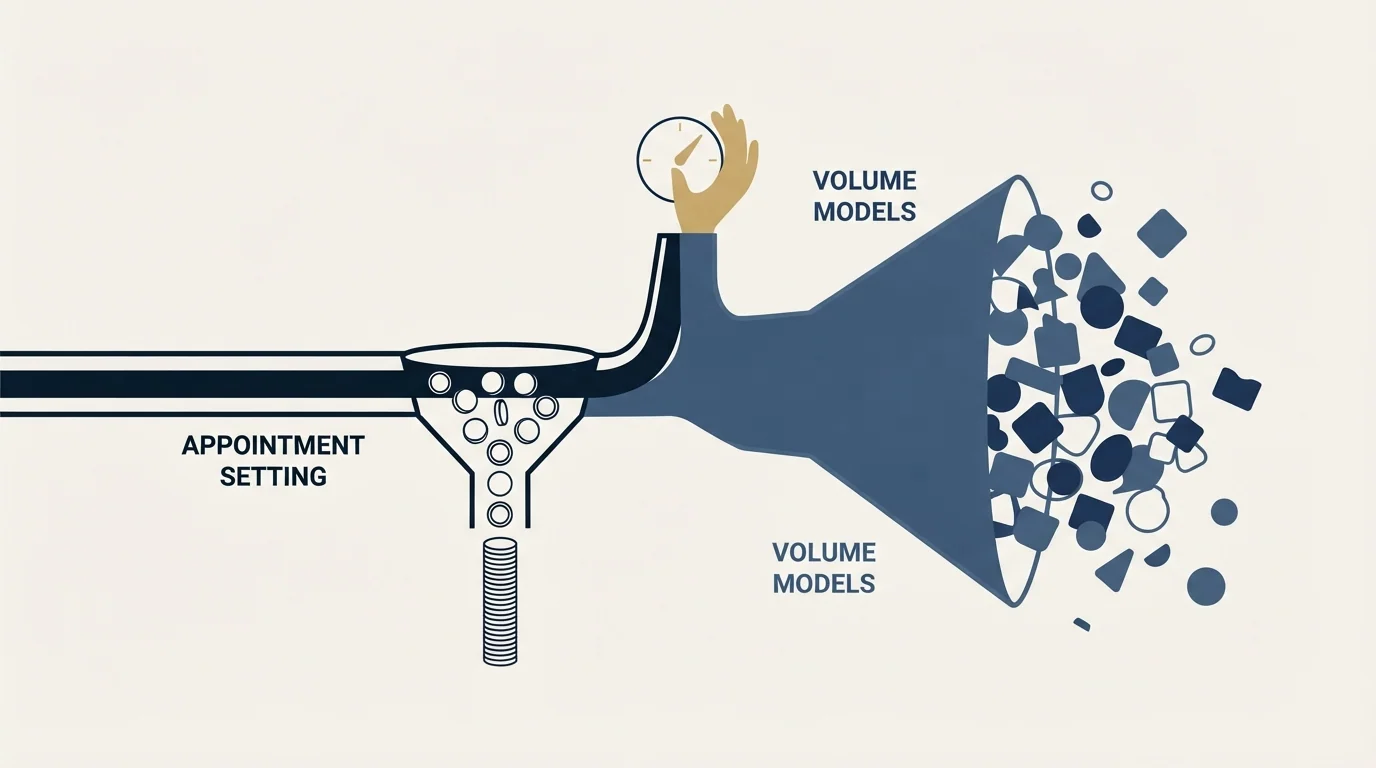
A call centre buys throughput, and is right when the market is large and the conversation is simple. An SDR agency or an in-house rep buys judgement per account, and is right when the list is finite; the evaluation questions for that route are in choosing an SDR company, and the wider category map is in outsourced sales companies. Email-led outbound buys reach at low cost per touch, with the trade-off that it produces no information when nobody replies, and outbound channel mix by deal size covers where each channel earns its place.
Most programmes above a modest deal size weight the second and third, and use volume dialling for one segment rather than as the whole motion.
What a good vendor will tell you unprompted
The floor is opaque from outside, so the vendor's own transparency is most of what you have to judge them on. Beyond the setter load above, three questions carry the signal: whether the team is dedicated or pooled, what turnover looks like and what happens when someone leaves mid-month, and which parts they subcontract, since some vendors broker to other floors, which is not disqualifying while not knowing it is.
A vendor who answers plainly will tell you when something is wrong rather than let the dashboard keep looking healthy, and in a volume model the failure mode is steady activity producing meetings nobody wants. What vendors publish about their own terms is collected in appointment setting companies.
Judging the first month

Meeting count in month one is mostly noise, and it is the number a volume vendor will lead with. Better early signals: held rate against booked rate, which exposes the incentive problem immediately; the qualified rate against your written criteria; and a listen to five recordings. If held rate sits well below booked rate, that is the model asserting itself, and the fix is commercial rather than operational.
The short version
Call-centre appointment setting is a volume model that works when the market is large, the offer is simple and qualification reduces to a few checkable questions. You buy three things: list accuracy, a calling window and hours. A bad list bills at full rate in an hourly model, so the data spend should go up, and payment should attach to held and qualified meetings against criteria written before dialling.
The rules invert across the Atlantic. The FTC exempts most business-to-business calls from the Telemarketing Sales Rule and from the National Do Not Call Registry, while the ICO requires UK business callers to screen against both the TPS and the CTPS. FCC rules on automated dialling and recorded voice to mobile numbers are drawn around the line rather than around residential status, and recording carries its own regime, with a one-party federal baseline and stricter all-party states.
Supply the suppression list, ask for call recordings, and judge the first month on held-versus-booked rate. If your list is finite and each conversation matters, that is the other model, and we work it on a pay-per-qualified-meeting basis with the definition agreed in writing first. See what a campaign would look like for your market.
Regulatory sources verified against the issuing regulator or statute in mid-2026, and summarised rather than reproduced in full. Rules change and vary by jurisdiction; this is not legal advice, and you should confirm your obligations with counsel before running a calling programme.
Sources: FTC, Complying with the Telemarketing Sales Rule, 47 CFR 64.1200, ICO, Telephone marketing, 18 U.S.C. 2511, California Penal Code 632
Frequently asked questions.
Frequently asked questions- When does a call centre suit appointment setting?
- When the addressable market runs to thousands of similar prospects, the offer can be stated quickly, qualification reduces to two or three checkable questions, the decision cycle is short and the deal value survives a mediocre conversion rate. Where each conversation needs judgement about the prospect's situation, the model is structurally unable to deliver it.
- Should you pay per appointment booked?
- No. Paying per booking rewards getting something into the calendar, including people who agreed to a meeting to end the call. Pay on held meetings at minimum, which stops a meeting that never happens from paying, and better on held and qualified meetings against criteria written down and agreed before dialling starts.
- What should you ask a call centre vendor before signing?
- How many accounts each setter carries, whether the team is dedicated or pooled, what their turnover looks like and what happens to your programme when someone leaves mid-month, where the floor sits and under which jurisdiction it operates, and which parts they subcontract. A vendor who answers all five plainly on a first call is showing the behaviour you most need.
- How should you judge the first month?
- Not on meeting count, which is mostly noise and is the number a volume vendor leads with. Compare held rate against booked rate, check the qualified rate against your written criteria, and listen to five actual recordings. Those recordings tell you more about what is being said in your name than any dashboard will.
About the author.

Ben Carden is CRO at RevenueFlow, which builds and operates outbound revenue engines for B2B companies. Previously at Gartner Enterprise. Studied at London School of Economics.
Ben Carden · CRO
Connect on LinkedIn →Explore more.
Ready to scale your outreach?
We build GTM engines that book real meetings. See the receipts.
Related articles.
Blue Zebra Appointment Setting: The Vendor's Pages Are Gone
Search results still describe a B2B appointment setting firm at this address. The pages themselves return 404 and the domain now serves something else entirely.
Last Outbound Agency Did Not Deliver: Locating the Failure
The leads were bad names a symptom and no stage. Four places an outbound engagement fails, the counts that separate them, and what to change in the next purchase.
Belkins Pricing: What the Service Page Publishes
Belkins publishes a starter price and four figures on its service page, and no price at all on its pricing page. Which page a number came from decides what it means.
What Is Callbox? The Campaign Pod Model
Callbox sells outbound in units it calls Campaign Pods, and it is one of the few agencies in the category that puts a monthly price band on its own pricing page.
ABM Reporting: Three Readers, Three Cadences
ABM reporting built around who reads it: a weekly operating page, a monthly allocation page and a one-page quarterly board report, each computed from CRM fields.
Unbounce Alternatives: Two Boundaries, Four Meters
Teams leave Unbounce at two published boundaries: the 500 visitor entry ceiling and testing starting on the third tier. Each alternative moves one, both or neither.