LinkedIn Outreach for Cleantech Companies
How a cleantech vendor reaches developers, utilities, corporate purchasers and credit buyers on LinkedIn inside the windows the IRS, ACORE and ACP pages date.
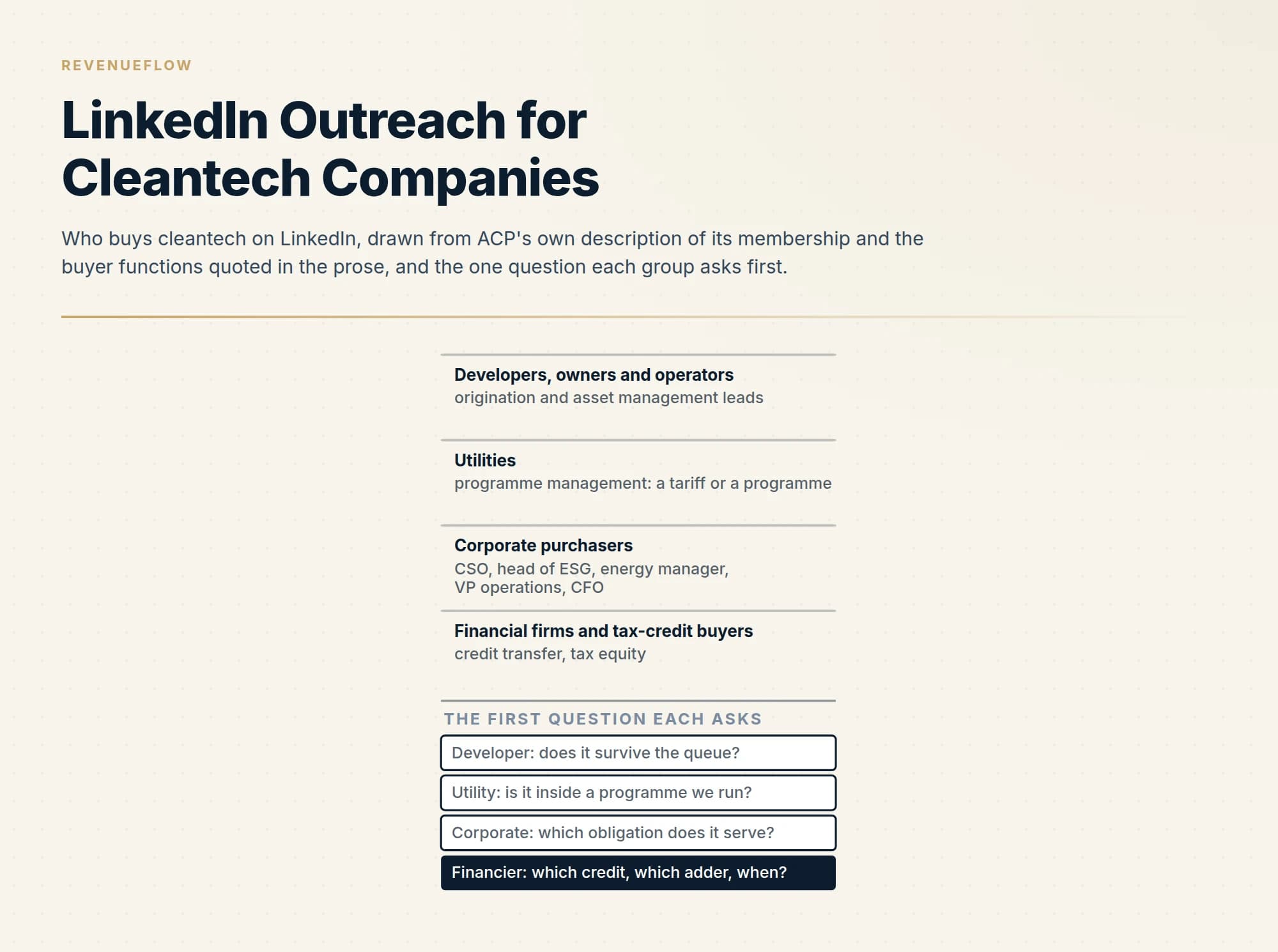
A cleantech vendor reaches developers, utilities, corporate purchasers and credit buyers on LinkedIn by writing inside a window the buyer's policy calendar has opened: the 48E and 45Y placed-in-service and adder rules, ACORE's grid questions, the reporting standards adopted in July 2026, RE+ week. LinkedIn forbids the automation most first-page vendors sell, so a person sends one message per buyer.
Key takeaways
- ACP's Annual Market Report 2025 finds clean power accounted for over 90 percent of new grid capacity, and ACP's membership, from developers and owner-operators to utilities, financial firms and corporate purchasers, is the buyer map a cleantech vendor works on LinkedIn.
- The IRS's 48E page sets a 6 percent base credit rising to 30 percent with wage and apprenticeship rules, plus ten-point adders for domestic content and energy communities, for facilities placed in service after 31 December 2024, with phase-out from 2032 at the earliest; those dates and adders are the buying moments.
- ACORE's resources page lists an interconnection-reform call, transmission comments and Section 232 tariff comments, and the European Commission adopted simplified sustainability reporting standards on 3 July 2026; each is a dated reason to write to a developer, utility or CSO.
- LinkedIn's User Agreement and help centre forbid scraping, automation and promotional invitations to strangers, which is what most of the first-page results for this phrase sell; the shape that survives is a person, one message per buyer, never a second under a silence.
Reviewed and updated September 18, 2026
The American Clean Power Association's flagship Annual Market Report 2025, listed on its resources page read on 18 September 2026, finds the clean power sector "invested $79 billion in new projects, supported more than 1.4 million jobs, and accounted for over 90% of all new electricity capacity added to the grid" (cleanpower.org). The people who signed those projects, the developers, owners and operators, utilities, financial firms and corporate purchasers ACP counts among its members, are on LinkedIn, and most of them are being written to by a vendor this week. The question for a cleantech company is not whether the buyer is there but whether the message arrives inside a window the buyer's own policy calendar has opened.
This page is for a cleantech vendor: a storage, efficiency, EV charging, carbon software or renewables services company using LinkedIn to reach commercial and industrial buyers, utilities and developers. It is not for an energy company, a utility or a renewables operator doing its own outreach; that reader is a different page. The persona and message work for emailing utility and energy buyers is in cold email for utilities and is not repeated here; the three LinkedIn routes and what they cost are in LinkedIn prospecting, and the platform's position on tools is in LinkedIn lead generation services. Every fact here comes from a page fetched on 18 September 2026 and is cited where it appears.
Where cleantech buyers are on LinkedIn, and what they own
ACP describes its members as "land-based and offshore wind, solar, transmission, and storage companies" alongside "manufacturing and construction businesses, developers and owners/operators, utilities, financial firms, and corporate purchasers" (cleanpower.org, read 18 September 2026). That list is the buyer map for most cleantech products, and each group carries a different title on LinkedIn. Leadriver, one of the two independent pages on the first page of results for this phrase, names the corporate side in the language its service sells: "Chief Sustainability Officers, Heads of ESG, VP Operations, and Energy Managers", with "CSO for strategic ESG platforms, Energy Manager for efficiency tools, CFO for carbon cost reporting" (leadriver.io, read 18 September 2026). Read that as a vendor's own framing, but the function split is right: an energy manager buys against a utility bill, a sustainability officer buys against a reporting obligation, and a CFO buys against a cost line.
On the developer and utility side the titles are origination, asset management and programme management, and the useful sentence to write to them is about a queue, a tariff or a programme rather than about carbon. The Cleantech Group's own home page frames the buyer's scepticism plainly, "new technologies emerge, policies shift", and it is hard, in the same sentence, to know which technologies will scale and which will fail (cleantech.com, read 18 September 2026). A LinkedIn message from a vendor is read through that sentence, so the burden is on the message to say which policy it rides and which buyer it serves.
The policy windows, dated from the IRS and the associations
Cleantech is bought on policy, and the policy pages are public. The IRS's page for the Clean Electricity Investment Credit, section 48E, describes "a newly established, tech-neutral investment tax credit that replaces the Energy Investment Tax Credit once it phases out at the end of 2024", available for a qualified facility or energy storage technology "placed in service after Dec. 31, 2024". The IRS page puts the base amount at 6 percent of the qualified investment, increased "up to 30%" for facilities meeting prevailing wage and registered apprenticeship requirements, with a further 10 percentage points for domestic content in steel, iron and manufactured products and 10 percentage points for an energy community; the phase-out "starts for the later of 2032 or when U.S. greenhouse gas emissions from electricity are 25% of 2022 emissions or lower", and the credit is eligible for elective payment or transfer with a pre-filing registration (irs.gov, read 18 September 2026). Its production-credit twin, section 45Y, "starts at a base rate of 0.3 cents per kilowatt hour" with a higher base for small facilities under 1 megawatt meeting the same labour requirements, and the same two adders (irs.gov, read 18 September 2026).
For a vendor those pages define three buying moments: the placed-in-service date a developer is racing toward, the domestic-content and energy-community adders that make a supplier's documentation worth money, and the transfer market, which ACP's resources page says now has "a new standardized Tax Credit Transfer Agreement form for Investment Tax Credits" (cleanpower.org). The grid side has its own windows. ACORE, which calls itself "the focal point for collaborative advocacy across the clean energy sector" (acore.org, read 18 September 2026), listed on its resources page a 4 August 2026 post headed "Fundamental Interconnection Reforms are Still Needed", comments on the Department of Energy's draft National Transmission Needs Study, comments on proposed Section 232 duties on "additional aluminum, steel, and copper derivative articles", a tax equity report from investor survey data, and a report finding that "energy savings from reduced line losses alone can offset the higher upfront cost of high-performance conductors" across eight projects (acore.org, read 18 September 2026). Each of those is a live cost or delay a developer or utility buyer is managing this quarter, and each is a legitimate reason to write.
Two windows are named without dates. State renewable portfolio standards and utility incentive cycles vary by state and the NCSL page that tracks them refused the request on 18 September 2026, so this page does not characterise them. For corporate buyers with European exposure, the European Commission's corporate sustainability reporting page, dated 3 July 2026, states that "EU rules require large companies and listed companies to publish regular reports on the social and environmental risks they face", and its timeline records a political agreement on the "Omnibus I" simplification package on 9 December 2025 and the adoption of amended reporting standards on 3 July 2026 (finance.ec.europa.eu, read 18 September 2026). A carbon software vendor writing to a European CSO in September 2026 is writing into a reporting regime that is being simplified, and the message should say which of the surviving obligations it serves.
| Product line | The window the buyer's question lives in | Who asks |
|---|---|---|
| Storage and solar equipment and services | 48E and 45Y: the placed-in-service date, the domestic-content and energy-community adders, the transfer market; the interconnection queue | Developer origination; tax-credit buyers |
| Efficiency tools | The utility bill and the tariff; utility programmes already running | Energy manager; utility programme manager |
| Carbon and ESG software | Reporting obligations, including the EU standards adopted on 3 July 2026 | Chief sustainability officer, head of ESG; CFO for cost reporting |
The platform's rules are the regulation for this play
The rule that touches LinkedIn outreach is LinkedIn's own. Section 8.2 of the User Agreement says a member will not "Develop, support or use software, devices, scripts, robots or any other means or processes (such as crawlers, browser plugins and add-ons or any other technology) to scrape or copy the Services", nor "Override any security feature or bypass or circumvent any access controls or use limits of the Services" (linkedin.com, read 18 September 2026). The help centre's page on prohibited software states that LinkedIn does not permit "any third party software" that would "scrape, modify the appearance of, or automate activity on LinkedIn's website", naming crawlers, bots, browser plug-ins and browser extensions, and that members using such tools "risk having their accounts restricted or shut down" (linkedin.com, read 18 September 2026); a separate page describes what happens when an account is restricted for automated activity (linkedin.com). The Professional Community Policies add: "Do not use our invitation feature to send promotional messages to people you don't know or to otherwise spam people" (linkedin.com, read 18 September 2026).
That matters here because the first page of results for this phrase is largely automation vendors. Phewdo's renewable-energy outreach guide, published 26 August 2026, sits on a site whose product runs outreach "on autopilot" (phewdo.com, read 18 September 2026), and Leadriver's page sells "connection requests, message sequences, and follow-up". Read both as what those vendors sell. A sequence's second and third messages land under the first one the buyer ignored, which is a bump whatever the tool calls it, and an automated account is the thing LinkedIn's own pages say it restricts. The shape that survives is a real person on the vendor's own profile, Sales Navigator as the licensed route past a connection (LinkedIn's plan page lists 50 InMail messages a month on each tier, business.linkedin.com, read 18 September 2026), one message per buyer per campaign, and never a second LinkedIn message to someone who did not reply. Where email runs beside it, the FTC's CAN-SPAM guide "makes no exception for business-to-business email" (ftc.gov, read 18 September 2026). None of this is legal advice; it is what the platform and the regulator publish.
The trade calendar
The buyer-facing shows are public and close together this autumn. RE+ 2026 runs at the Las Vegas Convention Center with conference education on 16 to 18 November and the exhibit floor on 17 to 19 November, and RE+ 2027 is set for 15 to 18 November 2027 in Las Vegas (re-plus.com, read 18 September 2026); SEIA co-hosts it and, on the same day, was reporting 9.7 gigawatt-hours of new energy storage installed in the first quarter of 2026, which it calls "the strongest first quarter" in the sector's history (seia.org, read 18 September 2026). The Cleantech Group's 2026 Cleantech Retreat runs 16 to 18 November (cleantech.com). For a utility programme manager the dated hook this autumn is ACP's July 2026 report, "Clean Power Delivers During Heatwaves", whose summary on the resources page reads "Clean energy saved the grid more than $170 million during the July 2026 heatwave" (cleanpower.org, read 18 September 2026). The week after a show is when a developer's origination lead has a fresh shortlist, and the week before is when a message competes with every exhibitor's.
To a developer's origination lead
The IRS's 48E page adds ten points for domestic content in steel, iron and manufactured products, on top of the full rate for projects meeting wage and apprenticeship rules. Our [component] ships with the domestic-content documentation a credit buyer will ask for; if a project placed in service next year is short of that paperwork, we can send what ours looks like.
Source: IRS Clean Electricity Investment Credit page. Legitimate because the adder is the buyer's money and the documentation is the offer.
To a utility programme manager
ACP's July 2026 report puts a figure on what clean energy saved the grid during that month's heatwave. If your demand-response or storage programme is being re-scoped for next summer, [product] does [what it does for that programme]; we can show how it sits inside a programme you already run rather than beside it.
Source: ACP resources page. Legitimate because the event is public and dated and the message asks about the buyer's own programme.
To a corporate sustainability officer with EU exposure
The Commission adopted simplified sustainability reporting standards on 3 July 2026 after the December agreement on the Omnibus package. If your team is re-scoping what it still has to report, [product] covers [the surviving obligation it serves] and nothing that was cut; happy to walk through the delta.
Source: European Commission corporate sustainability reporting page. Legitimate because the obligation changed on a dated page the recipient's function owns.
What one message has to carry
A LinkedIn message to a cleantech buyer has room for three things: the policy or event that makes this week the moment, the buyer's own function named in their own terms, and one offer that costs the reader nothing to accept, a document, a comparison, a walkthrough. It has no room for the vendor's mission, a carbon statistic without a population, or a request for thirty minutes. Openers make no claim about the sender's results and name no real person as a recipient; the three above are the shape.
When LinkedIn is the wrong play for a cleantech vendor
It is the wrong play when the buyer is a utility running a formal procurement, because a solicitation has its own rules for vendor contact and a LinkedIn message cannot move it. It is the wrong play for consumer solar, residential storage or home EV charging, where the buyer is a household and none of the business rules above describe the outreach. It is the wrong play when the message has no dated policy or event to ride, because the Cleantech Group's sentence about which technologies will scale is the reader's default posture and an undated message confirms it. And it is the wrong play as a sequence: a second message to a developer who did not answer costs a reputation in a market where ACP's members sit on the same panels every November.
The short version
A cleantech vendor uses LinkedIn to reach developers, utilities, corporate purchasers and credit buyers by writing inside a window the buyer's own policy calendar has opened: the 48E and 45Y placed-in-service and adder rules on the IRS's pages, the interconnection, transmission and tariff questions ACORE is litigating, the reporting standards the Commission adopted on 3 July 2026, and the RE+ and Cleantech Retreat weeks in November. LinkedIn's User Agreement forbids the automation most of the search results sell, so the programme is a person, one message per buyer, never a second under a silence. If your list is longer than your founders can write to by hand, RevenueFlow runs LinkedIn and email outreach on a pay-per-meeting basis, with qualified defined in writing before the first message.
Tax credit, grid and reporting facts on this page are taken from the IRS, ACORE, ACP, SEIA and European Commission pages read on 18 September 2026 and summarised rather than reproduced; the NCSL state RPS page refused the request that day and state incentive cycles are not characterised. Credit rules depend on the project and this is not tax or legal advice.
Sources: ACP resources, ACP about, ACORE about, ACORE resources, IRS Clean Electricity Investment Credit, IRS Clean Electricity Production Credit, SEIA, RE+, Cleantech Group, European Commission, corporate sustainability reporting, Leadriver, LinkedIn outreach for cleantech, Phewdo, LinkedIn outreach for renewable energy, LinkedIn User Agreement, LinkedIn prohibited software, LinkedIn automated activity, LinkedIn Professional Community Policies, Sales Navigator plans, FTC CAN-SPAM guide
Frequently asked questions.
Frequently asked questions- Who are the LinkedIn buyers for a cleantech company?
- ACP's own membership description is the map: developers and owner-operators, utilities, manufacturing and construction businesses, financial firms and corporate purchasers. On the corporate side the titles are chief sustainability officers, heads of ESG, energy managers and VP operations, each buying against a different thing: a reporting obligation, a utility bill, a cost line. On the developer and utility side they are origination, asset management and programme management leads who read messages through queues, tariffs and programmes.
- What policy dates should a cleantech vendor time outreach around?
- The IRS's 48E and 45Y pages: facilities placed in service after 31 December 2024, a 6 percent base credit rising to 30 percent with prevailing wage and apprenticeship rules, ten-point adders for domestic content and energy communities, phase-out from 2032 at the earliest, and transferability with pre-filing registration. Add ACORE's interconnection and tariff work, the Commission's 3 July 2026 reporting standards for EU-exposed buyers, and the RE+ week in November. State RPS cycles are not characterised here.
- Can a cleantech company automate LinkedIn outreach?
- LinkedIn's User Agreement section 8.2 forbids software, scripts or robots that scrape the service or bypass its access controls, its help centre says accounts using tools that automate activity risk restriction or closure, and its community policies forbid promotional invitations to strangers. Several first-page results for this phrase sell exactly that. The shape that survives is a real person on the vendor's own profile, Sales Navigator as the licensed route, and one message per buyer per campaign.
- When is LinkedIn the wrong play for a cleantech vendor?
- When the buyer is a utility running a formal procurement, because a solicitation has its own vendor-contact rules and a message cannot move it. When the product is consumer solar, home storage or home charging, where the buyer is a household. When the message has no dated policy or event to ride, since the reader's default is scepticism about which technologies will scale. And as a sequence, because a second message to a silent developer spends reputation.
About the author.

B2B cold email experts helping companies generate qualified leads through done-for-you outreach campaigns.
RevenueFlow Team
Explore more.
Ready to scale your outreach?
We build GTM engines that book real meetings. See the receipts.
Related articles.
LinkedIn Outreach for Machine Shops
How a job shop or CNC machine shop uses LinkedIn to win OEM work: the four buyer titles, the RFQ gate, the ISO, AS9100 and ITAR facts, and LinkedIn's own rules.
Lead Generation for Material Handling Companies
How a forklift dealer, racking maker or integrator finds plants with a dated reason to talk: OSHA evaluation cycles, dealer consolidation, MHI show rosters.
LinkedIn Outreach for Ecommerce Companies: Who Is Reachable
LinkedIn outreach to ecommerce brands: why the storefront address reaches support, what Shopify's partner agreement says about contacting merchants, and who is reachable.
LinkedIn Outreach for Logistics Companies: Finding Shippers
LinkedIn outreach for brokers, forwarders and 3PLs: why the industry filter returns competitors, how to find shippers by function, and what goes in one checkable message.
Appointment Setting for Food Distributors
How a foodservice distributor opens accounts its routes do not reach: independents, chains and institutions, the FDA traceability rule as the opener, the DSR handoff.
LinkedIn Outreach for Software Development Companies
LinkedIn outreach for development firms: buyers are saturated with capacity pitches, LinkedIn prohibits the usual playbook, and public signals earn a reading.