Appointment Setting for Material Handling Companies
Appointment setting in material handling starts with whose appointment it is: dealer territories, the ProMat and MODEX calendar, and OSHA's dated duties.
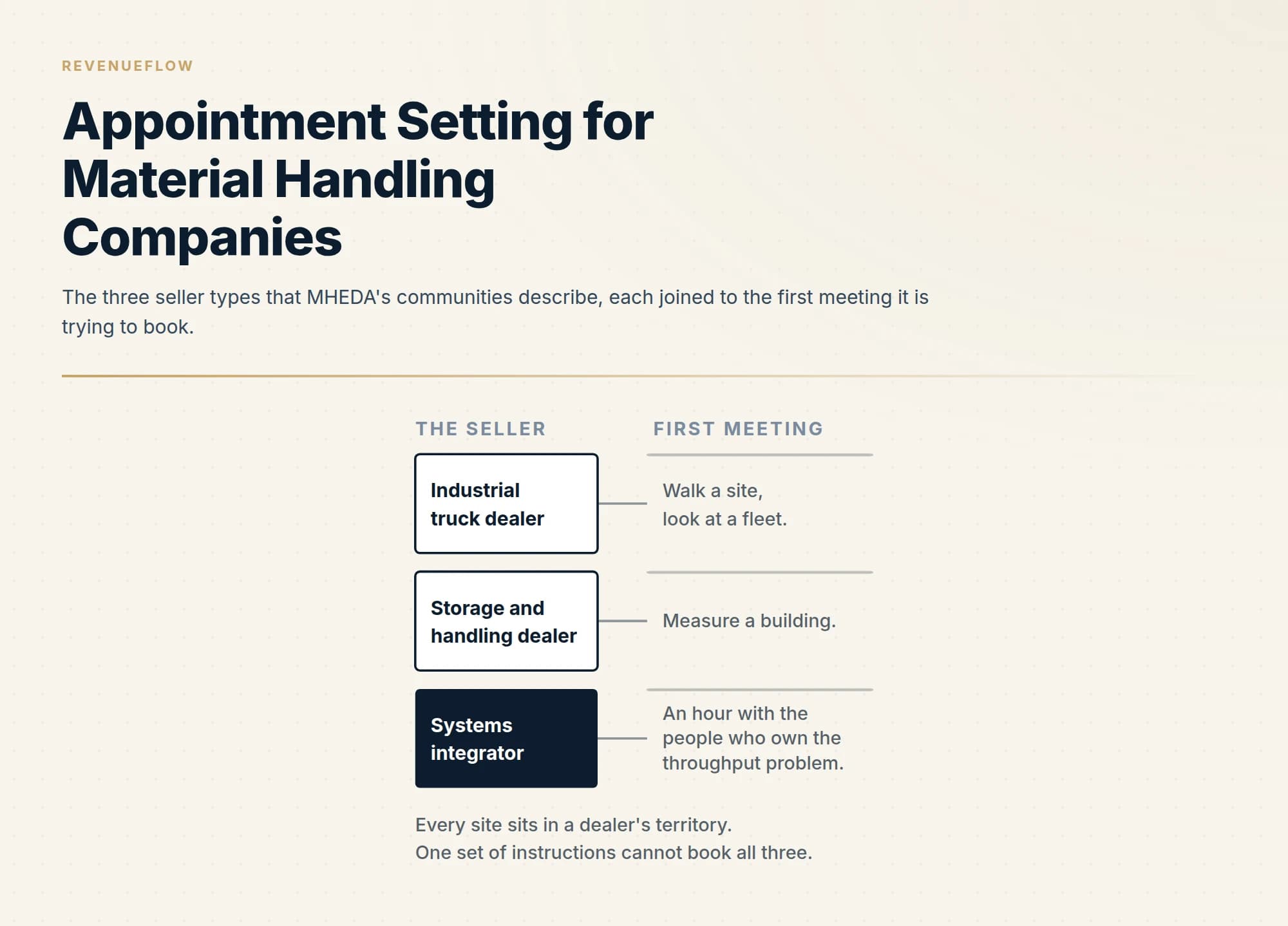
Appointment setting in material handling works when the instructions say whose appointment it is. A truck dealer, a storage and handling dealer and an integrator want different first meetings, and where a manufacturer sells through dealers every site sits in a territory. Route by territory, time calls to ProMat and MODEX, and open with duties OSHA places on the site.
Key takeaways
- MHEDA's three communities, industrial trucks, storage and handling, and systems integrators, describe three sellers who each want a different first meeting.
- Where a manufacturer sells through dealers, the list must be cleaned against the dealer's customers and every booked appointment routed by territory.
- ProMat runs April 19 to 21, 2027 in Chicago, and MODEX lists Atlanta and Las Vegas editions in 2028, per each show's own site.
- OSHA's 29 CFR 1910.178 requires an operator evaluation at least once every three years, a dated duty that gives a dealer a reason to call.
Reviewed and updated September 18, 2026
An appointment setter working for a lift truck manufacturer books a meeting with the operations manager of a distribution centre two states away. The meeting is confirmed, the calendar invite goes out, and the manufacturer's regional manager forwards it to the local dealer, because the dealer owns that territory. The dealer's rep opens it and recognises the name. He has serviced that fleet for six years, was at the site on Tuesday, and now has to explain to a customer why a stranger rang to introduce the brand already parked in the building.
This guide is for companies inside the material handling trade: equipment dealers, manufacturers and systems integrators that want booked appointments with the people who run warehouses, plants and distribution centres. It covers what is particular to this trade, which is mostly a question the generic advice never asks. Before anyone decides how to book an appointment, somebody has to decide whose appointment it is.
Three sellers, three different appointments
The Material Handling Equipment Distributors Association organises its members into three communities, and its own descriptions are a fair map of who is selling. Industrial trucks: "Providers of forklifts, pallet jacks, and other industrial trucks." Storage and handling: "Optimizing space and improving warehouse organization." Systems integrators: "Streamlining operations with automation, software and more." On its About page MHEDA says "Nearly 600 distributor and manufacturing companies worldwide rely on our resources daily", and that "Our members include major material handling distributors and leading manufacturers of storage, lift trucks, conveyors, and related technology."
Those three sellers want three different first meetings. An industrial truck dealer wants to walk a site and look at a fleet. A storage and handling dealer wants to measure a building. An integrator wants an hour with the people who own the throughput problem, because nothing it sells can be quoted from a telephone call. A set of instructions that asks only for meetings with warehouse managers produces the wrong meeting for at least two of them.
The territory question comes before the list
Many manufacturers in this trade reach end users through dealers, and the dealer map is public. Toyota Material Handling's dealer page, for one example, advertises "50+ Dealers & 230+ Locations Across North America" and lists them "sorted alphabetically by state/province". Every address on a prospect list therefore already belongs to somebody.
That has a direct consequence for appointment setting, and it is the reason the opening story happens. If a manufacturer runs the program, each booked appointment has to be routed to the dealer whose territory the site sits in, and the list has to be cleaned of that dealer's existing customers before the first call, using the dealer's records rather than the manufacturer's. If a dealer runs the program, the list stops at the territory line, and the national accounts the manufacturer handles directly come out. Our guide to manufacturing lead generation treats channel conflict as a targeting constraint for industrial sellers in general. In material handling it is the first step, because the conflict is with a business that carries your name on its building.
The show calendar is the anchor
The trade's calendar is set by its association. MHI describes itself as "the nation's largest material handling, logistics, and supply chain association" and runs the two shows that matter most. ProMat's site gives its next dates as April 19 to 21, 2027, in Chicago, and promises "more than 1,200 exhibits, 200 educational sessions and three keynotes". MODEX's site lists two 2028 editions: "Atlanta, GA | April 3-5, 2028" and "Las Vegas, NV | October 18-20, 2028".
For an appointment setter these dates do two jobs. They are a reason to call that the prospect already recognises, since an operations leader planning a visit is deciding which stands to see. And they set the rhythm of the year: the weeks before a show are for booking time at the stand, and the weeks after are for converting conversations into site visits. Our guide to cold email for warehousing and 3PL covers the buyer this trade shares.
- April 19 to 21, 2027ProMat, Chicago
More than 1,200 exhibits, per ProMat's site.
- April 3 to 5, 2028MODEX Atlanta
From MODEX's site.
- October 18 to 20, 2028MODEX Las Vegas
From MODEX's site.
OSHA gives the dealer a dated reason to call
Most appointment setting fails on the first sentence, because the caller has no reason to be calling this site this month. Material handling has one written into federal regulation.
OSHA's page on the subject begins "Powered industrial trucks, commonly called forklifts or lift trucks, are used in many industries, primarily to move materials." The standard that governs them, 29 CFR 1910.178, puts duties on the employer that recur on a schedule. On operators: "The employer shall ensure that each powered industrial truck operator is competent to operate a powered industrial truck safely", and "An evaluation of each powered industrial truck operator's performance shall be conducted at least once every three years." On the trucks: they must be examined before being placed in service, and "Such examination shall be made at least daily."
A dealer that offers operator training or planned maintenance is therefore calling about something the site is already obliged to do. The same OSHA page lists how workers get hurt, including when "lift trucks are inadvertently driven off loading docks" and when "lifts fall between docks and an unsecured trailer", which is the storage and handling dealer's subject. The rule is the employer's to meet, and nothing here is legal advice. Its value to a caller is that it turns a cold call into a question the person answering is expected to have an answer to.
What the rules require of the caller
Where appointment setting is done by telephone, the telemarketing rules matter as much as the email ones. The FTC's guide to the Telemarketing Sales Rule says "Most phone calls between a telemarketer and a business are exempt from the TSR." The exception it names is calls to sell nondurable office or cleaning supplies, which a dealer selling consumables should read for itself. Calls to mobile numbers and calls placed with automated dialling equipment fall under separate FCC rules, and state laws vary; this guide does not summarise either, and an outsourced calling team should be asked how it handles both.
For the email half, the FTC's CAN-SPAM compliance guide applies to business recipients as it does to consumers. How calling vendors are structured and paid is covered in call center appointment setters.
Three openers, each from a source the prospect can check
Each is an example of the shape, for a different seller. None names a real person or claims a result, and each is said or sent once.
Industrial truck dealer, from the OSHA standard. Source: 29 CFR 1910.178.
OSHA requires an evaluation of every lift truck operator at least once every three years. We run those on site for fleets in this county. If yours are due in the next twelve months, would a date in the spring be useful to pencil in?
Systems integrator, from the show calendar. Source: ProMat's site.
ProMat is in Chicago from April 19 to 21. If your team is going to look at picking automation, we can hold forty minutes at our stand with the engineer who designed a comparable system, so the visit answers your questions rather than ours.
Storage and handling dealer, from OSHA's hazard list. Source: OSHA, Powered Industrial Trucks.
OSHA lists trucks driven off loading docks among the ways people are hurt around lift trucks. We survey dock positions for restraints and levellers and leave a written report. Would a walk of your dock doors be useful before peak season?
From the OSHA standard: an evaluation of every lift truck operator at least once every three years. Asks for a date in the spring.
From the show calendar: ProMat is in Chicago from April 19 to 21. Asks for forty minutes at the stand.
From OSHA's hazard list: trucks driven off loading docks. Asks for a walk of the dock doors.
When appointment setting is the wrong play in material handling
There are four situations in which a material handling company should not buy or build this.
When the dealer agreement says no. A manufacturer whose contracts reserve end-user contact to the dealer cannot run a direct program, however good the list. The program to fund is the dealer's.
When the sale is an integration project. A first meeting with an integrator is the start of a long engineering conversation, and the supply of those is rarely limited by the number of first meetings. Count qualified projects, and read appointment setting versus lead generation before paying per meeting.
When the customer is a national account. Large operators often buy equipment centrally and tell their sites what arrives. A booked meeting with a site manager who cannot choose a supplier is a courtesy visit.
When nobody has written down what a qualified appointment is. In this trade the definition has to say which seller it is for, which territory it sits in and whether the site is already a customer. The scoring framework in B2B appointment setting companies shows how to make that definition checkable before money depends on it.
The short version
Appointment setting for material handling companies starts with whose appointment it is. A truck dealer, a storage and handling dealer and an integrator each want a different first meeting, and where a manufacturer sells through dealers every site on the list already sits in somebody's territory. Clean the list against the dealer's customers, route every booked meeting by territory, and use what the trade gives you: a show calendar that MHI publishes, and an OSHA standard that puts dated duties on every site that runs a lift truck. Do not build it where the dealer agreement forbids it, where the sale is an engineering project, where a national account buys centrally, or where nobody has defined a qualified appointment.
We run email and LinkedIn rather than calling, one message per campaign. If you want to see how the written half of this would look for your territory, you can see what a first campaign looks like.
Show dates, membership descriptions and regulatory text were read from the named organisations' own pages on 18 September 2026, from stored snapshots. Dates change: check the organiser before relying on one. Nothing in this article is legal advice.
Sources: MHEDA, home page communities, MHEDA, About, Toyota Material Handling, authorized dealers, ProMat, MODEX, OSHA, Powered Industrial Trucks, OSHA, 29 CFR 1910.178, FTC, Complying with the Telemarketing Sales Rule, FTC, CAN-SPAM Act: A Compliance Guide for Business
Frequently asked questions.
Frequently asked questions- How does appointment setting work for material handling companies?
- It starts by naming the seller. An industrial truck dealer wants a site walk and a look at the fleet, a storage and handling dealer wants to measure a building, and an integrator wants an hour with the people who own the throughput problem. The instructions, the list and the definition of a qualified appointment all change with that answer.
- Who should receive an appointment booked by a forklift manufacturer?
- The dealer whose territory the site sits in. Many manufacturers reach end users through dealers, and dealer maps are public, so every address on a list already belongs to someone. Clean the list against that dealer's existing customers before calling, using the dealer's records, and route each booked appointment to that dealer.
- What is a good reason to call a warehouse or plant about lift trucks?
- A duty the site already has. OSHA's standard at 29 CFR 1910.178 says an evaluation of each operator's performance shall be conducted at least once every three years, and that trucks must be examined at least daily. A dealer offering training or planned maintenance is calling about something the employer is expected to have an answer to.
- When is appointment setting the wrong choice in material handling?
- In four cases. The dealer agreement reserves end-user contact to the dealer. The sale is an integration project, where first meetings are rarely the constraint. The customer is a national account that buys centrally, so a site meeting cannot choose a supplier. Or nobody has written down what a qualified appointment means.
About the author.

B2B cold email experts helping companies generate qualified leads through done-for-you outreach campaigns.
RevenueFlow Team
Explore more.
Ready to scale your outreach?
We build GTM engines that book real meetings. See the receipts.
Related articles.
Outbound Sales for ERP Vendors: Follow the Support Clock
Outbound for ERP vendors and resellers works when lists follow published end-of-support dates, the first reader is the controller, and channel rules come first.
Lead Generation for HR Consulting Firms: The Threshold Map
Lead generation for HR consultancies and PEOs built on federal headcount thresholds: 15, 20, 50 and 100 employees, each a dated reason to write to an owner.
SDR Outsourcing for Biotech Companies: When It Fits
SDR outsourcing for life science sellers: which parts of the job can go outside, what FDA research use only guidance means for the brief, and when it is the wrong play.
Lead Generation for K12 Vendors: Follow the Funding Stream
K-12 lead generation starts from the money: E-Rate filings that name the buyer, USAC gift rules that limit offers, and the privacy and accessibility gates.
B2B Sales for Hardware Companies: Sell Inside the Rules
B2B hardware sales differ from software: FCC authorization limits when a radio device may be offered, pilots cost a unit each, and distributors share compliance.
LinkedIn Outreach for Ecommerce Companies: Who Is Reachable
LinkedIn outreach to ecommerce brands: why the storefront address reaches support, what Shopify's partner agreement says about contacting merchants, and who is reachable.