Lead Generation for K12 Vendors: Follow the Funding Stream
K-12 lead generation starts from the money: E-Rate filings that name the buyer, USAC gift rules that limit offers, and the privacy and accessibility gates.
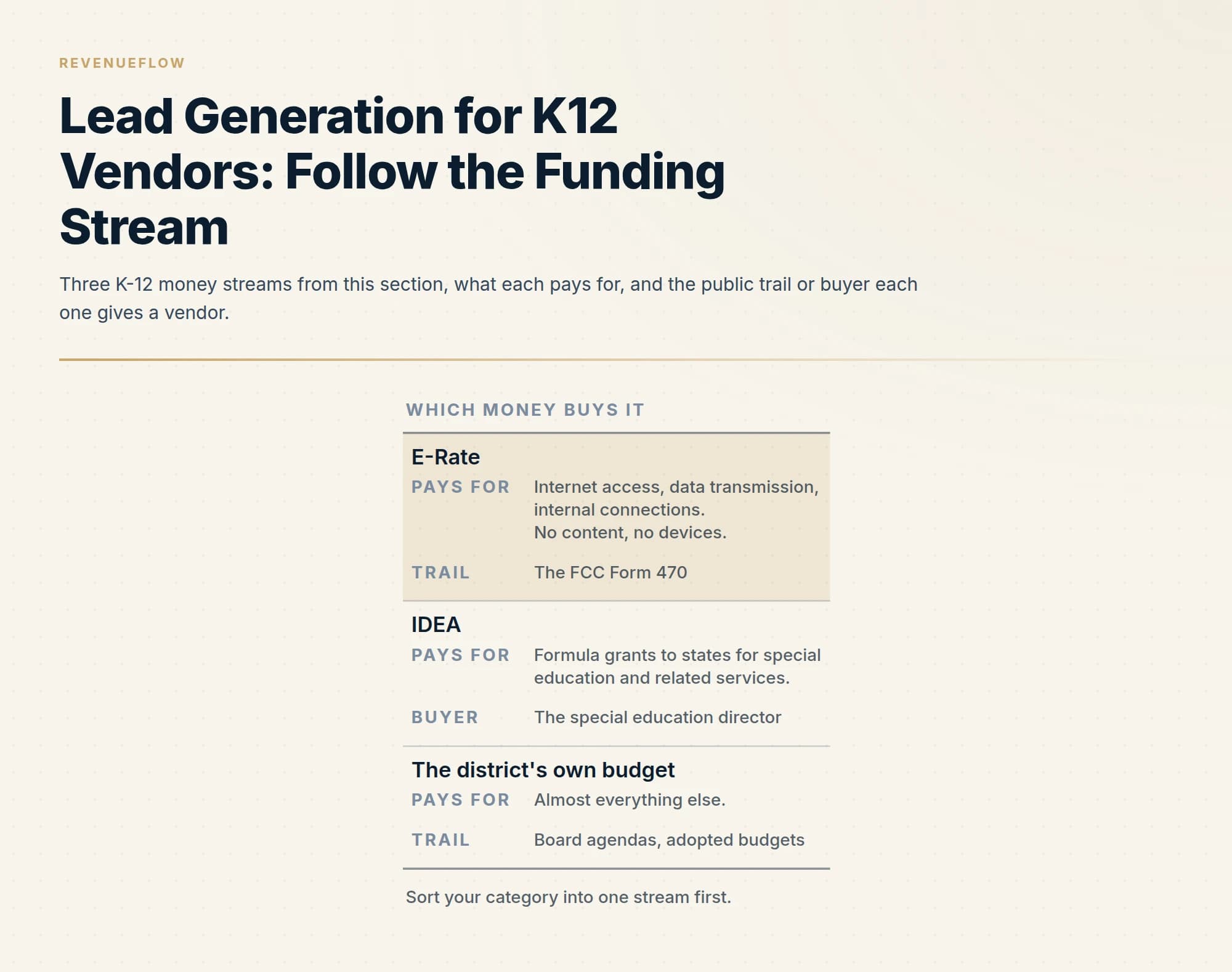
Lead generation for K-12 vendors works when it starts from the funding stream that pays for the category. E-Rate buyers publish an FCC Form 470 and must wait at least 28 days before closing bids, so outreach belongs before the form. Every vendor should know which of FERPA, COPPA, USAC's gift rules and the ADA Title II web rule applies.
Key takeaways
- USAC publishes a Form 470 download tool that lets a service provider search for applicants seeking bids and see the technical contact for each.
- Applicants must wait at least 28 days after certifying an FCC Form 470 before closing bidding, and price must carry the most weight in evaluation.
- USAC's gift rules name marketing calls and on-site product demonstrations among examples of gifts, so campaign offers need review.
- FERPA, COPPA and the ADA Title II web rule each apply to a different kind of vendor, and stating which you have cleared belongs in the first message.
Reviewed and updated September 18, 2026
A networking vendor emails a district technology director in late February about a wireless upgrade. The director agrees the network needs work and says so. What the vendor does not know is that the district certified a federal form describing exactly that upgrade in December, waited the required four weeks, scored the bids and picked a provider in January. The email was well written and it arrived about ten weeks after the only moment it could have mattered.
This guide is for companies that sell to K-12 schools and districts in the United States, and it covers one thing: how the money that pays for your category decides where your leads come from. It does not repeat the fiscal calendar, the buying committee or the difference between K-12 and higher education, because our guide to lead generation in education already covers those. It starts one level down, at the funding stream.
Start from the money stream, not the title
Most K-12 lead generation starts with a job title: technology director, curriculum director, special education director. The title tells you who might care. It does not tell you whether there is money, which rules attach to it, or whether the district has already said in public what it intends to buy.
A district pays for things from several streams at once, and each stream has its own rulebook and leaves its own paper trail. Sort your category into one of three streams before building a list.
E-Rate, for connectivity. USAC, which administers the program for the FCC, describes it this way: "The E-Rate program offers discounts of up to 90 percent to eligible schools and libraries on internet access, data transmission services, and internal connections." The scope is narrow. USAC's eligible services overview says of the connectivity category "These services cannot include charges for content, end-user devices or equipment purchases", so a curriculum product or a laptop is not an E-Rate sale, and a vendor of either should ignore this stream entirely.
IDEA, for special education. The Department of Education's IDEA site says the law governs how states and public agencies provide services to "more than 8 million (as of school year 2022-23)" eligible children, and that it authorizes "Formula grants to states to support special education and related services and early intervention services." A vendor of special education tools is selling into obligations that a federal law defines, and the buyer is the special education director whose job is meeting them.
The district's own budget, for almost everything else. This is where the fiscal calendar and board approval govern, where board agendas and adopted budgets are the public trail, and where the education guide linked above is the reference.
E-Rate is the most readable buying signal in K-12
If your category is E-Rate eligible, the district is required to tell the market what it wants before it buys, and the rules of that process decide when outreach is useful.
USAC's competitive bidding page sets out the sequence. The applicant certifies an FCC Form 470 describing the services it is requesting. Then, in USAC's words, "Applicants must wait at least 28 days from the date the FCC Form 470 is certified before closing the competitive bidding process." The same page says "The FCC Form 470 for the upcoming funding year is generally available in EPC one year before the start of the funding year". The funding year itself runs from July 1 to the following June.
Two rules inside that process matter to anyone planning outreach. The first is how bids are scored: "The price of the eligible equipment and services must be given the most weight during the bid evaluation process." A relationship does not outrank a price once a form is posted. The second is that the forms are public. USAC's tools page describes an FCC Form 470 Download Tool and lists the questions it answers, including "How can a service provider search for applicants seeking bids for products and services for the upcoming funding year?" and "Who is the technical contact for the applicant?"
That is a lead list published by the program itself, with the requested services and the named contact attached. After a form is posted, the only useful response is a bid. Outreach belongs months earlier, when a district is deciding what to put on the form, and again with districts whose multi-year contract is approaching its end, since USAC notes that a new form is not needed until the existing contract has expired and a new contract is required.
The gift rules reach further than most vendors expect
E-Rate also carries the one outreach rule in K-12 that names sales tactics directly. USAC's gift rules page says "Any soliciting, offering, acceptance, or receipt of gifts between involved parties is considered a competitive bidding violation" that could put the applicant's funding at risk. The limits USAC sets are low and specific: "Applicants may not accept gifts with a retail value greater than $20", and "The combined value of items received by any individual may not exceed $50 from any one source per funding year".
USAC's examples of gifts include gifts for attending seminars and "marketing calls; loans of products, including those characterized as on-site product demonstrations". A free pilot unit left at a school, a lunch attached to a webinar, a prize draw at a booth: each is the kind of offer a lead generation program produces without thinking, and each can be a problem for the district that accepts it.
| The offer | What USAC's page says |
|---|---|
| A lunch attached to a webinar | Gifts for attending seminars are named as gifts. Meals at conferences are permitted only under the low value limit. |
| A free pilot unit left at a school | Loans of products, including on-site product demonstrations, are named as gifts. |
| A prize draw at a booth | Prizes at conferences are permitted only under the low value limit. |
| A donation to a literacy program | Permitted when not related to E-Rate procurement activities or decisions. |
USAC states that meals and prizes at conferences are permitted when they fall under the value limit, and that charitable donations, such as those for literacy programs, are permitted as long as they are not directly or indirectly related to E-Rate procurement activities or decisions. None of this is legal advice. The practical point is that the offer in a campaign needs the same review as the message, and that the safest offers are information: a specification checklist, a reference district, a plain answer about eligibility.
The privacy and accessibility gates, by vendor type
Three further rules decide whether a K-12 lead can ever become a customer, and each applies to a different kind of vendor.
FERPA. The Department of Education's Student Privacy Policy Office keeps a page for education technology vendors, addressed to third party providers whose apps or services use students' personally identifiable information, with resources "to ensure they are properly handling FERPA-protected information". If your product holds student records, that page is the reading list your buyer's privacy reviewer expects you to know. State student privacy laws sit on top of FERPA and vary, so check the state you are selling into.
COPPA. For products used by children under 13, the FTC's COPPA FAQ explains that when a district contracts with an operator for an educational service, "the schools may act as the parent's agent and can consent under COPPA to the collection of kids' information on the parent's behalf". Two limits follow in the same answer: "the school's ability to consent for the parent is limited to the educational context", and "it is the responsibility of the operator to comply with the Rule". A vendor cannot write that duty into the district's terms of service.
The ADA Title II web rule. ADA.gov's fact sheet says state and local government web content and mobile apps usually need to meet WCAG 2.1, Level AA, including content that someone else provides for them under an arrangement, which is where a vendor's product comes in. It says a school district takes its compliance date from the population of its city or county, and "If it is an independent school district, it would use the population estimate in the most recent Small Area Income and Poverty Estimates". The extended dates it records are April 26, 2027 for populations of 50,000 or more and April 26, 2028 for smaller ones.
| Row | Applies when | Published by |
|---|---|---|
| FERPA | The product uses students' personally identifiable information | Student Privacy Policy Office |
| COPPA | The product is used by children under 13 | FTC |
| E-Rate gift rules | You sell E-Rate eligible services | USAC |
| ADA Title II web rule | You provide web content or apps for a district | ADA.gov |
Saying in the first message which of these gates you have already cleared is worth more than any claim about outcomes.
Cooperative contracts change who the lead is
A district does not always run its own bid. Sourcewell, one of the national cooperatives, describes itself as "combining the buying power of 50,000 government and education entities" and says "Sourcewell holds hundreds of competitively solicited cooperative contracts". One line on its cooperative purchasing page matters to vendors that sell through dealers: "We award contracts at the manufacturing level, but they can be leveraged locally to support your local dealer."
For lead generation this cuts two ways. A vendor that holds a cooperative contract can say so in the first line, because it answers the procurement question before it is asked. A vendor that does not should find out early whether a target district buys its category through a cooperative, since the conversation that matters may be with the cooperative rather than with the district. Procurement staff respond to different things than program staff do, which is covered in how to cold email procurement managers.
Three openers, each grounded in a public source
Each example is one message, sent once, with no follow-up underneath it. None names a real person or claims a result.
From a posted FCC Form 470. Source: USAC's E-Rate tools page and its Form 470 dataset.
Your district's Form 470 for the coming funding year lists internal connections for four buildings. We are preparing a bid and have two questions about the attached RFP so that the numbers we send are the right ones. Is the technical contact on the form the right person to ask?
From the ADA.gov fact sheet. Source: the fact sheet on the web accessibility rule.
The Title II web rule covers content that vendors provide for a district, and the compliance date for a county of your size is 26 April 2027. We have an accessibility conformance report for our parent portal and can send it to whoever is collecting these from vendors.
From the FTC's COPPA FAQ. Source: Complying with COPPA: Frequently Asked Questions.
When a school consents on behalf of parents, the FTC says the operator still has to give the school a direct notice of its data practices. Ours is two pages. Would it help your privacy review to have it before anyone looks at the product?
Message construction for this market is covered in cold email for EdTech companies and cold email for education, and typical response patterns in education cold email benchmarks.
When outbound lead generation is the wrong play for a K-12 vendor
There are four cases in which a K-12 vendor should not build this.
Inside an open bid. Once a Form 470 is posted, price carries the most weight and the rules punish anything that looks like influence. Bid, and save the outreach for the next cycle.
When the product spreads teacher by teacher. A free classroom tool that teachers adopt on their own creates its own leads, and the district conversation starts from usage data rather than from a cold list.
When the district buys your category only through a cooperative you are not on. The work is getting onto the contract.
When the product cannot yet pass the gates above. A campaign that produces interested educators who then meet a failed privacy review spends your reputation.
The short version
Lead generation for K-12 vendors works best when it starts from the money: E-Rate for connectivity, IDEA for special education, or the district's own budget for almost everything else. If it is E-Rate, read the posted Form 470s, respect the 28-day bidding window and review every offer against USAC's gift rules. Whatever the stream, know which of FERPA, COPPA and the ADA Title II web rule applies to you, say which you have cleared, and check whether a cooperative contract is the real route to the purchase.
If you want a target list built against public filings and a first message that a district would recognise as informed, you can see what a first campaign looks like.
Program rules, limits and dates were read from the named agencies' own pages on 18 September 2026, from stored snapshots. They change: check the source before relying on any figure or date here. Nothing in this article is legal advice.
Sources: USAC, E-Rate: Get Started, USAC, Competitive Bidding, USAC, Gift Rules, USAC, Eligible Services Overview, USAC, E-Rate Tools, U.S. Department of Education, About IDEA, Student Privacy Policy Office, Education Technology Vendors, FTC, Complying with COPPA: Frequently Asked Questions, ADA.gov, fact sheet on the web accessibility rule, Sourcewell, Cooperative Purchasing
Frequently asked questions.
Frequently asked questions- How do K-12 vendors generate leads?
- Start from the money that pays for the category. Connectivity vendors can read posted FCC Form 470 filings through USAC's public tools. Special education vendors sell into obligations defined by IDEA. Almost everything else is paid from the district's own budget, where board agendas and adopted budgets show intent. Then write once, to the named owner, with something the district has published.
- What is an FCC Form 470 and why does it matter to vendors?
- It is the form an E-Rate applicant certifies to describe the services it wants bids for. USAC says applicants must wait at least 28 days after certifying it before closing competitive bidding, and that price must carry the most weight. The forms are public through USAC's download tool, which makes them a lead list published by the program itself.
- Can a vendor offer free pilots or lunches to school districts?
- For E-Rate eligible services, be careful. USAC's gift rules say applicants may not accept gifts above a low retail value, and its examples of gifts include gifts for attending seminars, marketing calls and loans of products described as on-site demonstrations. Offers built on information, such as a specification checklist, avoid the problem. This is not legal advice.
- Which privacy laws apply when selling software to schools?
- FERPA applies when a product uses students' personally identifiable information, and the Department of Education keeps a resource page for vendors. COPPA applies to products used by children under 13; the FTC says a school can consent on a parent's behalf in the educational context, while compliance stays the operator's responsibility. State student privacy laws vary.
About the author.

B2B cold email experts helping companies generate qualified leads through done-for-you outreach campaigns.
RevenueFlow Team
Explore more.
Ready to scale your outreach?
We build GTM engines that book real meetings. See the receipts.
Related articles.
Outbound Sales for Higher Education Vendors: Which Door to Use
Outbound for higher education vendors, built on universities' own purchasing policies: three doors, the ask that fits each one, and a dated accessibility review.
Outbound Sales for ERP Vendors: Follow the Support Clock
Outbound for ERP vendors and resellers works when lists follow published end-of-support dates, the first reader is the controller, and channel rules come first.
B2B Sales for Hardware Companies: Sell Inside the Rules
B2B hardware sales differ from software: FCC authorization limits when a radio device may be offered, pilots cost a unit each, and distributors share compliance.
SDR Outsourcing for Biotech Companies: When It Fits
SDR outsourcing for life science sellers: which parts of the job can go outside, what FDA research use only guidance means for the brief, and when it is the wrong play.
Lead Generation for HR Consulting Firms: The Threshold Map
Lead generation for HR consultancies and PEOs built on federal headcount thresholds: 15, 20, 50 and 100 employees, each a dated reason to write to an owner.
Appointment Setting for Material Handling Companies
Appointment setting in material handling starts with whose appointment it is: dealer territories, the ProMat and MODEX calendar, and OSHA's dated duties.