SDR Outsourcing for Solar Companies: The Commercial Layer
For the solar company weighing an outside setter: which segment a setter fits, the four sentences it must be able to say, and the consumer rules it inherits.
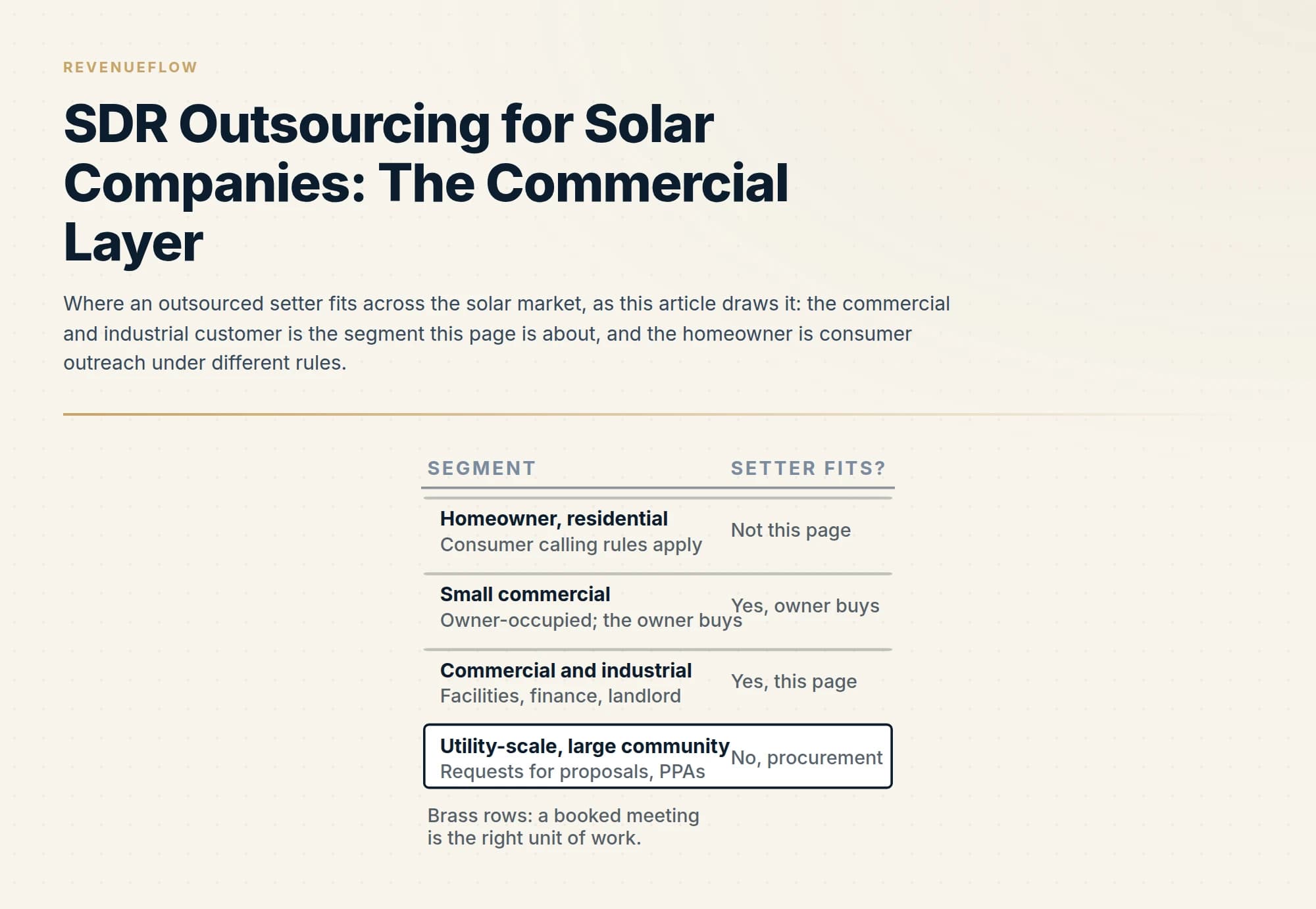
A solar company outsources sales development only for the commercial and industrial segment: business buyers with a roof and a bill. The setter needs a true sentence on the credit, the clock, the grid and the credential, and the contract keeps every residential number, autodialer and prerecorded voice out, because those sit under consumer telemarketing rules.
Key takeaways
- Martal's guide, citing SEIA's analysis, says the residential federal credit ended on 31 December 2025 while the commercial credit continues, which splits the market into homeowner appointment setting and commercial account opening.
- The IRS page on the Clean Electricity Investment Credit, last reviewed 5 January 2026, states who may claim it; a setter may say the credit exists and what the page says, never what a given customer qualifies for.
- The FCC's guide states that autodialed or prerecorded calls to wireless numbers need prior express consent, so the contract with a setter excludes residential numbers, autodialers and prerecorded voice in writing.
- The meeting a setter books is a meeting for the engineer, so the engineer's calendar is the programme's real capacity, and the qualification bar is a building the customer controls, a bill and an engineer's slot.
Reviewed and updated September 18, 2026
The residential federal solar credit ended on 31 December 2025 and the commercial credit continues. That sentence, from Martal's guide to solar lead generation companies, read on 18 September 2026, which says that "The residential 25D tax credit ended on December 31, 2025 under the One Big Beautiful Bill Act, per SEIA, which cooled consumer demand while the commercial 48E credit and third-party leases continued", splits the solar market into the two readers a page about outsourced SDR work has to keep apart: the residential installer that wants appointments with homeowners, and the solar company that sells to businesses. This page is written for the second reader, the solar company itself, an installer, an engineering-procurement-construction firm, a developer or a storage integrator, deciding whether to pay an outside team to book its first conversations with commercial and industrial customers. Residential setting is consumer outreach under different rules, and is named below only to be kept out. If you sell to solar and energy companies and want to reach them, the cold email for utilities and energy services guide covers that direction.
Nine of the ten pages that answer a search for this phrase, read the same day, are written by companies that want to be hired; the tenth is a job-board page describing the solar SDR role. None is written from the solar company's side of the contract.
What the four outsourcing models are, what a seat or a meeting costs, and where the learning should live are answered in SDR outsourcing, outsourced SDR pricing and outbound sales outsourcing, and are not repeated. The solar layer is below: which segment of the solar market can use a setter at all, what the setter has to be able to say about money and the grid, the dated federal clock the buyer is on, the consumer-calling rules a third-party caller inherits the moment it dials a homeowner, the objections the vendors themselves report, three openers, and the cases where the purchase is wrong.
Which segment can use a setter
Martal's guide to solar lead generation companies, read on 18 September 2026, says the plain thing: "For commercial and B2B solar, outbound appointment setting to decision-makers usually beats buying consumer leads, because the deals are larger and the buyers do not fill out" the consumer quote forms. It also says where the residential market went after the credit ended: "demand pulled forward and then softened, and acquisition costs stayed high". ClearSource's post, published 14 July 2026 under Marco Rosales's byline, is the residential reading: it describes a solar call centre trained on system sizing, net metering, permitting timelines, warranties and financing, says lead costs are rising, and notes in passing that "Spring and summer typically drive higher residential inquiry volume, while commercial ones often spike around the fiscal year-end".
The segment decides the purchase. A homeowner is a consumer, and the rules in the section on calling below apply to every dial a setter makes on your behalf. A business owner, a facilities director, a school district's operations lead or a developer's asset manager is a business buyer, and the ordinary business-to-business outbound rules apply. Utility-scale and large community-solar projects are won through requests for proposals and power purchase agreements, not booked meetings, and are outside this page. What is left, and what this page is about, is the commercial and industrial customer: the building owner, the manufacturer, the cold-storage operator, the retailer with a portfolio of roofs, the agricultural business with land and a large bill.
What the setter has to be able to say
A solar meeting with a business is a financing conversation before it is an engineering one, and a setter who cannot hold the first thirty seconds of it books nothing. Four topics come up on the first call, and the setter needs a true sentence on each.
The credit. The Internal Revenue Service's page on the Clean Electricity Investment Credit, last reviewed 5 January 2026 and read on 18 September 2026, states that the credit is available to taxpayers with a qualified facility placed in service after 31 December 2024; the page states that "The base amount of the Clean Electricity Investment Credit is 6 percent of the qualified investment", increased by "up to 30% for facilities meeting prevailing wage and registered apprenticeship requirements", with a further 10 percentage points for meeting domestic content requirements and 10 for location in an energy community; and it states that "Elective payment and transfer of credits may be available to certain applicable entities to include tax-exempt organizations and government entities", with a pre-filing registration required. What a setter may say is that the credit exists and what the page says about who can claim it; what it may never say is what a given customer qualifies for, which ClearSource's own training note puts as representing "what a customer qualifies for without overclaiming", and which is the customer's tax adviser's call.
The clock. SEIA's Solar Market Insight 2025 Year in Review, published 9 March 2026 with Wood Mackenzie, reports that the "solar industry installed 43.2 gigawatts direct current (GWdc) of capacity in 2025, a 14% decrease from 2024", that "The utility-scale sector shrank nearly 40% quarter-over-quarter in the fourth quarter", and that "Revised tax credit timelines and safe harbor dynamics reduced the imperative to interconnect by year-end" while they "increased the urgency to begin construction on new projects". Martal's guide, citing SEIA's analysis of the July 2025 law, gives the dates a commercial buyer is being told about: the commercial credit "continues for projects that begin construction by July 4, 2026 or are placed in service by December 31, 2027". Those two dates are the vendor's reading of the association's analysis, not the regulator's page, and a setter should say so if asked; the point is that a commercial buyer with a roof and a bill is on a clock.
The grid. ClearSource lists what its residential reps must handle and the list is the same for commercial: "Net metering rules, interconnection requirements, and incentive structures vary by state and utility", so a setter selling across markets has to know which utility the building sits under before it dials. The buyer will ask how long interconnection takes; the honest answer is the utility's queue.
The credential. The North American Board of Certified Energy Practitioners' site, read the same day, lists a "PV Installation Professional" board certification, an "Energy Storage Installation Professional (ESIP) Certification" and a company accreditation programme. A setter that can say which of the installer's people hold it has answered the first credibility question before it is put.
The rules a third-party caller inherits the moment it dials a homeowner
This section exists so that the line between the two readers stays drawn, because the moment a setter working for a solar company calls a homeowner, or calls a business owner about the owner's own house, it has stepped into consumer telemarketing. None of this is legal advice, and a vendor describing itself as compliant is making a claim only its counsel can support.
The Federal Communications Commission's consumer guide on unwanted robocalls and texts, read on 18 September 2026, states that "FCC rules require a caller to obtain your prior written consent" before "a prerecorded telemarketing call to your home or wireless phone number", and oral or written consent before making an autodialed or prerecorded call or text to a wireless number; that "Prerecorded telemarketing calls must provide an opt-out option at the start of the message"; that prerecorded messages must open with the caller's name, number and business name; and that "AI-generated voice calls are illegal unless the consumer has agreed to receive them or the caller is exempt". The underlying rule, 47 CFR 64.1200 as displayed on the eCFR up to date as of 16 September 2026, opens by providing that no person or entity may initiate a call "using an automatic telephone dialing system or an artificial or prerecorded voice", other than for emergencies or with the called party's prior express consent, to the categories of numbers it lists, including cellular numbers. The Federal Trade Commission's guide to the Telemarketing Sales Rule states that "Most phone calls between a telemarketer and a business are exempt from the TSR", but that calls to business lines soliciting individual employees to buy for their own use "are not business-to-business solicitations and are not exempt from the TSR". And the Commission's CAN-SPAM guide states that the law makes no exception for business-to-business email and that "even if you hire another company to handle your email marketing, you can't contract away your legal responsibility to comply with the law".
The commercial programme this page describes sits on the business side of every one of those lines, and the contract with a setter says in writing that no residential number is dialled under it, that no autodialer or prerecorded voice is used, and that the solar company sees every email before it goes out in its name.
| Question | Commercial programme | Residential setting |
|---|---|---|
| Who is called | Facilities, finance, owners of businesses | Homeowners, or owners about their own house |
| Telemarketing rule | Most business calls exempt, per the FTC guide | Consent and disclosure rules apply, per the FCC guide |
| Autodialer or prerecorded voice | Not used under the contract | Prior express consent required to wireless numbers |
| CAN-SPAM applies, responsibility stays with you | CAN-SPAM applies, responsibility stays with you |
What the vendors say against it
The objections are on the vendors' pages. ClearSource lists five reasons the sale is hard: rising lead costs as installers and national players compete for the same pool, sales cycles that run weeks to months, technical questions about sizing, net metering, permitting, warranty and financing that a rep who cannot answer loses, regulatory variability by state and utility, and the education a buyer needs before committing. Martal's guide adds the buying-leads objection: "Shared aggregator leads are sold to multiple installers and convert poorly", so cost per close matters more than cost per lead, and it says "Most growing solar firms run a hybrid weighted toward qualified outbound and appointment setting for commercial deals". The objection a solar company's own engineer will raise is the one the vendors do not print: a setter cannot size a system or read a bill, so the meeting it books is a meeting for the engineer, whose calendar is the real capacity of the programme.
The calendar the industry keeps is short. RE+ runs 16 to 19 November 2026 at the Las Vegas Convention Center, per its site, co-hosted by SEIA, with the 2027 edition dated 15 to 18 November 2027; it is a supplier show, which makes it the wrong place to find commercial customers and the right place to find the financiers, developers and storage partners a commercial programme needs behind it. The buyer's own calendar is the one ClearSource names: the fiscal year-end, when a capital budget either gets spent or lapses.
When outsourced setting is the wrong purchase
Four cases. Your business is residential, and what you want is homeowner appointments; that is a consumer telemarketing operation with its own rules and vendors, and nothing on this page applies. Your commercial pipeline is won through requests for proposals and power purchase agreements, where the door is the procurement process. Your installation crews are booked through the tax-credit deadline the buyer is being told about, so a meeting booked now is a project you cannot build in time. And you sell through a channel partner, a roofing contractor, an energy-services company or a utility programme, whose accounts a setter must not call.
Three openers, each on a fetched fact
Three illustrative openers follow, each built on a page read on 18 September 2026; each is one message to one business buyer, sent once, on email and LinkedIn, with no follow-up bump, and the reply or the silence is the answer. They name no real recipient, make no claim about results, and the installer that speaks in each is invented.
The first illustrative opener is for a facilities director at a cold-storage operator, and it rests on the Internal Revenue Service's page quoted above: the credit applies to qualified facilities placed in service after 31 December 2024, and who can claim it is the taxpayer's question.
Your Fresno warehouse sits under a utility whose commercial rate schedule we have modelled for two other cold-storage sites this year, and the roof is the size that makes a rooftop array worth a look. The federal Clean Electricity Investment Credit applies to qualified facilities placed in service after 31 December 2024; whether your company can claim it is a question for your tax adviser, not for us. If your fiscal year ends in December and the capital budget is being set now, would twenty minutes with our commercial engineer, who has your utility's interconnection queue in front of him, be worth it?
The second illustrative opener is for a chief financial officer at a regional manufacturer, and it rests on SEIA's 2025 Year in Review quoted above: revised tax credit timelines reduced the imperative to interconnect by year-end and increased the urgency to begin construction.
The industry's own timelines shifted this year with the revised tax credit rules, and the urgency moved from interconnecting by year-end to beginning construction. We are a commercial installer with eleven manufacturing rooftops in your state completed and interconnected. If you are weighing a project against the dates your adviser has given you, our engineer can walk through what beginning construction has meant for our last three clients, in thirty minutes, at a time you choose.
The third illustrative opener is for a school district's director of operations, and it rests on two pages quoted above: the Internal Revenue Service's sentence on elective payment for tax-exempt and government entities after a pre-filing registration, and NABCEP's company accreditation and board certifications.
Elective payment of the federal credit may be available to tax-exempt and government entities after a pre-filing registration, which is the route two districts we have built for used. We hold the industry's company accreditation and have four board-certified installers on staff. If your board is considering solar for the high school's roof, would a forty-minute briefing for your business office on how those two districts approached the registration be useful before your next capital meeting?
What to agree in writing
No residential numbers, no autodialer, no prerecorded voice, and every email seen by you before it is sent. The segment and the list: commercial and industrial accounts under named utilities, with channel-partner accounts excluded. The four sentences the setter may say about the credit, the clock, the grid and the credential, and the one it may never say. The qualification bar: a building the customer owns or controls, a bill, and an engineer's slot to take the meeting. One message per campaign, no bumps. A solar company that wants to see the shape run against its own commercial list before signing a contract can start with a free campaign and count the meetings its engineer would actually take.
No residential numbers, no autodialer, no prerecorded voice; every email seen by you before it is sent.
Commercial and industrial accounts under named utilities, channel-partner accounts excluded.
The credit, the clock, the grid and the credential, and the one sentence the setter may never say.
A building the customer owns or controls, a bill, and an engineer's slot to take the meeting.
One message per campaign, no bumps.
Frequently asked questions.
Frequently asked questions- Which solar companies can use an outsourced SDR at all?
- Companies selling to commercial and industrial customers: building owners, manufacturers, cold-storage operators, retailers with portfolios of roofs, agricultural businesses. Residential installers want homeowner appointments, which is consumer telemarketing under different rules, and utility-scale developers win work through requests for proposals and power purchase agreements rather than booked meetings. The segment decides whether a booked meeting is the right unit of work.
- What does a solar setter have to be able to say on the first call?
- Four things, each as a true sentence with a source. The credit: that it exists and what the IRS page says about who can claim it, never what a customer qualifies for. The clock: the dated timelines the industry's own review describes. The grid: which utility the building sits under and which interconnection queue applies. The credential: which of the installer's people hold NABCEP certifications, as its site lists them.
- Which rules does a third-party caller inherit from a solar company?
- The moment a setter dials a homeowner it is consumer telemarketing. The FCC's guide, read on 18 September 2026, states that autodialed or prerecorded calls to wireless numbers need prior express consent and that prerecorded telemarketing calls must offer an opt-out. The FTC's guides state that most business-to-business calls are exempt from the Telemarketing Sales Rule and that CAN-SPAM makes no exception for business email. None of this is legal advice.
- When is outsourced setting the wrong purchase for a solar company?
- When the business is residential and wants homeowner appointments, because that is a different operation with its own rules. When the pipeline is won through requests for proposals and power purchase agreements. When installation crews are already booked through the credit deadline the buyer is being told about, so a meeting booked now is a project that cannot be built in time. And when the company sells through channel partners whose accounts a setter must not call.
About the author.

B2B cold email experts helping companies generate qualified leads through done-for-you outreach campaigns.
RevenueFlow Team
Explore more.
Ready to scale your outreach?
We build GTM engines that book real meetings. See the receipts.
Related articles.
Appointment Setting for Manufacturers: Who a Setter May Call
For the manufacturer hiring a setter: the ranked titles to hand over, the rep and distributor map that decides which accounts may be called, and the meeting types.
SDR Outsourcing for Fintech Companies: Assessability Test
For the fintech weighing an outside setter: the three assessability sentences, the promotion rules that bind every message, the sponsor test and which model fits.
SDR Outsourcing for Food and Beverage Companies: Food Layer
For the food or beverage brand weighing an outside setter: the buyer by channel, the broker and distributor map, the review calendar and the traceability rule's dates.
Outbound Sales for Higher Education Vendors: Which Door to Use
Outbound for higher education vendors, built on universities' own purchasing policies: three doors, the ask that fits each one, and a dated accessibility review.
Appointment Setting for Material Handling Companies
Appointment setting in material handling starts with whose appointment it is: dealer territories, the ProMat and MODEX calendar, and OSHA's dated duties.
Lead Generation for IoT Companies: A B2B Playbook
Written for the IoT vendor, not the agency: who decides an IoT purchase, why the pilot is a pipeline stage, the dated regulatory clocks and shows to write against.