Lead Generation for IoT Companies: A B2B Playbook
Written for the IoT vendor, not the agency: who decides an IoT purchase, why the pilot is a pipeline stage, the dated regulatory clocks and shows to write against.
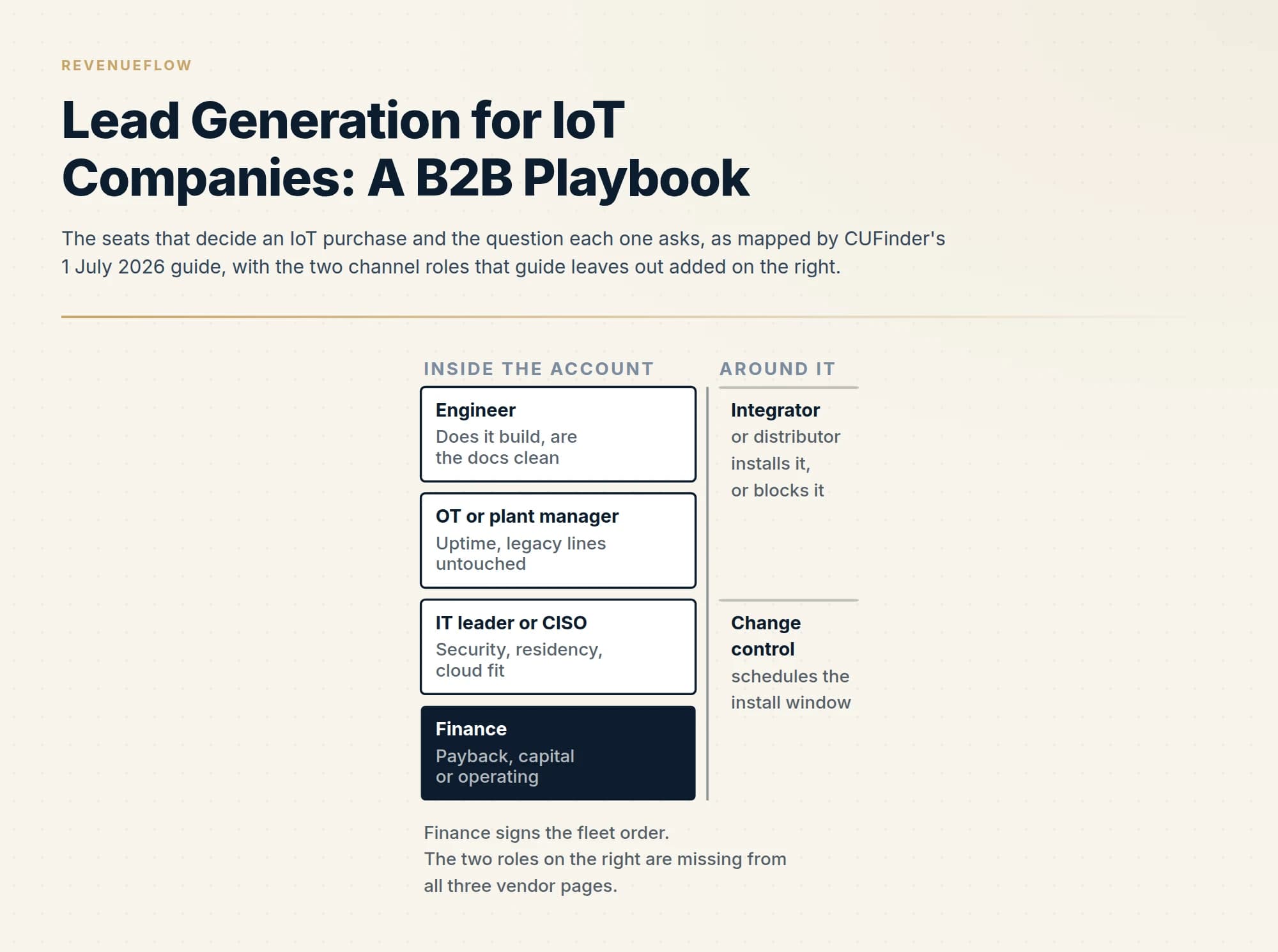
An IoT company generates B2B leads by writing to a committee, not a champion: the engineer, the plant manager, the IT leader and finance, plus the integrator who installs or blocks the product. A lead is a kit request, a booked audit or a saved payback figure, and openers stand on dated clocks.
Key takeaways
- CUFinder's 1 July 2026 guide maps an IoT purchase to four seats, engineer, OT or plant manager, IT leader or CISO and finance, each with its own offer; the integrator and the change-control owner, absent from every agency page read, decide installs.
- The pilot is the middle of the funnel: a lead is a completed evaluation-kit request, a booked brownfield audit or a saved payback figure, and that bar belongs in writing before anyone books meetings on your behalf.
- The European Commission's Cyber Resilience Act page states reporting obligations apply from 11 September 2026 and main obligations from 11 December 2027; the FCC requires radio devices to be authorised before they are marketed or imported into the United States.
- The paid channels in the search results deliver registrations, a directory or labour against a list; IoT Business News says pilot campaigns carry no guarantee of lead volume, and the IoT M2M Council states a 28,000-member community about itself.
Reviewed and updated September 18, 2026
Search for lead generation for IoT companies and eight of the ten pages that come back are selling to you: agencies offering account-based programmes for IoT vendors, a publisher offering content syndication, an industry council offering its membership as a prospect pool, and two guides from data vendors. Read on 18 September 2026, none is written from inside the company that has to build the pipeline. This page is. It is written for the IoT company: a device maker, a connectivity provider, a platform or device-management vendor selling to businesses. If you sell to IoT companies and want to reach them, the cold email for IoT guide is the page for that direction; the definitions sit in B2B lead generation and outbound lead generation.
What follows is a working map for the seller: who decides an IoT purchase, why the pilot is a pipeline stage rather than a win, which dated regulatory clocks give an opener a reason to exist, the trade calendar for the next six months, what the paid channels in those results deliver, and when outbound is the wrong play.
Who is in the room
CUFinder's guide to lead generation for IoT companies, published 1 July 2026 and written by its marketing manager Mary Jalilibaleh, maps the purchase to four seats: a firmware or hardware engineer who asks whether the thing builds and whether the docs and protocols are clean; an OT or plant manager who asks about uptime and whether legacy PLC and SCADA lines survive untouched; an IT leader or CISO who asks about security, data residency and cloud fit; and a finance owner who asks about payback and whether the spend is capital or operating. The guide routes each seat to a different offer, an evaluation kit or cloud sandbox for the engineer, a "Brownfield integration audit for existing PLC and SCADA lines" for operations, a security architecture review for IT, a payback calculator for finance, and puts the last seat in four words: "Finance wants the payback math".
UnboundB2B's twelve-strategy guide, published 5 January 2023, adds the gap that causes most of the trouble: "technical buyers may understand IoT but may lack decision-making powers", while the decision-makers lack the technical knowledge, so the seller has to prepare each stakeholder for the sale rather than convince one champion. Callbox's IoT page, read the same day, names the titles an agency would target on your behalf, IT managers, CIOs and CTOs, operations and purchasing: the same committee seen from outside.
Two people are missing from all three pages, and both decide deals. The first is the systems integrator or distributor who already services the account and will either install your product or block it. The second is whoever owns the plant's change-control calendar, because a device that needs a maintenance window is scheduled by that person, not by whoever liked the demo. A target list for an IoT company therefore has two layers: the accounts, and the integrators and distributors through whom they buy. The manufacturing lead generation guide works through why the senior title is often the wrong first contact in a plant and how channel conflict constrains who a vendor may approach directly.
The pilot is a pipeline stage, not a win
The word that recurs across the vendor pages is the pilot. CUFinder's guide puts it plainly, "treat the pilot as the middle of your funnel, never the finish line": design it around one metric a finance owner cares about, such as downtime avoided or fuel saved, and write the scale plan, the rollout cost, the payback period and who signs, before the pilot ends.
This changes what counts as a lead. A downloaded white paper is not one. A completed evaluation-kit request with real project details is, because an engineer does not fill one in for a project that does not exist. A booked brownfield audit is, because a plant manager does not open a line to a stranger for fun. A saved payback figure from the calculator is, because a budget conversation has started. The qualification bar an IoT seller agrees with anyone generating leads on its behalf should be one of those three events, in writing, before the first message goes out. A meeting that produces none of them is a conversation, and the fleet order is signed by finance, not by whoever took the meeting.
The dated clocks a first message can stand on
An opener needs a reason to exist this month rather than any month, and in this vertical the best reasons are regulatory dates, which bind the prospect whether or not it answers you. What each requires is stated from the regulator's own page; none of this is legal advice, and a seller should never tell a prospect that a product settles the prospect's obligations, because that determination belongs to the prospect's counsel and, where required, a notified body or test laboratory.
The European Commission's Cyber Resilience Act page, last updated 7 September 2026 and read on 18 September 2026, states that "The CRA entered into force on 10 December 2024" and that "The main obligations introduced by the Act will apply from 11 December 2027, with reporting obligations to apply as of 11 September 2026". It requires manufacturers of hardware and software with digital elements to meet mandatory cybersecurity requirements from design through maintenance, to handle vulnerabilities across the product's lifecycle and, from the September date, to report actively exploited vulnerabilities; "Some products of particular relevance for cybersecurity may need to undergo a third-party assessment by a notified body before they are sold on the EU market". For an IoT vendor this is a deadline on its own roadmap and a dated reason to write to every OEM shipping a connected product into Europe.
The Federal Communications Commission's equipment authorization page, read on 18 September 2026, states that "Radio Frequency (RF) devices are required to be properly authorized under 47 CFR part 2 prior to being marketed or imported into the United States". It sets out "two different approval procedures for equipment authorization", Certification and a Supplier's Declaration of Conformity; certification requires testing by an FCC-recognised accredited laboratory and a grant issued by a Telecommunication Certification Body. Two consequences for outreach. A vendor may not market a radio device in the United States ahead of its authorisation, which puts a floor under the first outbound date for a new product. And a newly issued grant, public in the Commission's database, is the most reliable signal that an OEM has just finished a connected product.
CUFinder's guide keeps a trigger calendar of the same kind: a carrier's 2G or 3G network sunset, which forces fleets and meters onto new hardware; a new product's FCC certification, which signals an OEM needs connectivity or a platform for launch; and fourth-quarter capital planning, when utilities and cities lock the next year's budget. Its own words for why these work: a dated reason to act converts better than any generic efficiency pitch.
The calendar for the next six months
Trade shows matter more here than in most verticals, because the buyer wants to hold the device. The dates are from the organisers' own pages, read on 18 September 2026.
CES 2027 runs 6 to 9 January 2027 in Las Vegas, and its site says "Registration for CES 2027 is now open!"; its organiser was also staging CES Asia Unveiled in Seoul on 13 to 16 October 2026, which it says "will showcase Korean companies preparing to exhibit at CES 2027". embedded world 2027 runs 16 to 18 March 2027 in Nuremberg, with halls open 09:00 to 18:00 on the first two days and to 17:00 on the third.
The lead-generation use of a show is not the booth but the exhibitor list, published weeks before the doors open: every company on it has a product, a budget and a date on which its people will be in one building. CUFinder's guide recommends scanning the Hannover Messe exhibitor list and pre-booking meetings; the same applies to embedded world and CES. Write once, before the show, to the person who owns the product line, and propose a time on the floor. A show opener has a built-in expiry, which every other opener has to manufacture.
Cyber Resilience Act reporting obligations apply: manufacturers must report actively exploited vulnerabilities.
CES Asia Unveiled, Seoul: a preview of Korean exhibitors bound for Las Vegas.
CES 2027, Las Vegas. Exhibitor list is the account list.
embedded world 2027, Nuremberg. Halls open 09:00 to 18:00 on the first two days.
Cyber Resilience Act main obligations apply to products with digital elements sold in the EU.
What the paid channels in the search results deliver
Three kinds of paid channel sit in the results, and each publishes enough about itself to be judged.
A publisher's content syndication. IoT Business News's content syndication page, read on 18 September 2026, describes the product: the publisher builds a gated resource page for your white paper or webinar, promotes it on its site, in its newsletter, by email to an agreed portion of its list and on social channels, and readers register before they can download. You receive the registrations plus a performance report. The page claims more than 100,000 monthly readers and more than 60,000 addressable email contacts, figures the publisher states about itself without a method, and says that "Pilot campaigns do not include a guarantee of lead volume". What you are buying is a registration: a contact, by the bar above, not a lead.
An association's membership. The IoT M2M Council's lead-generation page, read the same day, offers sustaining members registrants from its events inside CES and Hannover Messe, leads from its webinars, referrals through its template RFP programme and in-mail through its membership directory. It says "Only IMC Sustainers have access to our community of 28,000 enterprise users, product makers/designers, and apps developers for purposes of lead generation", across what it calls 24 vertical markets, a figure the council states about itself, and says it pre-qualifies registrants through paid access or application review. What you are buying is a directory and event registrants: a better-shaped pool than a readership, but a pool, not a pipeline.
An agency's programme. Ironpaper's IoT page and Callbox's IoT page, both read on 18 September 2026, sell account-based marketing, demand generation and outbound to the titles listed earlier; UnboundB2B lists content syndication and cold calling among its outbound tactics. What you are buying is labour against a list, and the arithmetic of agency floors applies: below a certain monthly budget the agency cannot staff the account, and the four SDR outsourcing models decide whether that labour learns your product or only a script. In this vertical the script is the problem: an outsourced caller cannot answer an engineer's question about protocol support or a CISO's question about data residency, so the only outsourced model that survives first contact is one where the agency books the meeting and your own engineer takes it.
| Channel | What you receive | Said on its own page |
|---|---|---|
| Publisher syndication (IoT Business News) | Registrations on a gated resource page, plus a report | No guarantee of lead volume on pilot campaigns |
| Council membership (IoT M2M Council) | Event and webinar registrants, directory in-mail, RFP referrals | Registrants pre-qualified by paid access or application review |
| Agency programme (Ironpaper, Callbox, UnboundB2B) | Labour against a list: ABM, demand generation, outbound | Targets IT, operations and purchasing titles |
When outbound is the wrong play
Four situations in which an IoT company should spend the money elsewhere.
Your product is consumer-grade and sells through retail or an app store. The committee above does not exist and the rules for reaching households are different in kind; this page is about business buyers.
Your product needs an authorisation it does not yet hold in the market you are writing into. A message that arrives before the product may be marketed there is at best premature; sequence the outreach behind the authorisation.
You sell only through integrators or distributors who own the account relationship. Writing directly to their customers is how a vendor loses its channel. The right outbound in that position is to the integrators themselves: a different list, a different message, usually a partner programme rather than a sales campaign.
You cannot staff the pilot. A programme that books more pilots than your engineers can run is a queue, not a pipeline; size the outreach to the pilots you can deliver this quarter.
Three openers with a source under them
One message has to carry the campaign, so it needs a reason that belongs to the reader. Three illustrative openers follow, each built on a page read on 18 September 2026; each is one email, sent once, to one person, with no follow-up bump. They name no real recipient, make no claim about results, and the vendor that speaks in each is invented.
The first illustrative opener is for the product owner at an OEM shipping connected equipment into Europe, and it rests on the European Commission's Cyber Resilience Act page quoted above: reporting obligations from 11 September 2026, main obligations from 11 December 2027.
Since 11 September the Cyber Resilience Act's reporting obligations have applied to manufacturers of connected products sold in the EU, and the main obligations follow on 11 December 2027. We make the device-management layer that several OEMs in your category use to push updates and track vulnerability status across a fleet. If the reporting duty has landed on your desk, would a thirty-minute walk-through of how the OEMs we work with are handling it be useful? Your engineer can join; there is nothing to install.
The second illustrative opener is for an exhibitor's head of product, and it rests on embedded world's own dates, 16 to 18 March 2027 in Nuremberg.
You are on the exhibitor list for the Nuremberg show on 16 to 18 March. We will be there with the connectivity module that three exhibitors in your hall already ship in. If you are evaluating cellular options for the next revision, would a twenty-minute slot on the Tuesday morning work? We can bring a working kit to your stand so your engineer can see it on your own board.
The third illustrative opener is for a plant manager after a carrier sunset notice, and it rests on the trigger CUFinder's guide names: a carrier's 2G or 3G network sunset forces fleets and meters onto new hardware.
Your region's 2G network is being retired and meters on it lose connectivity on the shutoff date. We make a drop-in module and data plan for exactly that migration. If your metering or telemetry sits on the old network, would it help to have our integration engineer look at the installation and say what a swap involves, before the date is close enough to be a problem?
To: Head of Product, connected equipment OEM. Subject: the reporting duty that started on 11 September
Since 11 September the Cyber Resilience Act's reporting obligations have applied to manufacturers of connected products sold in the EU, and the main obligations follow on 11 December 2027. 1
We make the device-management layer that several OEMs in your category use to push updates and track vulnerability status across a fleet. 2
If the reporting duty has landed on your desk, would a thirty-minute walk-through of how the OEMs we work with are handling it be useful? Your engineer can join; there is nothing to install. 3
- 1Two dates from the regulator's own page, attributed in the prose. The reader can check both in a minute, which is what earns the second sentence.
- 2What the sender makes and who uses it, in one line. No claim that the product makes anyone compliant.
- 3A time-boxed ask that invites the engineer, because the engineer is the seat that vetoes.
Setting it up
Two list layers, accounts and the integrators through whom they buy, each with its own message. A qualification bar written down before the first send: a kit request, a booked audit or a saved payback figure, not a conversation. One message to one person per campaign, on email and LinkedIn, no bump, standing on a dated fact from a regulator's or organiser's own page. Outsourced help, if any, books the meeting and hands it to your engineer. To see that shape run against your own list first, a free campaign is the fastest way to find out whether the committee replies.
Frequently asked questions.
Frequently asked questions- Who is the buyer for an IoT product?
- A committee. CUFinder's guide, published 1 July 2026, names a firmware or hardware engineer, an OT or plant manager, an IT leader or CISO and a finance owner, each asking a different question. Two more people decide deals and appear on none of the three vendor pages: the systems integrator or distributor who installs or blocks the product, and whoever owns the plant's change-control calendar. A target list therefore has two layers, accounts and the channel through which they buy.
- What counts as a lead for an IoT company?
- An event that a real project produces: a completed evaluation-kit request with project details, a booked brownfield integration audit, or a payback figure saved from a calculator session. A white-paper download or a registration on a publisher's gated page is a contact, not a lead. Agree the bar in writing with anyone generating leads on your behalf before the first message goes out, because a meeting that produces none of those events is a conversation.
- Which regulatory dates can an IoT opener stand on?
- The European Commission's Cyber Resilience Act page, read on 18 September 2026, states that reporting obligations for manufacturers of products with digital elements apply from 11 September 2026 and the main obligations from 11 December 2027. The FCC's equipment authorization page states that radio frequency devices must be authorised under 47 CFR part 2 before being marketed or imported into the United States. State what a rule requires and never tell a prospect a product settles its obligations.
- When is outbound the wrong play for an IoT company?
- When the product is consumer-grade and sells through retail or an app store, because the business committee does not exist. When the product lacks an authorisation in the market you are writing into. When you sell only through integrators who own the account relationship, because writing to their customers loses the channel. And when you cannot staff the pilots the outreach would book, because a queue of pilots is not a pipeline.
About the author.

B2B cold email experts helping companies generate qualified leads through done-for-you outreach campaigns.
RevenueFlow Team
Explore more.
Ready to scale your outreach?
We build GTM engines that book real meetings. See the receipts.
Related articles.
SDR Outsourcing for Fintech Companies: Assessability Test
For the fintech weighing an outside setter: the three assessability sentences, the promotion rules that bind every message, the sponsor test and which model fits.
Appointment Setting for Manufacturers: Who a Setter May Call
For the manufacturer hiring a setter: the ranked titles to hand over, the rep and distributor map that decides which accounts may be called, and the meeting types.
Outbound Sales for Higher Education Vendors: Which Door to Use
Outbound for higher education vendors, built on universities' own purchasing policies: three doors, the ask that fits each one, and a dated accessibility review.
Outbound Sales for Ecommerce Companies: The Business Buyers
For the brand or merchant building business accounts: the business buyers, the show calendar, the proof a store already holds, and the domain rule that protects checkout.
LinkedIn Outreach for Ecommerce Companies: Who Is Reachable
LinkedIn outreach to ecommerce brands: why the storefront address reaches support, what Shopify's partner agreement says about contacting merchants, and who is reachable.
Outbound Sales for Architecture Firms: The Two Roads
For the firm winning its own work: who commissions buildings, the private road and the public qualifications road, the six FAR criteria, and the wrong-play cases.