Cold Email for Consulting Firms: Building a Pipeline
Consulting firms sell expertise and trust, making cold email a delicate balance. Here's how to position your consulting services effectively through outreach.
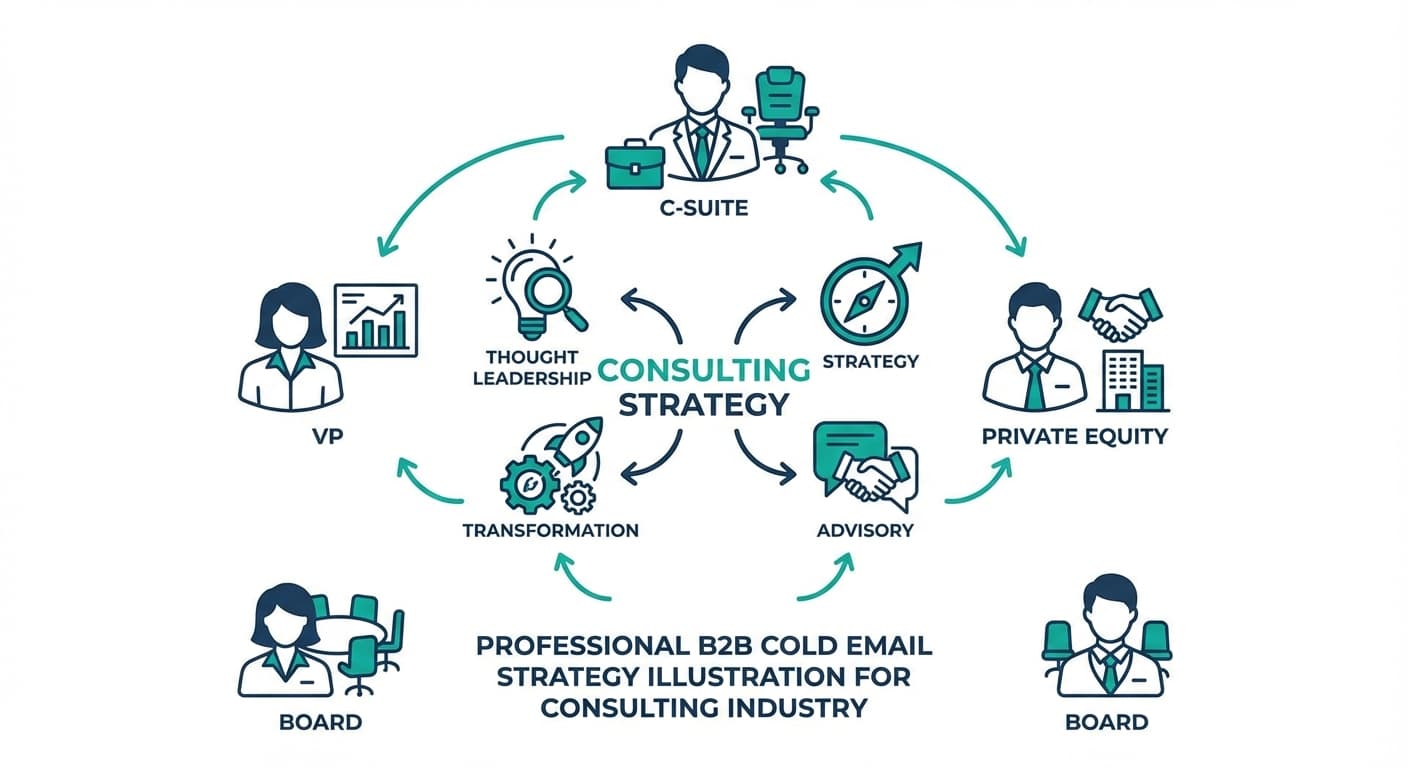
Cold email for consulting firms works when it leads with expertise to a small, researched list: an insight, a named problem or a piece of research, then a soft ask. Woodpecker's platform medians put cold email replies at 1.5% overall and 2.7% on campaigns of 50 prospects or fewer, the benchmark a consulting list should beat.
Key takeaways
- Lead with an insight, a named problem or your own research, position the firm as a peer rather than a vendor, and ask for a short conversation.
- Woodpecker's cold email data puts the median reply rate at 1.5% across campaigns and 2.7% for campaigns of 50 prospects or fewer.
- Mailboxes sending 1 to 20 emails a day reply at 2.0% in Woodpecker's data, four times the 0.5% of mailboxes sending 101 to 200.
- Email marketing for consultants is a newsletter to opted-in readers; cold email is a first message, and its volume and consent rules differ.
Reviewed and updated October 15, 2026
Consulting is a relationship business. Clients hire consultants because they trust their expertise, judgment, and ability to solve complex problems. This creates a unique challenge for cold email outreach: how do you establish credibility and trust with someone who has never heard of you?
The answer lies in strategic positioning. Cold email for consulting firms requires a different approach than selling software or commoditized services. You need to demonstrate expertise before asking for anything, position yourself as a peer rather than a vendor, and make it easy for prospects to take a low-commitment next step.
Appointment setting for consulting firms runs into the same requirement, because a meeting booked by somebody who cannot demonstrate that expertise arrives with the positioning still to do.
This guide covers the positioning, the targets and the consulting cold email templates that work, with the reply benchmarks a small, researched list should beat. One distinction first. Email marketing for consultants means a newsletter to people who opted in; cold email means a first message to someone who did not. The positioning and targeting below serve both, and the volume and consent rules do not transfer.
Why Cold Email Works for Consulting
Consulting is rarely bought on impulse: a client has a specific problem and looks for someone who has solved it before. Cold email, done well, puts the firm in front of them at that moment, for four reasons:
High deal values justify personalization. A $50,000 or $500,000 engagement makes it worthwhile to spend 15 minutes researching and writing a single email. The economics favor quality over volume.
Timing can be read. Acquisitions, new executives and expansions are public, and each opens a window.
Senior buyers are reachable. The people who approve consulting spend can be written to directly, and a message about their own situation is the kind they read.
Expertise can be demonstrated in writing. A well-written email that articulates a prospect's challenge and proposes a thoughtful approach demonstrates exactly the kind of thinking they would be paying for.
The Consulting Positioning Challenge
Consulting cold emails fail when they sound like every other vendor pitch: "helping companies grow" or "driving transformation" differentiates nothing. Position the firm on three dimensions.
1. Industry Expertise
Industry knowledge is the first thing a buyer checks for, so the email should show it.
Reference the sector's regulations, its common operational problems, its recent market shifts and the terms insiders use.
A consultant reaching out to healthcare organizations should discuss HIPAA compliance, value-based care transitions, or EHR integration challenges.
2. Functional Specialization
Beyond industry, name the function: strategy, operations, technology, human capital, finance, marketing or supply chain. A CFO reads an email about financial operations differently from a generic consulting pitch.
3. Methodology Differentiation
What makes your approach different? Do you use proprietary frameworks? Do you focus on implementation rather than just strategy?
A named way of working is what makes a firm hard to compare line by line with the next one.
Finding the Right Decision Makers
Consulting engagements need buy-in at more than one level, so know who initiates, who influences and who approves.
C-suite executives approve significant engagements and care about strategic outcomes: growth, efficiency, risk and competitive position. Lead with business outcomes rather than deliverables, reference priorities they have discussed publicly, keep it brief, and offer direct access to a senior partner.
Vice presidents and senior directors often identify the need and champion the engagement internally. Show you understand their function, offer to help build the internal business case, and expect a longer cycle while they build consensus.
Private equity partners and board members often drive consulting decisions at portfolio companies. Lead with portfolio-wide value creation, due diligence or post-acquisition support, and with their timeline and investment thesis.
Structuring Your Outreach
Consulting cold emails should demonstrate expertise and start a conversation rather than pitch services. Lead with an insight when you have one, with the problem when a trigger event or public signal points to it, and with your published research when it bears on their situation (never with confidential client material).
Insight-led
- An observation about their business or industry
- Your perspective on it
- Why your expertise is relevant
- A soft ask for a conversation
Problem-solution
- Name a problem they likely face
- Show why it is hard
- Hint at your approach
- Offer to share more in a short call
Thought leadership hook
- Something timely about their situation
- A piece of your research or thinking
- Your background in the area, briefly
- An invitation to discuss how it applies
Avoiding the Commoditization Trap
When an email reads like every other consultant's pitch, the firm loses pricing power.
What Commoditizes You
- Generic claims: "We help companies improve performance" says nothing
- List of services: Itemizing capabilities like a catalog positions you as interchangeable
- Price competition: Mentioning competitive rates signals commodity positioning
- RFP chasing: Responding to open requests puts you in a competitive pool
What Differentiates You
- Specific expertise: "We have worked with six regional healthcare systems on post-merger integration" is specific and credible
- Point of view: Sharing a perspective on an industry challenge demonstrates thought leadership
- Named methodology: Referencing a proprietary approach or framework signals unique value
- Selective positioning: Being willing to walk away from poor-fit opportunities signals confidence
Getting onto the Approved Vendor List
Many large buyers route consulting spend through a preferred or prime vendor list, where one firm holds the master agreement and others work beneath it. That gives outreach two routes: the sponsor who can bring a new firm through procurement, or the prime vendor already inside, who may need a specialist to subcontract. Either way the first email asks for a conversation, not a contract.
Project vs. Retainer Positioning
How you frame the engagement model affects who replies. Project work suits a prospect with one problem and no appetite for a long commitment: time-bound, clear deliverables, a low-risk first step. A sample line: "We typically start with a focused 4-6 week assessment to identify the highest-impact opportunities, then work with your team to prioritize implementation." If that first step is a free or low-cost assessment, cold email for audits covers how to frame the offer.
Retainers suit executives who want ongoing access to expertise, framed as fractional or on-demand strategic support. The common path runs from one to the other, and the outreach can say so: "Most of our relationships start with a specific project where we demonstrate value."
Consulting cold email templates
Example 1: Insight-Led Approach to CFO
Subject: Observation on [Company]'s recent acquisition
Hi [First Name],
[Company]'s announcement about acquiring [Target] is the reason for this note. Integration of financial operations post-acquisition is often where value creation either accelerates or stalls. The first 90 days typically determine whether synergy targets are realistic.
We lead integration work for mid-market acquisitions, with particular focus on finance function consolidation. One pattern we see repeatedly: companies underestimate the complexity of harmonizing financial close processes while overestimating technology synergies.
If you are thinking through integration priorities, we would be happy to share what we have learned about sequencing finance integration effectively. Would a brief conversation be useful?
Best, [Your name]
Example 2: Problem-Solution Approach to CEO
Subject: Growth planning question
Hi [First Name],
Companies in [industry] often hit a plateau around [Company]'s current scale. The operational approaches that worked to reach this point start creating friction.
We work with founder-led companies navigating this exact transition. The challenge is usually clarifying which problems are truly strategic versus operational, then building the right capabilities to address each.
If you are thinking about how to structure the next growth phase, we would welcome a conversation about what we have seen work at similar companies.
Best, [Your name]
Example 3: Thought Leadership Hook to VP Operations
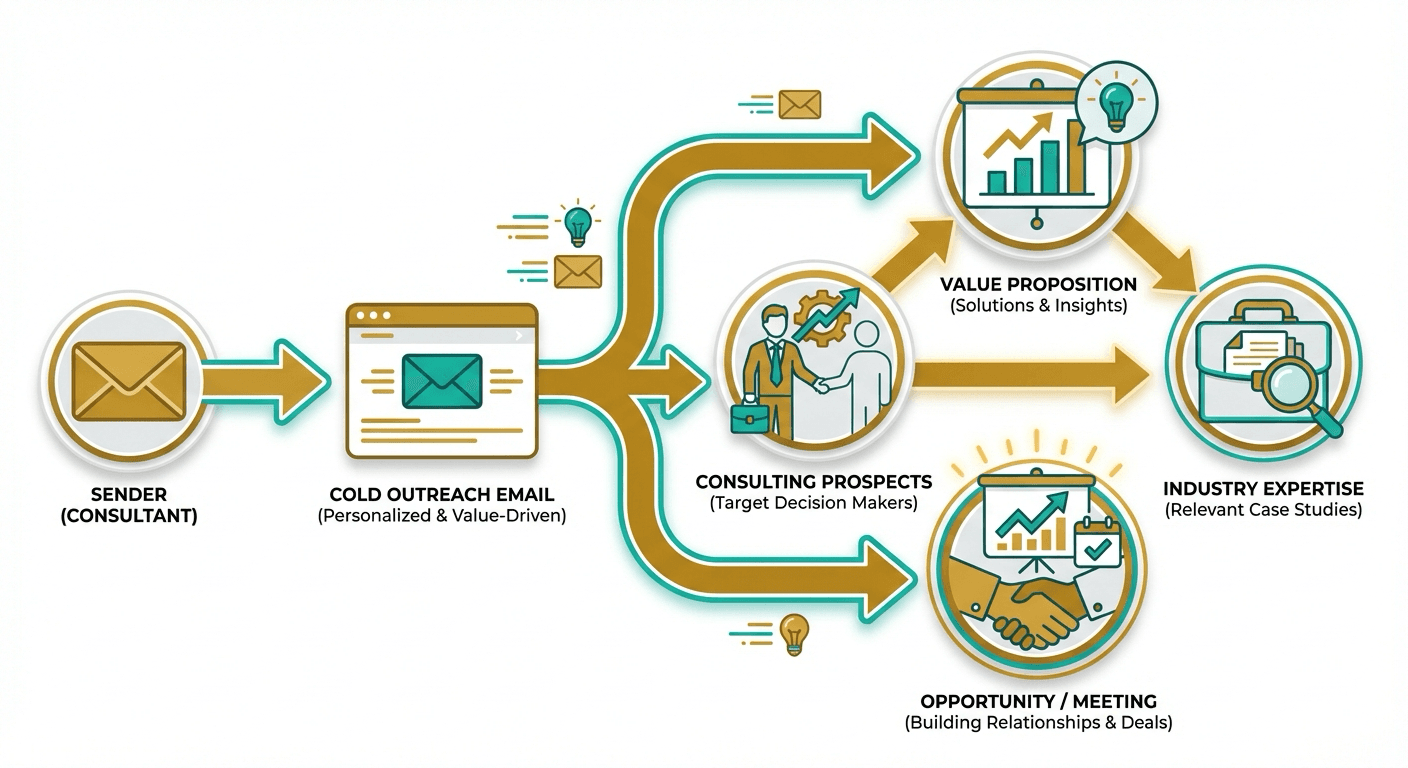
Subject: Framework that might be relevant
Hi [First Name],
[Company]'s recent expansion into [new market/region] caught our attention. This kind of geographic growth often surfaces unexpected operational complexity, particularly around supply chain and local compliance requirements.
We recently completed research on how mid-market companies scale operations across multiple regions. One finding stood out: [the finding, in one sentence, with the number behind it].
Happy to send the summary if it would help, and to compare notes if you are working through regional expansion now.
Best, [Your name]
Example 4: PE Portfolio Company Approach
Subject: Value creation in [sector] portfolio
Hi [First Name],
[PE Firm]'s acquisition of [Portfolio Company] is why this note is going to you. Companies in [sector] typically have significant operational improvement potential post-acquisition, particularly in [specific area].
We work with PE-backed companies on operational value creation. Our focus is usually on improvements that can be implemented within the first 12-18 months of ownership, directly impacting EBITDA and exit multiples.
If [Portfolio Company] is still in the operational assessment phase, we would welcome a conversation about where we have seen the highest-impact opportunities in similar businesses.
Best, [Your name]
Timing Your Outreach
Consulting needs follow predictable events, and outreach tied to one reads as relevant rather than random: mergers and acquisitions (integration support), new executive hires (a fresh look at priorities), regulatory changes, market disruptions and funding rounds (growth planning). Annual planning is the other window, because reaching a buyer before next year's budget is set puts the firm in consideration.
The same budget window decides when the phone can reach a buyer, and cold calling for consulting firms covers who picks up, what the call may say and why a partner-led firm's economics argue for a short list.
The Proposal Process
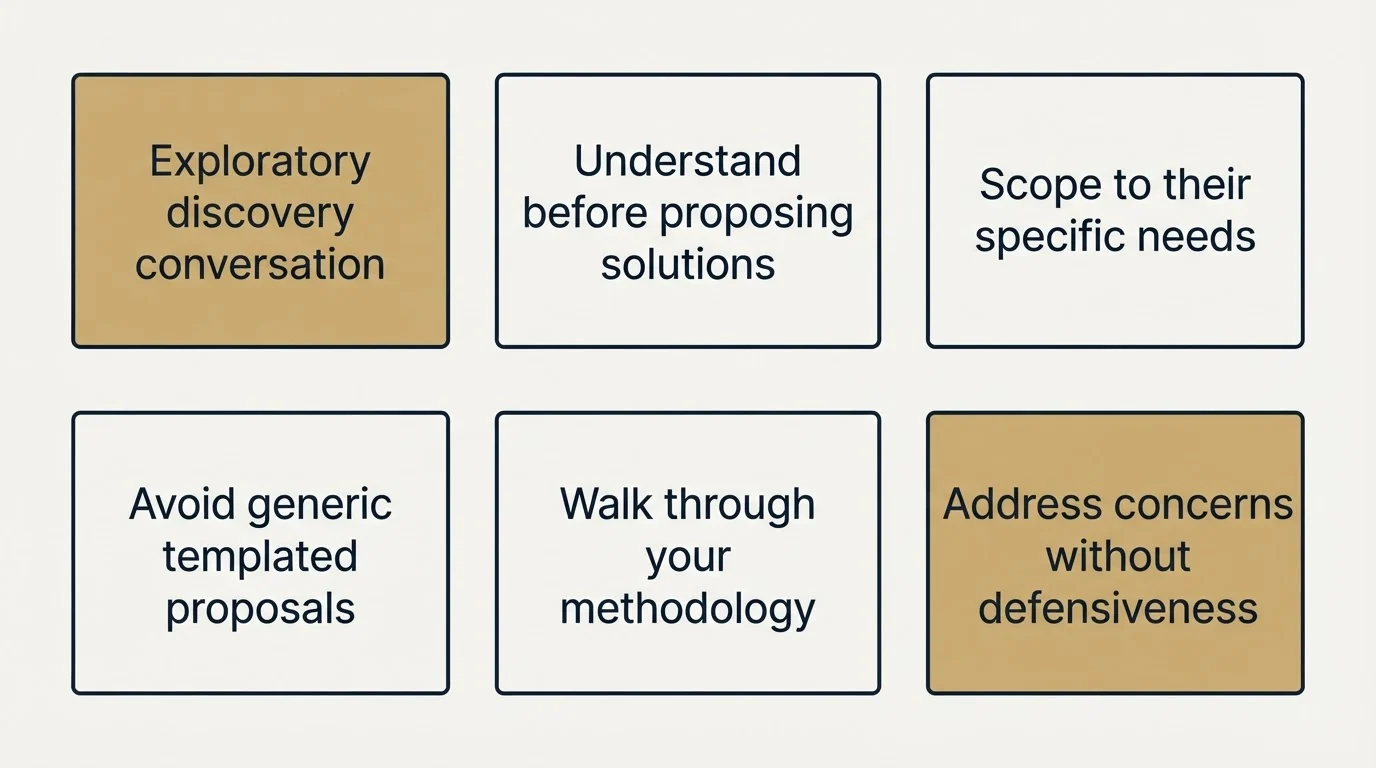
Cold email is the start of a relationship, not the close. The first conversation is discovery: understand the situation, challenges and priorities before proposing anything. The scope then follows from what discovery found rather than from a template, the presentation explains how the firm works as well as what it will deliver, and the common objections, price, timeline and the client's own capacity to support the work, are answered directly and without defensiveness.
Building a Sustainable Outreach Practice
Cold email should be one part of a broader business development system.
Consulting teams ready to scale their outreach systems can compare platforms in this guide to email sending tools for consultancies.
Consistency Over Volume
Small, researched batches beat large templated ones, and platform data shows the shape. In Woodpecker's cold email benchmarks, independent companies get a 2.7% median reply rate on campaigns of 0 to 50 prospects and 1.2% at 1,001 to 5,000, and mailboxes averaging 1 to 20 emails a day reply at 2.0%, four times the 0.5% of mailboxes sending 101 to 200 a day. Consulting deal values make the small end of both curves the right place to be.
Where we differ from standard practice
Much of the advice on this page reflects how outbound is commonly run. We run it differently, and since this page sits on our site it is worth saying where the difference is and what it costs us.
- A sequence of messages to each prospect over several weeks
- Later messages often land in the same email thread
- Every contact is reached more than once, so a distracted reader gets another chance
- The later messages go only to people who did not answer the first
- Reputation cost accrues on the sending domain across everything else it sends
- One message, then that campaign is finished for that contact
- No thread replies and no bumps
- More of the work moves into targeting and into the one message
- We reach each contact less often, and that is the cost we accept
The reasoning is mechanical rather than moral. A follow-up arrives underneath a message the recipient has already seen and chosen not to answer, so it is delivered to the population most likely to mark it as spam, and the reputation cost of that lands on the sending domain across every campaign running on it. We set that cost against the replies a sequence recovers and decided the trade was not worth it. The full argument, with the numbers from our own campaigns, is in why we stopped using follow-ups.
Follow-Up Discipline
Most consulting programmes plan three to four follow-ups over four to six weeks.
Measuring What Matters
Track response rates, conversation rates, and pipeline generated. But recognize that a single closed engagement may justify months of outreach effort.
Since tracking response and conversation rates matters so much, choosing the right system to manage that pipeline is worth attention, as covered in this guide to consulting-friendly CRM platforms.
Key metrics to monitor:
- Reply rates: Woodpecker's platform median is 1.5% across 56,614 campaigns, and 2.7% for independent companies' campaigns of 0 to 50 prospects. A small, researched consulting list should clear the second number.
- Open rates: a weak signal. Woodpecker's benchmark calls open rate "the noisier of the two, because tracking pixels get blocked or auto-loaded", as Apple Mail Privacy Protection does.
- Positive response rates: Track how many replies express genuine interest
- Meeting conversion: What percentage of positive replies become discovery calls
- Pipeline value: Total potential engagement value from outreach-generated opportunities
- Time to close: How long from first email to signed engagement
| Measure | Median | Sample |
|---|---|---|
| Reply rate, all campaigns | 1.5% | 56,614 campaigns |
| Reply rate, campaigns of 0 to 50 prospects | 2.7% | 8,336 campaigns |
| Reply rate, mailboxes sending 1 to 20 a day | 2.0% | 231 mailboxes |
| Reply rate, mailboxes sending 101 to 200 a day | 0.5% | 1,671 mailboxes |
| Open rate, all campaigns (noisy) | 26% | 37,000 campaigns |
A 50% open rate means nothing if nobody replies.
Common Mistakes to Avoid
Even experienced consultants make predictable errors in their cold outreach.
Talking About Yourself Too Much
Centering the message on the firm's credentials and capabilities is the commonest mistake. Lead with the prospect's challenges, not the firm's resume.
Being Too Vague
Generic language like "helping companies achieve their goals" communicates nothing. Specificity signals expertise. Instead of "we work with healthcare companies," try "we specialize in revenue cycle optimization for multi-site specialty practices."
Asking for Too Much Too Soon
Asking for a 60-minute strategy session in the first email creates friction; a 15-minute conversation to explore fit does not.
Sending the Same Email to Everyone
Templated emails scale, but the campaign-size curve above shows replies falling as lists grow, and personalization is what a small list pays for.
Giving Up Too Early
Many consultants send one or two emails, get no response, and move on. The common remedy is persistence through more follow-ups.
Neglecting Subject Lines
Your email cannot work if it never gets opened. In Woodpecker's data, subject lines of 20 to 29 characters have the best reply rate both in the US and elsewhere. Keep them specific, intriguing and professional. Avoid clickbait or sales language that triggers spam filters or skepticism.
Final Thoughts
Cold email for consulting firms requires a different mindset than typical sales outreach. You are not selling a product. You are starting a professional relationship.
Start with a small, well-researched list. Write emails that demonstrate your expertise. Give a non-responding audience a new premise rather than a reminder. Treat every conversation as the beginning of a potential long-term relationship.
A single engagement won through cold email can justify a year of outreach, which is what makes the patience worthwhile.
Related Reading
- Cold Email for Security Services: The Complete Guide
- Cold Email for Architecture Firms: 2026 Strategy Guide
If you would rather have this run for you, RevenueFlow books qualified meetings on a pay-per-meeting basis and publishes client results. The outbound sales agency page covers the whole engine, and how pay per meeting works covers the billing definition.
The examples and approaches in this guide represent general best practices. Your specific approach should be tailored to your firm's positioning, expertise, and target market.
Frequently asked questions.
Frequently asked questions- How do consulting firms use cold email?
- They write to a small, researched list of the executives who approve or champion consulting spend, and lead with expertise rather than a pitch: an observation about the prospect's business, a problem a trigger event points to, or relevant research. The ask is a short conversation, and the engagement is scoped only after discovery.
- What is a good consulting cold email template?
- An insight-led one: open with a specific observation about the prospect, such as an acquisition or an expansion, give the firm's perspective on what usually goes wrong, say briefly why the firm's experience is relevant, and ask whether a short conversation would be useful. Write it in the firm's voice and keep it to four short paragraphs.
- What reply rate should a consulting cold email campaign expect?
- Woodpecker's platform data puts the median cold email reply rate at 1.5% across 56,614 campaigns, and 2.7% for independent companies' campaigns of 0 to 50 prospects. A small, carefully researched consulting list should aim to clear the second figure, and open rates are too noisy to judge it by.
- Is email marketing for consultants the same as cold email?
- No. Email marketing for consultants means a newsletter or nurture sequence to people who opted in to hear from the firm. Cold email is a first message to someone who has not. Positioning and targeting carry across, but the volume, consent and deliverability rules each one runs under are different.
About the author.

Fernando Cao is CEO at RevenueFlow, which builds and operates outbound revenue engines for B2B companies. Previously at Accenture Strategy. Studied at University of Bath.
Fernando Cao · CEO
Connect on LinkedIn →Explore more.
Ready to scale your outreach?
We build GTM engines that book real meetings. See the receipts.
Related articles.
Cold Email for Telecom: Reaching Carriers and MSPs
Telecom companies face rapid technology changes and competitive pressures. Here's how to approach cold email outreach to carriers, MSPs, and UCaaS providers.
Cold Email for Architecture Firms: 2026 Strategy Guide
Architecture firms buy on project phases rather than fiscal quarters. How to build a list, time the spec window, and write cold emails principals answer.
Cold Email for Trucking and Fleet Companies: 2026 Guide
How to reach carriers, fleet operators, and safety buyers with cold email: FMCSA-driven list building, trigger timing, four templates, and compliance.
Cold Email for Cannabis Companies: 2026 Strategy Guide
The April 2026 rescheduling order split cannabis buyers into two tax realities. Here is how to segment, list-build, and write cold email for each.
Cold Email for Private Equity Firms: 2026 Strategy Guide
How to run cold email into private equity: mapping fund-level and portfolio-level buyers, list sources, four templates, and PE-specific deliverability rules.
Cold Email for Wealth Management Firms: 2026 Strategy Guide
RIAs are 16,500+ mostly small firms with public Form ADV data, small buying committees, and a compliance gate. How to run cold email into wealth management.