Cold Email for Audits: Complete Strategy Guide
How to offer a free audit or assessment in cold email: the offer, who to send it to, five templates, and how a delivered audit becomes paid work.
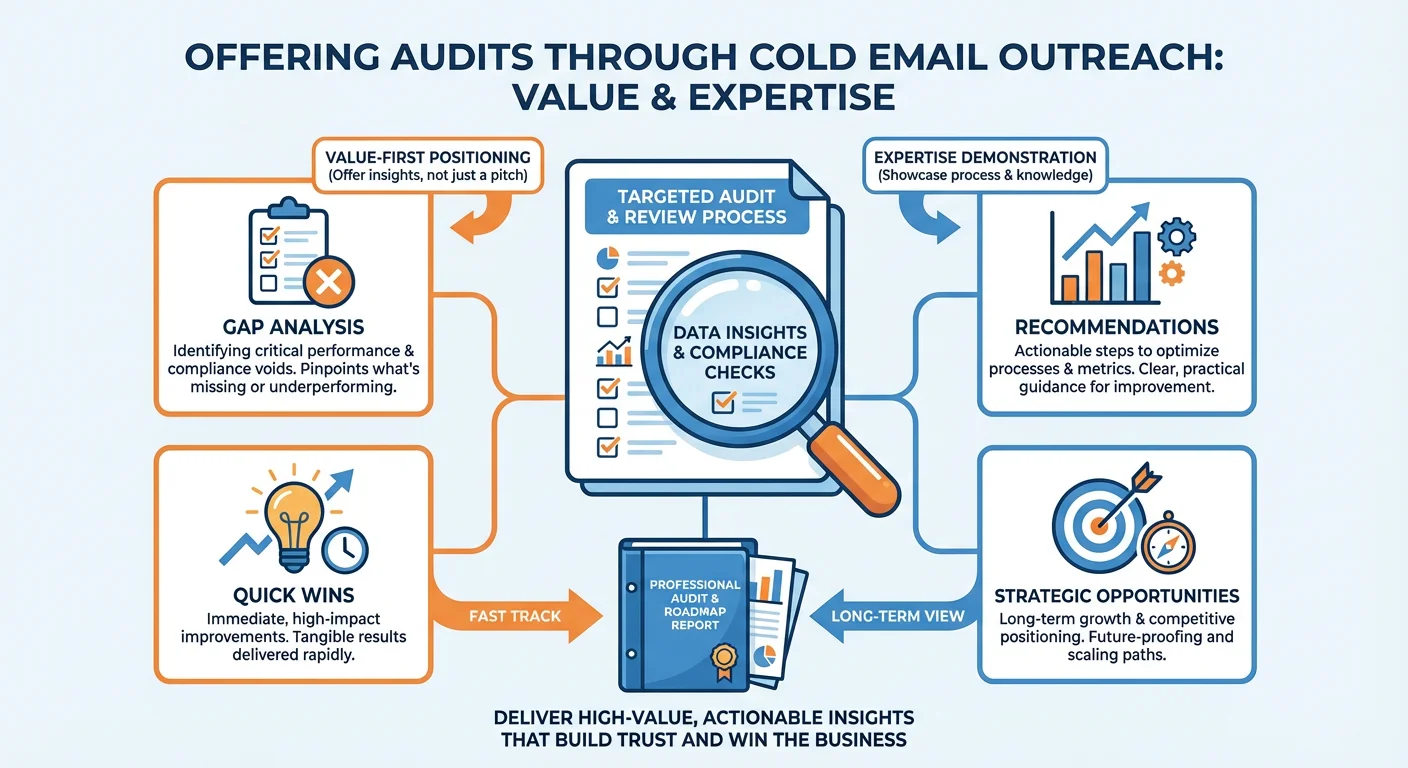
To offer a free audit or assessment in sales outreach, open with one specific observation about the prospect, name exactly what the audit covers and what they receive, make it useful even if they never hire you, and ask for a short call to scope it. Send it once. If it goes unanswered, return later with a different premise.
Key takeaways
- A free audit offer works when the prospect can see you have already looked: the observation is the one part of the email a competitor could not have sent.
- A strong audit has five parts: current state assessment, gap analysis, prioritized recommendations, quick wins and strategic opportunities.
- Do not send reminders about an unanswered audit offer, because a follow-up tells the prospect the first email was a campaign. Return later with a new premise.
- Selling belongs in the review call after delivery, never inside the audit, and the proposal should address the findings the prospect cared about most.
Reviewed and updated September 19, 2026
To offer a free audit or assessment in sales outreach, name one specific thing you have already noticed about the prospect, say exactly what the audit covers and what they will receive, make it useful even if they never hire you, and ask for one short call to scope it. That is the whole mechanism. This guide covers the audit offer itself, who to send it to, five audit email templates, and how a delivered audit turns into paid work.
How do you offer a free audit or assessment in sales outreach?
Lead with an observation, then make the offer concrete. A free audit works in cold email when the prospect can see you have already looked at their situation, when the deliverable is named, and when there is no obligation attached. An assessment described as "a quick chat about your needs" is a sales call with a different label, and prospects read it that way.
Subject: [Specific observation] at [Company]
"Looking at [Company]'s [website/platform/system], one thing stood out: [specific observation]." 1
"We specialize in [audit area] and would be happy to conduct a complimentary audit of [Company]'s [specific area]." 2
"The audit includes a full review of current state, a gap analysis, prioritized recommendations and quick-win opportunities." 3
"You'll receive a detailed report you can act on immediately, whether or not you decide to work with us." 4
"Would a 15-minute call to discuss your situation and schedule the audit be useful?" 5
- 1The observation: proof you have already looked, and the reason this email exists.
- 2The offer, in plain words, with the area named.
- 3The scope: what the audit covers, as a short list.
- 4Standalone value and no obligation, said once.
- 5One specific next step, a short call to scope it.
Why Cold Email Works for Audit Offers
An audit gives a prospect something useful before they pay anything, which lowers perceived risk. The work itself shows whether they have problems you can solve, and a good audit demonstrates your method better than any pitch. It also creates a natural series of conversations with someone who has chosen to engage: the scoping call, the delivery and the review. Most of your competitors send a description of their services. An audit offer is a piece of help, and it reads differently.
Defining Your Audit Offer
Before any outreach you need an audit that delivers real value and that you can deliver repeatedly.
Scope. A tightly focused audit is easier to deliver and to describe. A comprehensive one is worth more and costs more of your time. Decide how many hours each audit gets, because that sets your capacity as well as the perceived value, and decide whether the deliverable is a written report, a video walkthrough or a live presentation.
Audit Structure
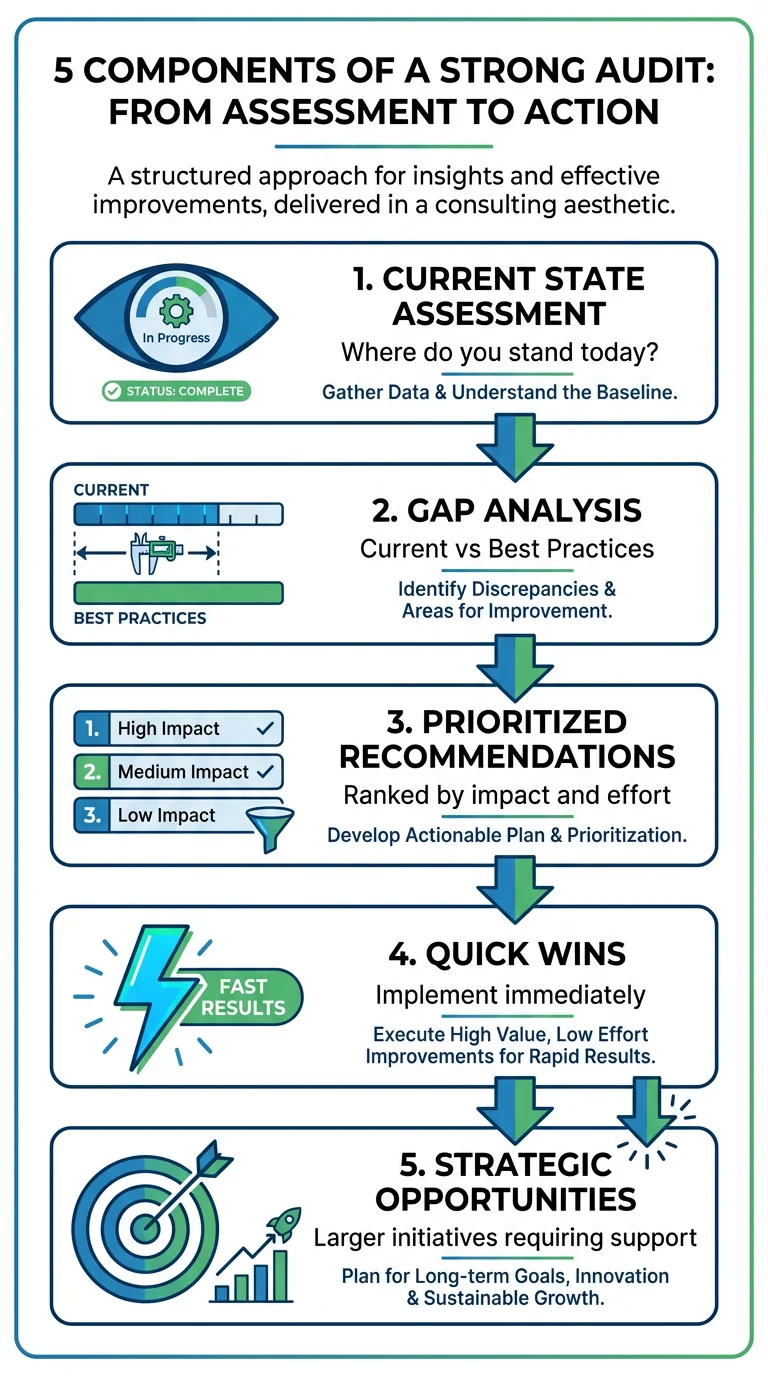
A strong audit has five parts: a current state assessment, a gap analysis against best practice or competitors, prioritized recommendations ranked by impact and effort, quick wins they can implement without you, and the larger strategic opportunities where professional support would help.
Positioning. The audit should be useful even if they never hire you, and you should say so. Make clear there is no obligation, position it as access to specialist expertise, and promise specific recommendations instead of vague observations.
Identifying Ideal Audit Prospects
Audits take time, so targeting decides whether the investment produces real opportunities.
The company. Large enough to have the problems your audit addresses and the resources to fix them. Growing companies often have infrastructure that has not kept pace. Look for visible indicators of an audit-worthy problem, such as an outdated website, security issues or poor reviews.
The contact. The person who owns the area you are auditing: marketing for an SEO audit, IT for a security audit. They should be able to authorize improvements, and be open to an outside view.
The timing. Leadership changes, funding rounds, competitive losses and regulatory changes all prompt evaluation. Budget cycles and planning periods affect receptivity too.
Building Your Audit Prospect List
LinkedIn Sales Navigator, ZoomInfo and Apollo provide filtered company and contact lists. BuiltWith and Wappalyzer reveal technology stacks that can indicate an audit opportunity. Review sites, public filings in regulated industries, conference attendee lists and award entries all surface engaged companies.
The research is what makes the offer land. For each prospect, note what you can observe about their online presence in your audit area, what reviews and news tell you, how they compare with competitors, and whether anything changed recently that makes an audit timely. Verify every address before sending, with a service such as NeverBounce or ZeroBounce, and remove risky addresses.
Crafting Audit Cold Emails
Subject lines should create interest without misleading. Patterns that work: "Free [Type] audit for [Company]", "[Specific observation] at [Company]", "Quick [Type] review, no strings attached". Avoid subjects that do not match the content, salesy language, and all caps.
The tone is helpful rather than salesy, confident about the expertise on offer, curious about their situation, and free of pressure. The observation carries the most weight, because it is the only part a competitor could not have sent.
Audit Email Templates

Each template is one message. Replace every bracket with a real detail, use only results you can evidence, and cut any line you cannot fill truthfully.
Template 1: Observation-Based
Subject: [Specific observation] at [Company]
Hi [Name],
Looking at [Company]'s [website/platform/system], one thing stood out: [specific observation]. This is common with [type of company], and it typically [consequence of issue].
We specialize in [audit area] and would be happy to conduct a complimentary audit of [Company]'s [specific area]. The audit includes:
- [Component 1: e.g., Full review of current state]
- [Component 2: e.g., Gap analysis against best practices]
- [Component 3: e.g., Prioritized recommendations]
- [Component 4: e.g., Quick-win opportunities]
You'll receive a detailed report you can act on immediately, whether or not you decide to work with us on implementation.
We've done similar audits for [client type or example], and they typically uncover [type of insight].
Would a 15-minute call to discuss your situation and schedule the audit be useful?
Best, [Your Name] [Title/Company]
Template 2: Problem-Focused
Subject: [Type] audit for [Industry] companies
Hi [Name],
Most [industry] companies we talk to are dealing with [common challenge]. The issue often starts with [root cause] and compounds over time.
We offer a complimentary [type] audit that identifies exactly where problems exist and what to do about them. The audit covers:
- [Audit component 1]
- [Audit component 2]
- [Audit component 3]
At the end, you'll have a clear picture of your current state and a prioritized action plan. Many companies implement the quick wins immediately and see improvement within [timeframe].
We've conducted [number]+ audits for [company type], including [client example]. Would it be helpful for [Company]?
If so, let's schedule a brief call to discuss your specific situation. [Calendar Link]
[Your Name] [Title/Company]
Template 3: Competitive Context
Subject: How [Company] compares to [Industry] leaders
Hi [Name],
We've been analyzing [type of performance/systems] across [industry] companies, and some patterns stand out.
Companies leading in [relevant metric] tend to [common characteristic]. Those struggling often share [common weakness].
We'd be happy to conduct a complimentary [type] audit for [Company] that shows exactly where you stand relative to industry best practices and top performers. You'll receive:
- Benchmarking against [number] key metrics
- Gap analysis vs. industry leaders
- Specific recommendations prioritized by impact
- Implementation roadmap
No sales pitch, just useful analysis you can act on.
Interested? A 15-minute call is usually enough to scope the audit properly. [Calendar Link]
[Your Name] [Title/Company]
Template 4: Trigger-Based
Subject: [Type] audit timing for [Company]
Hi [Name],
Congratulations on [trigger event: funding, acquisition, new role, expansion]. That's exciting news.
These transitions are often the perfect time for a [type] audit. The processes and systems that worked before [trigger] may need adjustment for [new reality].
We offer a complimentary audit that assesses your current state and identifies what needs to change. The audit covers [scope] and delivers [specific deliverable].
Companies in similar situations have used these audits to [specific outcome]. [Client example] found that [specific insight] after their [similar trigger].
Would an audit be useful for [Company] right now? Happy to discuss in a 15-minute call.
[Your Name] [Title/Company]
Template 5: Risk-Focused
Subject: [Type] risks at [Company]
Hi [Name],
[Industry] companies face increasing [type of risk] threats, and many don't realize their exposure until problems occur.
We conduct complimentary [type] audits that identify vulnerabilities and prioritize remediation. The audit covers:
- [Risk area 1]
- [Risk area 2]
- [Risk area 3]
You'll receive a risk assessment with clear recommendations, not a generic checklist. [One finding from your own audits that you can evidence. If you have none yet, cut this line.]
Would it be valuable to know where [Company] stands? We can explain the audit process in a quick 15-minute call.
[Your Name] [Title/Company]
Where we differ from standard practice
Most outbound programs send a sequence of messages to each prospect over several weeks. We send one message per campaign, with no thread replies and no bumps, and since this page sits on our site it is worth saying what that costs us: we reach each contact less often, and more of the work moves into targeting and into the one message.
The reasoning is mechanical rather than moral. A follow-up arrives underneath a message the recipient has already seen and chosen not to answer, so it is delivered to the population most likely to mark it as spam, and the reputation cost of that lands on the sending domain across every campaign running on it. We set that cost against the replies a sequence recovers and decided the trade was not worth it. The full argument, with the numbers from our own campaigns, is in why we stopped using follow-ups.
When the audit offer goes unanswered

An earlier version of this guide recommended a sequence of follow-up emails. We no longer do that, for the reason above, and an audit offer is an especially poor candidate for a reminder: "following up on my free audit" tells the prospect that the first email was a campaign, which undoes the impression that you had looked at them in particular.
Silence usually means the observation did not land. So the next approach, weeks later and in a new thread, is a new offer with its own premise.
Three premises are worth building a later campaign on. A different observation, because the first one may simply not have been their priority. A different audit angle, such as the risk-focused template where the first approach was competitive. Or the benchmarking value by itself: how they compare with the other companies you have assessed is useful to them whether or not anything is wrong.
Converting Audits to Engagements
The audit is the start of the sales process. Once somebody has accepted one, you are in a conversation they chose, and the work is to make it worth their time.
Audit delivery. A superficial audit undermines trust, so invest the time. Present findings live where you can, because it allows discussion. Emphasize the findings that match their stated concerns, and set out what they could do themselves and where professional help would add value.
The review call. Do not just send the document. Schedule time to go through it, listen for which findings concern them most and why, and find out whether acting on them is a priority this quarter. If there is fit, propose a specific engagement for those findings.
Those who do not convert. People who accepted an audit have a relationship with you, so staying in touch is welcome: share useful content, watch for trigger events that reopen the conversation, and ask whether they know someone else who would benefit.
Measuring Audit Campaign Success
Track three layers. For the outreach: emails delivered, reply rate and audit booking rate. For the audits: how many you delivered, how many led to a proposal, and how many became engagements. For the business: revenue from audit-sourced clients, average engagement value, time from audit to close, and the return on the hours you spent auditing. Judge your rates against your own previous campaigns, because a target quoted without its source tells you nothing about your market.
Common Mistakes to Avoid
Audit scope creep. Define clear boundaries or you will spend too much time on free work.
Selling during the audit. Deliver value. Selling comes in the review call.
Generic audits. Templates save time, but each audit has to reflect the specific prospect.
Delayed delivery. Delays signal disorganization and lose momentum.
A weak review call. Delivery is the beginning. Plan the conversation that follows it before you send the report.
Underselling recommendations. Be clear about what implementation requires and where your help would add value.
Start Booking Audits
A free audit is one of the most useful offers a service provider can put in a cold email, because it is help the prospect can evaluate before spending anything. The templates here are a foundation. What decides the result is an observation that is true, an audit that is worth having, and a review call that starts from their priorities.
If you're looking to scale your audit outreach without building an internal team, RevenueFlow can help. Our done-for-you cold email campaigns apply these principles to generate audit requests for professional services firms.
Get Your Free Campaign and start filling your audit calendar today.
Related Reading
Frequently asked questions.
Frequently asked questions- How do you offer a free audit in a cold email?
- Open with one specific thing you noticed about the prospect's website, system or results. Then say plainly what the complimentary audit covers and what they will receive, state that it is useful whether or not they hire you, add one line of relevant experience, and ask for a short call to scope it. Keep the whole email to a handful of short paragraphs.
- What should a free assessment include to be worth accepting?
- Five parts: an assessment of where they stand today, a gap analysis against best practice or competitors, recommendations prioritized by impact and effort, quick wins they can implement without you, and the larger opportunities where professional support would help. It should have standalone value, with specific recommendations instead of vague observations, and carry no obligation.
- Should I follow up if nobody replies to my audit offer?
- Not with a reminder. A message that follows up on a free audit tells the prospect the first email was part of a campaign, which undoes the impression that you looked at them in particular. Wait, then send a new first message in a new thread with a different premise: another observation, another audit angle, or benchmarking.
- How do I turn a free audit into a paying client?
- Deliver it promptly and well, then hold a review call instead of only sending the document. Listen for which findings concern them most, find out whether acting on them is a priority, and if there is fit propose a specific engagement for those findings. Keep selling out of the audit itself, because a superficial or salesy audit undermines trust.
About the author.

Ben Carden is CRO at RevenueFlow, which builds and operates outbound revenue engines for B2B companies. Previously at Gartner Enterprise. Studied at London School of Economics.
Ben Carden · CRO
Connect on LinkedIn →Explore more.
Ready to scale your outreach?
We build GTM engines that book real meetings. See the receipts.
Related articles.
Cold Email for Affiliate Recruitment: Strategy Guide
Master cold email outreach to recruit high-performing affiliates who can drive significant revenue for your business with proven templates and strategies.
Cold Email for Reseller Partnerships: Strategy Guide
Learn how to use cold email to recruit resellers and channel partners who can expand your market reach and drive revenue through their existing customer relationships.