Sales Prospecting for Energy Companies: The Regulator's List
Prospecting for a retail energy supplier, broker or efficiency seller: the eligible customer list, the state's choice map, building grades, the triggers and the licence.
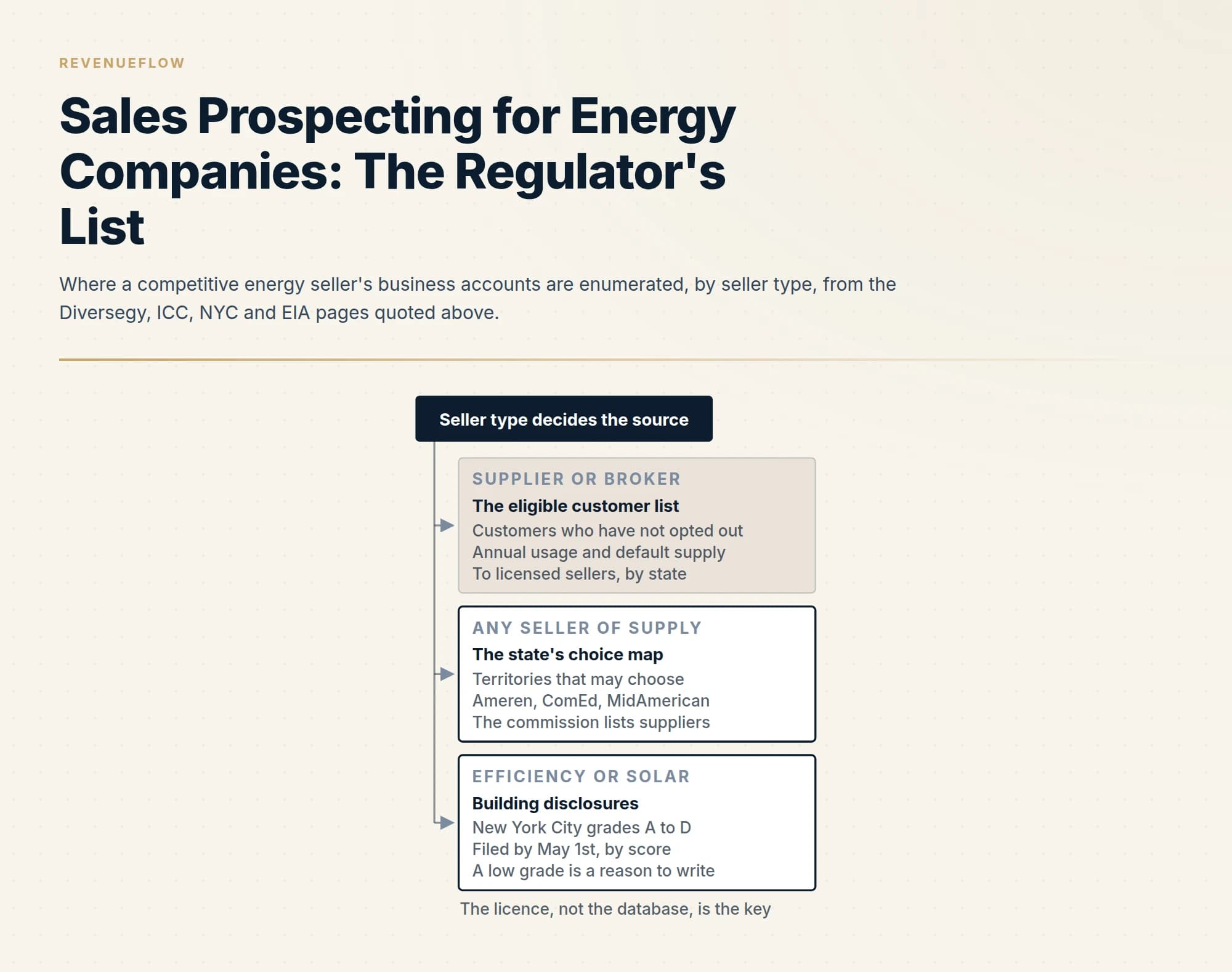
A competitive energy seller's business accounts are enumerated on the regulator's eligible customer list, which several states grant to licensed suppliers and brokers with usage, rate class and default-supply status per row; on the state's map of which territories may choose a supplier; and, for efficiency and solar sellers, on a city's building grades. The contract end is the trigger.
Key takeaways
- Diversegy's guide says several states grant licensed brokers and suppliers access to the eligible customer list, showing every customer not opted out in a utility with annual usage, rate class and whether it is still on default supply.
- The Illinois Commerce Commission says consumers in the Ameren Illinois, ComEd and MidAmerican territories may choose their supplier, and it lists certified alternative retail electric suppliers and the certification rule.
- New York City's benchmarking law requires covered building owners to submit energy and water data by May 1st each year and assigns letter grades from the resulting scores, a listed reason to write for an efficiency seller.
- Sales Focus's guide, updated 1 July 2026, names contract renewal periods, seasonal rate changes and extreme-weather surges as the switching windows, and says a pitch in a regulated state is wasted effort.
Reviewed and updated September 21, 2026
An energy broker's prospect list has a property no other seller's list has: in the states that publish it, the list already exists, with every commercial customer's annual usage and whether it is still on the utility's default supply, and it is handed to licensed suppliers and brokers by the commission. A retail energy seller who builds a list from a business database is rebuilding, worse, a file the regulator maintains. Prospecting in this trade is mostly the work of knowing which lists exist, who may see them, and what makes a business on them a prospect this month.
This page is prospecting for the energy company: the retail electricity or gas supplier, the energy broker or consultant, and the commercial solar or efficiency seller, prospecting business accounts. It is written for the people inside the energy seller, not for vendors selling to energy companies, and not for a utility; utilities buy through proceedings and are a different reader. It covers where business accounts are enumerated, the trigger events that make one a prospect, the calendar, the rules that are specific to selling supply, and when cold prospecting is the wrong play. The general method is in sales prospecting and prospecting methods and is not repeated; a vendor selling into utilities is the cold email for utilities reader. Every outside page below was fetched on 21 September 2026 and is dated where it publishes a date.
What a search for this returns
Six of the ten pages name energy. Diversegy, an energy brokerage, publishes the on-point piece, how an energy broker makes an effective prospect list; Sales Focus and Leadbeam sell outsourced sales and field tools to energy sellers; FirstSales publishes a renewable-energy prospecting guide; a sales forum thread asks whether anyone has sold energy by cold calling, and it refused every fetch from here; a video was left unread. The other four are generic prospecting guides, one of them twice. Only the brokerage's piece names the list the regulator keeps.
Where business accounts are enumerated
The eligible customer list. Diversegy's guide, dated 17 January 2022, describes the source that reorganises the trade: "If you are working under a licensed broker, or have a license yourself, several states will grant you access to the Eligible Customer List (ECL). This list displays all commercial and residential customers, who have not opted-out, in a particular utility", and lists what each row carries, "annual energy usage ( kWh or CCF) rate classes and codes account name service address information default supply or third part supply verification and more" (Diversegy, energy broker sales: how to make an effective prospect list). The same guide names the sort that turns the file into a plan: "you can sort the list by customer type, annual usage, and even find out if customers are still with the local utility on default supply". That is a brokerage's description of a regulator's file, quoted as such; which states grant access, to whom, and on what terms is on each commission's own page, and the licence is the condition.
The state's own map of who may choose. Whether a business can choose its supplier at all is a fact per state and per utility territory, and the commissions state it. The Illinois Commerce Commission's page says "Electric consumers in the Ameren Illinois, ComEd, and MidAmerican service territories are able to choose who provides the supply portion of their electric service. Electric supply may be sold either by the public utility or an Alternative Retail Electric Supplier (ARES)", and it links the list of certified suppliers, the certification application and the rule under which they are certified (ICC, alternative retail electric suppliers, as fetched). Diversegy's list of deregulated states, dated 28 April 2026 on its page, names Texas, Pennsylvania, Ohio, New Jersey, New York, Illinois, Connecticut, Maryland, Delaware, Massachusetts, Maine, New Hampshire, Rhode Island, Virginia in part, and the District of Columbia as states with deregulated electricity markets (Diversegy, deregulated energy states); Sales Focus's guide, updated 1 July 2026, adds the point that matters for a list: "Territory planning has to start from deregulation status, right down to the customer class that is actually eligible" (Sales Focus). Both are vendors' summaries; the commission's page is the source for any one state.
The building's own disclosures, for the efficiency and solar seller. New York City's benchmarking law "requires owners of buildings that meet the criteria outlined in the law to annually measure their energy and water consumption through a process called benchmarking", using the EPA's Energy Star Portfolio Manager, with data submitted "by May 1st of every year", and a later local law assigns letter grades from those scores: an A for a score of 85 or more, a B for 70 to under 85, a C for 55 to under 70 (NYC Department of Buildings, benchmarking, as fetched). A city that grades its buildings has published a list of the buildings that scored badly, which is the efficiency seller's account list with the reason attached. The federal picture behind it is the EIA's survey: "the estimated 5.9 million U.S. commercial buildings consumed 6.8 quadrillion British thermal units of energy and spent $141 billion on energy in 2018", with electricity and natural gas the main sources (EIA, CBECS, 2018 survey results as fetched).
The triggers, and the calendar they make
Sales Focus's guide names the three windows: "Energy demand and switching behavior both spike around predictable points: contract renewal periods, seasonal rate changes, and extreme-weather demand surges", adds that "U.S. residential electricity use routinely peaks in summer and winter, and switching interest tends to follow the bill", and argues that a push aligned to those windows, "when prospects are already thinking about their energy costs", beats a campaign on an internal calendar; the weather surge is the one window nobody schedules. The first of the three is the one a list can carry. A business on a fixed supply contract is a prospect in the months before the contract ends and a name the rest of the term, which is why the eligible customer list's default-supply field matters: an account still on default supply has no contract end at all, and is a prospect now.
The efficiency and solar seller has a dated trigger of its own in the tax code. The Internal Revenue Service's page on the energy efficient commercial buildings deduction says "Building owners who place in service energy efficient commercial building property (EECBP) or energy efficient commercial building retrofit property (EEBRP) may be able to claim a tax deduction", that "The deduction is allowed under Internal Revenue Code (IRC) Section 179D", and that "Beginning Jan. 1, 2023, the deduction is available to" owners of qualified commercial buildings and designers of such property in buildings owned by specified tax-exempt entities (IRS, energy efficient commercial buildings deduction, as fetched). A deduction with a placed-in-service test puts the buyer's tax year on the seller's calendar.
The rules that are specific to selling supply
A retail supplier or broker is a licensed or certified seller in most choice states, and the commission that certifies it also sets its conduct. The Illinois page above links the certification application, the certification rule and a licence-or-permit bond template for in-person solicitation, and it lists filing requirements for certified suppliers; a seller that prospects in Illinois reads that page before it reads a list. Diversegy's own description of the eligible customer list ties access to the licence, "If you are working under a licensed broker, or have a license yourself", which is the practical meaning of the rule for prospecting: the list is a licensed seller's tool, and an unlicensed seller who obtains it has a problem before it makes a call.
The consumer boundary sits close to this trade and this page stays on the business side of it. The eligible customer list includes residential customers, and residential door-to-door and telephone selling of supply is governed by the commission's consumer rules and the federal calling rules; those are outside this page's scope, and the federal calling rules for a business line are quoted in what cold calling is and which rules apply. Nothing here is legal advice, and the commission's current page is the source for any state.
| Activity | Where the rule sits | What it means for the list |
|---|---|---|
| Selling supply in a choice state | The commission's certification rule and application | Certified first; the commission lists certified suppliers |
| Obtaining the eligible customer list | The state's grant of access to licensed sellers | A licensed seller's tool, not a business database |
| In-person solicitation | A bond template on the Illinois page | Read the page before prospecting in person |
| Residential customers on the list | Consumer rules, outside this page | Outside a business campaign |
What the trade says against it
The trade's own voice on prospecting is the brokerage's, and it is candid about the difficulty: "Selling deregulated energy to commercial customers is not always easy. And, finding the right prospects is the hardest part of the job", from the same Diversegy guide. Its companion piece on cold prospecting, also dated 17 January 2022, calls cold prospecting "an artform that only the most successful sales professionals have mastered" (Diversegy, commercial energy sales: how to effectively cold prospect). Sales Focus, selling outsourced sales to the same reader, states the objection that decides most campaigns in one line: "In regulated states, the same pitch is wasted effort, because the prospect has no supplier choice to make."
Read together, the objections are about the list rather than the message: the wrong state, the wrong customer class, an account mid-contract, or a residential row in a business campaign. Each is a field on the regulator's file.
When cold prospecting is the wrong play
Four cases. The regulated territory, where Sales Focus's line applies and no message creates a choice the customer does not have. The mid-contract account, which is a name until the months before its end. The residential row, which belongs to a different set of rules and a different page. And the unlicensed seller, for whom the eligible customer list is not available and prospecting supply is not yet permitted; certification comes first.
RevenueFlow runs email and LinkedIn for clients, one message per campaign with no follow-up bumps, so the reason to write has to be a dated fact: a contract end, a benchmarking grade, a placed-in-service year. If you would rather have the choice map, the list fields and a first message prepared for a licensed seller, see what a first campaign would target.
Three openers, each on a fetched fact
Each opener below is one message, sent once, to one person; each rests on a page quoted above, names no real recipient and makes no claim about results. The companies and buildings in them are invented for illustration.
The first is built on the eligible customer list's default-supply field as Diversegy describes it, and is for the finance lead at a business still on the utility's default rate.
{{first_name}}, the utility's list shows {{company}} taking supply at the default rate, which means there is no contract end to wait for. We are a supplier certified in {{state}} and we would like to quote a fixed term against that rate. If you would send the most recent bill, we will return one page with the two numbers side by side and the date a fixed term could start.
The second is built on New York City's benchmarking grades and is for the owner of a building that received a low grade.
{{first_name}}, {{building}} was assigned a {{grade}} in the city's benchmarking grades this year, from the energy data filed by the May 1st deadline. We retrofit buildings of that type in {{borough}} and would like to look at what moved the score. If the retrofit is already planned, tell us and this is the only note; if not, thirty minutes with our engineer is yours.
The third is built on the IRS description of the commercial buildings deduction and is for the finance lead at a company planning a lighting or envelope project.
{{first_name}}, the deduction for energy efficient commercial building property turns on the year the property is placed in service, per the IRS's own page. If {{company}}'s {{project}} is scheduled for this tax year, the placed-in-service date is worth fixing before the design is final. Our team does the energy modelling that the deduction requires; would twenty minutes with them before the schedule is set be useful?
The short version
A competitive energy seller's business accounts are enumerated on the regulator's file, the eligible customer list that several states grant to licensed suppliers and brokers, with usage, rate class and default-supply status on every row; on the state's own map of which territories may choose, which Illinois states for three utilities and lists its certified suppliers; and, for the efficiency and solar seller, on a city's building disclosures and grades. The triggers are the contract end, the benchmarking deadline, the seasonal peaks the bill follows, and the tax year a placed-in-service test creates. The licence is the key to the list and the rule on the seller; the residential row and the regulated territory are the places to leave alone.
Frequently asked questions.
Frequently asked questions- Where do energy brokers get their prospect lists?
- In the states that publish one, from the regulator. Diversegy's guide says several states grant licensed brokers and suppliers access to the eligible customer list, which shows all commercial and residential customers who have not opted out in a utility, with annual usage, rate classes, account name, service address and whether the customer is still on default supply. Which states grant it, to whom and on what terms is on each commission's own page.
- Which states allow businesses to choose their energy supplier?
- The commission for each state says so for its own territories. Illinois's commission states that consumers in the Ameren Illinois, ComEd and MidAmerican service territories may choose who supplies their electricity, from the utility or a certified alternative retail electric supplier. Diversegy's April 2026 list names Texas, Pennsylvania, Ohio, New Jersey, New York, Illinois, Connecticut, Maryland, Delaware, Massachusetts, Maine, New Hampshire, Rhode Island, Virginia in part and the District of Columbia.
- When is the best time to prospect a business for an energy contract?
- In the months before its supply contract ends, and immediately if it is still on default supply, since that account has no contract end to wait for. Sales Focus names contract renewal periods, seasonal rate changes and extreme-weather demand surges as the windows when prospects are already thinking about energy costs. For efficiency and solar sellers, a city benchmarking deadline and the tax year a placed-in-service test creates are dated triggers too.
- Do you need a licence to sell energy to businesses?
- In most choice states a supplier or broker is certified or licensed by the commission, and the same commission sets its conduct. Illinois links its certification application, the certification rule and a bond template for in-person solicitation from its suppliers page. Diversegy ties access to the eligible customer list to holding a licence or working under a licensed broker. Residential selling sits under consumer rules outside this page, and nothing here is legal advice.
About the author.

B2B cold email experts helping companies generate qualified leads through done-for-you outreach campaigns.
RevenueFlow Team
Explore more.
Ready to scale your outreach?
We build GTM engines that book real meetings. See the receipts.
Related articles.
Sales Prospecting for Consulting Firms: Find the Event
Prospecting for a consulting firm: where triggers are published by practice, who inside the firm reads them, why alumni and referrals come first, when to skip it.
Sales Prospecting for Utilities: Read the Filings First
Prospecting utilities from the proceedings that announce their spend: rate cases, resource plans and procurement decisions, who owns each, and the supplier gate.
Sales Prospecting for SEO Agencies: Four Public Signals
How an SEO agency builds its own prospect list from signals Google documents: the index check, position, core update dates and site moves, under the warning owners read.
Sales Prospecting for Health Systems: The Public Record
Where health systems are written down in public: the Medicare cost report, the facility list a non-profit system files, and the two gates that follow qualification.
Physician Email Lists: The Row, Its Sources and Its Gaps
The anatomy of a physician email list: the six field groups, which CMS, AMA and state board records hold each, what vendors claim, the rules, and the order to verify.
B2B Lead Lists for Travel Agencies: Registers and Gaps
The travel trade is written down in state consumer protection registers, not industry directories, and an exemption inside one decides who is missing from your file.