Sales Prospecting for Utilities: Read the Filings First
Prospecting utilities from the proceedings that announce their spend: rate cases, resource plans and procurement decisions, who owns each, and the supplier gate.
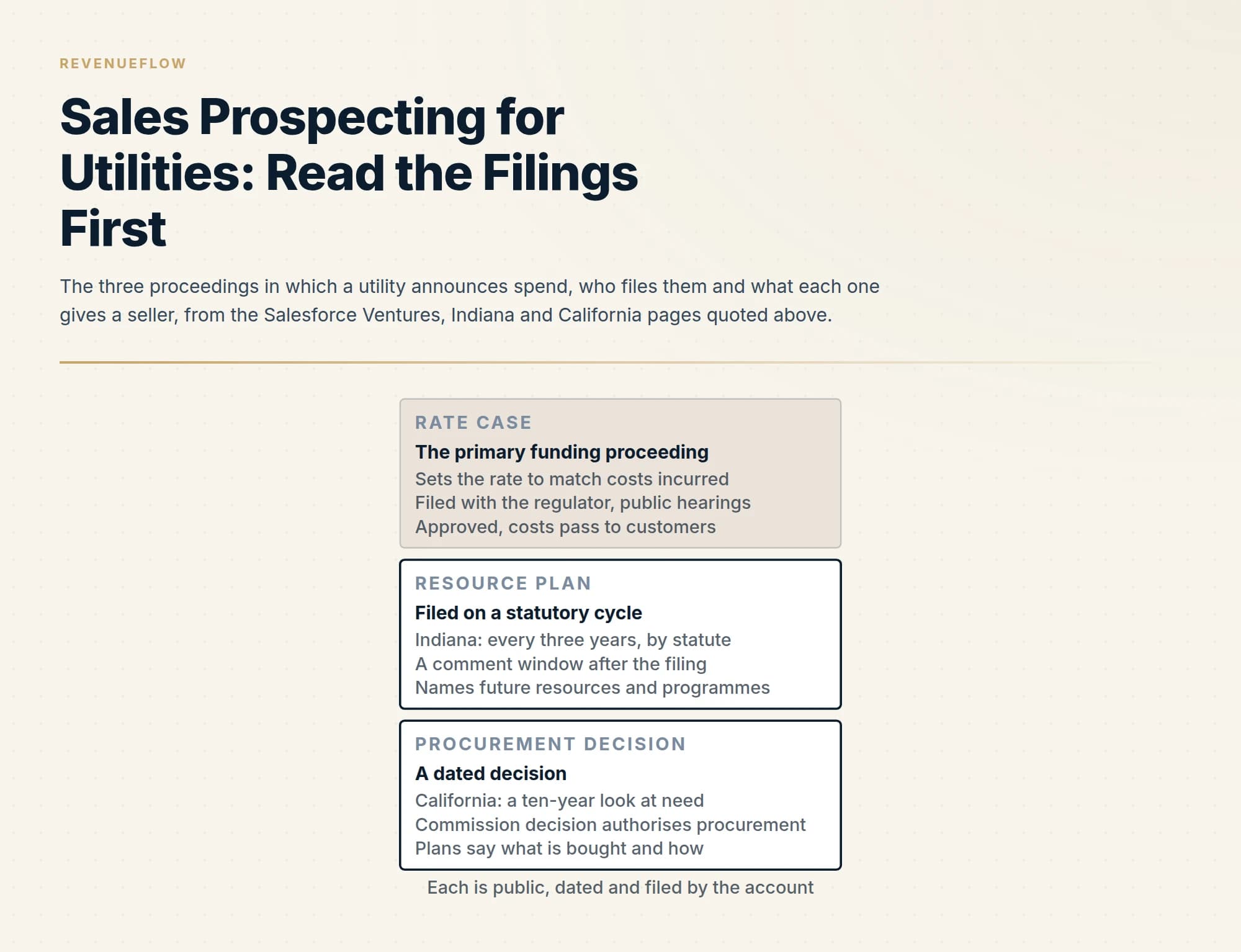
Utilities announce spending in public proceedings: the general rate case, which Salesforce Ventures calls the largest, the resource plan Indiana requires every three years, and the procurement decisions California issues once needs are found; each is dated and owned inside the utility by a named group. The filing is the reason to write; the supplier page is the door.
Key takeaways
- Salesforce Ventures' guide to selling to utilities, dated 30 January 2024, says utilities receive the majority of their funding through regulatory filings and proceedings, the largest being the general rate case, and that rate case eligibility typically applies to CapEx rather than recurring fees.
- Indiana's commission requires jurisdictional electric utilities to submit integrated resource plans every three years, with a comment window after filing; California's commission authorises procurement by decision after a ten-year-ahead look at need.
- The guide maps five stakeholder groups: the C-suite, business users, IT, procurement and regulatory affairs, which leads the filings and proceedings related to utility funding.
- Southern Company's supplier page says all suppliers are expected to compete on quality, reliability and price and awards business on best overall value, so a filing is a reason to write and the supplier page is the door.
Reviewed and updated September 21, 2026
A utility announces the purchases it will make years before it makes them, in documents anyone can read, and most sellers into utilities never read them. They buy a contact list, write to a director of operations, and hear nothing, while the same utility's resource plan, rate case and solicitation schedule sit on a state commission's site with dates attached. Prospecting utilities is mostly a reading job, and the reading is public.
This page is for the seller into utilities, whether software, engineering services, equipment or field work, who has to decide which utilities to work this quarter and why. It covers where the accounts and their intentions are enumerated (the regulatory proceedings and the supplier gates), which events inside those proceedings are triggers, who inside a utility owns each of them, the conference calendar that puts them in one building, and when cold prospecting is the wrong play. The general method, a filter against a signal, lives in B2B prospecting and sales prospecting and is not repeated. The buying cycle, the prequalification gate and the org chart of a utility are the cold email for utilities guide's subject, and a utilities list built from the federal registries is its own page. Every outside page below was fetched on 21 September 2026 and is dated where it publishes a date.
What a search for this returns
Half of the ten pages ask the generic question: prospecting guides from Salesforce, Capsule, Janek, Reevo and Highspot, none of which mentions a utility. Of the rest, Moody's page on customer intelligence for utilities describes a utility prospecting its own commercial customers, which is a different reader, and Diversegy's piece on cold prospecting commercial energy is written for energy brokers selling supply, which is a different reader again. Salesgenie and Leadbeam sell lists and tools. One page is on point: Salesforce Ventures' guide to selling to utilities, written for early-stage climate and software companies, dated 30 January 2024 and built on a workshop with two named practitioners (Selling to Utilities). This page takes that reader, the seller into a regulated utility.
Where the money is announced
The Salesforce Ventures guide states the fact that reorganises utility prospecting: "Utilities receive the majority of their funding through regulatory filings and proceedings. The largest of these, as previously mentioned, is the general rate case." It defines the proceeding: "Rate casing is the process by which a utility company sets the rate it charges customers for services to match the costs incurred to provide those services", a process that "involves preparing and filing a rate case with the regulatory body that governs the utility, evidence gathering, and several rounds of public hearings". And it says why a seller should care: "Having a rate case approved essentially enables the utility to pass on increases in costs (say, from a new SaaS tool) to customers." The guide also puts a number on the map: "There are 50 different state regulators as well as numerous federal regulators governing more than 5,000 utilities providers in the U.S."
The second proceeding is the resource plan, and the commissions describe it in their own words. In Indiana, the commission states that "Jurisdictional electric utilities are required to submit Integrated Resource Plans (IRPs) every three years", citing the state code section that requires it, that "IRPs describe how the utility plans to deliver safe, reliable, and efficient electricity at just and reasonable rates", and that each plan "explains how it will use existing and future resources to meet customer demand"; the page lists the utilities that must file and links each one's most recent plan, the comments received and the commission staff's final report (IURC integrated resource plans, page dated 13 July 2026). California runs the same planning inside one docket. The commission's page calls it an "umbrella" planning proceeding, says it "takes a 10-year-ahead look at" system, local and flexibility needs, and states the mechanism a seller should underline: "When needs are identified, the CPUC authorizes procurement in the form of a Commission Decision", and "Procurement plans detail what is going to be procured and how it will be done" (CPUC integrated resource plan and long term procurement plan, as fetched).
Read as a seller, those pages say three things. A utility's intentions are filed, on a statutory cycle, with a public comment window. The filing names programmes and, in the rate case, the spending the utility wants recovered. And the decision that authorises procurement is itself a public document with a date. That is a trigger source in the sense the prospecting hub means: an event, published by the account, that changes what it is about to buy.
Who owns each trigger inside the utility
The Salesforce Ventures guide maps the five groups a seller meets, and each group owns a different piece of the calendar. The C-suite "are primarily concerned with achieving their key performance indicators (KPIs)", and "Startups should aim to present the C-suite with proof points of other utility companies that hit their KPIs". Business users "will look to integrate a new product or service if they believe it will help them achieve success on a project or program", and their need "can help push an IT organization that otherwise may not be interested". IT "will likely first consider whether an existing software can address the problem or if they can build the solution internally", then integration, then a security review. Procurement "oversees all software acquisitions" and, given the long cycles, "are most concerned with vendor viability". And regulatory affairs "is focused on meeting the utility's regulatory requirements and regulatory stakeholder management" and "is also the lead in utility filings and proceedings related to utility funding".
That last group is the one a prospecting programme built on filings should reach first, and the guide's practitioner says why: "One thing that can be really helpful is looking at old rate cases that have included SaaS software, and then asking the regulatory affairs folks how they handled that process". The guide says "startups should look into whether their target customers have rate-cased SaaS products in the past", and adds the constraint that decides whether a product can ride a rate case at all: "Note that rate case eligibility typically applies to CapEx and not ongoing expenses, such as recurring SaaS fees." A seller whose product is an operating expense is prospecting the business user and the budget line; a seller whose product can be capitalised is prospecting regulatory affairs and the filing.
Owns the filing
Regulatory affairs leads the filings and proceedings related to funding; the question is whether the utility has rate-cased such products in the past.
Owns the programme
Business users integrate what helps them achieve success on a project or programme, and their need can push an IT organization.
Owns the gate
IT first considers whether existing software or an internal build can address the problem, then integration, then security; procurement is most concerned with vendor viability.
Owns the target
The C-suite is concerned with its key performance indicators, and wants proof points of other utility companies that hit theirs.
The supplier gate, and why a filing is not a purchase order
Reading a filing tells a seller what a utility intends to buy. It does not put the seller on the list of companies it may buy from. Southern Company's supplier page states the standard plainly: "All suppliers are expected to compete on quality, reliability and price", and "The Southern Company system awards business based on the best overall value"; suppliers "must meet policies for legal compliance, equal employment, harassment, workplace threats and violence, electronic communications, safety, the environment, drugs and alcohol and conflicts of interest" (Southern Company suppliers, as fetched). PG&E's doing-business page points prospective suppliers to bid packages and solicitation schedules, a trade professional alliance for those who sell or install products, and separate routes for wholesalers and power producers (Doing business with PG&E, as fetched).
The prospecting consequence is a sequence rather than a single message. The filing supplies the reason and the date; the supplier page supplies the door; and the first message asks about the door, which is the ask the utilities email guide sets out as the one procurement can grant a stranger. A seller who writes about the resource plan to an operations director at a utility where it is not registered has done the reading and skipped the step the reading was for.
The trade calendar
The proceedings put dates on a utility's intentions; the shows put its people in one building. DTECH, whose page title calls it "The leading T&D Event", lists its next edition for "March 1-4, 2027" at the "Georgia World Congress Center" in Atlanta (DTECH, as fetched). The American Public Power Association's National Conference is listed for "Orlando, Florida" on "June 18 - 23, 2027" (APPA National Conference, as fetched); that is the public power segment's own meeting, and its attendee list is the closest thing to a roster of general managers who run the small utilities. The cooperative segment has its own annual meeting through the national cooperative association, whose event pages did not render on the fetch date, so its dates are not stated here.
What utilities say against it, from the guide's own voices
The objections are in the guide because its authors collected them from people who sell into utilities. On culture: utilities "move cautiously and are often slow to change as a means of managing risk", and "are also siloed, with communication between departments restricted as a result of longstanding cultural norms and mandatory security protocols". On brand: "They often associate reliability with brands that have solid, long-standing reputations. For this reason, utility companies may avoid doing business with startups." On the build-versus-buy reflex: "Pushback from IT typically occurs when the team feels they can build the solution internally, the software poses security or skill set concerns". And the practitioner's summary, attributed in the guide to Leo Trudel: "Each utility is different, and you're not going to figure out how these organizations buy software unless you do your research and talk to a bunch of internal stakeholders".
Two of those objections point back at the filings. A utility that avoids startups still cites its peers, and the guide notes that regulated utilities "do not directly compete" and "often look to other utilities as references on a proposed solution", so a reference at a utility whose filing names the same programme is worth more than any deck. And the research the practitioner demands is exactly the reading of the rate case and the plan, which is public and free.
When cold prospecting is the wrong play
Three cases. The product is an operating expense at a utility that only buys what it can capitalise into a rate case; the guide's note on CapEx eligibility says so, and the first conversation belongs with regulatory affairs about whether that is true at this utility, not with a business user about a pilot. The category is bought only through sealed solicitations, where the utilities email guide's rule applies and contact outside procurement during a bid can disqualify the seller; the work is on the portal and the schedule PG&E points to, and a message in that window is a liability. And the seller cannot pass the supplier standard on its own page: a vendor that cannot yet meet a safety, insurance or compliance policy the buyer publishes should fix that before reading a single docket.
RevenueFlow runs email and LinkedIn for clients, one message per campaign with no follow-up bumps, so the reason to write has to be a dated event the utility published; filings are where those reasons come from in this vertical. If you would rather have the docket reading and the supplier-gate research done for you and a first message prepared, see what a first campaign would target.
The short version
Utilities announce their spending in public proceedings: the general rate case, which the Salesforce Ventures guide calls the primary funding proceeding, the integrated resource plan that Indiana's commission requires every three years by statute, and the procurement decisions California's commission issues once needs are found. Each is dated, filed by the account, and owned inside the utility by a named group, with regulatory affairs leading the filings. A filing is a reason to write; the supplier page is the door, and the first message asks about the door. DTECH in March and the APPA conference in June put the people in one building. Where the product cannot be capitalised, the category is bid-only, or the seller cannot meet the published supplier standard, prospecting waits.
Frequently asked questions.
Frequently asked questions- Where do you find utilities that are about to buy?
- In their filings. A rate case sets the rate a utility charges to match the costs it incurs, and approval lets those costs pass to customers, which is why the Salesforce Ventures guide calls it the primary funding proceeding. Resource plans, filed every three years in Indiana by statute, describe how the utility will meet demand. Commission decisions, in California, authorise procurement. All are public, dated and filed by the utility itself.
- Who should a vendor contact first at a utility?
- It depends on what the trigger is. The guide says regulatory affairs leads the filings and proceedings related to utility funding, so a product that can be capitalised into a rate case starts there. Business users adopt what helps a programme succeed and can push IT to consider it. IT asks whether it can build or reuse, then integration, then security. Procurement cares most about vendor viability, given the long cycles.
- When is the best time to prospect a utility?
- When a filing has just been made or a decision has just issued, because that is when the utility's intention is public and dated. Indiana's resource plans open a ninety-day comment window after submission. The shows put people in one building: DTECH lists 1 to 4 March 2027 in Atlanta and the APPA National Conference lists 18 to 23 June 2027 in Orlando. A sealed bid period is the time not to write.
- Why does cold prospecting fail with utilities?
- Because a filing is not a purchase order. Southern Company's supplier page says all suppliers are expected to compete on quality, reliability and price and that business is awarded on best overall value, and PG&E points suppliers to bid packages and solicitation schedules. A seller who writes about a resource plan without being registered as a supplier has skipped the door. The guide adds that utilities move cautiously, are siloed and may avoid startups.
About the author.

B2B cold email experts helping companies generate qualified leads through done-for-you outreach campaigns.
RevenueFlow Team
Explore more.
Ready to scale your outreach?
We build GTM engines that book real meetings. See the receipts.
Related articles.
Sales Prospecting for SEO Agencies: Four Public Signals
How an SEO agency builds its own prospect list from signals Google documents: the index check, position, core update dates and site moves, under the warning owners read.
Sales Prospecting for Consulting Firms: Find the Event
Prospecting for a consulting firm: where triggers are published by practice, who inside the firm reads them, why alumni and referrals come first, when to skip it.
B2B Lead Lists for Utilities: Three Registries, One Gap
The anatomy of a utilities lead list: the EIA-861 census, PHMSA annual reports and SDWIS enumerate electric, gas and water utilities; vendors sell the field they lack.
Sales Prospecting for Energy Companies: The Regulator's List
Prospecting for a retail energy supplier, broker or efficiency seller: the eligible customer list, the state's choice map, building grades, the triggers and the licence.
Sales Prospecting for Health Systems: The Public Record
Where health systems are written down in public: the Medicare cost report, the facility list a non-profit system files, and the two gates that follow qualification.
B2B Lead Lists for Aviation Companies: Build or Buy
Aviation is one of the few industries whose accounts are published by its regulator, which changes what is worth buying and what is worth downloading yourself.