Sales Strategy for Professional Services: Who Sells
A professional services firm's sales strategy before any channel: Hinge's four selling models, pricing the way buyers are told to demand it, and the conduct rules.
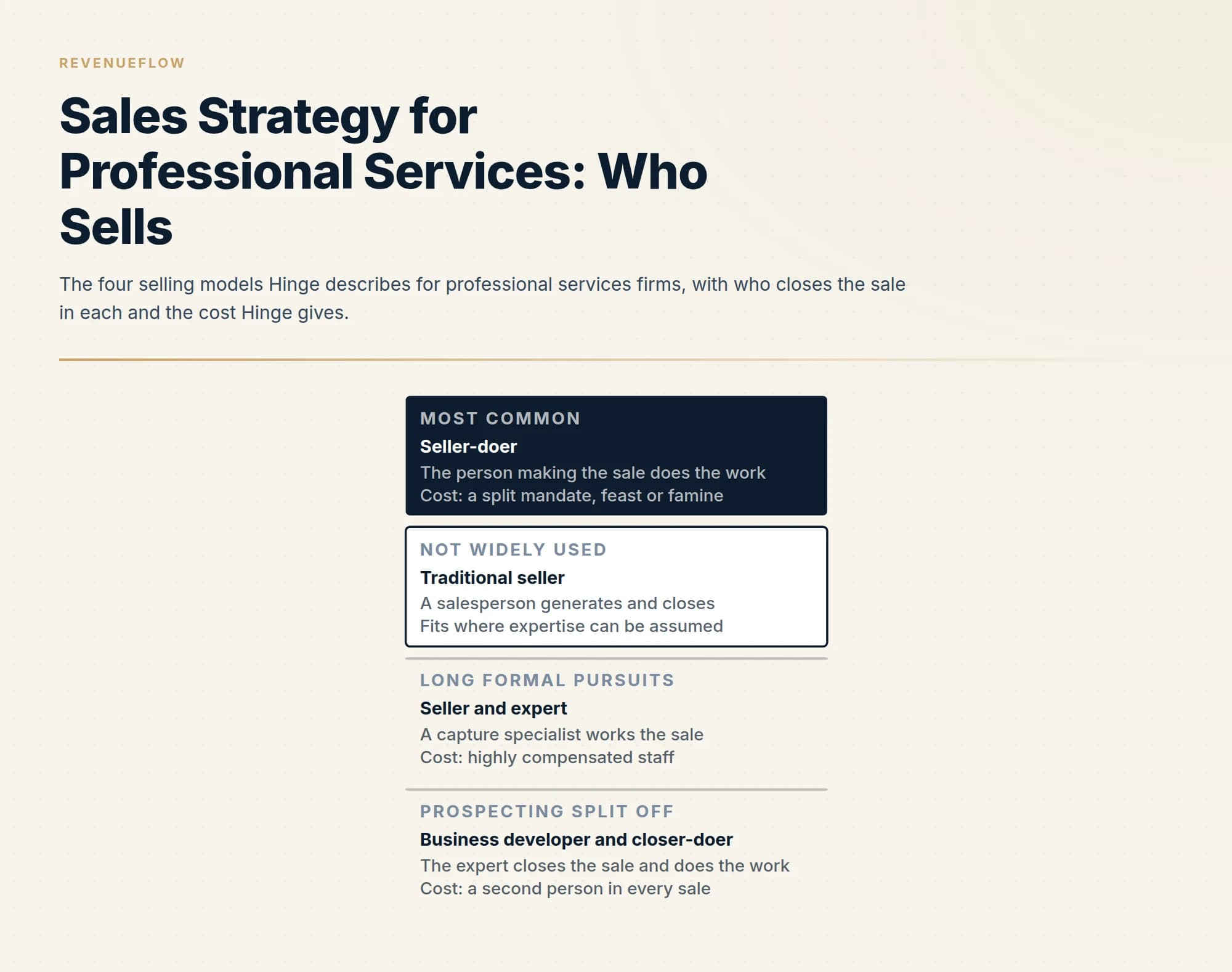
A professional services firm's sales strategy is decided before any channel. Hinge describes four selling models, from the common seller-doer to a business developer paired with an expert who closes and does the work. Buyers are advised to make firms stand by a price built on agreed assumptions. Conduct rules such as ABA Model Rule 7.3 limit solicitation.
Key takeaways
- Hinge describes four selling models for professional services: seller-doer, traditional seller, seller and expert, and business developer with closer-doer; it calls the first the most common and says the second is not widely used.
- A general counsel writing for Thomson Reuters advises in-house departments that a firm should stand by its pricing unless assumptions and a process to change the price were agreed in advance.
- Hinge's 2026 High Growth Study reports median growth of 9.9% and High Growth firms spending 12% of revenue on marketing against 5% for no-growth firms; its two pages give different samples, 770 firms and 495 firms.
- ABA Model Rule 7.3 bars live person-to-person solicitation for pecuniary gain except with another lawyer, a person with a prior relationship, or a person who routinely uses that type of legal services for business purposes.
Reviewed and updated September 18, 2026
Hinge, which publishes an annual study of professional services firms, describes the default sales strategy of the whole sector in one sentence: "In the seller-doer model, the person making the sale is also the person doing the work." It calls this perhaps the most common strategy, especially for small firms, and then names what is wrong with it: "The seller-doer has a split mandate," selling when they feel they should be doing client work and working when selling suffers, so that revenue arrives in waves. "Feast or famine is the way it feels" (Hinge, Sales and Marketing Strategy for Professional Services, 28 October 2025).
This page is for the professional services firm, in law, accounting, consulting, engineering advisory or a similar field, that is deciding its own sales strategy. It is not about selling to professional services firms, which the site's cold email guide for professional services covers. It is also not about running outbound for such a firm, including whether to build or buy it and what partner time costs, which is in outbound for professional services and is not repeated here. This page covers the decisions that come before any channel: who in the firm sells, how the price is made, how much the firm invests in being known, and what its profession's rules allow.
The first decision: who sells
Hinge sets out four models, and each is a different firm. The seller-doer model has the advantage, in Hinge's account, that the client knows who they will be working with and builds familiarity and trust during the sale. Its cost is the split mandate above, which Hinge says is less extreme in larger firms where partners can hand work to their teams, though the friction is always there.
The second is the traditional seller model, in which a salesperson generates and closes the opportunity and the doer arrives afterwards. Hinge is blunt about it: "This strategy is not widely used in professional services firms." The reason it gives is that the client cannot evaluate an individual's expertise or establish trust with someone who will not do the work, and it suggests the model fits where expertise can be assumed, as in commodity services.
The third Hinge calls seller and expert, for long formal pursuits: engagements that need an extensive proposal and contract negotiation phase, such as federal government contracts and large engineering and construction projects. A dedicated capture specialist works the sale while the expert who will do the work takes an active part. Hinge says it is not more widely used because it requires more highly trained, highly compensated staff.
The fourth is the business developer and closer-doer model. A sales-oriented professional generates, qualifies and nurtures leads but does not close; a subject matter expert closes the sale and does the work. Hinge lists its advantages as specialization and the fact that the client can establish a working relationship during the sales process, with no information lost in the transition from prospect to client. Its cost is a second person in every sale.
The strategic point is that the choice follows from what the firm sells. A firm whose clients buy a named person's judgement cannot put a salesperson between that person and the client, but it can take the prospecting off that person, which is what the fourth model does. A firm with more than one kind of work should not run all of it through the model that suits only one.
The price is part of the sale, and buyers say so
In professional services the scope and the price are negotiated inside the sale, and the clearest account of what the buyer wants comes from a buyer. Sterling Miller, writing for in-house legal departments on Thomson Reuters' site, opens with the state of the market: in-house counsel's selection of outside lawyers now often includes the use of requests for proposals. He lists questions a department should put to firms, among them "How will you learn my business? How will you handle conflicts?" and, pointedly, "What do I get for free?" (Thomson Reuters, Generating good RFPs and building a basic law firm panel, 13 December 2023).
On price he tells buyers what to demand: "The firm should stand by its pricing unless you have agreed in advance on assumptions and a process to change the price if those assumptions are wrong." He warns them to understand how a blended rate will actually be staffed. The article is about law firms; it is one profession's buyers speaking for themselves.
For a firm's strategy the lesson is that scoping is a selling skill. A firm that can state its assumptions, price against them and say in advance what happens when they fail is answering the question the buyer has been told to ask. A firm that quotes an hourly rate and an estimate leaves the buyer carrying the risk. What the diagnosis that precedes a scoped price costs, and who pays for it, is in the consultative sales process.
| What the buyer is told to ask | In the article's words | What the firm needs ready |
|---|---|---|
| Knowledge of the client | "How will you learn my business?" | A stated plan for the first weeks |
| Conflicts | "How will you handle conflicts?" | The firm's process, in writing |
| Extras | "What do I get for free?" | A decision made before the question arrives |
| Price | "The firm should stand by its pricing" | Assumptions, and a process to change the price if they are wrong |
How much to invest in being known
Hinge's annual study of professional services firms gives the investment picture. Its 2026 summary says "Median growth has cooled to 9.9%," the lowest since 2018, that the firms it classes as High Growth spend 12.0% of revenue on marketing, and that top firms are 2.5 times more likely to make their subject matter experts visible (Hinge, 2026 High Growth Study executive summary, read 18 September 2026). Hinge's own post on the study puts the comparison at 12% of revenue for High Growth firms, up from 10% the year before, against 5% for firms with no growth (Hinge, 5 Key Takeaways from the 2026 High Growth Study, read 18 September 2026).
One caution about the sample, because Hinge's two pages do not agree. The summary page describes the data as 770 firms with $87 billion in combined revenue. Hinge's post describes the same edition as 495 firms representing almost $85 billion. We could not reconcile the two from the pages themselves, so both are given here as Hinge states them. The figures also describe what faster-growing firms do, not what made them grow.
The strategy reading is modest: if the person who sells is the expert, then the expert's visibility is the firm's pipeline. No source fetched for this page states a buying calendar or fiscal year common to professional services clients, so none is asserted.
What the professions' rules require of the seller
Professional services firms sell under conduct rules that ordinary companies do not have, and they differ by profession and by state.
For lawyers the model is the American Bar Association's Model Rule 7.3. It defines solicitation as "a communication initiated by or on behalf of a lawyer or law firm that is directed to a specific person the lawyer knows or reasonably should know needs legal services in a particular matter" and that offers to provide legal services for that matter. It then bars live person-to-person solicitation for pecuniary gain, with exceptions: contact with another lawyer, with a person who has a family, close personal, or prior business or professional relationship with the lawyer or firm, and with a "person who routinely uses for business purposes the type of legal services offered by the lawyer" (ABA, Model Rule 7.3: Solicitation of Clients, read 18 September 2026). The Model Rules are a model; each state adopts its own version, and a firm follows its own state's text.
For accountants the rules sit with state boards. North Carolina's is an example: "A CPA shall not seek to obtain clients by advertising or using other forms of solicitation in a manner that is deceptive," under its rule on advertising or other forms of solicitation, 21 NCAC 08N .0306 (North Carolina State Board of CPA Examiners, Section .0300, read 18 September 2026).
Email outreach also falls under the ordinary federal rule. The Federal Trade Commission's guide is short on the point: the CAN-SPAM Act "makes no exception for business-to-business email," each separate email in violation is subject to penalties of up to $53,088, and a commercial message must carry a valid physical postal address and a clear way to opt out (FTC, CAN-SPAM Act: A Compliance Guide for Business, read 18 September 2026). Whether a specific practice is permitted is a question for the firm's own regulator and counsel.
- Yes: Another lawyer
- Yes: A person with a family, close personal, or prior business or professional relationship with the lawyer or firm
- Yes: A person who routinely uses for business purposes the type of legal services offered
- No: Anyone else the lawyer knows needs legal services in a particular matter
The objections, from the sector's own sources
The first objection is internal, and Hinge has named it: the people who would sell are the people who bill. Any strategy that adds selling time to the same individuals will meet the split mandate, and a plan that ignores it will be abandoned in the first busy month.
The second is the buyer's scepticism about a salesperson. Hinge's explanation for why the traditional seller model is rare is the buyer's own objection: a client wants to evaluate the individual who will do the work.
The third is price certainty. The buyer's guide quoted above tells departments to expect a firm to stand by its price. A firm that cannot say what its assumptions are has no answer.
Channel reality, and when outbound is the wrong play
Written outreach by email and LinkedIn can start conversations for a professional services firm, and it is the motion RevenueFlow runs, one message per campaign. RevenueFlow does not cold-call. In-person networking and events are a large part of how this sector builds relationships, in Hinge's account of what High Growth firms prioritize, and they are described here as the sector's practice. How an outbound programme for a firm is set up and judged is in outbound for professional services.
Outbound is the wrong play in three cases. It is wrong for a firm that has not decided who takes the meeting, because a booked conversation with no expert in it confirms the buyer's scepticism. It is wrong where the profession's rules bar the contact: a lawyer's message to a specific person known to need help in a particular matter is solicitation under the model rule, which is a different thing from writing to a business that routinely uses such services, and the firm's state rule decides. And it is wrong for a firm that cannot scope and price what it is offering, because the first serious question will be about exactly that. How accounting firms in particular find clients is in accounting lead generation.
Three openers, each grounded in a page the reader can check
Three sample first lines a firm could send, each tied to one fetched source. Each makes no results claim, names no real person and gives no contact details. A firm in a regulated profession should check each against its own state's rules before sending anything like them.
From a consulting firm's practice lead to an operations executive. Hinge's research on professional services describes the seller-doer model, where the person who sells does the work. That is how we operate: the partner writing to you would lead the engagement. If the problem we wrote about last month is one you have, a conversation with that partner is the ask. The model is named from published research and the message answers the where-is-the-expert objection.
From a law firm partner to a general counsel who routinely uses outside counsel. Advice to in-house departments says a firm should stand by its pricing unless assumptions were agreed in advance. For the type of matter you send out regularly, we price against written assumptions with a stated process if they change. If you are reviewing your panel, a short conversation is the ask. The standard is the buyers' own.
From an accounting firm partner to a finance director. Our state board's rule is that a CPA shall not seek clients by advertising in a manner that is deceptive, so here is the plain version: we do one thing, for companies of your size, and the partner writing to you would do the work. If it is useful, a short conversation is the ask. The rule is quoted from the board and the message is built to meet it.
To: General counsel, a company that routinely uses outside counsel
Advice to in-house departments says a firm should stand by its pricing unless assumptions were agreed in advance. 1
For the type of matter you send out regularly, we price against written assumptions with a stated process if they change. If you are reviewing your panel, a short conversation is the ask. 2
Postal address and opt-out line in the footer. 3
- 1The buyers' own standard, from the Thomson Reuters article.
- 2Written to a business that routinely uses such services, and offers assumptions and a process, not a result.
- 3The postal address and opt-out line the FTC's CAN-SPAM guide requires of every commercial email.
What the strategy has to decide
A professional services firm's sales strategy is four decisions: which selling model fits each kind of work it does; how it states assumptions and stands by a price; how much it invests in making its experts visible, knowing what the faster-growing firms spend; and what its own profession's rules allow it to say, to whom, and how.
RevenueFlow books those meetings by email and LinkedIn, one message per campaign, to criteria agreed in writing before launch, and charges for attended meetings that meet them. If starting the conversations is the part you would rather have run, with your expert in the meeting, you can see what a campaign would look like for your market.
The Hinge, Thomson Reuters, ABA, North Carolina State Board of CPA Examiners and FTC pages were fetched on 18 September 2026 from the pages linked. Hinge's two pages state different samples for its 2026 study, and both are given. The ABA's rules are a model and North Carolina's are one state's; your profession's and your state's rules govern. Nothing here is legal advice.
Sources: Hinge, Sales and Marketing Strategy for Professional Services, Hinge, 2026 High Growth Study executive summary, Hinge, 5 Key Takeaways from the 2026 High Growth Study, Thomson Reuters, Generating good RFPs and building a basic law firm panel, ABA, Model Rule 7.3, North Carolina State Board of CPA Examiners, Section .0300, FTC, CAN-SPAM compliance guide
Frequently asked questions.
Frequently asked questions- Who should do the selling in a professional services firm?
- It depends on what the firm sells. Hinge describes four models. In the seller-doer model the person who sells does the work, which builds trust but splits that person's time. The traditional seller model is not widely used because clients want to evaluate the expert. Seller and expert suits long formal pursuits. In the business developer and closer-doer model someone else generates and nurtures leads while the expert closes and does the work.
- How should a professional services firm price in a competitive proposal?
- The way buyers are told to demand it. Sterling Miller, writing for in-house legal departments on Thomson Reuters' site, says a firm should stand by its pricing unless assumptions and a process to change the price were agreed in advance, warns buyers to understand how a blended rate will be staffed, and says buyers should expect to give firms enough information to price the work. Stating assumptions is therefore a selling skill.
- Can lawyers and accountants use cold outreach to win clients?
- Their professions' rules decide, and they differ by state. ABA Model Rule 7.3 bars live person-to-person solicitation for pecuniary gain, with exceptions that include a person who routinely uses that type of legal services for business purposes, and states adopt their own versions. North Carolina's CPA board says a CPA shall not seek clients by advertising or solicitation in a manner that is deceptive. Email also falls under the FTC's CAN-SPAM guide.
- When is outbound the wrong play for a professional services firm?
- When the firm has not decided who takes the meeting, because a booked conversation with no expert in it confirms the buyer's scepticism about salespeople. When the profession's rules bar the contact, such as a lawyer writing to a specific person known to need help in a particular matter. And when the firm cannot scope and price what it offers, because the first serious question will be about exactly that.
About the author.

B2B cold email experts helping companies generate qualified leads through done-for-you outreach campaigns.
RevenueFlow Team
Explore more.
Ready to scale your outreach?
We build GTM engines that book real meetings. See the receipts.
Related articles.
Sales Strategy for Logistics Companies: Segment, Seat, Cycle
How a broker, forwarder, carrier or 3PL sets its sales strategy: Armstrong's segments and contract terms, the four provider seats shippers keep, and the rate cycle.
Sales Strategy for Manufacturing Companies: Direct or Reps
How a manufacturer decides whose salespeople carry its line: the published definition of a representative, MANA's agreement clauses and the split commission problem.
Lead Generation for Trucking Companies: Three Routes
How a motor carrier finds freight customers: the load board, the broker relationship and the shipper's annual bid, with the calendar and the rules on outreach.
MEDDIC vs BANT: What Each Qualifies and When to Use Which
MEDDIC and BANT from the originators' own text: IBM's BANT form as a gate after the first call, PTC's six themes as an audit of a live deal, and when to run each.
Gap Selling vs SPIN Selling: What Each Method Diagnoses
Gap Selling and SPIN Selling from their authors' own pages: four question types that develop a stated need, against a measured gap between two states.
Merchant Services Cold Calling Scripts: The Honest Version
Six call scripts for merchant services agents and ISO reps, built around what the FTC alleged about this exact call: no affiliation claim, no rate before a statement.