Gap Selling vs SPIN Selling: What Each Method Diagnoses
Gap Selling and SPIN Selling from their authors' own pages: four question types that develop a stated need, against a measured gap between two states.
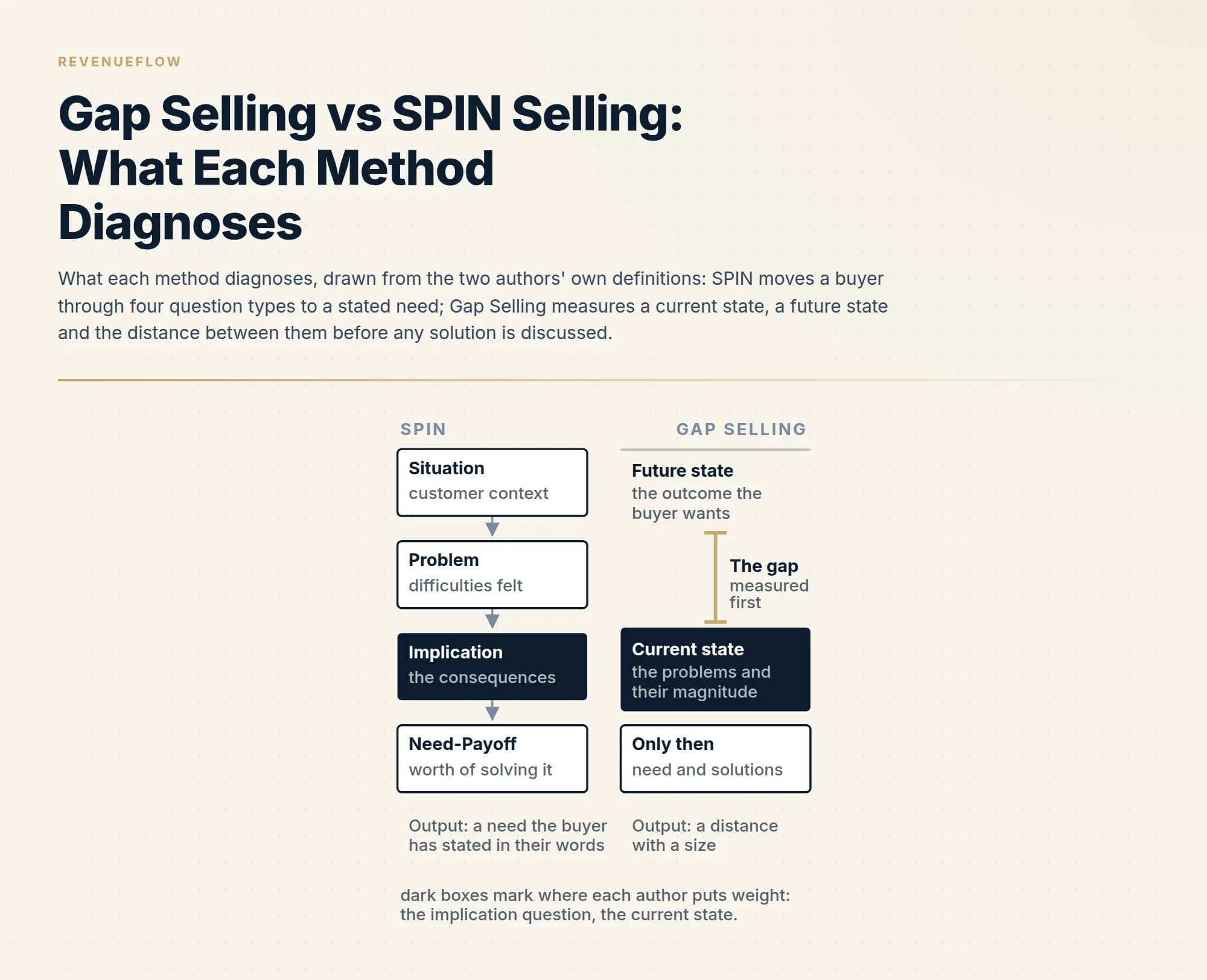
SPIN, as Huthwaite publishes it, is four question types that develop a need the buyer states in their own words, with the Implication question doing the work. Gap Selling, as Keenan publishes it, measures a current state, a future state and the gap between them before any solution is discussed. One diagnoses by question, the other by measurement.
Key takeaways
- Huthwaite's own guide defines the four SPIN question types, dates the method to Neil Rackham's 1988 book and research on 35,000 calls, and calls the questions a logical framework rather than a rigid sequence.
- Keenan's own pages define Gap Selling as problem-centric selling: current state and its magnitude first, then the future state, and only then need and solutions, because selling to need starts the sale halfway through.
- The two methods refuse the same thing, the early pitch, with different instruments: SPIN's product is a need the buyer has stated, Gap Selling's product is a distance with a size.
- Read side by side, Keenan's objection to selling to need lands on SPIN's Need-Payoff question; SPIN trusts an articulated need, Gap Selling treats it as unreliable until the current state is measured.
Reviewed and updated September 19, 2026
SPIN Selling and Gap Selling are thirty years apart and both are still sold by the people who wrote them. SPIN comes from Neil Rackham's 1988 book and is taught by Huthwaite International, which calls itself the originator; Gap Selling comes from Keenan's 2018 book and is taught by A Sales Growth Company, the firm he founded. Both refuse to pitch before the buyer's problem is established, which is why they get compared, and they establish it by different instruments. This page takes each from its author's own pages, says what each one diagnoses, and says where each fits an outbound motion. It ranks neither.
The four SPIN question types and the order they depend on are defined in the SPIN Selling entry, and twelve worked implication questions are on implication questions in SPIN Selling; neither is restated here. Where both methods sit among the sixteen named methodologies is on B2B sales methodologies.
SPIN, as Huthwaite publishes it
Huthwaite International's guide to SPIN Selling (published 24 June 2021, last modified 19 June 2026, fetched 19 September 2026) opens with the claim that "SPIN Selling is the world's leading sales methodology", as outlined in Neil Rackham's book of that name, first published in 1988. The research behind it is described on the same page: "In the early 1970s, Neil Rackham and his team set out to uncover what really made top salespeople the best." and "Out of 35,000 sales calls came the answer, and SPIN Selling was created."
The four question types are defined there in the publisher's own words: "Situation: questions about the customer's current situation", "Problem: questions about the customer's difficulties or dissatisfactions", "Implication: questions about the consequences or implications of the customer's problems" and "Need-Payoff: questions that explore the importance to the customer of solving a problem". One sentence on that page is worth more than the acronym: "These SPIN questions provide a logical framework rather than a rigid sequence". The publisher also states what the research dispelled, and the first item on its list is that closing techniques are counterproductive to the sales process.
So what SPIN diagnoses is a need, its instrument is the question, and its output is a need the buyer has stated in their own words. Situation and Problem questions get a difficulty stated; Implication questions make the buyer follow that difficulty to its consequences; Need-Payoff questions get the buyer to say what solving it would be worth. The diagnosis is complete when the buyer has said, in their own words, that the problem matters and what a solution would do.
Gap Selling, as Keenan publishes it
A Sales Growth Company's page for the book (last modified 18 September 2026, fetched 19 September 2026) states the premise in three words and expands it in two sentences: "The Problem Drives the Sale." and "Buyers don't buy products. They buy solutions to problems." The page describes the method as teaching a seller "to diagnose the gap between where your buyer is and where they need to be" and close from that position. The gap is the unit.
Keenan's own comparison post, written against solution selling (published 31 March 2020, last modified 9 December 2025, fetched 19 September 2026), states the order of operations more precisely than any summary: "Gap Selling focuses the entire sales process around current state problems and their magnitude. Then moves the focus to a desired future state, based on desired business outcomes. Once these two elements have been identified, and only then, does the discussion move to need and potential solutions." The post names the position and its opposite: "Gap Selling coined the term problem-centric selling and doesn't advocate selling to need, or competing at the product level." And the reason: "Selling to need is starting the sales process half-way through the sale."
The book page publishes the nine rules the author calls truthbombs, and two of them carry the whole method. The second: "Every transaction is about identifying the distance between where customers are now and where they want to be. Never sell to need." The eighth: "You can't sell a future state unless you have a firm grasp on your customer's current state. The current state is where their problems live." The page also names the instrument for the current state, a Problem Identification Chart, as a resource referenced inside the book.
So what Gap Selling diagnoses is a distance: the measured difference between a current state, with its problems and their cost, and a future state the buyer wants. Its output is a distance with a size, and the diagnosis is complete when both states are described and the gap between them has been measured.
The same refusal, two instruments
Both authors refuse the early pitch, and both say so in their own pages. Huthwaite's guide steers the seller toward the customer's needs and away from features until a need is explicit; Keenan's post says the discussion moves to solutions only then, after current state and future state are identified. A buyer who has met both methods would notice the same thing at the same moment: the seller declining to describe the product.
The instruments differ in what they produce. SPIN's product is a sequence of things the buyer has said. Its Implication question is the one that does the work, because it is where a stated difficulty acquires a cost, and Huthwaite's guide describes that step as discussing the impact current issues could have on the buyer's business long-term if their situation stays the same. Gap Selling's product is a measurement. The current state is described in enough detail to say what the problems cost, the future state is described in enough detail to say what the outcome is worth, and the seller's claim is that the gap, once both ends are fixed, is what the buyer is actually buying.
Keenan's published contrast is with solution selling: "In the conventional solution selling methodology, sellers look to find a need." His objection is that a need the buyer has not diagnosed is unreliable. Read against SPIN, that objection lands on the Need-Payoff question. SPIN asks the buyer to state the value of solving the problem; Gap Selling wants the seller to have measured the current state before the buyer's own statement of need is trusted. That is our reading of the two texts side by side, and it is the practical difference: SPIN trusts a need the buyer articulates under good questioning, and Gap Selling treats even an articulated need as unreliable until the state behind it has been measured.
| Question | SPIN, per Huthwaite | Gap Selling, per Keenan |
|---|---|---|
| What is diagnosed? | A need, developed through four question types | A gap between a current state and a future state |
| What does the work? | The Implication question, where a problem acquires consequences | The current state, described and measured first |
| When may the seller present? | Once the buyer has explored the importance of solving the problem | Only after both states are identified and the gap has a size |
| What is refused? | Closing techniques, which the research found counterproductive | Selling to need, and competing at the product level |
What the same moment sounds like under each
The example below is invented, including the company and every figure of speech in it; it illustrates the two instruments at one moment in one conversation, and it is not a transcript of anything. A buyer at a mid-sized logistics firm has said that their dispatch team re-keys orders from email into the routing system.
SPIN, the Implication question
Buyer: the dispatch team re-keys orders from email into the routing system.
Seller: when an order is keyed twice, what happens on the days the two copies disagree?
Buyer: a truck goes to the wrong dock and the customer calls.
Seller: how often does that call come, and who takes it?
Gap Selling, the current state
Buyer: the dispatch team re-keys orders from email into the routing system.
Seller: how many orders a day, how many people, and how long per order?
Seller: what does a mis-keyed order cost you, and how many were there last month?
Seller: if none of that happened, what would dispatch look like in a year?
Under SPIN the seller's next move is a Need-Payoff question, asking the buyer what it would be worth to have orders arrive in the routing system once. Under Gap Selling the seller's next move is to write down the current state with numbers attached and then describe the future state, and the conversation about a solution waits until the distance between them has been stated. A reader can see why the two are compared and why they are different: one develops a need through the buyer's answers, the other measures a gap through the seller's diagnosis.
Where each fits an outbound motion
Neither method creates a conversation, and the first message in an outbound campaign is not a diagnosis. It cannot ask four questions in order, and it cannot measure a current state it has never seen. What a first message can do is carry one observable fact about the buyer's business and what it usually means, which is a Situation question answered in advance, or in Gap Selling's terms a first guess at the current state that the buyer is invited to correct. That is the honest amount of either method a cold message can hold.
Once a call is booked, the two methods fit differently. SPIN fits a first call because a question order is portable: a seller with the four types learned can run them on any account, and the implication question in particular is a thing to practise. Gap Selling asks more of the seller before the call, because a current state cannot be measured without knowing which numbers describe the buyer's business, and the Problem Identification Chart the book refers to is a preparation instrument as much as a conversation one. Sellers new to a market carry SPIN's questions more easily; sellers who can name, before the call, the numbers that describe a buyer's current state can measure a gap quickly, because they already know where the problems live. Deals lost after the buyer agreed the problem usually mean that neither instrument was run far enough to fix its cost.
- Yes: Sellers can name, before the call, the numbers that describe a buyer's current state
- Yes: Calls run into one vertical the team knows well
- Depends: Sellers are new and need a question order they can practise
- Depends: Deals are lost after the buyer agreed the problem, because its cost was never fixed
- No: The first message is expected to do the diagnosis
The first two rows point at Gap Selling, the third at SPIN, the fourth at whichever method the team will run rigorously enough to attach a cost to the problem, and the fifth at neither.
Where our own practice differs
Both authors describe a seller working a conversation. We work the step before it, and one message per campaign. A message carries one premise and is sent once; a later approach is a separate campaign with a separate premise, and on LinkedIn there is no second message at all. The reasoning, and what it costs, is set out where we take apart a published fifteen-touch cadence, the Agoge sequence.
The other difference is what a qualified meeting means. Gap Selling's measured current state and SPIN's need-payoff are things to establish on the call. A booked meeting is qualified against criteria agreed in writing before launch: the company is in the agreed audience, the person has real responsibility for the area, they agreed to a relevant business conversation and they attended. The size of the gap is never a condition on whether the meeting counted, because a real conversation with the right person should not be voidable afterwards on a fact the call itself exists to find.
The short version
SPIN, as Huthwaite publishes it, is four question types, Situation, Problem, Implication and Need-Payoff, described as a logical framework rather than a rigid sequence, drawn from research on tens of thousands of calls and built to develop a need the buyer states in their own words. Gap Selling, as Keenan publishes it, is problem-centric selling: describe the current state and its magnitude, describe the future state, measure the gap, and only then discuss need and solutions, because selling to need starts the sale halfway through. Both refuse the early pitch. SPIN's instrument is the question and its product is a stated need; Gap Selling's instrument is the diagnosis and its product is a measured distance.
Neither creates the conversation it runs in. If the constraint is that too few of those conversations are starting, a first campaign shows what your market returns before you choose the instrument to run on it.
Every quotation above is from the named page as fetched on 19 September 2026: Huthwaite International's complete guide to SPIN Selling (published 24 June 2021, modified 19 June 2026); A Sales Growth Company's Gap Selling book page (modified 18 September 2026) and Keenan's post on Gap Selling versus solution selling (published 31 March 2020, modified 9 December 2025). Publishers revise these pages; confirm the current text before relying on it.
Frequently asked questions.
Frequently asked questions- What is the difference between Gap Selling and SPIN Selling?
- SPIN, in Huthwaite's own definition, is four question types, Situation, Problem, Implication and Need-Payoff, that develop a need the buyer states in their own words. Gap Selling, in Keenan's own definition, describes the buyer's current state and its magnitude, then the desired future state, and discusses need and solutions only after the gap between them has been measured. One diagnoses by question, the other by measurement.
- Is Gap Selling just a newer version of SPIN Selling?
- Both refuse to pitch before the problem is established, which is why they are compared, but their units differ. SPIN's unit is the question and its output is a stated need; Gap Selling's unit is the gap, and its author explicitly rejects selling to need at all until the current state has been measured. Keenan's published contrast is with solution selling, and read against SPIN that objection lands on the Need-Payoff question.
- Which is easier for a new sales team to learn, SPIN or Gap Selling?
- A question order is portable, so SPIN's four types can be learned and practised on any account, and the Implication question in particular is a skill to rehearse. Gap Selling asks more before the call, because measuring a current state requires knowing which numbers describe the buyer's business; the book's Problem Identification Chart is as much a preparation instrument as a conversation one. Teams selling into one well-known vertical measure a gap faster.
- Can either method be used in a cold email?
- Only in miniature. A first message cannot ask four questions in order or measure a current state it has never seen. What it can carry is one observable fact about the buyer's business and what it usually means, which is a Situation question answered in advance or a first guess at the current state that the buyer is invited to correct. The diagnosis itself belongs to the call the message books.
About the author.

B2B cold email experts helping companies generate qualified leads through done-for-you outreach campaigns.
RevenueFlow Team
Explore more.
Ready to scale your outreach?
We build GTM engines that book real meetings. See the receipts.
Related articles.
MEDDIC vs SPICED: What Each Qualifies, From Both Publishers
MEDDIC and SPICED from their own publishers: six themes that audit an existing deal against five elements written to carry across a subscription customer's whole journey.
Sandler vs Challenger: What Each Trains, From Both Publishers
Sandler and Challenger from their own publishers: a seven-step system that qualifies before presenting, against a message that reframes the buyer's thinking first.
The Summary Close: Restating What Was Agreed Before the Ask
The summary close restates the buyer's needs, the agreed answer to each and then asks. What the publishers say, the structure, a worked example, and where it fails.
Command of the Sale: Force Management's Process Programme
Command of the Sale is Force Management's sales process and qualification programme, not its messaging one. What the vendor says it is, delivers and how it runs.
MEDDIC vs BANT: What Each Qualifies and When to Use Which
MEDDIC and BANT from the originators' own text: IBM's BANT form as a gate after the first call, PTC's six themes as an audit of a live deal, and when to run each.
The Urgency Close: Real Deadlines and Manufactured Ones
The urgency close from the publishers who teach it, the test that separates a real deadline from a manufactured one, the structure, and why we never invent one.