Implication Questions in SPIN Selling: 12 Examples
Twelve implication questions grouped by the consequence each one follows, the three-move rule for writing your own, and the situation questions worth deleting.
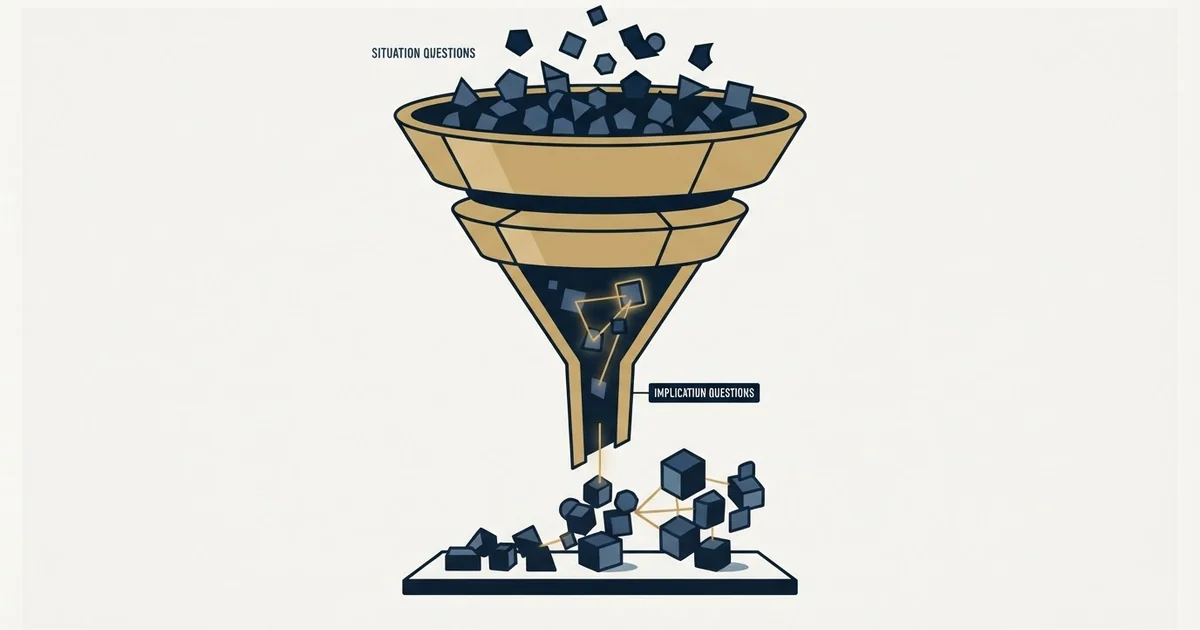
Implication questions take a problem the buyer has already stated and follow one consequence outward, covering time, money, blocked work, risk or people. Build them by using the buyer's own words for the problem, choosing a single axis, adding something specific to that business, and leaving the size of the answer to them.
Key takeaways
- One consequence per question. A question reaching for cost and risk at once gets answered on the easier half, and the seller records that half as the finding.
- Never propose the size of the consequence; a number the buyer produced is the one that survives a procurement review, and a number you supplied is one to argue with.
- Keep two or three situation questions whose answers cannot be looked up, and delete the rest, because senior buyers score preparation in the first few minutes.
- An implication question built on a problem the buyer never conceded reads as leading, and the correct move at that point is a problem question instead.
Reviewed and updated September 1, 2026
Halfway through a discovery call a seller asks how many people are on the support team. The answer is on the company's careers page, the buyer knows it is on the careers page, and the temperature of the conversation drops by a degree that never fully recovers. Twenty minutes later the same seller asks what happens if the backlog is still growing at the end of the quarter, and the buyer talks for three minutes without being prompted.
Those two questions come from the same framework. One is the class that does the work and one is the class that spends the buyer's patience, and the difference between them is the whole practical content of SPIN selling. This page is the example bank: twelve implication questions worth adapting, the situation questions worth keeping and deleting, and the construction rule that lets you write your own instead of borrowing anybody's.
What an implication question is doing
Implication questions take a problem the buyer has already named and follow its consequences outward. They do not introduce a problem, and they do not propose anything. Their only job is to move a stated difficulty from something the buyer mentioned to something the buyer has felt the size of.
The mechanism is that the buyer does the arithmetic. A consequence a seller states is a claim to be evaluated. The same consequence assembled by the buyer out loud is a position they now hold, and they hold it in front of the colleagues who will decide with them.
Which is why the class is the hardest of the four to fake. A generic implication question announces that the seller does not know how this kind of business works, and a buyer who reaches that conclusion answers everything afterwards in shorter sentences.
Twelve implication questions, grouped by the consequence they follow
Adapt the wording. The value is in which consequence each one reaches for, not in the phrasing.
Following cost and effort
- Walking through a typical week, how much of the team's time goes into working around that?
- When that goes wrong, who ends up fixing it, and what do they stop doing while they fix it?
- How much of what you are paying for that system is being spent on the part that does not work yet?
Following blocked work
- What is currently waiting on that being solved before it can start?
- If that constraint disappeared tomorrow, what is the first thing the team would do that they cannot do now?
- Which of this year's commitments depend on that being fixed first?
Following risk and exposure
- What is the worst version of that problem you have already seen happen here?
- If that happened during your busiest month rather than a quiet one, what changes?
- Who outside your team finds out when it goes wrong, and what do they do about it?
Following people
- What does that do to the people who have to deal with it every day?
- When somebody leaves the team, how much of the workaround leaves with them?
- What does a new starter have to learn that exists only because of this?
The last three are the ones sellers under-use, and in longer sales they are frequently the most productive. Cost arguments get audited by finance. Staffing pain gets raised by the person experiencing it, unprompted, in a meeting the seller is not in.
Two of the twelve deserve a note on how they behave. Question seven, asking for the worst version already seen, works because it requests a memory rather than a projection, and a remembered incident carries detail that a hypothetical never does. It also tends to surface who else was affected, which is the cheapest route into the decision map you will need later.
Question five, asking what the team would do first if the constraint disappeared, is the one most likely to be answered with genuine energy. It is also the one that most often produces the sentence a proposal should be built around, because the buyer has just described the outcome they want in their own vocabulary rather than agreeing to yours. Write that sentence down exactly as they said it.
The grouping matters less than the discipline of picking one axis per question. A question that reaches for cost and risk at once gets answered on whichever half is easier to talk about, and the seller records the easy half as the finding.
How to build your own in three moves
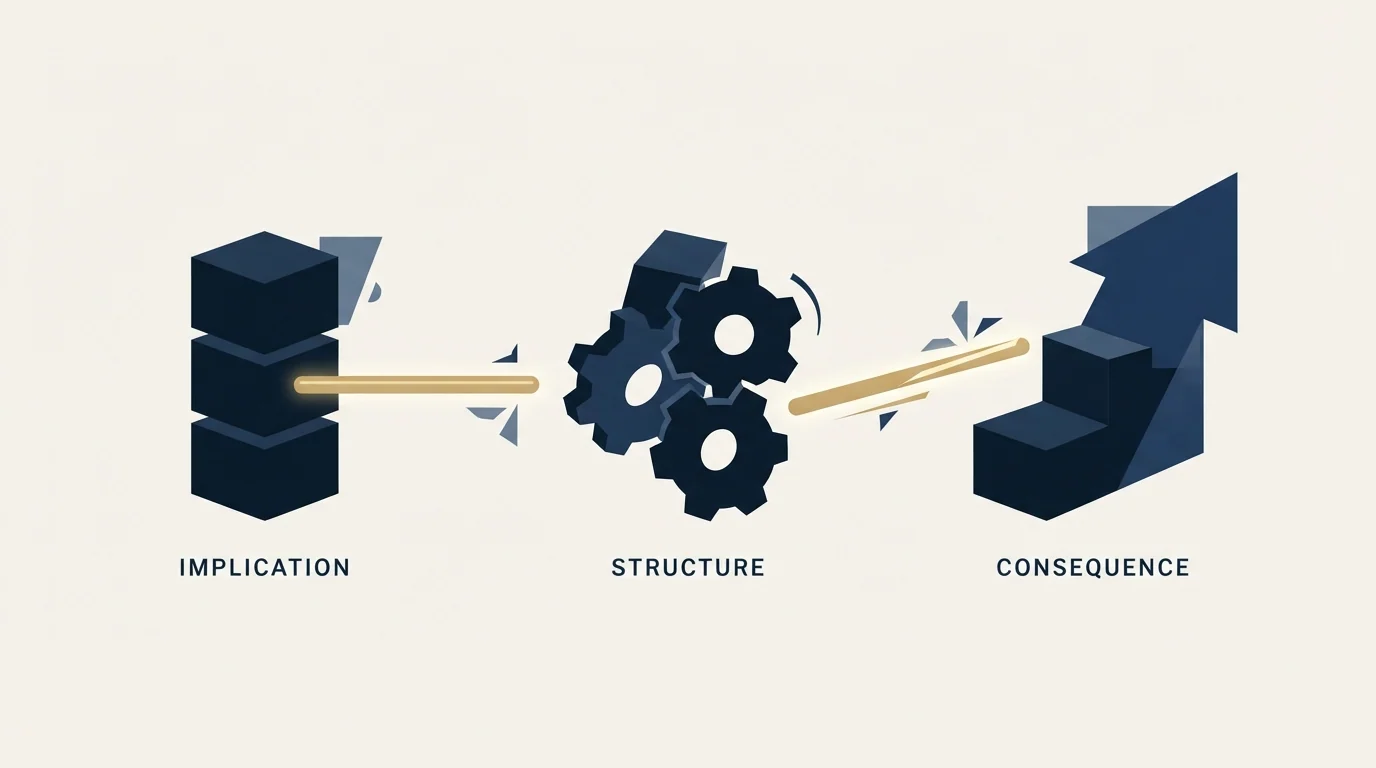
- Step 1Take the stated problem
Use their words, not your category name for it. If they said the handoff is messy, the question is about the handoff
- Step 2Pick one consequence axis
Time, money, blocked work, risk, or people. One per question, because a compound question gets answered on the easy half
- Step 3Add something only this business has
Their busy season, their regulator, their two-week close, the customer segment they named earlier
- Step 4Leave the size open
Ask how much or what happens rather than proposing a figure, because the number has to be theirs to survive procurement
The third move is where domain knowledge enters and it cannot be substituted. Asking what a problem costs is straightforward. Asking the specific question that makes a buyer stop and reconsider requires knowing how their business runs, which is research rather than technique. Narrowing the population you sell to is the cheapest way to acquire it, which is one of the underrated arguments for an ICP with the reasoning attached.
The fourth move catches the most common self-inflicted wound. A seller who says the delay is probably costing a day a week has handed the buyer a number to disagree with. A seller who asks how much time it costs gets a figure the buyer will defend later, to someone else.
Situation questions, and why most of them should be deleted
Situation questions establish the factual context: how the team is structured, what is in place today, how the process runs. They are the cheapest questions to ask, the easiest to prepare, and the standard failure mode of the whole framework, because most of the answers are available before the call.
The test is mechanical. A situation question earns its place when the answer cannot be looked up and genuinely changes what you ask next.
- How many people are in the sales team?
- What CRM are you using?
- How many offices do you have?
- Are you hiring at the moment?
- Who reports to whom in your team?
- What does your product do?
- Walk me through what happens between someone asking for a quote and the quote going out
- Which part of that has changed in the last year, and what prompted it?
- Where does that process sit when it is busy rather than when it is typical?
- Which of those steps did somebody build themselves rather than buy?
- Who has to be involved that is not in this conversation?
- What did you try before this that did not stick?
Three of the keepers are doing more than establishing facts. Asking what changed recently locates the trigger. Asking what was tried before locates the objection you would otherwise meet at proposal. Asking who is not in the conversation begins the map of the buying committee, which is the single thing SPIN's original framing does least to help with.
The practical budget is small. Two or three earned situation questions, then move. A senior buyer reads the number of researchable questions as a measurement of preparation, and forms that judgement inside the first few minutes.
Where an example bank goes wrong
Three failure modes account for most of the damage done by pages like this one.
Asking the list in order. The four classes describe dependencies, not a running order. An implication question cannot land before a problem has been named, and a buyer who opens by naming their problem has skipped a stage for you. Returning to situation questions to keep the order tidy spends attention on nothing.
Supplying the implication yourself. The temptation is strong, because the seller can usually see the consequence faster than the buyer can articulate it. Saying it out loud converts the buyer from a participant into an audience and evaporates the commitment the class was designed to produce. A silence after a well-placed question is the method working.
Following a problem the buyer never conceded. Implication questions built on a difficulty the seller assumed read as leading, and experienced buyers recognise it immediately. If the problem was not stated in their words, the question to ask is a problem question, not a consequence.
- Yes: Every situation question has an answer that cannot be looked up
- Yes: At least two implication questions name something specific to this company
- Yes: Each implication question follows a problem you expect them to state, in their words
- Yes: There is an answer they could give that would end the conversation honestly
- Yes: The plan survives them answering in a different order
- No: Any question proposes the size of the consequence for them
- No: The set would work unchanged for a company in another industry
The final item is the quickest audit of a borrowed question list, including this one. A set that transfers unchanged to any company is a set that establishes nothing, and the twelve above are starting shapes rather than a script for that exact reason.
Where these questions cannot help
Every question in this page assumes a conversation that already exists, with a person who has a stake in the answer. The framework says nothing about how that meeting came about, which is easy to overlook because it is so complete about everything after the introductions.
That gap is the practical one, because a well-built question set is wasted on the wrong person. Our own approach upstream of the call is deliberately narrow: one message per campaign, one premise, sent once, and any later approach run as a separate campaign with its own reason to exist rather than as a reminder of the first. The premise has to be true and specific enough to earn a considered buyer's attention on its own, which is the same standard the twelfth question on this page has to meet. What the templates people use to request these conversations reveal shows how much of the outcome is settled before anybody asks a question, and structuring the whole meeting around disqualifying well is the same discipline applied beyond one question class.
The short version

Implication questions take a problem the buyer stated and follow one consequence outward: time, money, blocked work, risk or people. Build them by taking their words, picking one axis, adding something only this business has, and leaving the size of the answer to them.
Delete most of your situation questions, keeping only the two or three whose answers cannot be looked up and would change what you ask next. Never supply the implication yourself, and never follow a problem the buyer has not conceded. Where the constraint is the supply of conversations to ask any of this in, that is the half we run: see what a first campaign produces.
Frequently asked questions.
Frequently asked questions- What is an implication question in SPIN selling?
- A question that takes a difficulty the buyer has already named and follows its consequences outward: what it costs, what it blocks, who else it affects, what happens if it continues. It introduces no new problem and proposes nothing. Its purpose is to have the buyer, rather than the seller, assemble the size of the problem out loud.
- How many implication questions should I plan for a call?
- Two or three specific ones, prepared in advance, rather than a long list. They depend on which problem the buyer actually states, so a set of twelve prepared questions mostly goes unused. Preparation pays off in this class and almost nowhere else, because the specific ones require knowing how that business runs.
- What is the difference between implication and need-payoff questions?
- Implication questions explore the cost of the problem continuing. Need-payoff questions ask the buyer to describe the value of solving it. The order matters: a value question asked before any consequence has been felt reads as an attempt to lead the buyer somewhere, and it is the point at which experienced buyers disengage.
- Which situation questions are worth asking?
- The ones whose answers are not published and would change what you ask next. Ask a buyer to walk through what happens between two points in their own process, what changed recently and what prompted it, what they tried before that did not stick, and who has to be involved who is not in the conversation.
About the author.

Ben Carden is CRO at RevenueFlow, which builds and operates outbound revenue engines for B2B companies. Previously at Gartner Enterprise. Studied at London School of Economics.
Ben Carden · CRO
Connect on LinkedIn →Explore more.
Ready to scale your outreach?
We build GTM engines that book real meetings. See the receipts.
Related articles.
Sales Call Planning: The Plan a Booked Call Needs
A call cannot produce a commitment nobody named in advance. The four fields a call plan carries, and why the ask has to be decided before the meeting opens.
Solution Selling: The Generic Term and the Licensed Method
One name covers a generic problem-led posture and a specific licensed methodology. The lineage, the three moves that matter, and the assumption that aged badly.
The NEPQ Sales Process: Seven Phases
Connection through presentation, in the order 7th Level publishes them, plus where a sequence built for one decision maker starts to strain in a committee purchase.
The Consultative Sales Process: What Diagnosis Costs
Diagnosis before prescription is easy to say and expensive to run. What the approach actually requires, and why proposal volume falls before close rate rises.
Monthly Sales Meeting Agenda: What the Month Decides
The weekly meeting triages deals in flight. The monthly one closes a period and changes the list. Six blocks, ninety minutes, one output each.
The Sandler Selling System: Seven Steps, One Worth Stealing
Sandler puts the presentation sixth of seven, after budget and the decision process. The seven published steps, and the up-front contract worth taking on its own.