SPIN Selling: The Question Order, and What It Assumes Already Happened
SPIN Selling is a questioning method from Neil Rackham's 1988 book, ordering discovery as Situation, Problem, Implication and Need-payoff questions. The order describes dependencies rather than a script, and the framework starts inside a live conversation, so it says nothing about how that conversation was booked.
Key takeaways
- SPIN names four question types in dependency order, so Implication questions cannot land before a problem has been conceded and Need-payoff questions are hollow before a consequence has been felt.
- Situation questions are the common failure: any one whose answer could have been researched spends a senior buyer's patience in the opening minutes of a meeting.
- Implication questions require real knowledge of how the buyer's business works, which is a research cost the framework identifies but does not supply.
- The method was built for high-value considered purchases with one person in a live conversation, and it addresses neither transactional buying nor how the meeting was arranged.
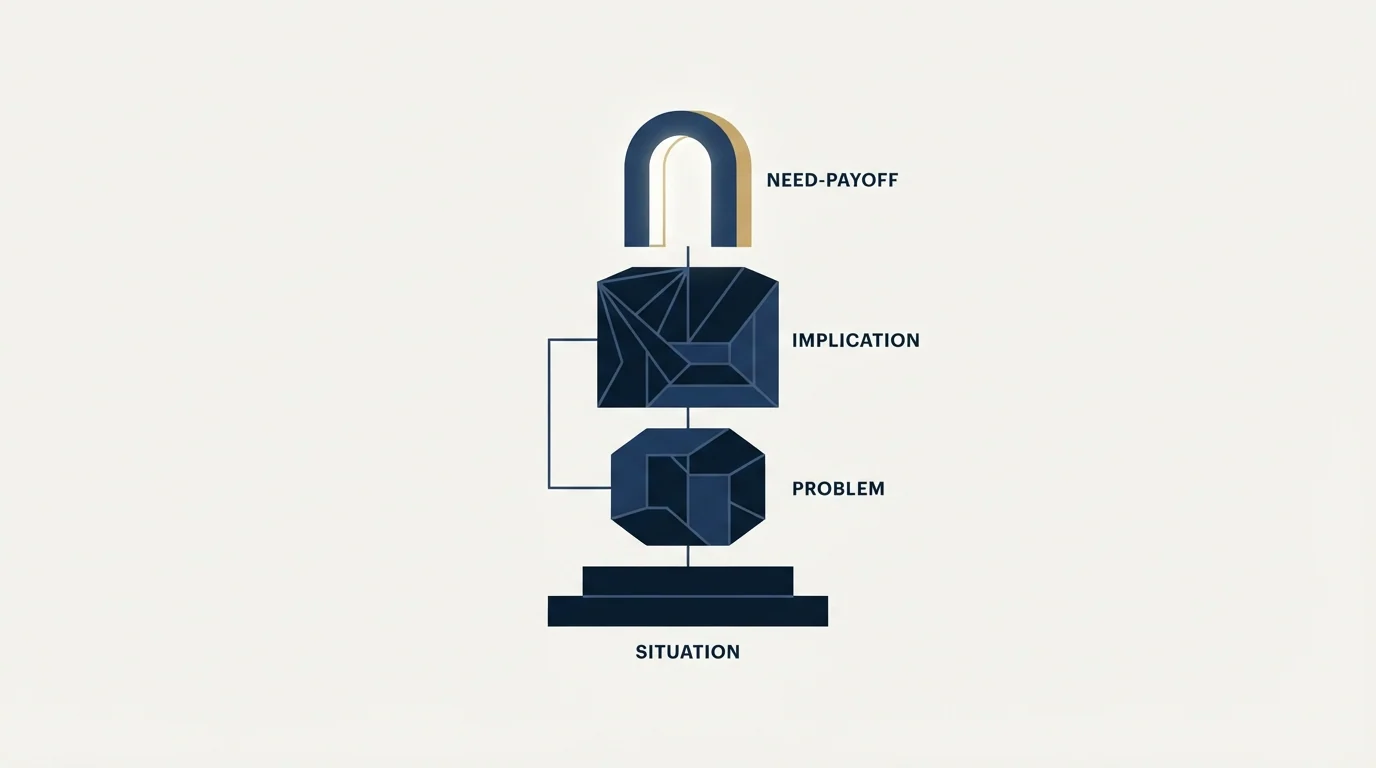
SPIN Selling is a questioning method for sales conversations, built around four kinds of question asked in a deliberate order: Situation, Problem, Implication and Need-payoff. It comes from Neil Rackham's book of the same name, published in 1988, and it is still taught widely as a structure for the discovery half of a complex sale. The four letters are usually presented as a framework. They work better understood as an order of operations.
The order is the whole idea. Each class of question is doing something the previous class made possible, and asking them in a different arrangement produces a conversation that feels like an interrogation rather than a diagnosis.
The SPIN sales methodology, as training providers usually label it, is those four question classes and the order they depend on.
The SPIN sales methodology and SPIN selling are one term rather than a method and a technique built on top of it, and the four question classes below are the whole of both.
The four question types, and what each one is for
Situation questions establish the factual context: how the team is currently structured, what tools are in place, how the process runs today. They are the cheapest questions to ask and the least valuable to hear the answer to, because the answers are frequently available elsewhere.
Problem questions surface difficulties, dissatisfactions and constraints in that context. This is where the conversation stops being an audit and starts being a conversation. A problem question invites the buyer to say something that is not on their website.
Implication questions take a stated problem and follow its consequences outward: what it costs, what else it blocks, who else it affects, what happens if it persists through the next planning cycle. This is the class of question that does the actual work, and it is the one most sellers under-use, because it requires enough understanding of the buyer's business to know which consequences are real.
Need-payoff questions ask the buyer to articulate the value of solving the problem. The mechanism being exploited is that a buyer who describes the benefit in their own words has committed to a position, whereas a buyer who has had the benefit described to them has merely listened politely.
- FirstSituation
Facts about how things work today, kept short because most of them are researchable in advance
- ThenProblem
Difficulties and constraints inside that context, in the buyer's own description
- ThenImplication
What the stated problem costs, blocks and affects if it continues
- LastNeed-payoff
The buyer articulating the value of solving it, in their own words
The argument underneath the acronym
The four letters are the memorable part, and the memorable part is not the interesting one. Rackham's underlying claim was that the behaviours which work in small, quick sales do not transfer upward, and that as the value and consequence of a purchase rise, the seller's job shifts from persuading toward diagnosing. Pressure that closes a small decision tends to stall a large one, because a large decision involves people who have to defend it internally afterwards.
The motion on the other side of that boundary, where the margin on one sale will not repay a diagnostic conversation, is transactional selling.
The framework that takes the same objection to scripted questioning and rebuilds qualification around it is NEAT Selling, which keeps four things a seller has to establish and drops the fixed order entirely.
That claim is what gives the question order its logic. If the objective were persuasion, the efficient move would be to present the strongest case as early as possible. If the objective is diagnosis, presenting early is a mistake, because a proposal made before a problem is agreed forces the buyer to evaluate a solution to a problem they have not yet accepted having. The order exists to delay the pitch until the buyer has done the work of defining what needs solving.
Understood that way, the framework is less a sales technique than a discipline of restraint. Most of what it prescribes is about what not to say yet, and most of what goes wrong with it in practice is impatience rather than misunderstanding.
A later method built on the same restraint, which measures the gap between a buyer's current state and future state before trusting any stated need, is compared with it in Gap Selling vs SPIN Selling.
Where the textbook version starts to mislead
It is treated as a script, and it was never one. The four letters name categories of intent, and a conversation that walks them literally, four questions in four blocks, is immediately recognisable as a technique being performed. The order describes dependencies rather than a running order for a meeting. Implication questions cannot land before a problem has been named, and Need-payoff questions are hollow before an implication has been felt, but nothing requires the categories to arrive in tidy groups.
Situation questions are the standard failure mode. They are the easiest to prepare and the most tempting to lean on, and every one of them asked about something publicly available spends the buyer's patience on information the seller could have found. A senior buyer reads a question about their headcount, their tech stack or their fiscal year as evidence about how much preparation went into the meeting, and that inference is made in the first two minutes. The practical rule is that a Situation question is only worth asking when the answer cannot be looked up and genuinely changes what comes next.
Implication questions require domain knowledge that the method does not supply. Asking what a problem costs is straightforward. Asking the specific question that makes a buyer stop and reconsider requires knowing how their business actually works, which is a research cost rather than a technique. This is the honest limit of any questioning framework: it tells you what kind of question to ask and it cannot tell you what the question is.
Need-payoff questions curdle when the problem was manufactured. If the buyer never conceded a real problem, asking them to describe the value of solving it reads as an attempt to lead them somewhere, and experienced buyers recognise it instantly. The method assumes the earlier stages worked. When they did not, the last stage makes that visible.
It has nothing to say about how the meeting happened. The framework begins with two people already in conversation. Everything upstream of that moment is outside its scope, which is easy to forget precisely because the framework is so complete about what it does cover.
- The order in which question types build on each other
- How to move from stated fact to felt consequence
- Getting the buyer to articulate value themselves
- Diagnosing before proposing anything
- Working through a considered purchase rather than a quick one
- That the company is a genuine fit for what is sold
- That the person in the room has a stake in the outcome
- That a meeting was booked in the first place
- That enough research was done to skip the obvious questions
- That there is a business reason for the conversation to exist
What it was built for, and where that boundary sits

The method was developed for high-value, considered purchases: long evaluations, several people involved, real consequences to getting it wrong. That context is doing more work than it appears. In a considered purchase the buyer benefits from being asked good questions, because the diagnosis is genuinely useful to them, and the length of the process leaves room for a conversation that develops rather than closes.
Shift the same technique into a low-value transactional purchase and the economics invert. A buyer deciding something small does not want a diagnostic interview, and the questioning that builds a complex sale simply extends a simple one. Rackham's framework has never claimed otherwise, but the framing rarely survives into the training deck.
The other boundary is the number of people. SPIN describes a conversation between a seller and a buyer. Complex purchases are decided by several people with different stakes, most of whom are not in the room when the questions are asked, and a well-run discovery conversation with one person still leaves the rest of the buying committee unaddressed. The framework improves the quality of one conversation. It does not tell you how many conversations the deal needs.
It says as little about how many people from your own side belong in the room, which is the decision team selling actually turns on.
- Yes: Every Situation question has an answer that cannot be looked up beforehand
- Yes: At least two Implication questions are specific to this company rather than generic
- Yes: The problems being probed are ones this business plausibly has
- Yes: There is a real disqualifying answer that would end the conversation honestly
- Yes: The plan survives the buyer answering in a different order
- Depends: Nothing in the plan requires the buyer to agree with a premise they have not stated
- Depends: The value question can be skipped if the problem never gets conceded
How to use it well
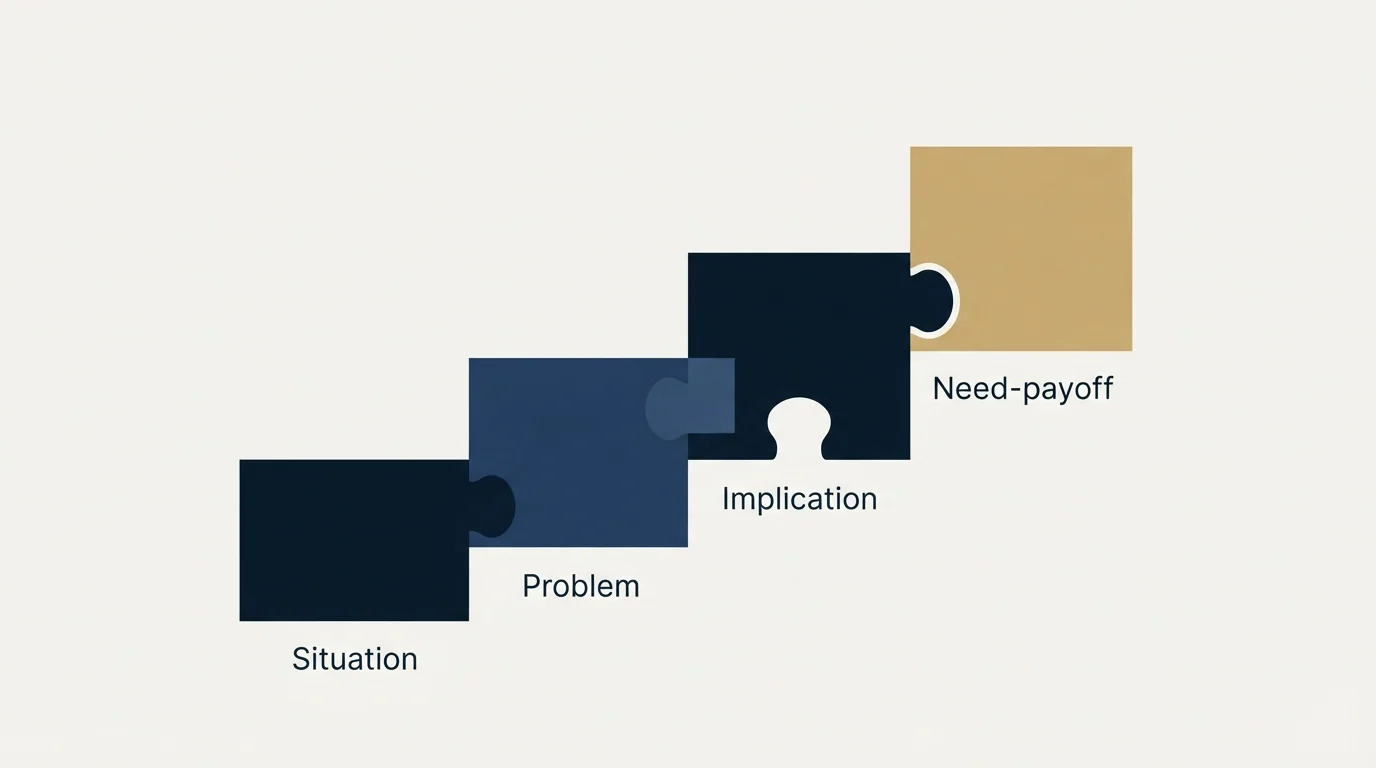
Prepare the Implication questions and improvise everything else. The Situation layer should mostly be research done before the meeting, the Problem layer is best left open enough for the buyer to take it somewhere unexpected, and the Need-payoff question writes itself once an implication has actually landed. Effort spent in advance pays back on the third class and nowhere else.
That is also why spin selling examples are worth reading for the Implication class and close to useless for the others: worked examples of the class that has to be specific to one company are the only ones that transfer, and our own set of them is in the implication questions collection.
Treat the order as a diagnostic rather than as a plan. If a conversation feels stuck, the usual reason is that a stage was skipped: a proposal offered before a problem was conceded, a value question asked before any consequence was felt. Naming which stage was jumped is a faster fix than adding more questions.
Write the questions down and then throw away the running order. Preparation and rigidity are easy to confuse, and the difference shows up the moment a buyer answers a Problem question with something the seller did not anticipate. A prepared seller follows that answer. A scripted one returns to the list. Everything valuable in the method lives in the first response, which is why the framework survives being taught badly only when the person taught it is comfortable improvising.
Watch for the version where the seller supplies the implication themselves. The temptation is strong, because the seller usually can see the consequence faster than the buyer can articulate it, and saying it out loud feels efficient. It converts the buyer from a participant into an audience, and the commitment the method was engineered to produce evaporates. A silence after a well-placed question is the framework working.
Be willing to end it early. A questioning method's most useful output is sometimes the discovery that the problem it was built to explore does not exist here. Structuring a discovery call around disqualifying well is the same discipline applied to the whole meeting rather than to one question class, and it is the part most sales training treats as failure.
Read it alongside its successors rather than as a settled answer. Winning by Design's SPICED framing and the assumptions inside it covers similar ground with a different emphasis, and the Challenger approach argues that the insight a seller brings matters more than the questions they ask. Each of them is describing the same conversation from a different angle, and none of them addresses how the conversation gets scheduled.
That last gap is the practical one, because the framework's quality is wasted on a meeting with the wrong person. Our own answer upstream of it is deliberately narrow: one message per campaign, one premise, sent once, and any later approach run as a separate campaign with its own reason to exist. The premise has to be true and specific enough to earn a considered buyer's attention on its own, which is the same standard a good Implication question meets. What a booked meeting actually costs is the arithmetic behind that decision, the templates people use to request those conversations show how much of the outcome is decided before anyone asks a question, and our pay per qualified meeting offer prices the conversation rather than the activity.
Frequently asked questions.
Frequently asked questions- What do the letters in SPIN selling stand for?
- Situation, Problem, Implication and Need-payoff. Situation questions establish factual context, Problem questions surface difficulties inside it, Implication questions follow the consequences of a stated problem outward, and Need-payoff questions ask the buyer to describe the value of solving it in their own words rather than hearing it described to them.
- Is SPIN selling still relevant?
- The question order still describes how a considered purchase gets diagnosed, which has not changed. What has changed is the research burden: buyers now expect the factual context to be known in advance, so the Situation layer belongs largely in preparation rather than in the meeting, and the Implication layer carries almost all of the value.
- What is the most common mistake when using SPIN?
- Running it as a script in four blocks, which is recognisable as a technique being performed. The second most common is the seller supplying the implication themselves because they can see it faster than the buyer can say it. That converts the buyer into an audience and removes the commitment the method exists to produce.
- Does SPIN selling work for small or transactional sales?
- It fits poorly. The method was developed for purchases with long evaluations, several people involved and real consequences to getting it wrong, where a buyer benefits from being asked good questions. A buyer deciding something small does not want a diagnostic interview, and the same questioning simply lengthens a short decision.