NEAT Selling: What Replaces Budget and Authority
NEAT selling is a sales qualification and discovery framework created by Richard Harris of The Harris Consulting Group. It stands for Need, Economic impact, Access to authority and Timeline, is worked in any order, and replaces BANT's budget question with the cost of doing nothing and its authority question with a path to the deciders.
Key takeaways
- NEAT selling stands for Need, Economic impact, Access to authority and Timeline, and its owner's page says it is built to be worked in any order.
- It replaces BANT's budget question with the cost of doing nothing, because a modern solution often had no budget line a year earlier.
- Access to authority asks whether your contact can reach the people who decide, since most champions cannot sign and decisions are group decisions.
- Its weakness is inspection: four qualitative answers are harder to score than four CRM fields, so a team has to decide how the evidence is recorded.
NEAT Selling is a sales qualification and discovery framework built on four things a seller has to establish about a deal: Need, Economic Impact, Access to Authority, and Timeline. Its owner's page describes it as "a sales qualification and discovery methodology created by Richard Harris, founder of The Harris Consulting Group", and states that it "is built to be worked in any order, because real sales conversations don't move in a straight line" (theharrisconsultinggroup.com, page last modified 10 August 2026, fetched 2 September 2026).
That last clause is the design decision that separates it from everything adjacent to it. BANT and MEDDIC are sequences a seller works through. NEAT is four things a seller has to end up holding, in whatever order the conversation supplies them.
What is NEAT selling?
NEAT selling is a way of qualifying a sales opportunity by establishing four things: the buyer's core Need, the Economic impact of leaving it unsolved, whether your contact gives you Access to the people with authority, and the Timeline event that makes the decision urgent. It was created by Richard Harris as a replacement for BANT, and unlike BANT it has no fixed order. The questions that establish each of the four are sorted in sales qualifying questions.
What the four letters ask
The framework's own page is the source for what each letter is meant to do, and each one is a deliberate correction of a question the older frameworks ask badly.
N, Need. The core problem rather than the stated one. The owner's page draws the distinction directly: the letter is about "the layered pains, not the surface-level need", and it sets a test for whether a seller has found it. Its wording is that "If a rep can't articulate the core pain in the prospect's own words, they haven't found the need yet, they've only found a talking point." That test is checkable in a deal review by asking one question, which is more than most qualification criteria manage.
E, Economic Impact. What the problem costs if nothing changes, in money and in risk. The page is explicit that this is a replacement for the budget question rather than a rewording of it: "It's not about the budget." The reasoning it gives is that a modern solution often "didn't exist as a line item a year ago", so asking whether a buyer has allocated money for it tests whether they have already solved the problem you are describing. The framework's own image for the distinction is a headache against a migraine.
A, Access to Authority. Whether your contact can get you in front of the people who decide, not whether your contact is one of them. The page states the position bluntly, that "Most champions cannot sign the contract, full stop", and that "Decisions are group decisions and it's about getting access to the authority figures, not just one." The failure mode it names is the reason the letter exists: "One champion with no path to the rest of the buying committee is not access, it's a rumor." The concept underneath it is the buying committee, and the person it is trying to reach is the economic buyer.
T, Timeline. The event that makes the decision urgent, rather than a date somebody offered. The page's line is that "A date on a calendar is not a timeline", and it names the questions that test one: "what breaks? Who notices? What's the cost of waiting?" It also states the sequencing point that most timeline coaching gets backwards, that urgency is discovered rather than created: "A sales rep cannot create urgency. They can discover an economic impact that feels like a migraine."
N
Need
The core pain can be stated in the buyer's own words, not the seller's.
E
Economic impact
The cost of doing nothing is expressed in money or in risk. A budget line for the category may not exist yet, and that is not the test.
A
Access to authority
There is a named path to the people who decide, not one enthusiastic contact.
T
Timeline
The timeline names an event, and what breaks if it slips.
not the test Collecting all four in a fixed order in one call
Why it matters, and what it was built against
Every qualification framework encodes an assumption about who holds the information. The reason a new one appears is that the assumption stopped being true.
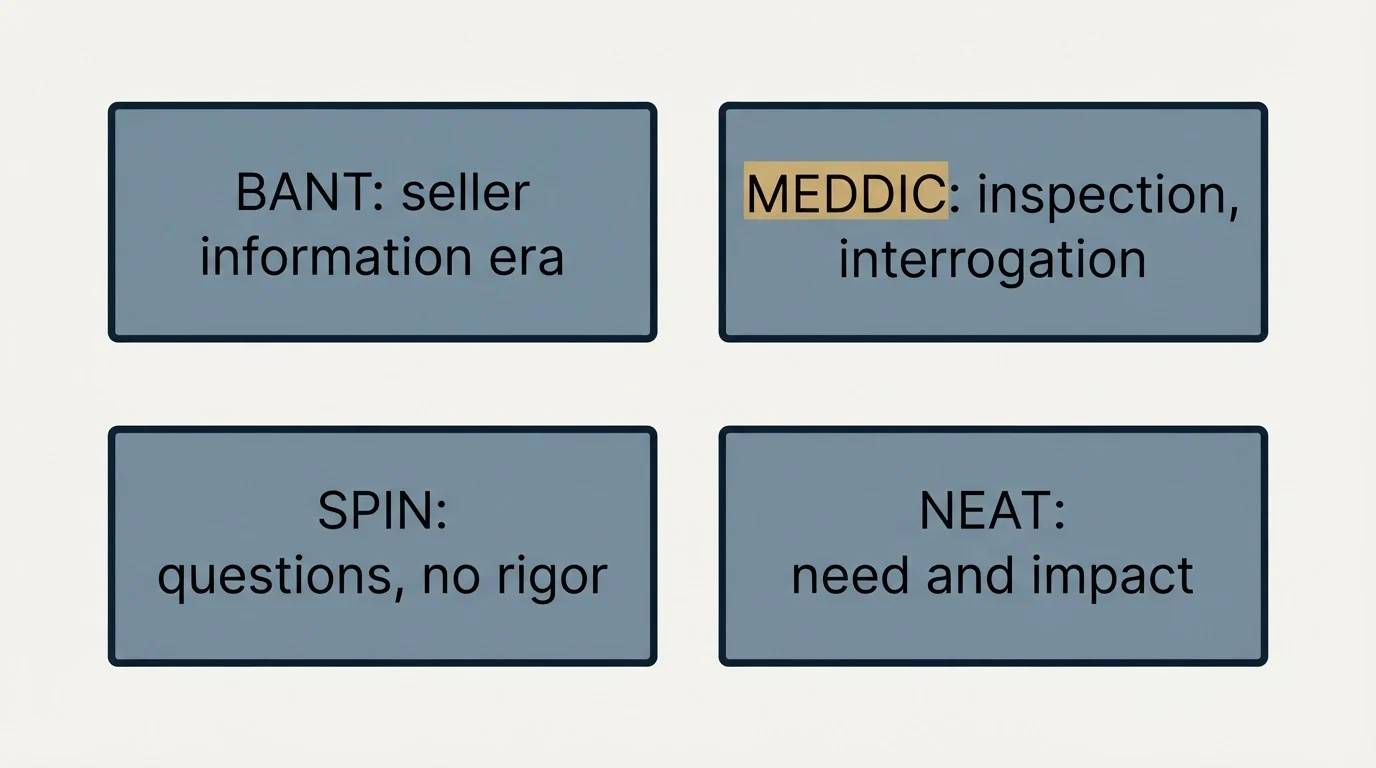
The owner's page makes that argument about BANT directly, writing that it "was built by IBM in the 1960s for a world where sellers had more information than buyers. That world is gone." Its objection to MEDDIC is different and narrower: MEDDIC "is strong for deal inspection on enterprise deals that are already in motion, but it turns discovery into a checklist and buyers feel interrogated". Against SPIN, the page's position is that it "gets reps asking better questions but doesn't give them a structure for qualifying access or timeline with any rigor".
Those are the framework's own claims about its neighbours, and they are worth reading as a design brief rather than as a verdict. What they describe is a buyer who arrives having already researched the category, brings several colleagues into the room, and can tell quickly whether a seller is running a script.
The practical cost of the older ordering is specific. Opening on budget and authority puts the two most transactional questions first, at the moment the seller has done least to earn them, and a buyer who answers them defensively teaches the seller nothing except that the conversation has become an interview. Starting on need and impact inverts that, and the qualification information arrives as a by-product of a conversation the buyer wanted to have.
| Framework | Built to do | Weakest where |
|---|---|---|
| BANT Budget, Authority, Need, Timing | Fast to teach and fast to score. Assumes an allocated budget line exists and front-loads the two most transactional questions | The category is new |
| MEDDIC Six things to prove | Inspecting deals already in motion. Strong on metrics and the decision process, and heavier per deal | Used in discovery, where it reads as an interrogation |
| NEAT Need, Economic impact, Access, Timeline | Replaces the budget question with a cost of inaction, asks for a path to the deciders, works in any order | Scoring, because the evidence is qualitative |
Where the framework is weaker than its own page says
A definition page is a poor place to look for a framework's limits, so three are worth stating plainly.
Qualitative criteria are harder to inspect. BANT's appeal is that its four answers fit in four CRM fields and a manager can scan a hundred deals in a morning. NEAT's four answers are paragraphs, and a manager reading a hundred paragraphs is doing something different from a pipeline review. Teams that adopt it without deciding how it will be recorded end up with the framework in the training and BANT in the CRM.
Order-free is not effort-free. The flexibility that makes it a better conversation makes it a worse checklist, because there is no point in the call where the seller has obviously finished. Something has to force the coverage question, and in practice that is a deal-review standard rather than the framework itself.
It does not settle what happens next. Qualification tells you whether to keep spending time on a deal. It does not tell you what the next stage requires or what evidence moves the deal into it, and a framework used as a stage definition produces a pipeline whose stages describe seller confidence rather than buyer action. That boundary is the subject of sales pipeline stages, and the general form of the argument is in lead qualification.
The framework and the permission to run it are separate things. The owner's page is unusually direct about this, treating what it calls the Respect Contract as the precondition: "N.E.A.T. tells a rep what to ask. The Respect Contract is what earns them the right to ask it." The mechanism it describes is an up-front frame that confirms the time, states a mutual purpose, and gives the buyer permission to end the conversation. Skipping it, the page argues, turns the four letters into "just another set of questions a stranger is firing at a prospect".
How it is used in outbound

Qualification frameworks are written for a conversation that already exists, and an outbound programme has to do something with them before one does. Three of the four letters are genuinely usable earlier, and one is not.
Economic Impact is a targeting instrument before it is a discovery one. The cost of the problem is a property of the account rather than of the conversation, so it can be reasoned about from the outside. A segment where the problem is expensive and a segment where it is annoying produce different reply rates to the same message, and the second one is a list that should not have been built. That reasoning belongs in the criteria stage, which is the work the ideal customer profile guide sets out.
Need decides the premise, not the pitch. The first message makes a claim about a situation the account would recognise, and the claim is a hypothesis about the core pain rather than a description of the product. A message written from the surface-level need reads like every other message the buyer received that week, because the surface-level need is the part every competitor also knows.
Access to Authority decides who is contacted. If decisions are made by a group, the outbound question is which member of that group can convene the others, and that is often not the most senior title on the list. The reply from a person with no path to the deciders is a conversation rather than a deal, and counting it as one is how a meeting standard drifts.
Timeline is the letter outbound cannot know. Nothing observable from outside an account tells you when its internal clock turns over, which is why timing is the variable an outbound programme buys volume to solve rather than intelligence to predict. Fit can be established before the first message; timing cannot.
| Letter | Usable before the first message? | Where it is used |
|---|---|---|
| Economic impact | Yes | Targeting: build the list where the problem is expensive, not where it is annoying |
| Need | Yes | The premise: a hypothesis about the core pain, not a description of the product |
| Access to authority | Yes | Who is contacted: the member of the group who can convene the others |
| Timeline | No | Nothing observable from outside says when the internal clock turns over. Fit can be established first; timing cannot |
One boundary from our own practice applies to all four. We run one message per campaign, with no bumps and no thread replies. The full trade is in why we stopped using follow-ups. The consequence for qualification is that there is no later touch in which a weak premise gets corrected, so the need hypothesis has to be right on the list rather than in the sequence. The commercial standard sits in the same place: meetings are qualified against criteria agreed in writing before launch, which for a NEAT-run team means deciding in advance whether a champion with a stated path to the deciders counts, or whether the deciders themselves are required.
The short version
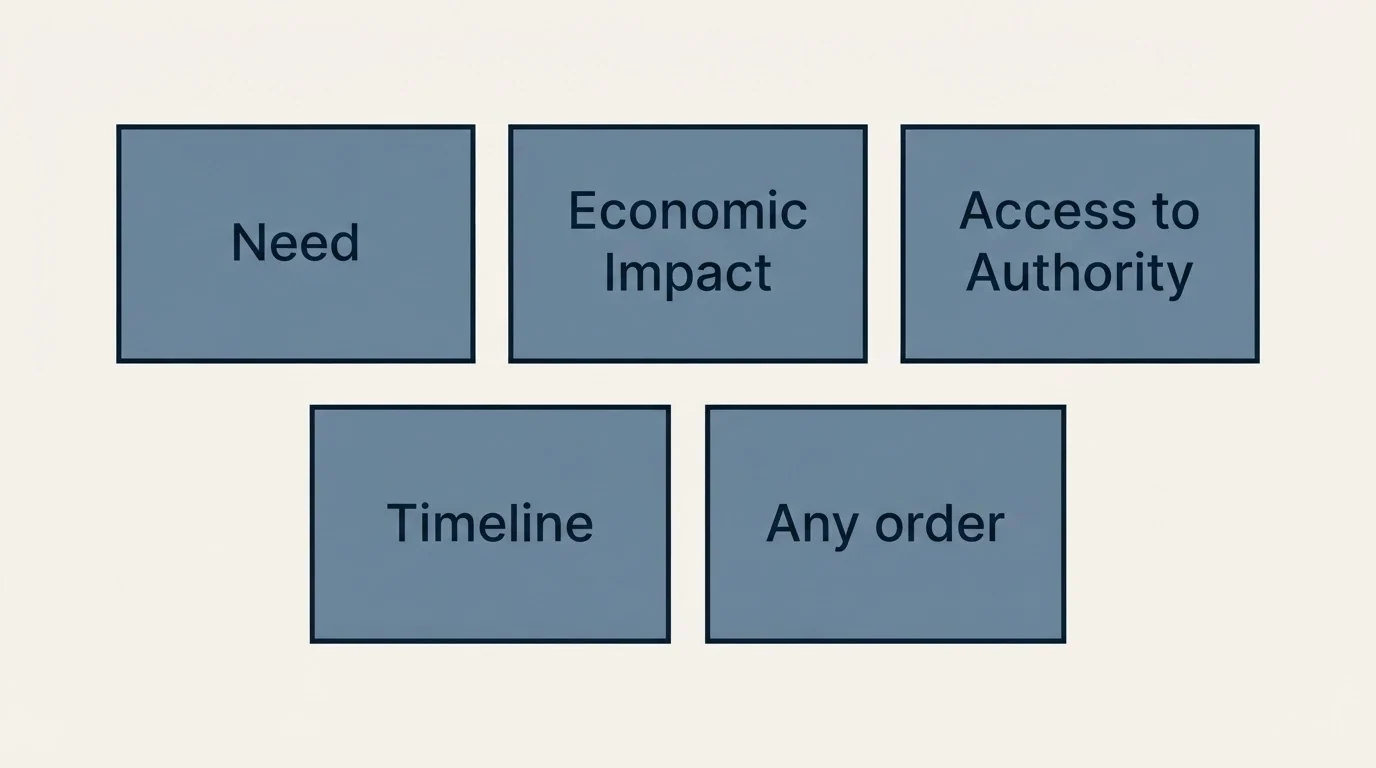
NEAT Selling is Need, Economic Impact, Access to Authority and Timeline, a qualification and discovery framework created by Richard Harris of The Harris Consulting Group and built to be worked in any order rather than as a sequence. It replaces BANT's budget question with the cost of doing nothing, and its authority question with whether your contact can get you in front of the people who decide.
Its strength is that the qualification information arrives as a by-product of a conversation the buyer wanted to have. Its weakness is that four qualitative answers are harder to inspect than four CRM fields, so a team adopting it has to decide how the evidence gets recorded or it will run NEAT in training and BANT in the pipeline.
The adjacent entries are BANT, MEDDIC, MEDDPICC, SPIN Selling and Challenger Sale. The objection side of the same job is in auditing an objection library, and if the constraint is that too few qualified conversations exist to run any framework on, see what one campaign against your list produces.
The four letters, "Need, Economic Impact, Access to Authority, and Timeline", and every other line inside quotation marks above are verbatim from The Harris Consulting Group's own N.E.A.T. Selling page, fetched 2 September 2026, publisher modification date 10 August 2026. Publishers revise these pages, so confirm the current text before relying on it.
Frequently asked questions.
Frequently asked questions- What is NEAT selling?
- NEAT selling is a sales qualification and discovery framework created by Richard Harris, founder of The Harris Consulting Group. The letters stand for Need, Economic impact, Access to authority and Timeline. Its owner's page says it is built to be worked in any order, because real sales conversations do not move in a straight line.
- What does NEAT stand for in sales?
- Need, meaning the core pain under the stated one. Economic impact, what the problem costs if nothing changes. Access to authority, whether your contact can get you in front of the people who decide. And Timeline, the event that makes the decision urgent, together with what breaks if it slips.
- What is the difference between NEAT and BANT?
- BANT asks about Budget, Authority, Need and Timing in sequence, and assumes an allocated budget line exists. NEAT replaces the budget question with the cost of doing nothing, replaces are you the decision maker with whether there is a path to the deciders, and can be worked in any order. NEAT is harder to score in a CRM.
- What are the limits of NEAT selling?
- Three are worth knowing. Its four answers are qualitative, so a manager cannot scan a hundred deals the way four BANT fields allow. With no fixed order there is no point where a seller has obviously finished, so a deal-review standard has to force coverage. And it qualifies a deal without defining what the next pipeline stage requires.