Team Selling: Who Joins the Deal, and When
Adding people to a deal often reads as a display of commitment. The version worth running names the seat, the trigger for it, and who still owns the thread.
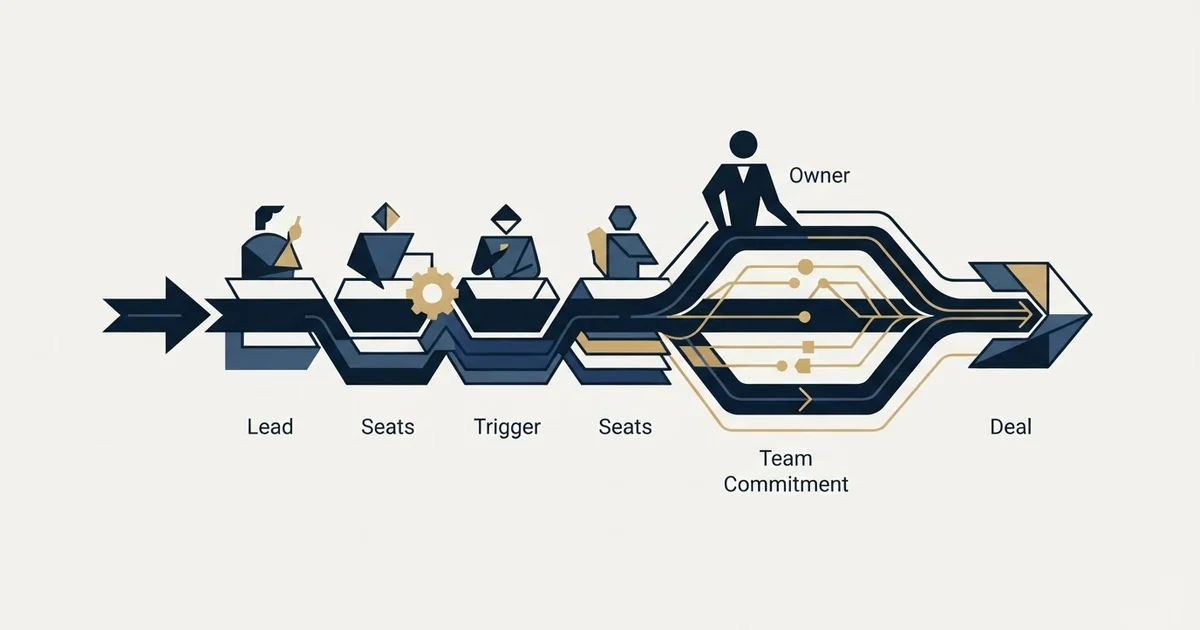
Team selling is the practice of putting more than one person from the selling side into a deal, with each of them owning a piece of the work the others cannot do. A seat earns its place when the buyer asks a question the current owner cannot answer with authority, and one person keeps the thread.
Key takeaways
- Team selling means more than one person from the seller's side working a deal, each owning a piece of the work the others are not equipped to do; a second person with no assigned job is attendance.
- The seats that recur are the owner of the thread, of the technical claim, of the risk conversation and of what happens after signature, and most deals need them at different moments.
- Add a seat when the buyer asks a question the current owner cannot answer with authority, such as a data-residency requirement, an escalation path or a delivery date; the question names the seat.
- Gartner's B2B buying journey page reports that 75% of B2B buyers prefer a rep-free sales experience, so every added seat has to leave the deal a fact, a constraint or a commitment.
Reviewed and updated September 21, 2026
Four people from the seller's side join a call that two people from the buyer's side are attending. The account executive runs the agenda. The solutions engineer answers one question. The VP says a version of what the account executive already said, in a warmer voice. The customer success lead says nothing at all and leaves after twenty minutes. Afterwards the internal note records a good call, and the buyer's note, if they wrote one, records a meeting that took an hour and produced one answer.
That is the version of team selling nobody defends and a lot of companies run. The idea underneath it is sound and the execution is usually undecided: adding people is treated as a display of commitment rather than as a set of choices about who owns what.
What is team selling?
Team selling is the practice of putting more than one person from the selling side into a deal, with each of them owning a piece of the work that the others are not equipped to do. The load-bearing phrase is owning a piece of the work. A second person who has no assigned job on the call is attendance, and attendance costs the buyer time without giving them anything.
The team selling approach worth running therefore starts from the work: which seats a deal needs, what event triggers each one, and who still owns the thread when the call ends.
What separates a team-sold deal from a crowded call
The test is whether each additional person leaves behind something the deal did not have before. A solutions engineer who confirms that an integration exists has moved the deal. A solutions engineer who watches a discovery conversation has spent an hour of a scarce resource on reassurance.
This distinction matters because the failure mode is invisible from the inside. Everyone on the seller's side experienced a full call with senior attendance and came away feeling the account is well covered. The buyer experienced a longer meeting with the same information density as a shorter one. Nothing in a CRM record separates those two events, so the habit persists.
| Seat | What they did | New to the deal |
|---|---|---|
| Account executive | Ran the agenda | The owner's job |
| Solutions engineer | Answered one question | One answer |
| VP | Said a version of what the account executive already said, in a warmer voice | A repeat |
| Customer success lead | Said nothing, and left after twenty minutes | Nothing |
The seats that recur, and what each one is actually for
Naming the seats is more useful than naming the roles, because the same job title does different work at different companies.
The owner of the thread. One person holds the relationship, the sequence of events and the commercial conversation, and remains the person the buyer contacts by default. Splitting this seat is where team selling most reliably goes wrong, because a buyer who is unsure who to reply to tends to reply to nobody.
The owner of the technical claim. Somebody has to be able to say what the product does and does not do, in the buyer's environment, without hedging. The value of this seat comes from the ability to say no on the spot. A technical seat that only confirms is a demo in a different chair.
The owner of the risk conversation. Larger purchases involve somebody on the buyer's side who has to defend the decision internally. An executive seat exists to talk to that person about consequences, escalation and what happens when something goes wrong. It does not exist to add gravity to a pitch, and buyers read the difference quickly.
Whether that person is reachable at all is a qualification question, and Need, Economic Impact, Access to Authority and Timeline are the four a seller has to end up holding.
The owner of what happens after signature. Where the buying decision turns on delivery rather than on capability, the person who will actually run the account is the most credible seat on the call. Bringing them early is expensive and it removes the largest unknown in a delivery-sensitive purchase.
Not every deal needs all four, and a deal that needs all four usually needs them at different moments rather than all at once.
When a second person earns a seat
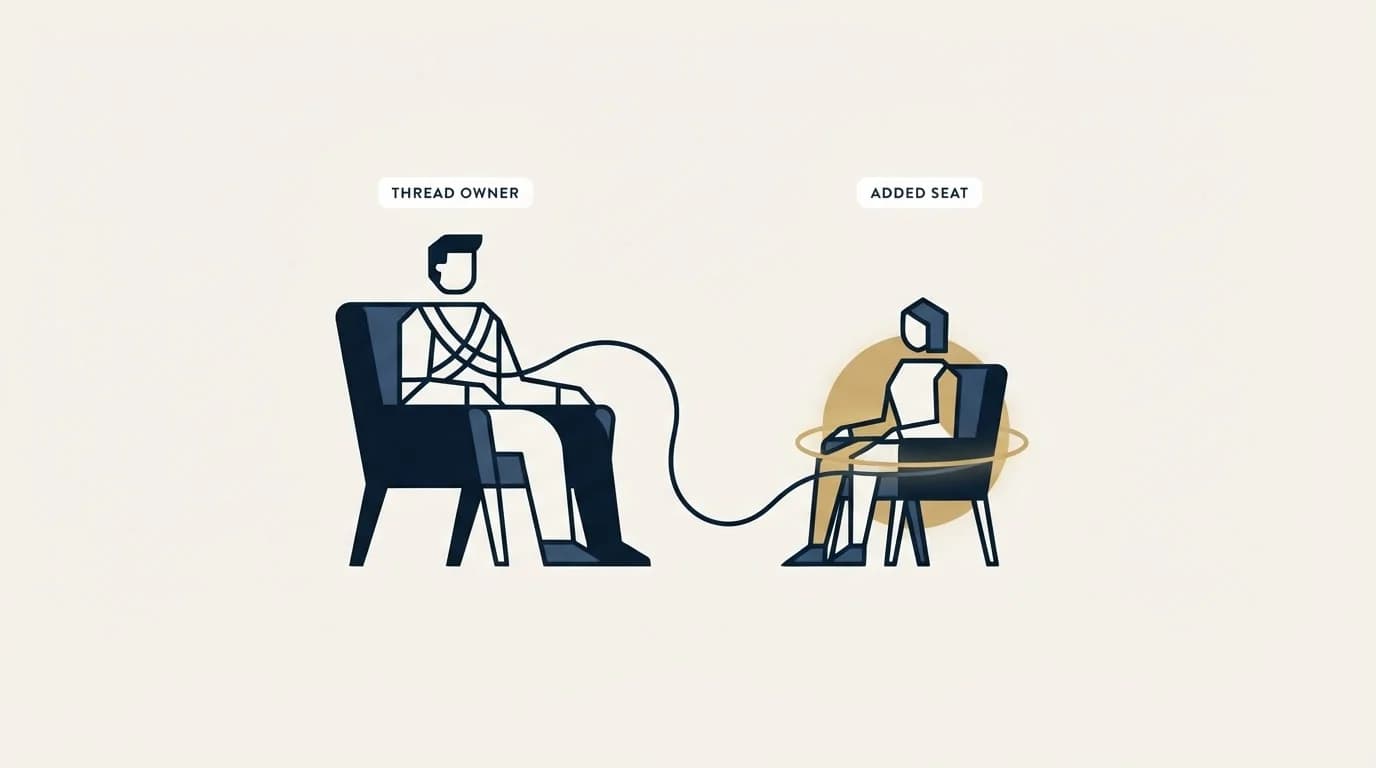
The common rule is to add people by stage: a solutions engineer at the demo, an executive at the proposal. Stage-based rules are easy to administer and they add people according to a calendar rather than according to the deal.
Software offering the same prompt carries the same weakness, since next best action recommendations can only rank moves that were already tried.
The better trigger is a question the current owner cannot answer with authority. That is a specific, observable event. The buyer asks whether the product handles a data-residency requirement, or asks who they escalate to when a deadline slips, or asks for a commitment on a delivery date. Each of those is a request for somebody with the standing to answer, and each of them names the seat.
Two consequences follow. The first is that the invitation is easier to write, because the reason for it is the buyer's own question. The second is that the added person arrives with a job, which is the condition the whole practice depends on.
Before the invitation goes out, three more things are worth settling: the agenda names who covers which section, the buyer knows in advance who is joining and why, and somebody has decided what happens if the added person disagrees with the owner in front of the buyer.
The related decision is how many people from the buyer's side are in the conversation at all. Adding seats on your side while talking to one person on theirs concentrates more of your cost on a single relationship, which is the risk that multi-threading in sales exists to spread. Coverage on your side is not coverage of the account.
What the coordination costs, and where it gets paid
Adding a person to a deal has three costs, and the reason team selling gets applied loosely is that only the first one is visible.
The visible cost is time. Two people in a meeting is twice the meeting, plus the preparation, plus the debrief that usually does not happen.
The second cost is the seam. Every additional person creates a boundary where an action can fall between two owners, and the classic version is the technical follow-up that the account executive assumes the solutions engineer is sending and the solutions engineer assumes is commercial. Buyers experience this as silence after a good meeting, which reads as disinterest.
The third cost is on the buyer's side and it is the one sellers rarely price. A buyer who brings colleagues to a call has spent internal credibility to do it. If the call produces less than a well-prepared conversation with one person would have, that credibility was spent on the seller's process. Gartner's B2B buying journey page puts a number on how little room there is for that. It reports that 75% of B2B buyers prefer a rep-free sales experience, and adds that self-service digital purchases are far more likely to result in purchase regret. A buyer who would rather not meet a rep at all has not asked for four of them, and the meeting that does happen has to leave behind something the website could not. Whether it does is entirely within the seller's control.
The practical defence is the same one that makes any meeting work. Decide the sections, assign each one, and end with a single owner for the next step. Structuring a discovery conversation so that it disqualifies well is the same discipline applied to one person, and the discipline does not get easier when more people are in the room.
How to tell whether it worked
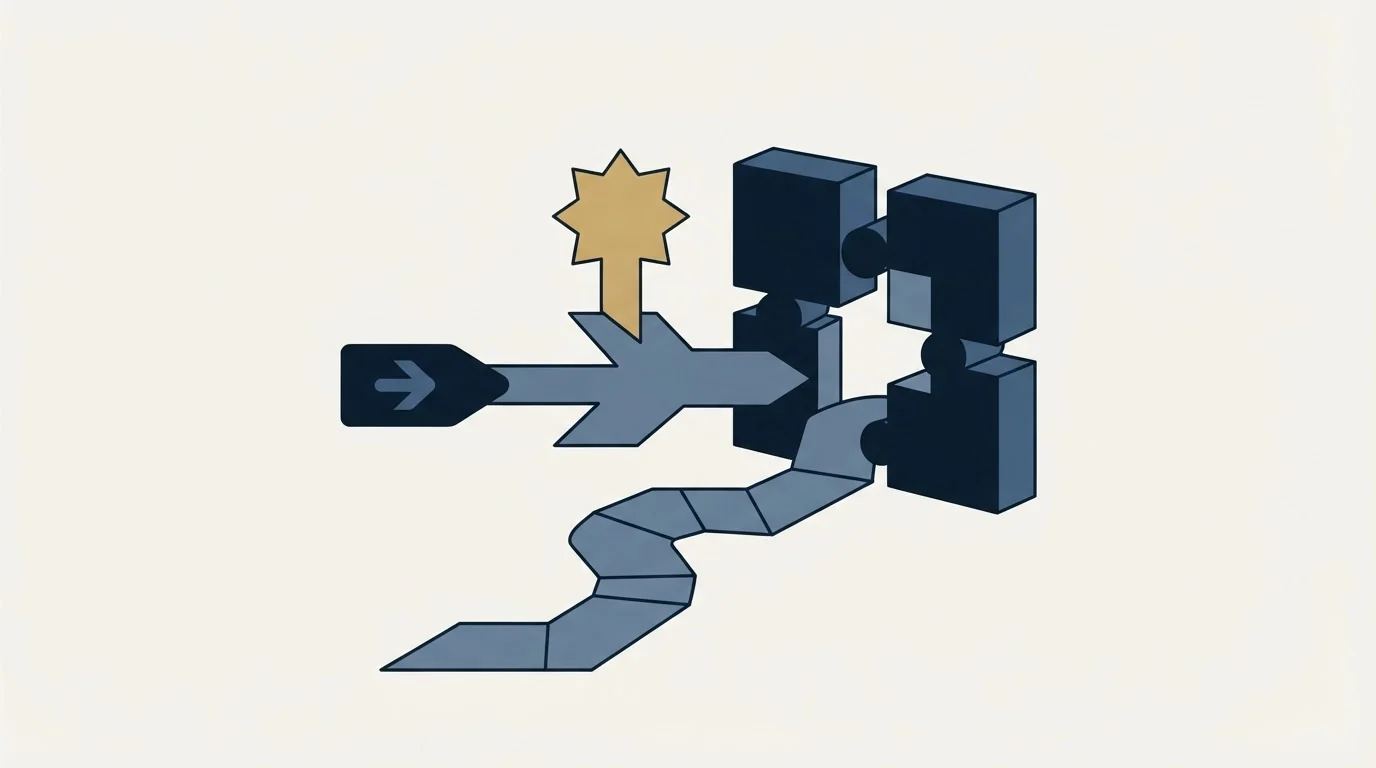
The honest measure is information, not atmosphere. After the call, write down what the deal knows now that it did not know before, and next to each item write who produced it. A team-sold call produces a list where more than one name appears. A crowded call produces a list with one name and a note that the meeting went well.
The second measure is the buyer's routing behaviour. When the buyer has met four people and still sends every question to the account executive, the other three seats were decorative. When the buyer emails the solutions engineer directly about an integration and the account executive about terms, the division of labour was real and the buyer adopted it.
The third measure sits in the pipeline. Deals worked with several seats should show a different shape from deals worked with one, and if the stages are defined on buyer evidence rather than on seller activity, that shape is readable. Pipeline stages that earn their place is the prerequisite for reading it at all, because a stage that advances on internal effort will happily record the crowded call as progress.
After a team-sold call
The integration exists: solutions engineer
Who to escalate to when a deadline slips: executive
A committed delivery date: delivery lead
Next step, one owner, a date: account executive
After a crowded call
The meeting went well: account executive
Where it does and does not pay
Team selling earns its cost where the purchase carries real consequences, involves several people on the buyer's side, and turns on questions that no single person can answer credibly. Complex technical evaluations, delivery-heavy services and purchases with a genuine escalation path are the natural home for it, and in those deals a well-run second seat can be the difference between a stalled evaluation and a decision. Gartner's same page says successful sales organizations "accommodate the growing number of buyers and their cross-functional representation in client organizations", and a second seat is the selling side's version of that: more people on the buyer's side bring more questions that one person cannot answer with authority.
It stops paying where the decision is small enough for one person to make, where the product is simple enough for one person to explain, and where the buyer's real question is commercial rather than technical. In those deals an added seat adds calendar friction and nothing else.
There is also a version that is worth naming because it is common and quiet. When a deal is stalling, adding people is an available action that feels like effort, and it frequently substitutes for the harder conversation about whether the deal is real. A stalled deal that gains attendees without gaining information has usually acquired a diagnosis problem rather than a coverage problem, and the tell is that nobody can name the question the new person came to answer. The buying committee on the other side is where the missing information actually lives, and the person who has to defend the purchase internally is usually the economic buyer rather than whoever is friendliest to the seller.
Where this sits relative to what we do
Everything above happens after a conversation exists. Our own work sits upstream of it, and our position there is deliberately narrow: one message per campaign, built on one premise, sent once, with any later approach run as a separate campaign that has its own reason to exist. We do not run bump sequences or thread replies on any channel.
That constraint has a bearing on team selling, because the same logic applies to a call. A message earns attention by having one specific reason to exist, and a seat on a call earns its place the same way. Adding volume to either one is the cheaper move and the one that degrades the signal. What a booked meeting actually costs is the arithmetic behind treating each conversation as expensive, and our pay per qualified meeting offer prices the conversation rather than the activity.
The short version
Team selling means more than one person from the seller's side working a deal, with each of them owning a piece of the work the others cannot do. The count of attendees says nothing; what says something is whether each person leaves behind a fact, a constraint or a commitment that the deal did not have before.
Add a seat when the buyer asks a question the current owner cannot answer with authority, name the seat by the question, split the agenda before the invitation goes out, and keep one owner for the thread and the next step. Then check afterwards whether more than one name appears on the list of what the deal learned. If only one does, the meeting had guests rather than a team.
Frequently asked questions.
Frequently asked questions- What is team selling?
- Team selling is a way of working a deal with more than one person from the selling side, where each person owns a piece of the work the others cannot do: the thread and the commercial conversation, the technical claim, the risk conversation with whoever defends the purchase, or delivery after signature. A second person with no assigned job is attendance, and it costs the buyer time.
- When should a solutions engineer or an executive join a sales call?
- When the buyer asks something the current owner cannot answer with authority. A question about whether the product handles a data-residency requirement calls for the technical seat, and a question about who to escalate to when a deadline slips calls for the executive seat. Adding people by stage, an engineer at the demo and an executive at the proposal, follows a calendar instead of the deal.
- What does team selling cost?
- Three things. Time, because two people in a meeting is twice the meeting plus preparation and debrief. The seam, because every added person creates a boundary where a follow-up can fall between two owners, which the buyer reads as disinterest. And the buyer's own credibility, spent internally to bring colleagues to a call that then has to justify it.
- How do you know whether a team-sold call worked?
- Write down what the deal knows after the call that it did not know before, and next to each item who produced it. A team-sold call produces a list with more than one name on it. Then watch the buyer's routing: if every question still goes to the account executive after meeting four people, the other three seats were decorative.
About the author.

B2B cold email experts helping companies generate qualified leads through done-for-you outreach campaigns.
RevenueFlow Team
Explore more.
Ready to scale your outreach?
We build GTM engines that book real meetings. See the receipts.
Related articles.
Win Rate Benchmarks: Which Figures State a Population
A catalogue of the published average sales win rates, sorted by whether the page names the population behind its own number. Most do not.
Sales Enablement Charters: What the Published Ones Ask For
Six publishers set out what a sales enablement charter should contain. Five describe a document nobody can check, and one writes a definition with inspection in it.
Sales Kickoff Agendas: Five Published, Session by Session
Five publishers print a sales kickoff agenda. They agree on four blocks and disagree on session length, rehearsal and where the agenda comes from.
Sales Cycle Length Benchmarks: What Each Figure Counts
The published B2B sales cycle benchmarks, sorted by what each page says it counted. The same number means two different things in two of them.
Sales Comp Plan Design: What the Publishers Prescribe
Four publishers set out how to design a sales compensation plan. Here are their procedures, their components, and which of their ratios carry a population.
Appointment Setting for Business Brokers: The Seller Meeting
What a bought meeting with a business owner has to be for a brokerage: the three-part qualification, the confidentiality rules, the licence line and the owner's reasons.