AI-Guided Selling: What the Recommendation Rests On
AI-guided selling is software that recommends what a seller should do next, inside the CRM the seller already works in, leaving the decision with the person. Salesforce's own page defines it as tools that provide deal context, insights and suggested actions across the sales cycle, and names clean data as the precondition.
Key takeaways
- The recommendation goes to a person who decides, which is what places guided selling below an agentic workflow on the ladder from automation to autonomy.
- Salesforce's page, published 25 March 2026, defines the category as tools that provide deal context, insights and suggested actions, and states that successful implementation depends on clean data.
- A next best action is fitted to the actions reps already took, so it reproduces an existing playbook with more confidence rather than finding a move nobody tried.
- The scarce weekly judgement is which accounts deserve time, and that rests on information a CRM does not hold, so ranking actions on an already chosen account improves the second-hardest decision.
A rep opens the CRM and a panel on the right suggests the next best action for the account: send the case study, then book a follow up. The suggestion is reasonable. It is also the suggestion the panel makes for every account at that stage, and the rep learned to ignore it in week three.
AI-guided selling is the use of software that watches a sales process and recommends what a seller should do next, inside the tools the seller already works in. The defining property is that the recommendation goes to a person who decides whether to take it, which is what separates guided selling from automation that simply acts.
The category is real and the claims made for it are wider than what the mechanism can support, so the useful definition has to say what the recommendation is derived from.
What the vendors selling it say it is
The definitions worth quoting are the ones published by the platforms that build the feature, because those are the definitions their products implement.
Salesforce's own page on the subject, published on 25 March 2026 and fetched on 2 September 2026, states that "AI-guided selling is the use of tools that support reps during the sales cycle that provide deal context, insights, and suggested actions". The same page says the tools are typically built into the CRM and use artificial intelligence to "surface insights and suggest next best actions throughout the sales process", and it names prospecting, qualification, quoting and post-sale follow-up as the stages involved.
Two things in that definition are worth pulling out.
The first is where the software sits. It is inside the CRM, which means its view of the account is the CRM's view of the account, and a CRM knows what people typed into it. That is the single largest constraint on the whole category and it is rarely stated as one.
The second is the phrase next best action. It presumes that the seller's difficulty is choosing among known actions. Sometimes it is. Often the difficulty is earlier and different, and no ranking of actions addresses it.
Guided, and what that word is doing
The live entry on agentic workflows sets out a ladder between fixed automation and software that constructs its own route. Guided selling sits deliberately below the top of that ladder: the model produces a recommendation and a human executes or discards it.
That placement is a design decision rather than a limitation, and it changes who is accountable. A recommendation the rep accepted is still the rep's action. A recommendation the rep ignored produces no record of having been wrong. Both properties make the category comfortable to buy and difficult to evaluate, because the system is never quite the thing that did anything.
It also means adoption is the whole implementation risk. A recommendation engine nobody follows is a reporting cost with no offsetting benefit, and a recommendation engine everybody follows without judgement has quietly become an automation without the review that would have been designed around one.
- A person reads the suggestion and decides
- Accountability stays with the seller
- Adoption is the main failure mode
- Wrong suggestions cost attention rather than reputation
- Evaluable only if acceptances are recorded
- Software produces the artefact and a person edits it
- Accountability shared in practice, unclear on paper
- Quality drift is the main failure mode
- Wrong drafts cost review time
- Evaluable by comparing edited and unedited output
- Software chooses the step and executes it
- Accountability sits with whoever set the permissions
- Blast radius is the main failure mode
- Wrong actions can reach a stranger with your name on them
- Needs a stopping condition and a permission list
Why it matters: the recommendation is only as good as the history under it
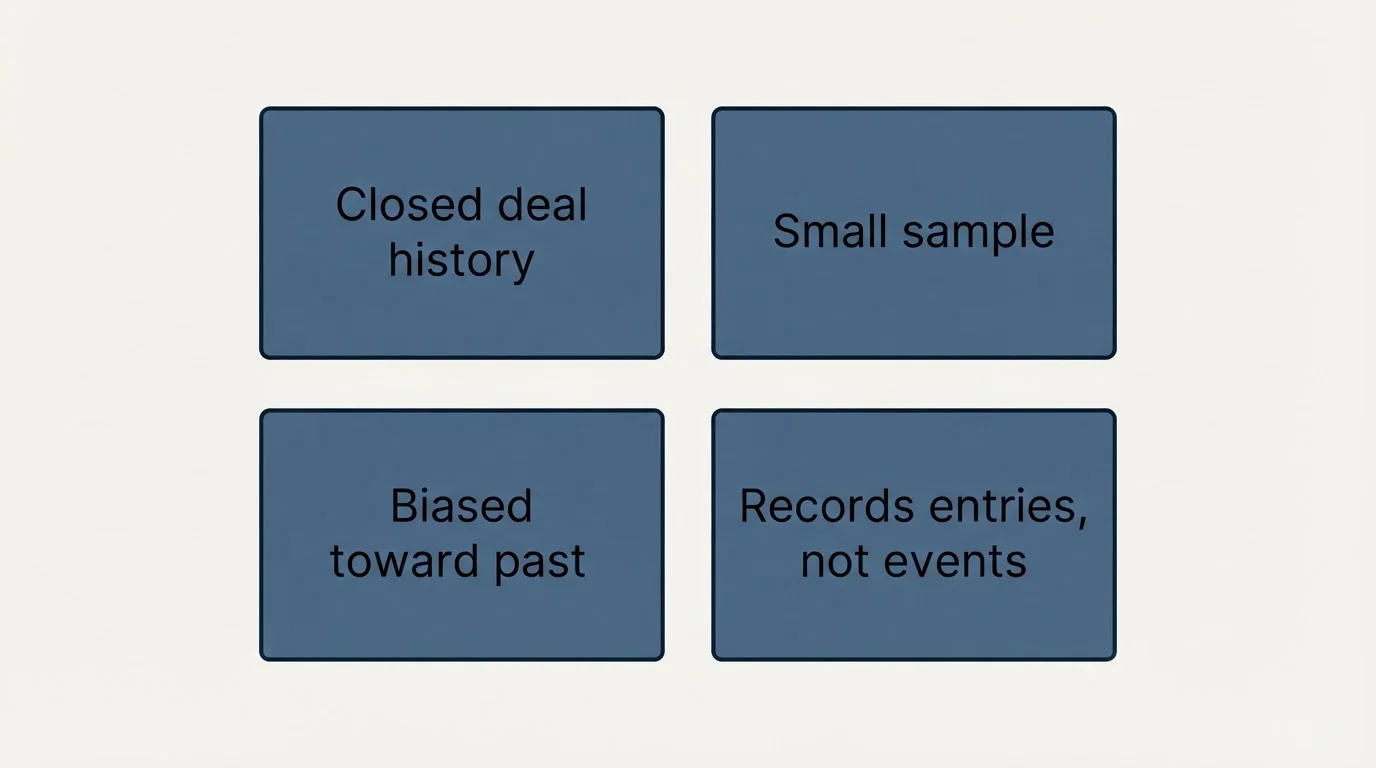
Every next best action is a prediction, and a prediction is fitted to something. In this category the something is usually the company's own closed deal history, sometimes augmented by patterns drawn from a vendor's wider customer base.
That history has three properties worth stating plainly.
It is small. A B2B company with a considered sales cycle closes a number of deals per year that would be a rounding error in most training sets. Patterns learned from a few hundred outcomes are patterns learned from a few hundred outcomes, whatever the interface implies.
It is biased toward what was already done. The history contains only the actions reps took, so a model fitted to it can rank the moves that were tried and has nothing to say about the move nobody tried. It reproduces the existing playbook with more confidence, which is valuable when the playbook is good and self-reinforcing when it is not.
It records what was typed, not what happened. Stage changes, activity logs and notes are produced by the people whose performance they describe, which is the same property that makes CRM pipeline reporting unreliable. The live guide on pipeline management in a CRM sets out why that record drifts, and a recommendation engine reading the drifted record inherits all of it.
Salesforce's own page is direct about the dependency, saying that "Successful implementation depends on clean data, the right tools, and ongoing iteration". That is the vendor naming the constraint, and it is the right place to start an evaluation.
Where the category oversells
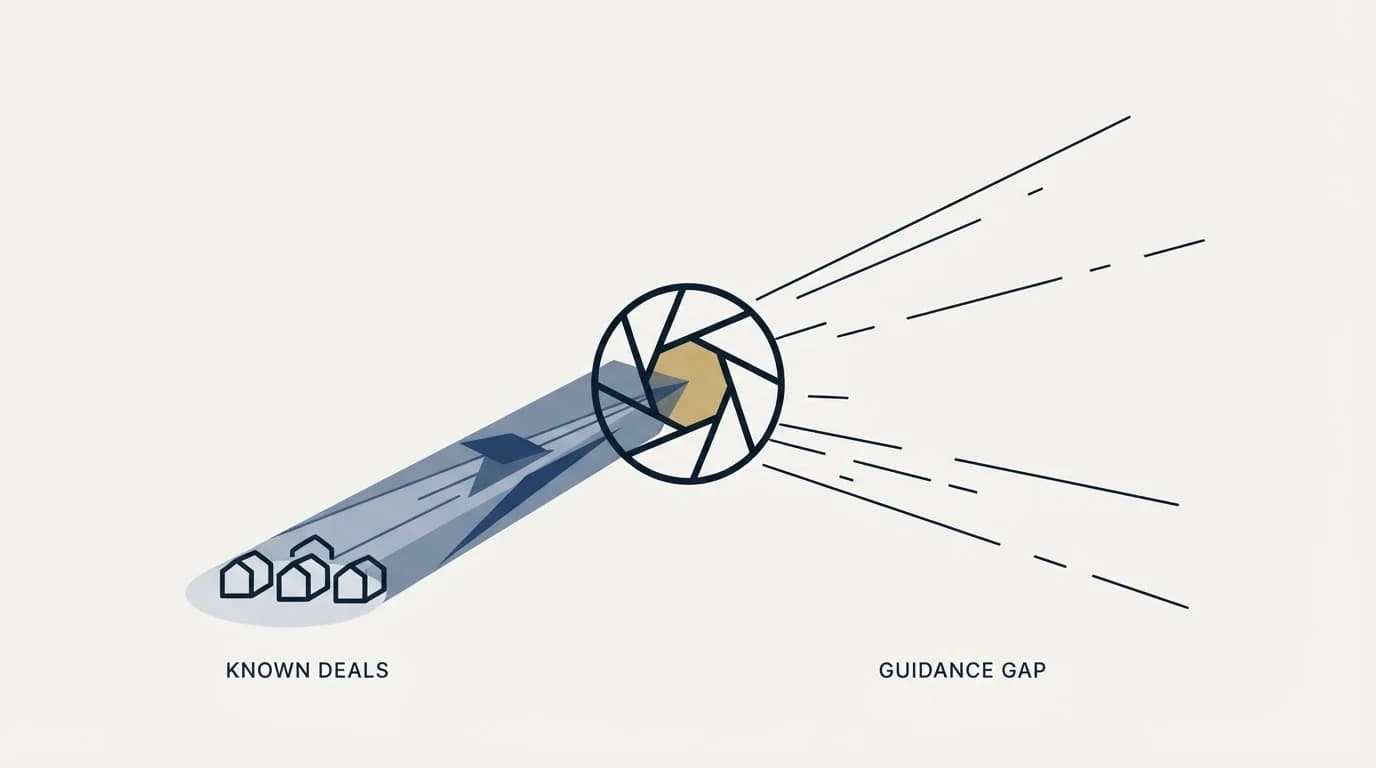
The scarce decision is usually not the one being ranked. A seller's hardest weekly judgement is which accounts deserve time at all, and that judgement rests on information the CRM does not hold: what is happening inside the account, who moved jobs, whether the trigger that made this a fit is still true. Ranking the actions available on an account already chosen improves the second-hardest decision.
Confidence is presented without provenance. A panel that says an account is at risk is more useful when it says which signal fired. Without that, the seller cannot tell an inference drawn from three weeks of buyer silence from one drawn from a stage that was never updated, and those call for opposite responses.
Guided selling in the ecommerce sense is a different product. A large part of the published material on guided selling describes a product finder that helps a shopper choose a configuration on a website. That is a genuine category with genuine vendors, and it has almost nothing in common with a seller-facing recommendation panel. A search on the phrase returns both, which is worth knowing before comparing tools.
It does not remove the step that was actually scarce. The argument in AI prospecting applies here without modification: the tasks that got cheap were rarely the tasks that constrained output, and making the cheap step cheaper again produces more volume against the same bottleneck.
How it is used in outbound
For an outbound programme the honest scope of this category is narrow and worth having.
What it does well is compression. Assembling account context that a rep would otherwise gather by hand, drafting a first version of a message, surfacing that a contact changed roles, and summarising a call so the next person does not start from nothing. Those are real hours and they are hours spent on retrieval rather than on judgement. HubSpot AI agents is a worked example of where one vendor draws that line inside its own product, and the AI SDR category covers the wider version of the same promise.
What it should not decide is who gets contacted and on what premise. That decision determines whether the whole programme works, it is the decision a model fitted to your existing history is least equipped to improve, and it is the one whose errors are paid for by the sending domain rather than by the model.
Our own doctrine constrains the useful surface further. We send one message per campaign, built on one premise, and any later approach is a separate campaign with its own reason to exist. There is no cadence to optimise, no bump to time and no thread to reply into, so the whole class of next best action recommendations about follow-up timing has nothing to act on. What remains is research compression before the send and reading the reply afterwards, which is a smaller claim than the category makes and a durable one.
The evaluation question to put to a vendor is therefore not what the model can do. It is what the recommendation was fitted to, whether the panel will say which signal produced it, and what the product does when the CRM record it depends on is wrong. A tool that cannot answer the third question is proposing to be confident about a record its own vendor page says has to be clean first.
- Yes: The vendor can say what the recommendation model was fitted to
- Yes: Every recommendation names the signal that produced it
- Yes: Accepted and rejected recommendations are both recorded, so the tool can be judged later
- Yes: The account-selection decision stays with a person
- No: The tool is permitted to send outbound messages without review
- Depends: The CRM record it reads has a named owner responsible for its accuracy
- Depends: A ninety day check is scheduled to compare recommended and ignored paths
Related terms
AI-guided selling sits one rung below an agentic workflow on the ladder from automation to autonomy, and the signal it most often consumes is intent data. The compression it performs on ranking is a relative of lead scoring, with the same objection about a single number hiding its inputs. The conversational judgement it claims to support is the subject of SPIN selling and, at the first meeting, of the discovery call. Where the motion being guided is cold, the definition of that motion is in outbound sales, and the numbers a rep genuinely controls are set out in SDR metrics.
The short version
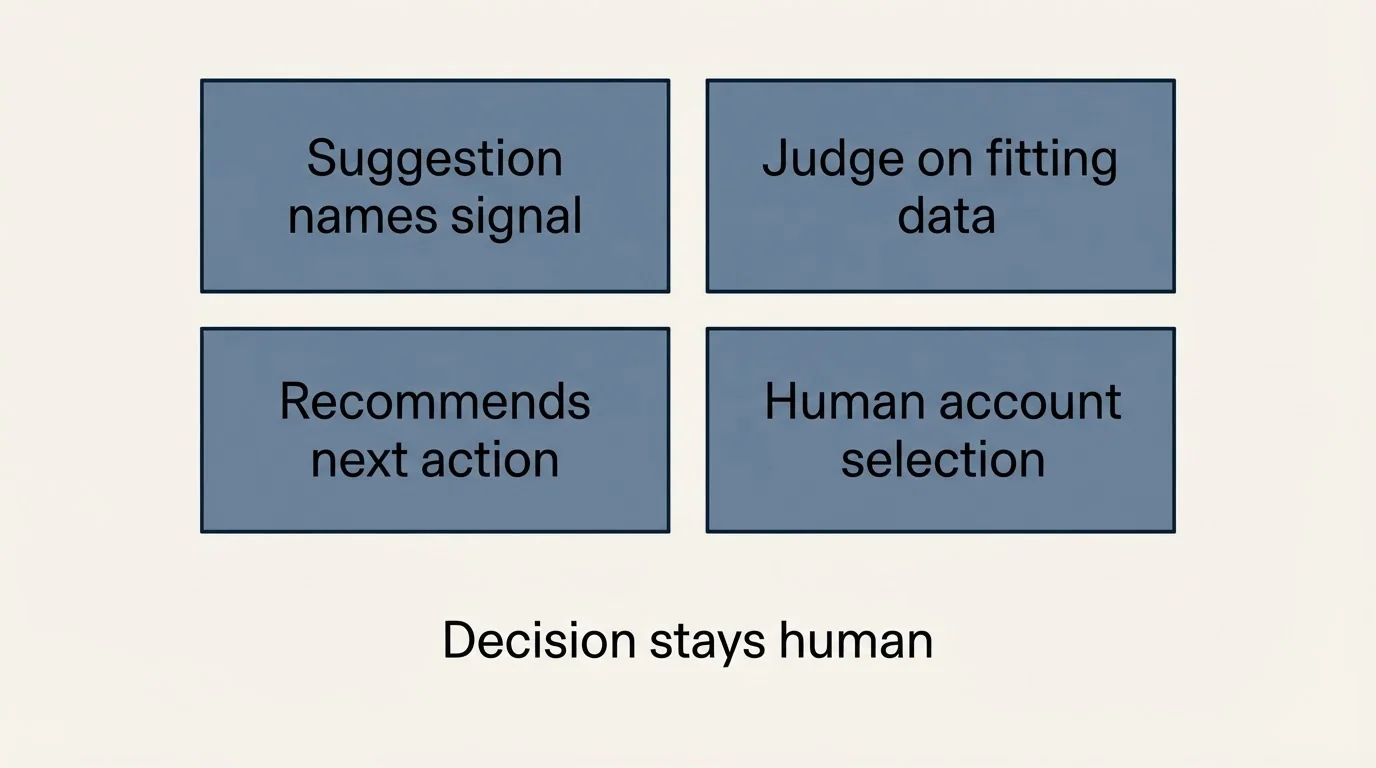
AI-guided selling is software that recommends a seller's next action inside the tools they already use, leaving the decision with the person. Salesforce's own definition puts the tools in the CRM and has them surface insights and suggest next best actions across the sales cycle, and the same page names clean data as the precondition. Judge the category on what the recommendation was fitted to, insist that every suggestion names its signal, and keep the account-selection decision with a human, because that is the judgement the history under the model is least able to improve.
RevenueFlow runs cold email and LinkedIn outreach for B2B teams, one message per campaign, with the targeting decision made by people and the research compressed by machines. If you would rather that arrangement were somebody else's job, see how the campaigns work.
Salesforce's AI guided selling page was published on 25 March 2026 and fetched on 2 September 2026. Verify current wording with the source before relying on it.
Frequently asked questions.
Frequently asked questions- What is the difference between AI-guided selling and sales automation?
- Guided selling produces a recommendation and a person decides whether to take it. Automation performs the step. The distinction matters for accountability and for evaluation: an ignored recommendation leaves no record of having been wrong, so a guided tool can only be judged if both accepted and rejected suggestions are logged. Automation, by contrast, needs a permission list and a stopping condition.
- Why does the CRM record matter so much here?
- Because it is what the model reads. Stage changes, activity logs and notes are entered by the people whose performance they describe, so the record drifts in predictable directions. A recommendation engine reading a drifted record inherits every one of those distortions and presents the result with an interface that implies certainty. Salesforce's own page names clean data as the first dependency.
- Is guided selling the same as a product finder on a website?
- No, and a search on the phrase returns both. One is a seller-facing panel inside a CRM that recommends the next step on a deal. The other is a shopper-facing configurator that helps a buyer narrow to a product on an ecommerce site. They share a name and almost nothing else, which is worth establishing before comparing vendors or reading benchmark material.
- What should AI-guided selling not be allowed to decide in outbound?
- Who gets contacted and on what premise. That decision determines whether the programme works at all, it depends on context outside the CRM, and its errors are charged to the sending domain rather than to the model. Research compression before the send and summarisation after the reply are the durable uses. The targeting judgement should stay with a person.