Transactional Selling: What the Deal Size Decides
Transactional selling closes an individual purchase quickly with little diagnosis of the buyer's situation. The choice is economic rather than philosophical: where the margin on one sale is smaller than the cost of a consultative conversation, diagnosis cannot be afforded. It still needs a tight script and qualification moved from the call into the targeting.
Key takeaways
- The motion is decided by the margin on one sale against the fully loaded cost of the conversation that produces it.
- A transactional motion needs a tighter script than a consultative one, because there is no second conversation in which to recover.
- Qualification does not disappear, it moves out of the call and into the selection of the audience.
- Most companies of any size run both motions, and the common failure is running one across two segments and reporting the blend.
Transactional selling is a sales approach organised around closing an individual purchase quickly, with little diagnosis of the buyer's wider situation. The seller presents the offer, answers questions about price and terms, handles the objection and closes or moves on, and no part of the motion is designed to produce a relationship that outlives the sale.
The word is usually used as a criticism. It is better read as a description of an economic choice, because the thing that decides whether a motion should be transactional is not the seller's character. It is the size of the deal against the cost of the conversation.
The arithmetic underneath the label
Every sales methodology is a way of spending time to raise the probability of a purchase. Diagnosis, discovery, stakeholder mapping and business-case work all cost hours, and the hours are worth spending when the deal is large enough or the cycle long enough to repay them.
Run the sum on a deal worth a few hundred pounds a year and it does not repay them. Two hours of diagnostic conversation, plus a follow-up, plus a proposal, exceeds the gross margin on the sale before anybody has been paid. A seller in that situation who insists on a discovery call is not being more consultative; they are producing a loss with better manners.
Run the same sum on a deal worth six figures across a three-person buying committee and the inversion is total. There the cheap close is the expensive mistake, because a purchase agreed without understanding the situation churns at renewal or stalls in procurement, and the cost lands after the commission is paid.
That is the whole boundary, and it is why both motions exist. Neil Rackham's questioning method carries the same caveat from the other direction: shift it into a low-value transactional purchase and the economics invert, which the SPIN selling entry sets out at the point the framework stops applying.
- Seller presents the offer and handles price
- Qualification is fast and mostly on fit attributes
- Success is measured in volume of closes per period
- Repeatable and easy to staff and script
- Loses larger deals that needed a diagnosis
- Seller establishes the situation before proposing
- Qualification runs through several stakeholders
- Success is measured in win rate and deal size
- Slow, expensive and hard to staff
- Destroys the margin on small purchases
What a transactional motion still requires
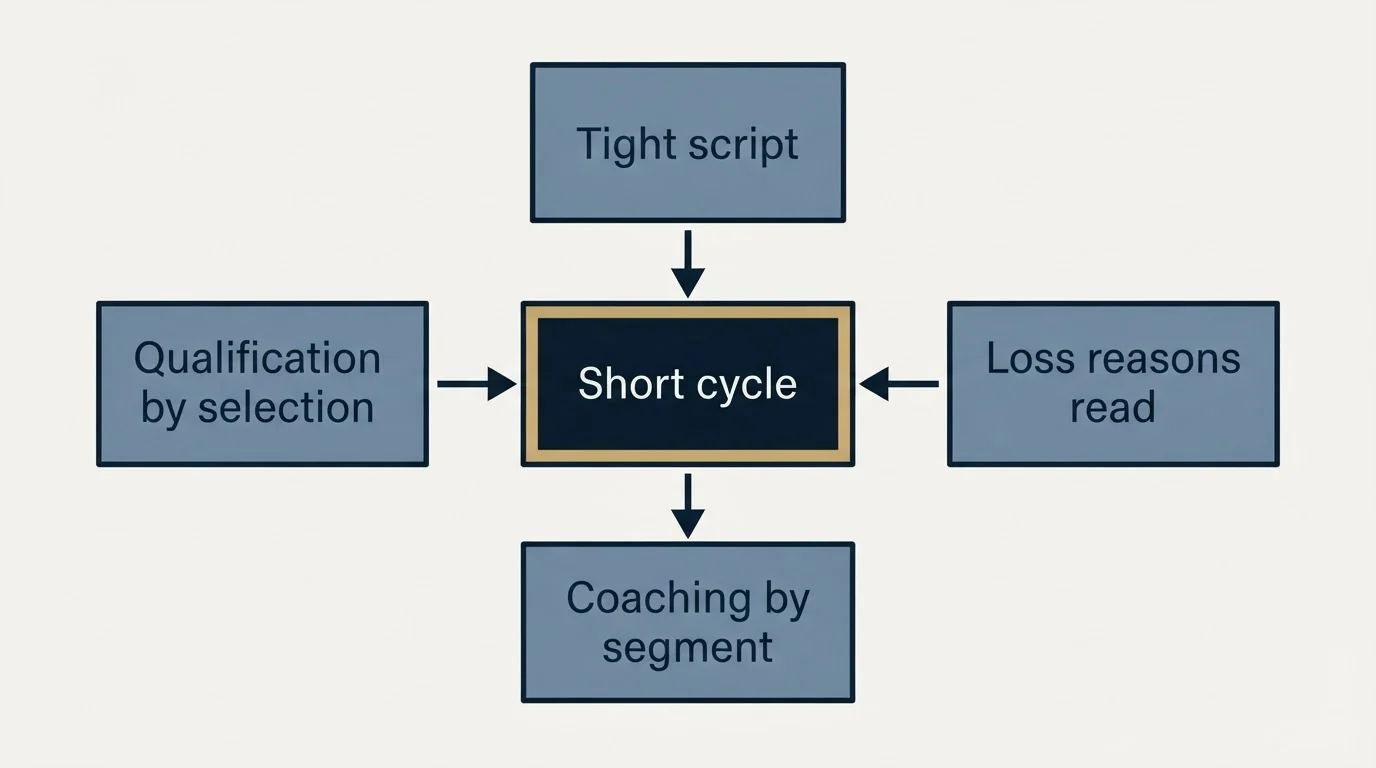
The label invites two mistakes. The first is treating a transactional motion as an absence of process, and the second is treating it as an absence of qualification.
Neither follows. A high-volume close rate depends on a tighter script than a consultative motion needs, because there is no time to recover from a bad opening and no second conversation in which to correct course. The offer, the proof and the objection handling all have to work the first time. What a consultative seller improvises across an hour, a transactional seller has to have decided in advance.
Qualification survives too, in a cheaper form. A consultative motion qualifies by asking. A transactional motion qualifies by selection: the audience is chosen so that it already fits, and the conversation begins after the fit question is settled. That moves the work from the call into the targeting, which is why transactional programmes live or die on their lists rather than on their sellers.
The third requirement is the one most often missing. A short cycle produces a lot of outcomes quickly, so the loss reasons arrive at a rate that makes them genuinely readable, and almost nobody reads them. At transactional volumes a month of losses is a real sample rather than an anecdote, and the practice that turns it into a targeting decision is win/loss analysis.
There is a fourth requirement that only appears at volume, and it is a management one. A consultative team is coached deal by deal, because each deal is large enough to be worth an hour of a manager's attention. A transactional team cannot be, so the coaching unit becomes the script and the segment rather than the opportunity. A manager reviewing individual small deals is spending more on the review than the deal is worth, and the useful review is of the pattern across fifty of them: which objection recurs, which segment closes below the rest, which part of the offer is being explained rather than understood. That is a different management job from the consultative one, and running the consultative version against a transactional team is one of the quieter ways a motion gets expensive.
Where the term misleads
It is used as a synonym for pushy. Urgency tactics, artificial scarcity and discount pressure are frequently present in transactional programmes and they are not what defines one. A motion is transactional because of what it does about the buyer's situation, which is very little, rather than because of how hard it pushes.
It is confused with self-serve. A product bought without a seller is not being sold transactionally; it is not being sold at all. The transactional motion is what sits between self-serve and a consultative motion, and the interesting question in a product-led company is which signals justify putting a human into an otherwise self-serve purchase, which is the argument in sales assist.
The deal size gets read off the price list rather than the account. The same product sold to a ten-person company and to a division of a large one is two different purchases, with different approval paths and different values. A company that runs one motion across both is over-serving half its pipeline and under-serving the other half.
Which side of that split an account sits on is a question about the value of the deals actually closing there, and average deal size covers how that figure is computed and why two defensible calculations produce different answers.
It is treated as a permanent property of a business. It is a property of a segment, and often of a moment: a product that was transactional at launch becomes consultative as it moves upmarket, and the motion usually changes a year after the deals do. Companies of any size tend to run both, and the failure is rarely the choice of motion. It is running one motion against two segments and reporting the blended result, at which point the numbers describe nothing. The sales cycle length by segment is the fastest way to see whether that is happening.
- Yes: Gross margin on one sale exceeds the fully loaded cost of the conversation that produces it
- Yes: One person can approve the purchase without building an internal case
- Yes: Fit can be established from account attributes before the conversation starts
- Yes: Loss reasons are collected and read, because the volume makes them a real sample
- No: The motion was chosen from the price list rather than from the buying process
- No: One blended motion runs across two segments with different approval paths
How it is used in outbound
Outbound is where the choice of motion changes the message, and getting it wrong is expensive in a specific and avoidable way.
A consultative motion asks a cold audience for a conversation, because the purchase cannot be decided in an email and the meeting is the thing being sold. A transactional motion has the opposite temptation: the deal is small enough that a meeting looks like overhead, so the email asks for the purchase, or for a trial, directly.
That temptation is usually worth resisting on a cold audience, for a reason that has nothing to do with sales philosophy. A cold recipient has no basis on which to evaluate an offer, so the direct ask is being made at the moment the buyer knows least. It converts a small percentage, and the percentage is small enough that the campaign's economics depend entirely on volume, which is the point at which the sending programme starts making decisions that damage the domain. Where the purchase genuinely can be decided from an email, the honest version is a specific offer with the fit already established by the targeting, sent to an audience narrow enough that the claim is true of every row.
Our own practice narrows this further and it applies to both motions. We send one message per campaign, with no bumps and no thread replies. For a transactional programme the consequence is direct: with one message there is no cadence to compensate for a weak offer, so the offer and the list carry the whole result, and the work moves to where a transactional motion should have it anyway, which is the selection of the audience.
The measurement changes too. A transactional programme reports closes per period, and a cold programme feeding one should still be judged on whether the accounts it selected were the right accounts rather than on how many messages produced a click. The ratio that tests the list rather than the copy is the one to watch.
The short version
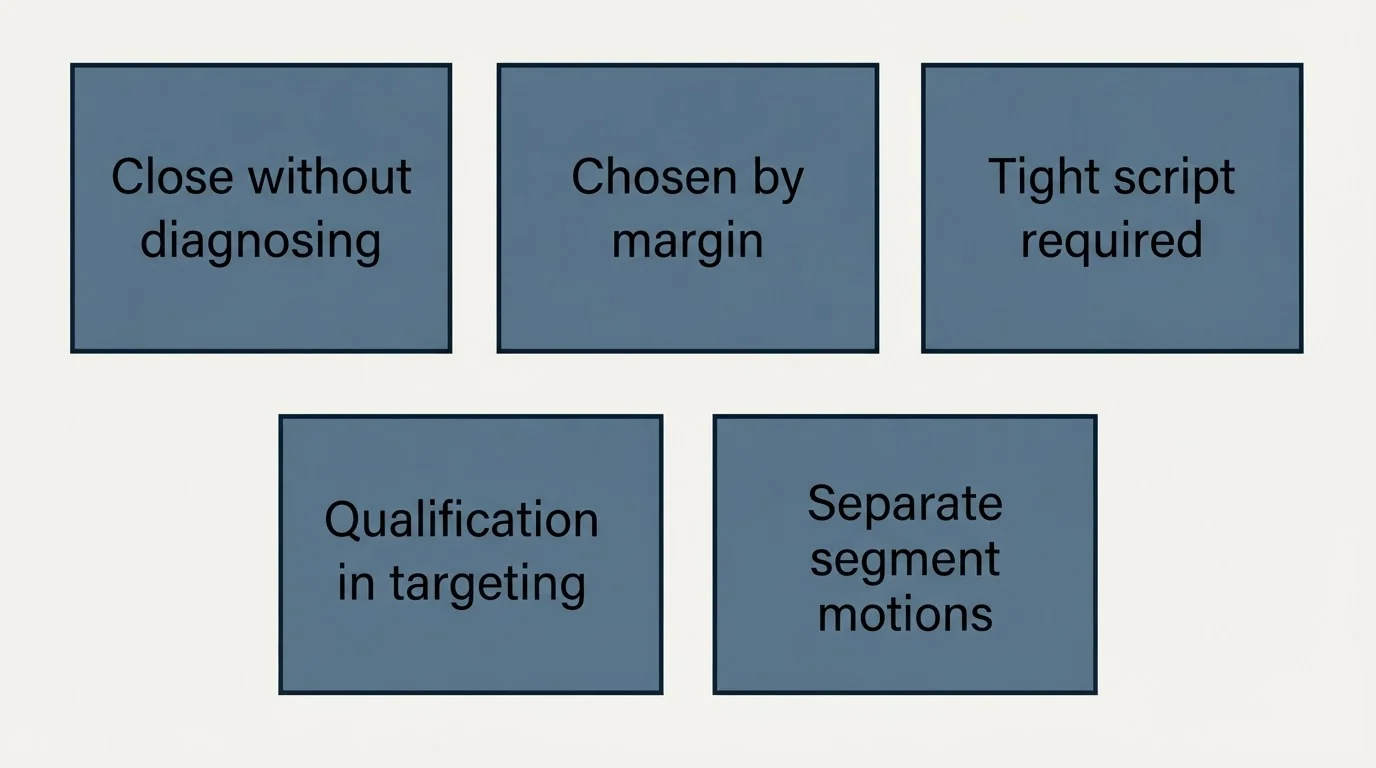
Transactional selling is closing an individual purchase quickly without diagnosing the buyer's situation. It is chosen by arithmetic: where the margin on one sale is smaller than the cost of a consultative conversation, diagnosis cannot be afforded, and where the deal is large the cheap close is the expensive mistake.
It still requires a tight script, because there is no second conversation, and it still requires qualification, moved out of the call and into the targeting. Companies tend to run both motions, and the failure is running one across two segments and reporting the blend.
The neighbouring definitions are the methodologies built for the other end of the spectrum: SPIN selling for the question order, NEAT selling for what replaces budget and authority in qualification, Challenger sale for the teaching approach, and account-based selling for the largest deals of all. The generic and branded senses of the consultative end are separated in solution selling, and the pitch a short cycle depends on is in sales pitch examples.
RevenueFlow runs cold email and LinkedIn outreach for B2B teams, one message per campaign, against a list narrow enough that the premise is true of every row. See what a first campaign produces.
Frequently asked questions.
Frequently asked questions- What is the difference between transactional and consultative selling?
- A transactional motion presents the offer and closes without establishing the buyer's wider situation. A consultative motion establishes the situation first and proposes against it. The dividing line is economic: a diagnostic conversation costs hours, and those hours are repaid on a large deal with a long cycle and lost on a small one.
- Is transactional selling bad practice?
- No, though the word is usually used as a criticism. It is a description of an economic choice. A seller who insists on a discovery call for a purchase worth a few hundred pounds a year produces a loss with better manners. What is bad practice is running a transactional motion against deals that needed a diagnosis, which shows up as churn at renewal.
- Does a transactional motion still need qualification?
- Yes, in a cheaper form. A consultative motion qualifies by asking questions during the call. A transactional motion qualifies by selection, choosing an audience narrow enough that most of it already fits before anyone speaks. That is why transactional programmes live or die on their target lists rather than on the skill of individual sellers.
- Should cold outreach for a transactional product ask for the purchase?
- Usually not on a cold audience. A cold recipient has no basis on which to evaluate an offer, so a direct ask lands at the moment the buyer knows least, and the campaign economics then depend on sending volume. Where a purchase genuinely can be decided from one email, the honest version is a narrow list where the offer is true of every row.