Account-Based Selling: The Definition, and the Arithmetic It Skips
Account-based selling chooses a fixed roster of high-value companies and works the several people inside each one who decide together, instead of ranking individual leads. Selection and research carry the method, volume is capped by design, and the number that decides whether it works is how many accounts one seller can genuinely carry.
Key takeaways
- The unit of work is the company rather than the lead, so success is measured as coverage of named accounts rather than as volume worked.
- Selection is most of the method: an account chosen on firmographics alone carries no premise for a first conversation.
- A roster longer than the sellers can carry is not an ambitious plan, it is a list where some accounts silently receive nothing.
- It is not account-based marketing, which is a campaign programme addressing a set an order of magnitude larger.
Account-based selling is a sales approach in which a team chooses a fixed set of high-value companies, treats each one as a market in its own right, and works the several people inside it who together decide, rather than pursuing individual leads wherever they arrive. The unit of work is the account instead of the lead, and every downstream difference follows from that one swap.
The definition is easy to state and it hides where the effort actually goes. Choosing the accounts is the larger part of the method, and the part that gets skipped is the arithmetic of how many a person can carry.
What changes when the account is the unit
In lead-based selling the pipeline is a queue. Records arrive, get ranked, and get worked in order, and the person is the object throughout. A seller can have a productive week without ever knowing which company mattered.
In account-based selling the queue is replaced by a roster. A named set of companies is chosen in advance, each one gets a plan, and the seller's week is allocated across that roster rather than across whatever arrived. Three practical consequences follow, and they are the reason the label exists at all.
Several people, one decision. A company of any size buys through a group: the person who feels the problem, the person whose work changes, the person who signs, and usually somebody in security or finance who can stop it without ever taking a meeting. Working the account means reaching more than one of them deliberately. The composition of that group is the subject of buying committee, and the seat that carries the money is the economic buyer.
Research before contact, not after. Because the list is small and fixed, spending an hour on one company is affordable, and the first message can reference something true about that business rather than about its category.
The measure moves from volume to coverage. A lead-based team asks how many were worked. An account-based team asks how many of the named accounts have a live conversation with the right person, which is a smaller number and a harder one to inflate.
- Records arrive and are ranked into a queue
- Fit is judged one contact at a time
- Volume is the lever, and it is available
- Research happens after a reply
- Success reads as leads worked
- A fixed roster is chosen before anyone is contacted
- Fit is judged for the company, then the people inside it
- Selection is the lever, and volume is capped by design
- Research happens before the first message
- Success reads as accounts with a live conversation
Why it matters, and what it costs to get wrong
The failure is not that the method does not work. It is that the roster is written and nothing else changes, so a team ends up doing ordinary prospecting against a longer spreadsheet and calling it a strategy.
Two mistakes account for most of that.
The list is built on firmographics alone. Sector, size and geography tell you a company could buy. They do not tell you why this quarter is different from the last four. An account chosen only because it matches a profile has no premise attached to it, and the seller working it has nothing specific to say. Fit and readiness are genuinely different questions with different failure costs, which is the distinction lead qualification is built on.
The roster is longer than the team can carry. This is the one that decides whether any of it happens. A researched account plan is hours of work to build and a recurring commitment after that, so the number of accounts a seller can hold is small and countable. A roster that exceeds it is not an ambitious plan, it is a list where some accounts are silently receiving nothing. The capacity arithmetic, and how to do it before anybody starts researching, is worked through in target account selling.
There is a third cost that only shows up later. Because the market is fixed, an account-based motion cannot be scaled by sending more. Growth has to come from a better roster, a wider definition of fit, or a higher conversion inside the accounts you already named, and each of those is a slower lever than volume. Teams that adopt the method expecting it to also solve a volume problem are usually disappointed by the second quarter.
- Yes: Every account has a written reason it is on the list
- Yes: Each account names at least two people and what each one owns
- Yes: There is a stated premise for the first conversation, specific to that company
- Yes: There is a date or a condition for taking an account off the list
- Depends: The account count divided by the sellers is a number one person can carry
- No: Accounts were added because somebody already had a contact there
How it is used in outbound
Account-based selling and cold outbound are often presented as alternatives. They are better understood as the same problem at two different market sizes, and the size decides which one you are running.
The number that settles it is the count of companies that could genuinely buy, not the revenue the market represents. Where that count is a few thousand or fewer, the whole market is addressable by name and account-based work is simply what selling looks like. Where it runs to tens of thousands, no team can plan account by account and the leverage moves to segmentation and to the quality of a single message. The arithmetic for computing that count from the bottom up, and the reason the by-product of doing it is a usable list, is in serviceable addressable market.
Inside an account-based motion, outbound is the mechanism that opens the accounts on the roster. Three things change about how it is written.
The premise is per company, not per segment. A message that would make sense sent to any of the two hundred accounts on the list has not used the research the method paid for. The test is whether the first line would be nonsense if sent to a different company on the same roster.
More than one person is approached, deliberately and separately. A single relationship inside an account is one resignation away from starting over, and the person who feels the problem is frequently not the person who signs. Approaching two people with the same message is not multithreading, it is the same message twice; each one needs a premise built on what that person owns.
There is no second attempt to rescue a weak first one. This is our own position rather than a general rule, and it is worth stating plainly because it constrains the motion. We run one message per campaign, built on one premise and sent once, and a later approach is a separate campaign with its own reason to exist. On a named roster that constraint is unusually well matched to the method: the first message either references something real about that company or it does not, and the discipline pushes the work upstream into the choosing and the research, which is where account-based selling claims its advantage in the first place.
The qualification bar that a resulting meeting has to clear should come from the same criteria the roster was built against. Where that bar is a commercial term rather than an internal preference, it gets agreed in writing before anything sends, which is the argument in appointment setting versus lead generation.
- Step 1Choose
A fixed roster, sized against what the sellers can carry, with a written reason per account
- Step 2Research
The people inside each account, what each one owns, and what changed at that company recently
- Step 3Write
One premise per person, specific enough that it would be nonsense sent to the account next to it
- Step 4Review
Coverage rather than volume: which named accounts have a live conversation with the right seat
Where the textbook definition misleads
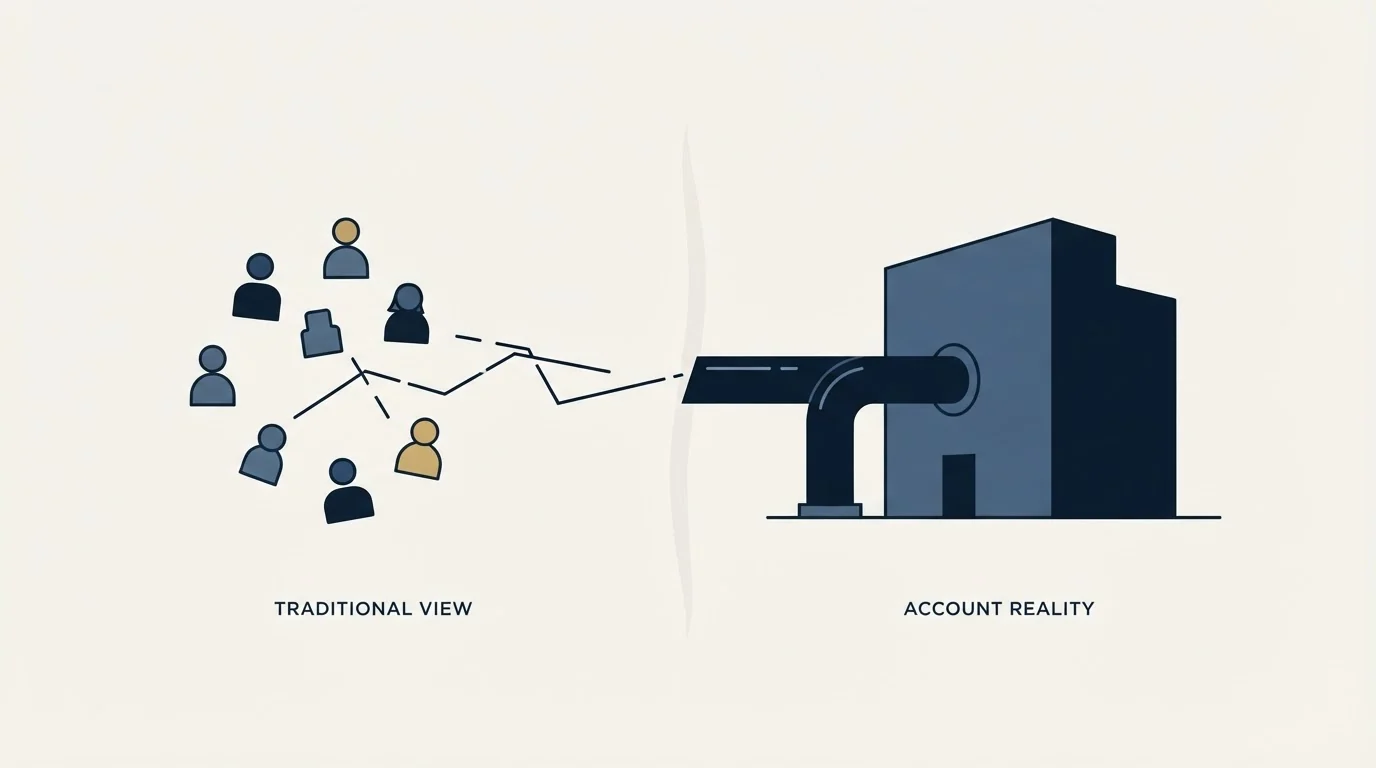
Three claims travel with this term and each one needs a qualifier.
That it is the same thing as account-based marketing. They coexist and they are not versions of each other. Account-based marketing is a coordinated programme of campaigns and content aimed at a defined set of accounts, and it can address a set far larger than any seller could plan for, because a campaign scales and a person does not. Account-based selling is what one seller does with one company. A team running both usually finds the marketing list an order of magnitude longer, and that is the two disciplines working correctly rather than a misalignment. The programme side is set out in B2B account-based marketing.
That it is for enterprise deals only. The threshold is not company size, it is whether the deal is worth the research. A market of six hundred companies at a moderate contract value supports named-account work comfortably, and a market of eighty thousand does not, whatever the individual deals are worth.
That choosing better accounts is the hard part. Choosing is the important part. The hard part is removing accounts, because a roster only grows unless something makes it shrink, and an unbounded roster is how the method quietly becomes ordinary prospecting again. The removal condition, written when the account goes on, is what keeps the arithmetic honest.
One thing the method genuinely does not address is what happens once the conversation starts. It selects who to talk to and says nothing about how to run the meeting, which is why it sits comfortably alongside a questioning method such as SPIN selling and a qualification framework such as MEDDIC rather than competing with either.
Related terms
Buying committee is the group an account-based approach exists to reach. Economic buyer is the seat that has to be reached eventually. Serviceable addressable market is the count that decides whether the method is available to you at all. Territory planning is the allocation problem one level up. And lead qualification is the judgment the roster is a scaled version of.
The short version
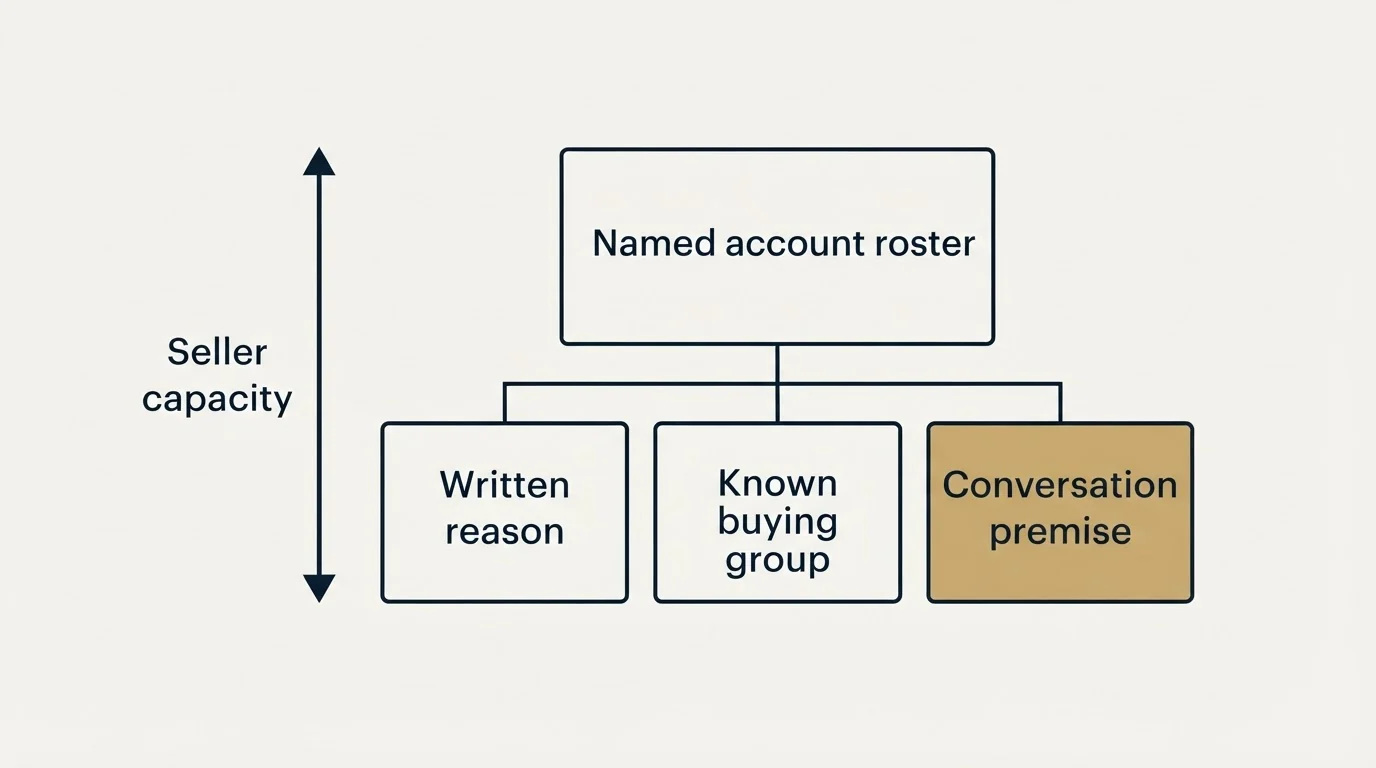
Account-based selling makes the company the unit of work: a fixed roster of named accounts, each with a written reason, a known buying group and a premise for the first conversation. The definition is simple and the discipline is in the two numbers nobody computes first, which are how many accounts a seller can genuinely carry and how many companies the market actually contains.
It is not account-based marketing, it is not restricted to enterprise deals, and it does not survive a roster that only grows. Where the market is small enough to address by name, it is the sensible default. Where it is not, the leverage moves elsewhere and the honest answer is to say so.
Opening the accounts on a roster is the half we run, against criteria agreed in writing before anything sends. See what a campaign into your named accounts produces.
Frequently asked questions.
Frequently asked questions- What is the difference between account-based selling and account-based marketing?
- They coexist rather than compete. Account-based marketing is a coordinated programme of campaigns and content aimed at a defined account set, and it scales, so its list is usually far longer. Account-based selling is what one seller does with one company: research, a buying group, and a premise per person. A team running both should expect the marketing list to be much larger.
- How many accounts should one seller carry?
- Small enough that every account on the list genuinely receives the research the method requires. Count what a plan costs to build and to maintain, divide the roster by the sellers, and check the result against the pipeline those sellers already own. The exact number varies by deal size and cycle length, and the arithmetic matters more than any published figure.
- Does account-based selling only work for enterprise deals?
- No. The threshold is whether the deal justifies the research, not company size. A market of a few hundred companies at a moderate contract value supports named-account work comfortably, because the whole market can be reached deliberately. A market of tens of thousands does not, whatever the individual deals are worth, because no team can plan account by account at that count.
- How does account-based selling change cold outbound?
- The premise becomes specific to the company rather than to the segment, and more than one person inside the account is approached with a message built on what that person owns. The useful test is whether the first line would be nonsense sent to a different account on the same roster. If it would still make sense, the research has not reached the message.