B2B Account-Based Marketing: The Four Plays
Four account-based plays that produce pipeline, in the order to run them, with the LinkedIn audience floor and the buying-group work most teams skip.
Four account-based plays carry most of the pipeline. Contact the whole list directly to find which accounts are reachable, expand the buying group inside open opportunities, run matched-audience ads alongside outbound where list size allows, and work customers and closed-lost. The other activities in a typical programme report well and move less.
Key takeaways
- Direct contact across the full list is the cheapest way to learn which accounts are reachable, which titles answer, and where the expensive treatment should go.
- Buying-group expansion inside open opportunities improves revenue you have already paid to originate, and needs no new budget or platform.
- LinkedIn company targeting lists need at least 300 rows and must match a minimum of 300 member accounts before an ad set can run, which rules out small named lists.
- Customers and closed-lost are the fastest of the four plays to produce a meeting, and both lists already sit in your CRM.
Reviewed and updated September 2, 2026
Most B2B account-based programmes contain about nine activities, and four of them produce almost everything that shows up in pipeline. The other five are real work that reports well and moves nothing measurable inside a quarter.
This is a working list of the four, written for a team that already has a target account list and now has to decide what to actually run against it.
Play one: direct contact with the whole list
Before any expensive per-account treatment, contact every account on the list directly and find out which ones are reachable. This is the least fashionable play in account-based marketing and the one that changes the most decisions.
Direct outbound answers three questions that no intent feed answers. Which accounts have contactable buyers at the titles you care about. Which framing gets a reply from this segment. And which accounts are simply not in the market right now, which is information you would otherwise pay six months of programme spend to discover.
Two things make this play work rather than merely happen.
Contact coverage is measured first, not assumed. For each account, you either hold a verified address for someone in the buying group or you do not. An account you cannot reach is not part of the campaign, whatever the list says.
One message per account, with a real reason for writing. We run single-message campaigns rather than sequences, because the second and third touch into an unresponsive account teach you nothing that the first did not, and they cost you the domain reputation that the rest of the list depends on. If the first message earns no reply, the account goes back into the pool for a different angle later, not into a bump sequence.
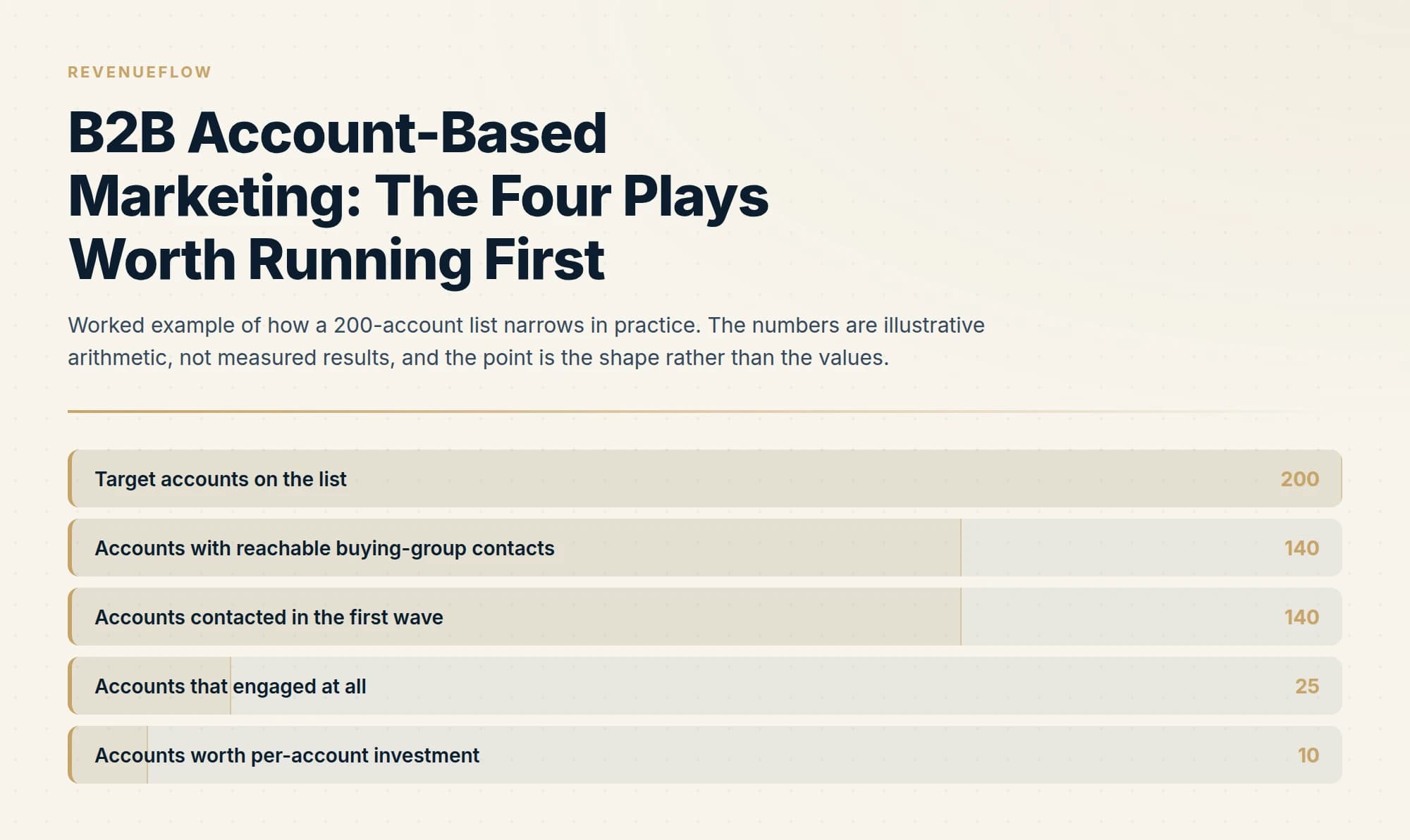
The output of play one is the input to everything else: a list of accounts sorted by whether anyone there engaged with anything.
Signed off by a named person in sales
Verified contact data at the right titles
One message each
Reply, click, or site visit
Where the expensive treatment now goes
The gap between row one and row two is the number nobody wants to look at, and it is the single most useful diagnostic in account-based marketing. Buying software before closing that gap buys orchestration for accounts you cannot contact.
Play two: buying-group expansion inside live opportunities
The highest-return account-based work in most companies is not aimed at new accounts at all. It is aimed at accounts already in an open opportunity where you know exactly one person.
Enterprise purchases are committee decisions. A deal with one champion and no other engaged contact is a deal that dies when the champion changes job or loses an internal argument. Adding two or three engaged people from the same account is cheaper than sourcing a new account and improves the odds on revenue you have already paid to originate.
The mechanics are simple and mostly manual. Take every open opportunity above a value threshold. List the roles that will touch the decision, which for most B2B software is an economic buyer, a technical evaluator, and whoever owns the process being changed. Compare that to who you have actually spoken to. Every gap is a named person to reach, with a genuine reason for contact, which is that their colleague is already evaluating you.
This play needs no platform and no new budget. It needs someone to run the comparison every fortnight and treat the gaps as work.
Play three: paid air cover, but only where the floor allows it
Running ads at your target accounts while outbound works the same list is the classic account-based combination, and it is the play most often bought before anyone checks whether it can run.
LinkedIn is the usual channel, and its own published requirements set a hard floor. A company targeting list must have at least 300 rows to upload, and it must match a minimum of 300 member accounts before it can be used in an active ad set, per LinkedIn's requirements for company targeting lists. The maximum list size is 20 MB or 300,000 companies, and it can take up to 48 hours for a list to process.
That floor is the whole story for small programmes. A 50-account list cannot be a LinkedIn matched audience. The workarounds are legitimate but they are workarounds: combine several lists, widen to a segment that contains your targets, or run the air cover on channels without a minimum. What does not work is buying an ads-led ABM programme for a list that is structurally too small to serve an ad to.
Where the list is large enough, keep the ordering deliberate: ads run against accounts outbound is actively working, in the same weeks, so the name in the inbox has been seen somewhere else. Ads running against accounts nobody is contacting is brand advertising with an account filter on it.
The mechanics of matched audiences and how they interact with a target account list are covered in more depth in our LinkedIn ABM guide.
Play four: customers and closed-lost
The fourth play targets accounts that already know you, and it is chronically underfunded because it does not feel like marketing.
Where these four plays target accounts directly, content programmes must instead match buyer stages, and the content funnel stage that resists mapping explains why calendars stall there.
Existing customers are the highest-converting account list you will ever hold, and expansion into a second department or a second product line is account-based marketing by any definition. You have usage data, an internal advocate, and a reason to write that no cold list can match.
Closed-lost opportunities are the second list. A deal lost eighteen months ago on price, timing, or a competitor selection has a decent chance of being live again, especially where the sponsor has changed. The qualifying question is what has changed since, and if you cannot answer it, the account is not ready.
Both lists live in your CRM already, which is why this play costs almost nothing to run and why it is usually the fastest of the four to produce a meeting.
- Direct contact across the full list
- Closed-lost revival
- Customer expansion
- Cheapest and fastest to first meeting
- Buying-group gap analysis on open opportunities
- Contact the roles you have never spoken to
- Improves revenue already originated
- No new budget required
- Matched-audience ads alongside outbound
- Requires 300+ matched companies on LinkedIn
- Runs in the same weeks as direct contact
- Support act, not the lead
What we deliberately left out
Four plays means a decision was made about everything else. The exclusions are as useful as the inclusions.
Bespoke one-to-one creative for a large list. It works, at a cost per account that only a handful of strategic targets ever justify. Below enterprise deal sizes it consumes the whole budget before the list is covered.
Intent-triggered programmes as the primary motion. Third-party intent is a prioritisation input, and it earns its place once you have a working motion to prioritise. It does not create a motion. Our B2B intent data guide covers what the signals do and do not tell you.
Direct mail and gifting. High response rates on small volumes, and a logistics operation nobody costs honestly at the outset.
Anything measured only in engagement score. A metric that rises reliably and cannot fall is a metric that reports the programme to itself.
How each play fails

Knowing the failure mode is more useful than knowing the play, because each one fails quietly and in a way that looks like something else.
Play one fails as a data problem wearing a copy problem's clothes. Reply rates collapse and the instinct is to rewrite the message. Check coverage and verification first: an unverified list produces bounces, bounces damage sending reputation, and a damaged reputation suppresses delivery for the accounts whose data was fine. The copy is usually the third thing wrong, not the first.
Coverage is testable before any contract, and running your own segment against a database settles more than the total record count on the vendor's page.
Play two fails through nobody owning the comparison. The gap analysis is obvious work that belongs to no role, so it happens once during a QBR and never again. Attaching it to an existing recurring meeting is the only version of this that survives past a month.
Play three fails by running against accounts nobody is contacting. Ads keep serving, the reach numbers look reasonable, and the programme reports impressions to an audience that received no other contact. This is the most expensive quiet failure of the four, because the spend continues automatically.
Play four fails on the qualifying question. Closed-lost revival works when something has changed since the loss, and the most common change is that the sponsor moved. Where nothing has changed, the account is not ready and contacting it burns the relationship a second time.
Sequencing a quarter
The four plays are not simultaneous. A workable order across a quarter concentrates the cheap, fast work at the start so the expensive work is allocated on evidence.
Read in that order, the four plays are a working account-based marketing playbook for a team that already has its list: what to run, when, and what each play has to show before the next one gets budget.
- First fortnightPlay four: customers and closed-lost
Needs no new data, and it gets meetings on the board while the rest of the programme is still being built.
- Weeks two to fivePlay one: direct contact across the whole list
The wave that produces information about which accounts answer, which titles engage and which framing lands. Do not commit research budget before it returns.
- From week fiveAllocate on the results, and start play two
Accounts that engaged get the expensive per-account treatment. Buying-group expansion runs in parallel, because open opportunities exist independently of the campaign calendar.
- Once outbound is runningPlay three, where the list is large enough
Air cover starts only when there is outbound activity for it to sit alongside. Air cover with nothing underneath it is just advertising.
In the first fortnight, run play four. Customers and closed-lost need no new data, and it gets meetings on the board while the rest of the programme is still being built.
In weeks two to five, run play one across the whole target list. This is the wave that produces information: which accounts answer, which titles engage, which framing lands. Do not commit research budget before this returns.
From week five, use those results to allocate. Accounts that engaged get the expensive per-account treatment. Play two starts in parallel, because open opportunities exist independently of the campaign calendar.
Play three, where the list is large enough to run it, starts once there is outbound activity for it to sit alongside. Air cover with nothing underneath it is just advertising.
Measuring four plays without inventing a dashboard
Each play has an obvious unit, and mixing them into one number destroys the information.
Play one reports accounts contacted, accounts engaged, and meetings held. Play two reports contacts per open opportunity, tracked over time, and win rate against a baseline. Play three reports reach against target accounts, and nothing else it claims should be believed without a holdout. Play four reports meetings and pipeline from customers and closed-lost separately from new-name accounts.
The one number worth reporting upward is pipeline created from target accounts, next to pipeline created from everything else, over the same period. It is cruder than an attribution model and considerably harder to flatter. The ABM agency buyer's guide covers the reporting questions to put to a vendor before signing, and what is ABM covers the vocabulary if the tier language is new.
Where to start on Monday
Pull the target list and count how many accounts you hold a verified contact for. That number, divided by the list size, is your coverage, and it caps everything else the programme can do.
Unlike building that contact list internally, a bought database carries no consent basis and blocks sending on platforms such as Mailchimp and Brevo, as detailed in what a bought email database really costs.
Then run play four this week, because it needs no new data, and play one next, because it tells you which accounts deserve the budget. Plays two and three follow from what those two teach you.
If direct contact across the list is the half you would rather not build in house, that is the half we run, and you can see what a campaign against your target accounts would look like.
LinkedIn advertising requirements verified against LinkedIn's Marketing Solutions Help Center as of mid-2026. Verify current requirements with LinkedIn before planning around them.
Sources: Requirements for company targeting lists in Campaign Manager, LinkedIn
Frequently asked questions.
Frequently asked questions- Which account-based play should we run first?
- Run customer expansion and closed-lost revival this week, because both need no new data, then direct contact across the target list, because it tells you which accounts deserve budget. Buying-group expansion and paid air cover follow from what those teach you. The ordering uses cheap signal to allocate expensive attention rather than the reverse.
- Can we run LinkedIn ABM ads on a 50-account list?
- Not as a matched audience. LinkedIn requires a company targeting list to have at least 300 rows and to match a minimum of 300 member accounts before it can run in an active ad set. Options are combining several lists, widening to attribute targeting that describes the accounts, or putting that budget into direct contact instead.
- What is buying-group expansion?
- Taking each open opportunity, listing the roles that will touch the decision, comparing that to who you have actually spoken to, and contacting the gaps. A deal with one champion dies when that champion changes job. Adding two or three engaged contacts from the same account is cheaper than sourcing a new account and improves the odds on existing pipeline.
- Should account-based campaigns use follow-up sequences?
- We run one message per campaign rather than sequences. A second and third touch into an unresponsive account teaches you nothing the first did not, and it costs the sending reputation the rest of the list depends on. If the first message earns no reply, the account returns to the pool for a genuinely different angle later.
About the author.

Ben Carden is CRO at RevenueFlow, which builds and operates outbound revenue engines for B2B companies. Previously at Gartner Enterprise. Studied at London School of Economics.
Ben Carden · CRO
Connect on LinkedIn →Explore more.
Ready to scale your outreach?
We build GTM engines that book real meetings. See the receipts.
Related articles.
ABM vs ABX: What Demandbase Added to the Model
One of these terms belongs to a vendor. What Demandbase says ABX adds, the three things that genuinely change, and the three that stay identical.
5 ABM Campaign Examples and How Each One Is Built
Five worked account-based campaign examples, each built on the same five fields: account set, tier, plays in order, owner and handoff, and the exit condition.
Field Marketing in B2B: What a Programme Costs Per Meeting
Two different practices answer to the name field marketing. The B2B one runs dinners and roadshows for named accounts, and it divides like any other channel.
ABM Reporting: Three Readers, Three Cadences
ABM reporting built around who reads it: a weekly operating page, a monthly allocation page and a one-page quarterly board report, each computed from CRM fields.
ABM Metrics: Coverage Decides Every Other Number
Every published ABM metric is a ratio whose denominator somebody chose. Six numbers, the denominator each one needs, and the comparison that settles it.
Goldcast Belongs to Cvent Now: The Buying Question
Cvent announced its Goldcast acquisition in December 2025 and completed its ON24 acquisition in April 2026. Two shortlist names, one owner, one live contract question.