What Is ABM? Account-Based Marketing Explained
Account-based marketing is a targeting decision rather than a software purchase. The tiers, the five workstreams, and the two inputs that decide whether it works.
Account-based marketing names the companies you want as customers first, then aims coordinated marketing and sales effort at only those accounts. The list becomes the campaign, and success is measured by movement inside named accounts rather than lead volume. It is a targeting strategy, and the software category that shares its name is optional.
Key takeaways
- ABM inverts demand generation: you choose the accounts before spending, and the reporting unit is the account rather than the lead.
- The three tiers, one-to-one, one-to-few and one-to-many, describe how many accounts share a single piece of creative, and they drive cost more than any other variable.
- Contact coverage caps everything: a programme aimed at 200 accounts that can reach buyers at 60 of them is a 60-account programme.
- If the requirement is pipeline inside a quarter, that is an outbound problem, and buying ABM to solve it produces engagement reporting instead.
Reviewed and updated September 1, 2026
A marketing lead gets told to "start doing ABM" in the same quarter the board asks where next quarter's pipeline is coming from. Those two instructions point in opposite directions, and most of the confusion around account-based marketing comes from nobody saying so out loud.
Account-based marketing is a targeting decision, not a technology purchase. You name the companies you want as customers, then aim coordinated marketing and sales effort at only those companies. Everything else follows from that one inversion.
The inversion, stated plainly
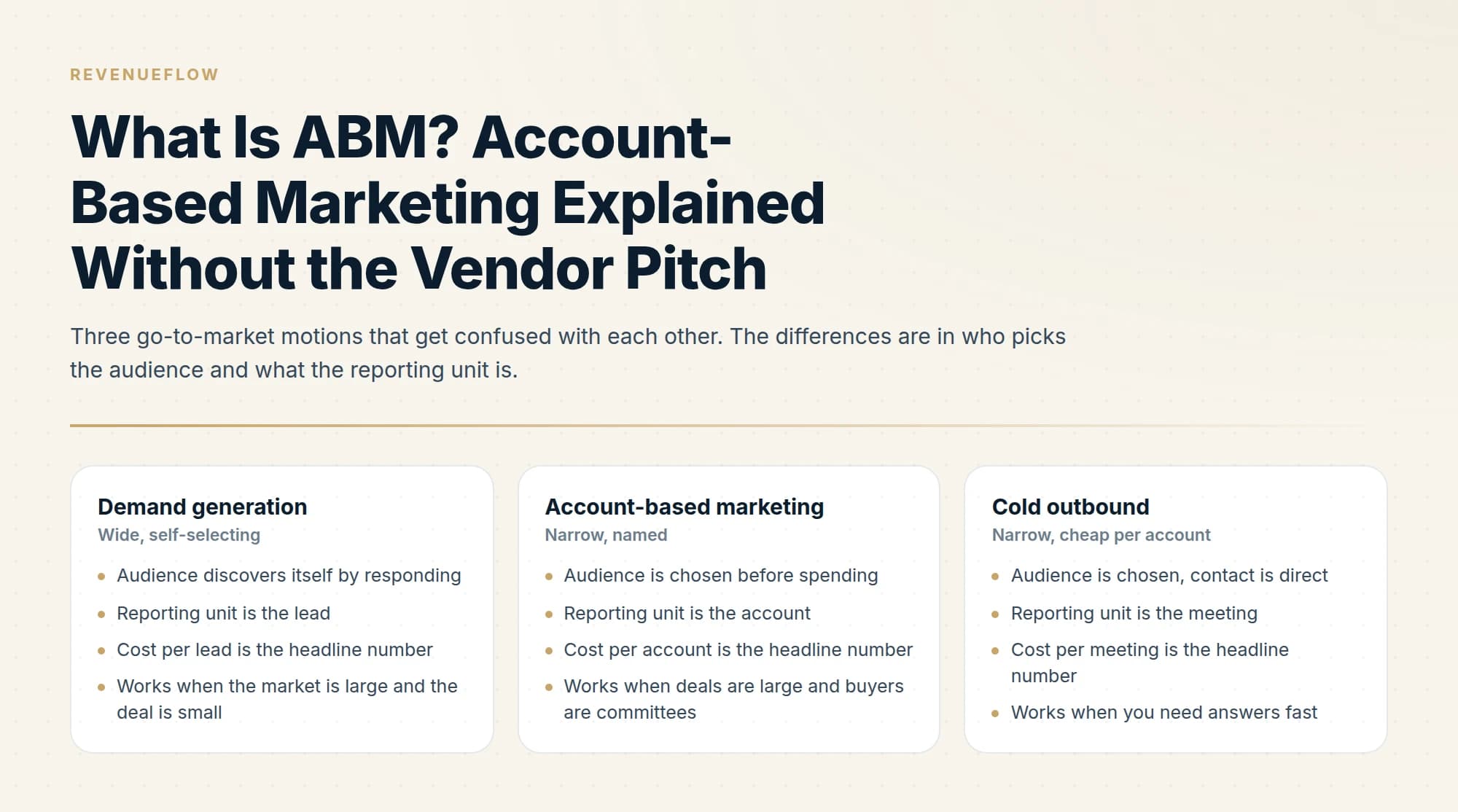
Conventional demand generation casts wide and filters down. You publish, you advertise, you collect people who raise a hand, and you qualify them until a small number turn into pipeline. The audience is discovered by who responds.
Casting wide has its own name and its own job, and the demand generation definition separates growing the pool from capturing somebody already in it.
ABM starts from the other end. You decide which accounts are worth winning before you spend anything, and the list becomes the campaign. Nobody outside the list is a target, and success is measured by movement inside named accounts rather than by volume of leads.
That difference sounds academic until it hits your reporting. A demand gen programme can report leads on day one. An ABM programme cannot, because the unit it produces is engagement inside a small number of companies, and small numbers move slowly.
Demandbase extends the same idea past the close under its own name, and what ABX adds and what it leaves identical is set out in ABM vs ABX.
- Audience discovers itself by responding
- Reporting unit is the lead
- Cost per lead is the headline number
- Works when the market is large and the deal is small
- Audience is chosen before spending
- Reporting unit is the account
- Cost per account is the headline number
- Works when deals are large and buyers are committees
- Audience is chosen, contact is direct
- Reporting unit is the meeting
- Cost per meeting is the headline number
- Works when you need answers fast
The third column matters because outbound and ABM are frequently sold as alternatives when they run on the same target list. Outbound holds spend per account low and contacts a lot of them. ABM raises spend per account and contacts fewer. The list can be identical.
Which answers the question that usually follows, whether an account-based programme needs different channels. It does not. Email and LinkedIn carry ABM outreach exactly as they carry outbound, and a programme is not account-based because of where the message is delivered. What changes is upstream and downstream of the channel: how the list was chosen, how many people inside each account are approached and by whom, how much production goes into each account, and whether the reporting unit is the lead or the account. A team told it must buy new channels to run ABM is being sold the tier rather than the motion.
The three tiers everyone uses
Every practitioner and every agency uses the same vocabulary for how many accounts share one piece of work.
One-to-one means research and creative built for a single named company. Reserved for a handful of strategic targets, because the cost per account is high enough that only large deals justify it.
One-to-few clusters accounts that share a trigger, an industry, or a use case, then builds one set of assets for the cluster. Usually five to thirty accounts per cluster.
One-to-many applies programmatic personalisation across a large segment. This is the tier closest to conventional demand generation, and the tier where the word "personalisation" does the least work.
Cost per account falls sharply from left to right, and so does depth. Choosing a tier is a budget decision wearing a strategy costume. If your list is 400 companies, you are running one-to-few or one-to-many whatever the proposal calls it.
What an ABM programme is actually made of

Strip out the software and five pieces of work remain. Every one of them is done by a person, on your side or an agency's.
- Step 1Account selection
Build and prioritise the target list against criteria sales will sign off on.
- Step 2Account research
Map the buying group, the incumbent vendor, and the trigger events worth referencing.
- Step 3Creative and content
Produce the account-specific or cluster-specific assets the programme runs on.
- Step 4Channel orchestration
Run ads, outbound, and events against the same list in a deliberate order.
- Step 5Measurement
Report account engagement and pipeline rather than lead volume.
Notice which of those a platform can do for you. Orchestration and measurement, mostly. Selection depends on knowing your market. Research is judgement. Creative is production. The three expensive ones are labour, which is why ABM budgets are dominated by people even when the software line item is the one that gets negotiated.
The part the category page skips
Two unglamorous inputs decide whether a programme functions at all.
Coverage. For each target account, do you hold usable contact data for the people who matter? A programme aimed at 200 accounts where you can reach buyers at 60 of them is a 60-account programme carrying a 200-account budget. Coverage is measurable before you spend anything, and almost nobody measures it first.
Buying group depth. Enterprise purchases involve committees, so one engaged contact at fifty accounts is a weaker position than four engaged contacts at fifteen. Depth moving up is the earliest honest sign that a programme is working, and it is visible long before pipeline is.
Both come out of your CRM and your contact data. Neither requires a platform to compute, which is worth remembering when a vendor explains that their reporting needs their platform.
ABM is a motion, and the software is optional
The category is unusual in that its name is used for three different things at once: a targeting strategy, a set of channel tactics, and a software category with six-figure entry points. The strategy predates all the software and works without it.
What the platforms genuinely add is third-party intent data, account-level advertising activation, and a unified view of engagement across channels. Those are real capabilities. They are also the capabilities that matter most at the top of the market, where a hundred-person revenue team needs one shared account view.
For a team of ten working a list of fifty accounts, the same motion runs on a CRM, a data and enrichment layer, an outbound sending stack, and a spreadsheet that everyone agrees on. We build the outbound half of that for clients daily, and the honest version is that the tooling gap between a modern data stack and an ABM platform is smaller every year. Our comparison of ABM platforms covers what each one actually sells, and the tools catalogue breaks the category down by job rather than by brand.
The vocabulary you will hear on a first call
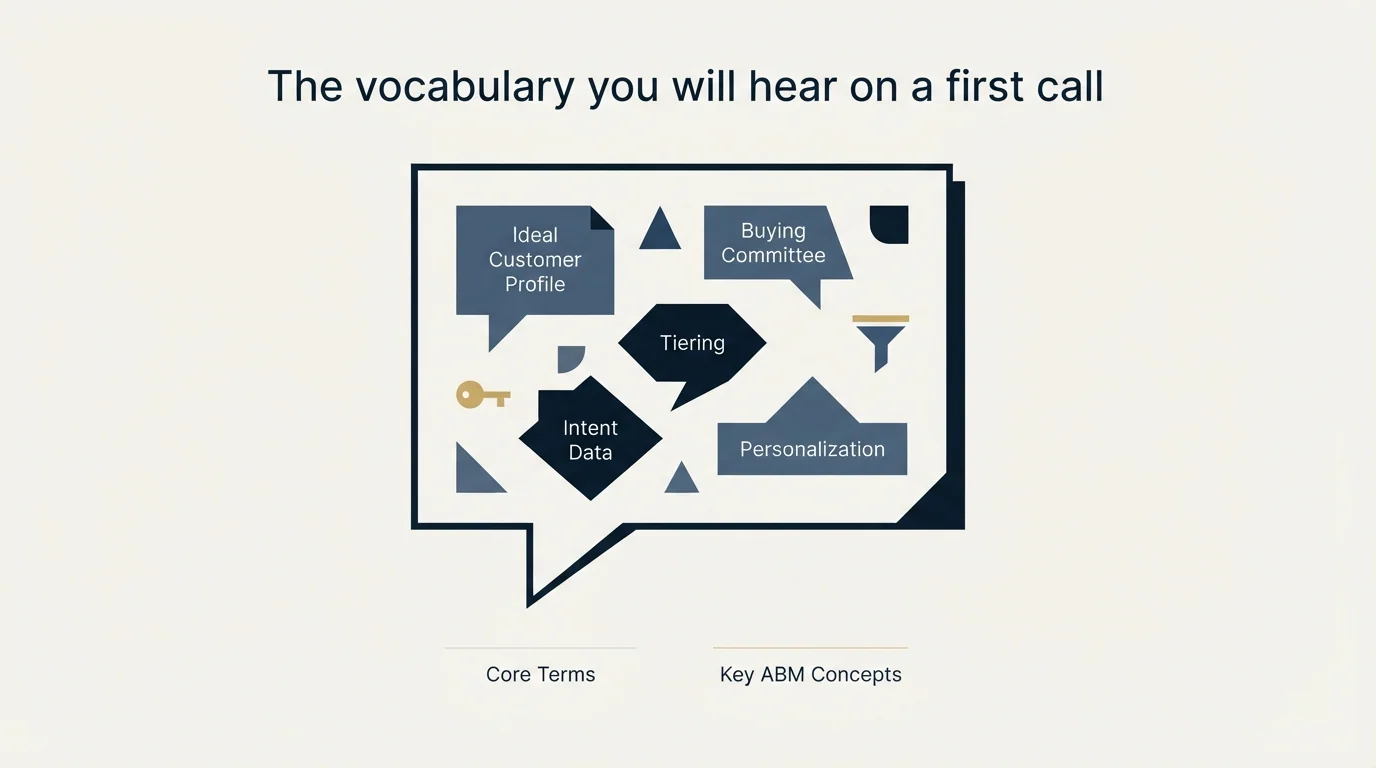
If you talk to agencies or vendors, three commercial models come up, and the labels are used inconsistently enough that the useful comparison is by what the fee attaches to rather than by what it is called.
Retainer is a fixed monthly cost for a defined scope. It is the most common model and the easiest to compare between vendors, and it means the fee is the same whether the account list converts or not.
Programme fee prices per campaign wave or per account tier, often with a research allowance per account. Scope changes show up as change orders rather than as slower delivery.
Performance prices per meeting or per qualified opportunity, which moves delivery risk to the vendor and requires the outcome to be defined in writing before anything starts. It is rare in ABM and common in outbound, which tells you something about how measurable each motion is.
None of these is inherently better. The question worth asking is what the fee is attached to, because that determines what happens when the programme grows or stalls.
What it costs in effort, not money
The budget conversation focuses on software and media, and the actual constraint is usually production time.
A one-to-one account needs research into the buying group, the incumbent vendor and the trigger worth referencing, then assets built around what that research found. Several hours per account is normal, and it does not compress much, because the value of the tier is precisely that a person thought about it.
A one-to-few cluster amortises that work across five to thirty accounts, which is why the middle tier is where most programmes should put their production budget. The research is done once per cluster and the assets serve every account in it.
Mapping content to buyer funnel stages sets out why the middle stage, where a category still lacks a shortlist, resists the same clear brief that research-driven account assets get.
The long tail needs no bespoke production at all, and trying to give it some is the most reliable way to run out of capacity in month two. A strong segment message with accurate fields beats a thin attempt at personalisation, and it costs a fraction as much to produce.
Plan the calendar around the production stage rather than the launch date. Creative arriving after the audience is live is the most common sequencing failure in the category, and it converts a targeted programme into expensive generic advertising for its first few weeks.
When ABM is the wrong answer
ABM aims at accounts with long buying processes, so it produces results on the timescale of those processes. Buying it to solve a pipeline gap inside a quarter produces an expensive programme that reports engagement while the gap stays open.
- Yes: You can name the accounts, or hold data good enough to build the list credibly
- Yes: Average deal size justifies per-account research time
- Yes: Sales and marketing already agree on what a good account looks like
- Yes: Someone in sales will sign their name to the target list
- No: You need pipeline inside this quarter
- Depends: Your CRM can join campaign response and web activity to the account record
- Depends: You have content production capacity, or budget to buy it
The "no" row is the one that catches people, and the "maybe" rows are the silent blockers. Where the CRM join does not exist, the programme cannot report the thing it exists to report, so you get activity summaries instead of account movement.
How to start without buying anything
The cheapest credible starting point is a list and a channel that gives you answers quickly.
Build the account list against criteria a named person in sales signs off on. Our guide to defining an ideal customer profile covers the criteria side, and building the target list you can actually work covers sizing it against the capacity you have.
Then run cheap contact against the whole list before committing research budget to any of it. Direct outbound tells you within weeks which accounts are reachable, which titles answer, and which framing lands. That is real signal, and it costs a fraction of what per-account creative costs. Reserve the expensive one-to-one treatment for the accounts that showed something.
That ordering uses cheap signal to allocate expensive attention. The reverse ordering, which is what most programmes do, commits the research budget before anyone knows which accounts respond at all.
If the immediate requirement is meetings rather than a programme, that is an outbound problem with an outbound answer, and you can see what a campaign against your target list would look like. If you have decided the programme is the right shape and the question is whether to hire help, the ABM agency buyer's guide covers engagement models and what they cost.
The short version
ABM is a decision to name your buyers before you spend, and then to concentrate effort on them. It is measured in account coverage, buying group depth, and pipeline from target accounts, none of which need a new platform to compute. The tier you can afford is set by your list size and your content capacity, and the failure mode is buying one-to-one treatment for accounts that never justified it.
Which numbers those are, and the denominator each one needs before it can be read, is worked through in ABM metrics.
Get the list right and sign it off. Use cheap contact to find out which accounts are live. Spend the expensive budget on the ones that answered.
Platform capabilities and vendor positioning verified as of mid-2026. Verify current terms with any vendor before relying on them.
Frequently asked questions.
Frequently asked questions- What is the difference between ABM and demand generation?
- Demand generation casts wide and lets the audience discover itself by responding, reporting on leads. Account-based marketing names the target companies before spending anything and reports on movement inside those accounts. The practical consequence is timing: demand gen can report leads in week one, while an account-based programme produces engagement inside a small number of companies, which moves slowly.
- Do you need an ABM platform to do account-based marketing?
- No. The strategy predates the software and runs on a CRM, a contact data layer, a sending stack and an agreed account list. What platforms genuinely add is third-party intent data, account-level ad activation and one shared view across many channels. Those matter most for large revenue teams running six or more channels against a big list.
- How many accounts should be on an ABM target list?
- As many as you can genuinely work, which is set by production capacity rather than market size. A list longer than capacity is a queue, and accounts at the bottom of it receive nothing for months. Most mid-market teams land on a small named tier, a middle tier grouped into clusters, and a long tail that gets direct contact only.
- How long before an ABM programme shows results?
- Longer than a quarter in most cases, because the motion aims at accounts with long buying processes. The earliest honest signal is buying group depth, meaning the number of distinct engaged people per target account, which moves months before pipeline does. If you need meetings sooner, run direct outbound across the list first.
About the author.

Ben Carden is CRO at RevenueFlow, which builds and operates outbound revenue engines for B2B companies. Previously at Gartner Enterprise. Studied at London School of Economics.
Ben Carden · CRO
Connect on LinkedIn →Explore more.
Ready to scale your outreach?
We build GTM engines that book real meetings. See the receipts.
Related articles.
ABM vs ABX: What Demandbase Added to the Model
One of these terms belongs to a vendor. What Demandbase says ABX adds, the three things that genuinely change, and the three that stay identical.
5 ABM Campaign Examples and How Each One Is Built
Five worked account-based campaign examples, each built on the same five fields: account set, tier, plays in order, owner and handoff, and the exit condition.
ABM Metrics: Coverage Decides Every Other Number
Every published ABM metric is a ratio whose denominator somebody chose. Six numbers, the denominator each one needs, and the comparison that settles it.
Lead Generation Statistics: The Denominator Nobody States
One roundup lists the same budget statistic twice in different words, and three list one finding under three different attributions. The genre explains itself.
ABM Reporting: Three Readers, Three Cadences
ABM reporting built around who reads it: a weekly operating page, a monthly allocation page and a one-page quarterly board report, each computed from CRM fields.
Lead Verification: What Each Check Actually Proves
Lead verification covers two different jobs. One asks whether a mailbox will accept mail, the other asks whether the person behind the row is real and lawful to contact.