ABM Platforms: Demandbase, 6sense, DemandScience vs Clay
Terminus now redirects to DemandScience, none of the enterprise vendors publish a price, and the build-or-buy line has moved. What each platform actually sells.
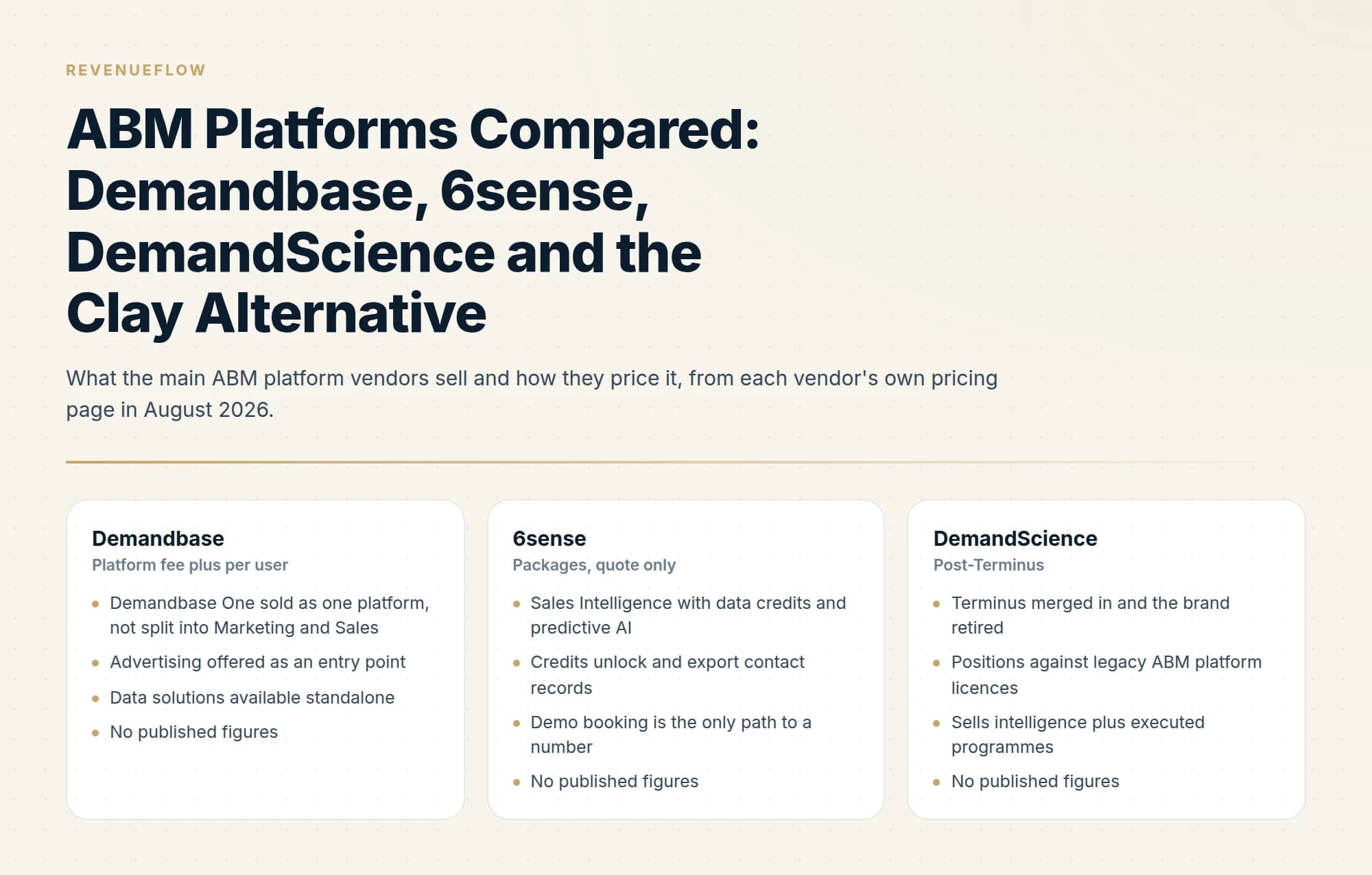
Demandbase, 6sense and DemandScience sell bundles of four separable jobs: account data, third-party intent, ad activation, and orchestration. None publish pricing. Intent and ad activation are the two hardest to replicate, while data and reporting can be assembled from a workflow layer and a CRM at a published cost.
Key takeaways
- Terminus merged into DemandScience in November 2024 and terminus.com now redirects there, so any shortlist naming Terminus as a standalone product is out of date.
- Demandbase, 6sense and RollWorks all publish pricing pages with no figures on them, so cost can only be established inside a sales process.
- Demandbase describes its model as a platform fee plus a flat fee per user, and does not split Demandbase One into separate Marketing and Sales editions.
- Clay publishes its prices, with a free tier and paid plans from $167 a month, which is what moved the build-or-buy line for account data and prioritisation.
Reviewed and updated September 5, 2026
Type terminus.com into a browser today and you land on demandscience.com. Terminus, one of the three names that defined the ABM platform category, merged into DemandScience in November 2024 and the combined company now operates under the DemandScience brand, per DemandScience's own announcement. The brand you were told to evaluate against Demandbase and 6sense no longer exists as a standalone product.
That single redirect is the most useful fact in any current ABM platform comparison, because it tells you what the category has been doing: consolidating, repositioning, and in DemandScience's case actively campaigning against the thing it used to sell. Its homepage now leads with a "Platform Tax" argument that after "spending six figures on a platform, most organizations still have to fund and execute every program required to generate pipeline."
Here is what is actually on the market, what each vendor sells, and what the alternative looks like.
Nobody at the top of this market publishes a price
Start with the fact that shapes every evaluation. The enterprise ABM platforms do not publish pricing, and their pricing pages are lead forms.
Demandbase publishes a pricing page with no numbers on it. It describes the model rather than the cost: "a clear platform fee that covers all the essential software and services. In addition, there's a flat fee per user." It also states that Demandbase One is not sold as separate Marketing and Sales products, so you buy the platform rather than a module (Demandbase pricing).
6sense publishes package names and no figures. Its pricing page lists Sales Intelligence combined with Data Credits and Predictive AI in three arrangements, and every call to action is a demo booking (6sense pricing).
RollWorks now redirects its pricing page to AdRoll, where the ABM packages carry a Contact Sales button rather than a price.
Influ2 publishes nothing at all: its own sitemap carried 278 URLs on 30 August 2026 and not one of them was a pricing, plans or cost page, so Influ2 pricing is established in a sales conversation rather than read off a page, and unlike Demandbase it does not publish the model either.
You can still evaluate these products, but not on cost until you are in a sales process. Compare them on the model, on what is bundled, and on how the fee scales, because those are the things you can learn before you talk to anyone.
- Demandbase One sold as one platform, not split into Marketing and Sales
- Advertising offered as an entry point
- Data solutions available standalone
- No published figures
- Sales Intelligence with data credits and predictive AI
- Credits unlock and export contact records
- Demo booking is the only path to a number
- No published figures
- Terminus merged in and the brand retired
- Positions against legacy ABM platform licences
- Sells intelligence plus executed programmes
- No published figures
The four jobs a platform is actually doing
Searches for 6sense marketing usually mean its Revenue Marketing product line rather than the company, and the four jobs below are the way to read any of these product names: the line you are quoted for is a bundle of them, and the price moves with how many you switch on.
The company is also searched as sixth sense, spelled out, and the question behind that spelling is almost always what the platform does inside an ABM programme rather than what it costs. Three of the four jobs answer it: predictive scoring to rank the account list, third-party intent to time the approach, and orchestration to run advertising and outreach against whatever scores. Which of the three you would genuinely use is the evaluation.
Vendors present themselves as one product. They are bundles of four separable jobs, and knowing which one you are short of is the whole evaluation.
Account and contact data. Firmographics, technographics, and contact records for the people inside target accounts. Widely available, competitively priced, and the least differentiated of the four.
Third-party intent. Signals that someone at an account has been researching your category somewhere you do not own. This is the capability with the least available substitute and the one that most justifies platform spend, and it is also the one whose accuracy you cannot audit from the outside.
Advertising activation. Serving ads to people at named accounts across display and social. Genuinely hard to replicate at scale, and the historical reason the category existed.
Orchestration and reporting. One account view across channels, engagement scoring, journey stages, and the reporting your CFO sees. Valuable in proportion to how many teams and channels have to share one picture.
A hundred-person revenue team with six channels needs the fourth job badly enough to pay for the other three. A team of twelve working fifty accounts usually needs the first job, sometimes the second, and can get the fourth from a CRM report.
The Clay and outbound alternative, honestly framed
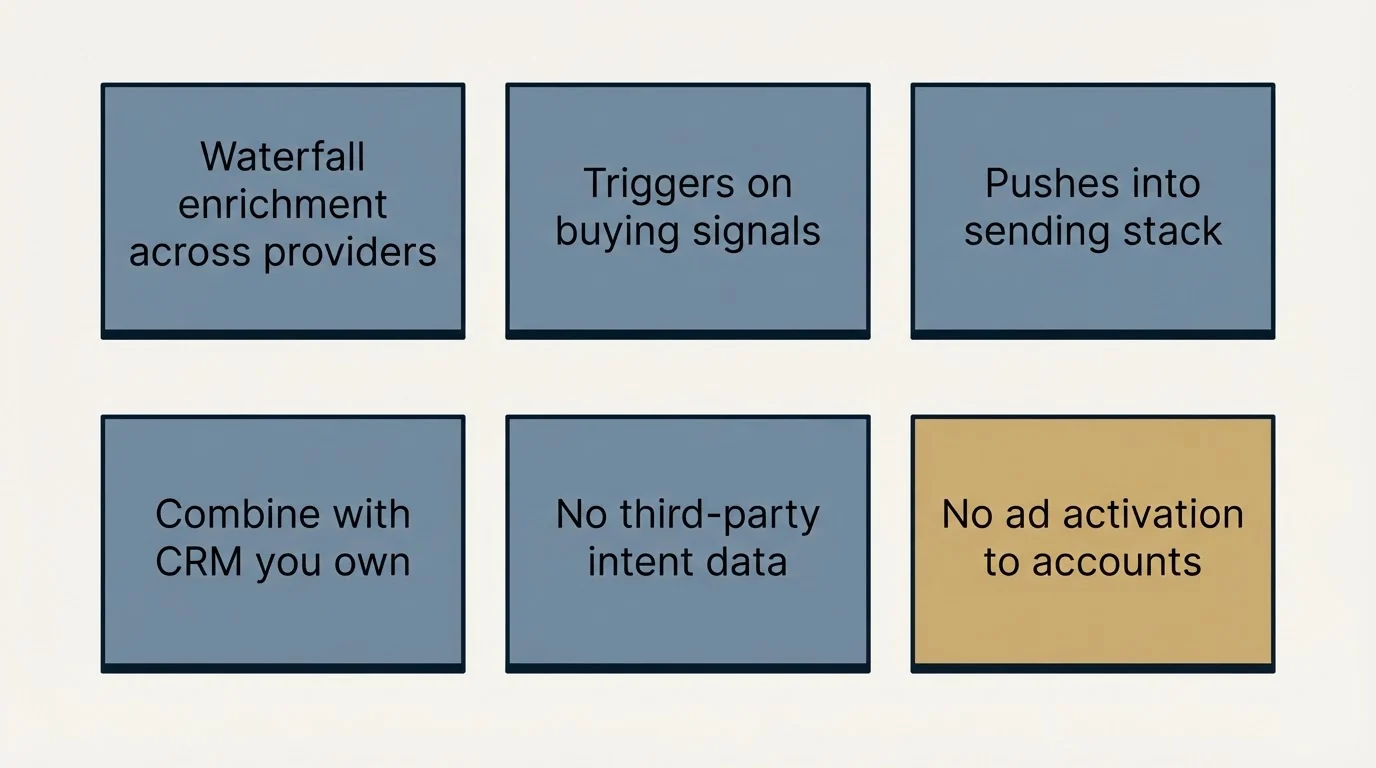
The reason this question is live in 2026 is that the data and workflow layer got good enough to assemble three of those four jobs yourself, at a published price.
Clay publishes its plans: a free tier with 500 actions and 100 data credits a month, Launch from $167 a month, Growth from $446 a month, and Enterprise on request. What you get is a workflow layer that runs waterfall enrichment across many data providers, plus the ability to trigger on signals and push into a sending stack.
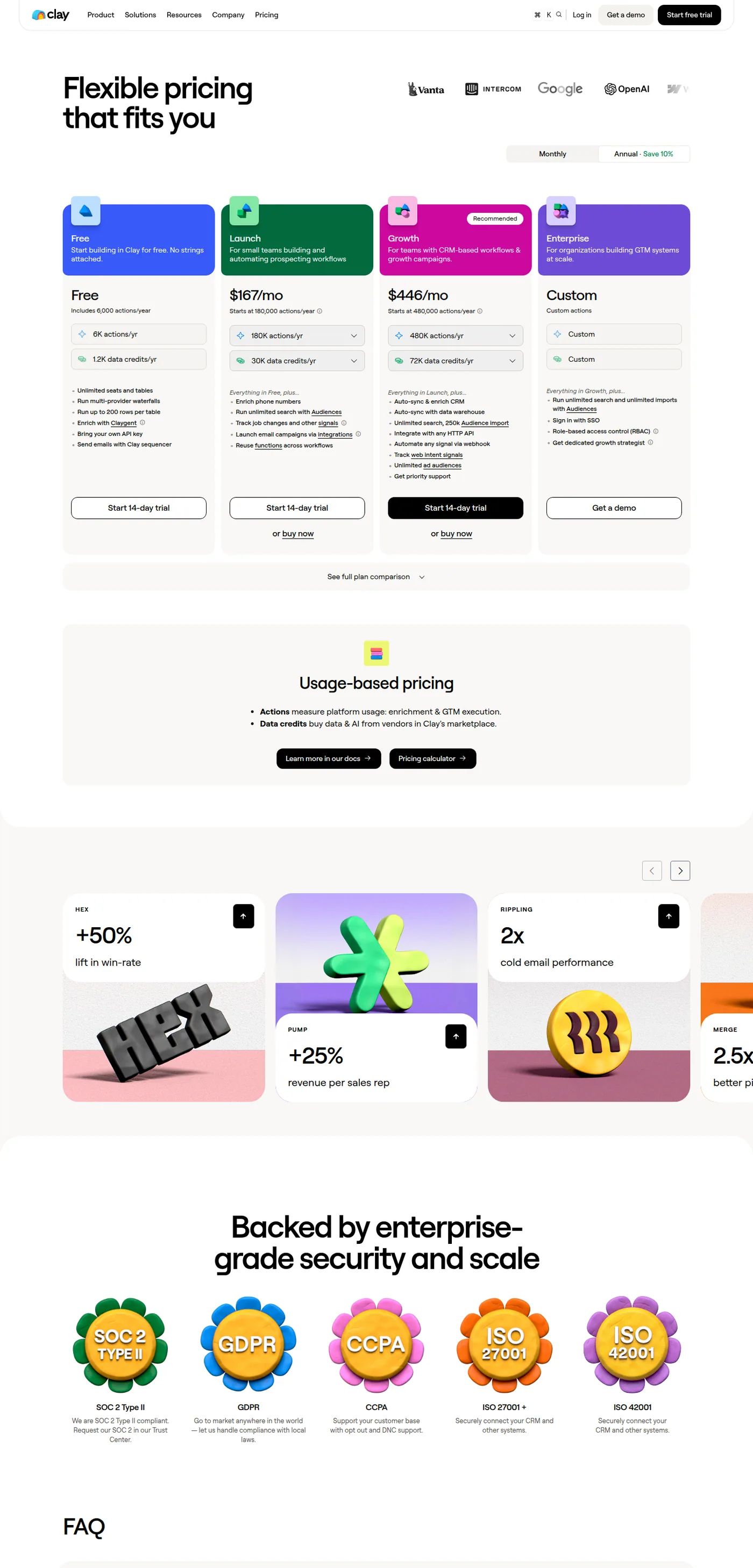
Clay publishes what the platform vendors above do not. Captured mid-2026.
Combine that with a CRM you already own and an outbound sending setup, and you have account data, signal-driven prioritisation, direct contact, and account-level reporting. The published cost of that combination is a small multiple of a single enterprise platform seat.
What it does not give you is third-party intent of the kind Demandbase and 6sense sell, or ad activation against named accounts. If those two are what you need, the platforms are what sells them.
- Yes: Multiple teams and channels need one shared account view
- Yes: Account-level advertising is a core part of the plan
- Yes: Third-party intent will change who your team contacts this week
- No: Your target list is under a few hundred accounts
- No: Outbound and CRM reporting already answer your prioritisation questions
- Depends: Your CRM can join campaign response and web activity to the account record
The third row is the honest test for intent data specifically. If a rep would work a different account tomorrow because of an intent signal, it is worth buying. If it produces a weekly list nobody acts on differently, it is an expensive newsletter.
Intent data is the capability to interrogate hardest
Third-party intent is the reason most platform deals get signed and the capability buyers examine least, largely because it is difficult to examine from the outside.
Three questions make it tractable.
Whose data is it? Intent is frequently sourced from a data co-operative or a publisher network rather than generated by the vendor. Two platforms drawing on the same underlying source are less differentiated than their demos suggest, and asking directly usually gets a straight answer.
What counts as a signal? Reading one article on a topic and downloading a competitor's comparison guide are both intent, and they are not the same evidence. Ask what behaviours feed the score and at what weight.
How is it resolved to an account? Individual readers are usually resolved to a company by network address or by a cookie graph, both of which have become less reliable. Remote work broke a lot of address-to-company mapping, and privacy changes eroded the rest.
None of that means intent data is worthless. It means the honest version is probabilistic, and the way to test it is to take last quarter's alerts and ask whether any of them changed which account a rep actually worked. That question is answerable from your own CRM before you sign anything.
What the consolidation means for a buyer
Three things follow from a category that is merging rather than growing.
Roadmaps move. A product acquired into a larger company gets integrated, repriced, or wound down on a timeline nobody shares with customers. Ask any vendor directly which of their components came from an acquisition and what the integration state is.
Reference customers age. A case study published under a brand that no longer exists tells you about a product that no longer ships in that form.
The pitch shifts to services. DemandScience's current positioning bundles execution with data, which is a different purchase from a software licence and should be evaluated as one. Compare it to an agency retainer, not to a platform fee. Our ABM agency buyer's guide covers how those engagements are priced.
How to run the evaluation
Four questions get you further than a feature matrix.
What is the fee attached to? Platform plus per user, per account, per credit, or per programme. This determines what happens when you grow, and it is knowable on a first call.
What is the minimum term and the minimum spend? Enterprise ABM contracts are typically annual, and the entry point matters more than the list price you never see.
Which components are yours and which are resold? Intent data in particular is frequently sourced from a third party, and knowing whose data it is tells you what you are actually buying.
What does the platform measure that my CRM cannot? Ask for the specific report. If the answer is engagement scoring, ask how the score is computed and whether it can fall.
- Step 1What is the fee attached to?
Platform plus per user, per account, per credit, or per programme. This determines what happens when you grow.
- Step 2What are the minimums?
Minimum term and minimum spend. Contracts here are typically annual, and the entry point matters more than a list price you never see.
- Step 3Which components are resold?
Intent data especially. Knowing whose data it is tells you whether two vendors are differentiated or reselling one feed.
- Step 4What does it measure that my CRM cannot?
Ask for the specific report. If the answer is engagement scoring, ask how the score is computed and whether it can fall.
For the tool-by-tool breakdown across the wider category, including the cheaper signal tools that publish their prices, see our ABM tools catalogue. If Demandbase specifically is on the shortlist, the Demandbase review covers who it fits. If it is 6sense, the 6sense alternatives piece maps each capability to what would replace it.
What the first year actually looks like
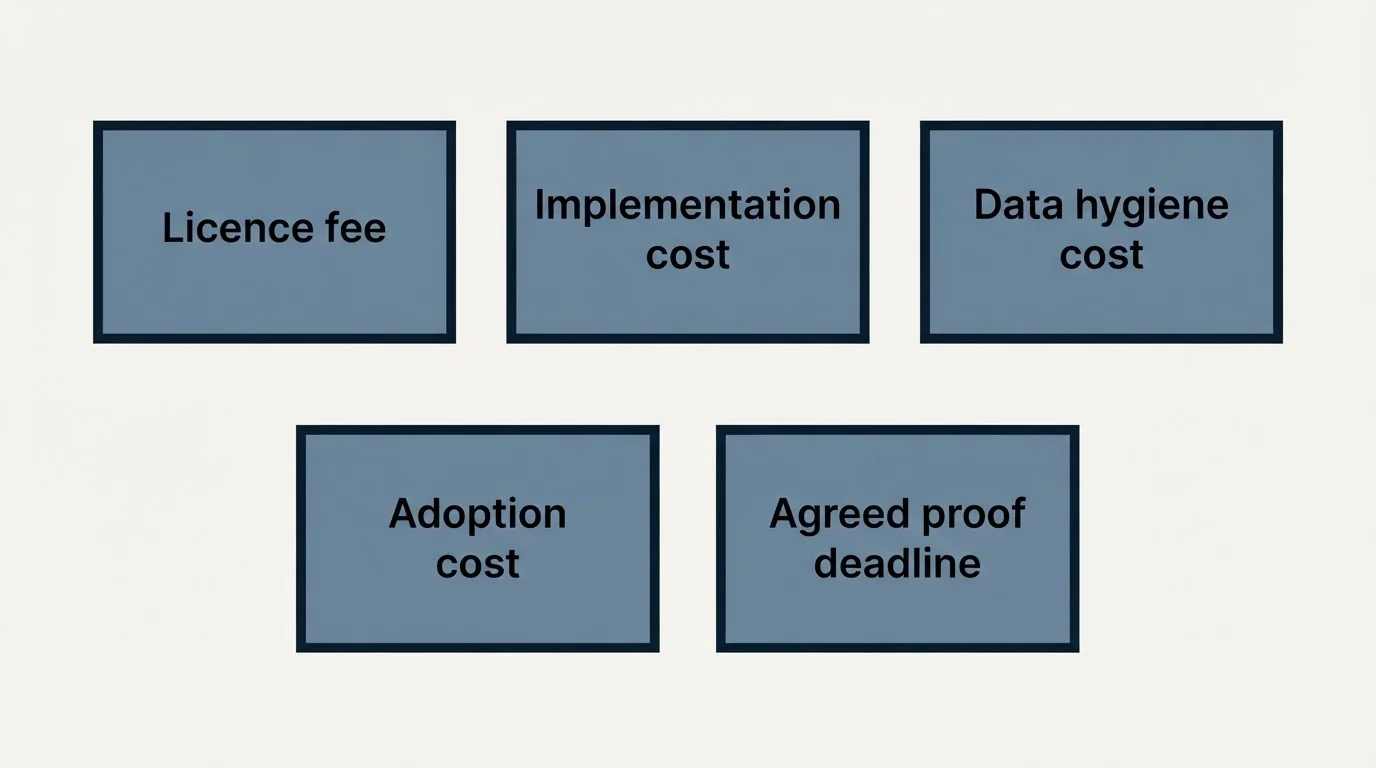
Two costs sit outside the licence fee and are routinely left out of the business case.
Implementation and data hygiene. A platform reports on accounts, so it needs your CRM account records to be clean, deduplicated and matched to its own account universe. Where duplicate accounts exist, and they do, engagement splits across them and the reporting understates everything. This work lands on your team regardless of what the vendor's onboarding covers.
Duplicate account records break more than platform reporting, because every comparison built over them inherits the error, which is one of the preconditions in what a CRM analytics layer assumes.
Adoption. Per-user pricing rewards deep adoption and punishes partial adoption, and platforms in this category are typically bought by marketing and used, or not used, by sales. A tool that two people open weekly costs the same as one the whole team lives in. Ask during procurement who is accountable for adoption after the launch quarter, and what happens if the answer turns out to be nobody.
Both of these argue for the same procurement discipline: agree what the platform must demonstrate by a specific date, in a metric you already track, and put that in front of the renewal rather than behind it.
The short version
The category consolidated: Terminus is now DemandScience, RollWorks prices through AdRoll, and none of the enterprise vendors publish a number. Evaluate them on which of the four jobs you are genuinely short of rather than on feature counts. Intent and ad activation are the two you cannot easily assemble yourself. Data and reporting you probably can, at a published price, and if direct contact against your target list is the part you want running first, you can see what that campaign would look like.
Vendor pricing pages, package names and product positioning verified as of mid-2026. None of the enterprise vendors above published a price at the time of writing. Verify current terms with the vendor before relying on them.
Sources: Demandbase pricing, 6sense pricing, DemandScience and Terminus merger announcement, Clay pricing
Frequently asked questions.
Frequently asked questions- How much does an ABM platform cost?
- None of the major vendors publish a figure. Demandbase describes a platform fee plus a flat fee per user, 6sense lists package names and routes to a demo, and RollWorks now points at AdRoll with a Contact Sales button. Decide your ceiling before the first call, expressed as a share of the pipeline the programme must produce.
- What happened to Terminus?
- Terminus merged into DemandScience in November 2024 and the combined company operates under the DemandScience brand. Its old domain redirects there. DemandScience now positions against the model Terminus sold, arguing that after spending six figures on a platform most organisations still have to fund and execute every programme themselves.
- Can Clay replace an ABM platform?
- It replaces the account data and prioritisation jobs at a published price, and combined with a CRM and a sending stack it covers direct contact and account reporting too. What it does not give you is third-party intent of the kind Demandbase and 6sense sell, or advertising activation against named accounts. Those two remain platform territory.
- What should you ask an ABM platform vendor first?
- Four questions: what the fee is attached to, what the minimum term and minimum spend are, which components are theirs versus resold, and what the platform measures that your CRM cannot. Ask for the monthly account report they would actually send you, taken from a live customer with names removed, rather than a dashboard tour.
About the author.

B2B cold email experts helping companies generate qualified leads through done-for-you outreach campaigns.
RevenueFlow Team
Explore more.
Ready to scale your outreach?
We build GTM engines that book real meetings. See the receipts.
Related articles.
Apollo and Clay Integration: What Connects, Who Meters What
Clay's docs list one Apollo source and eleven actions. How the account connects, which way each action moves data, and which vendor bills each step.
Reply.io Salesforce Integration: The Sixteen Sync Steps
Reply's support article lists sixteen sync steps, two profiles, required field mappings and a two-hour cadence. What the native Salesforce integration moves.
Alta Pricing: No Rate Card, a Quote in Hours
Alta publishes no price. What its plans page, FAQ and blog disclose about how the platform is priced, the inputs that set a quote, and the numbers to ignore.
Gojiberry AI Pricing: One Plan, Then a Quote
Gojiberry AI publishes one plan and quotes the rest. The dated price, the meters it names, the billing terms, and the look-alike domain that is not the vendor.
CRM Setup: The Objects, Stages and Write-Back Loop
A vendor neutral CRM setup for an outbound team: the object model, stage exit criteria, the required field set, ownership rules and the campaign write-back loop.
Cold Outreach Automation: Where the Line Sits
Cold outreach automation is seven decisions, not one purchase. Four stages automate cleanly, two produce confident nonsense, and one is the feature we decline.