6sense Alternatives: 7 Options and What Each One Replaces
6sense bundles four separable capabilities, so replacing it means replacing the ones you use. Seven alternatives mapped to the parts they stand in for.
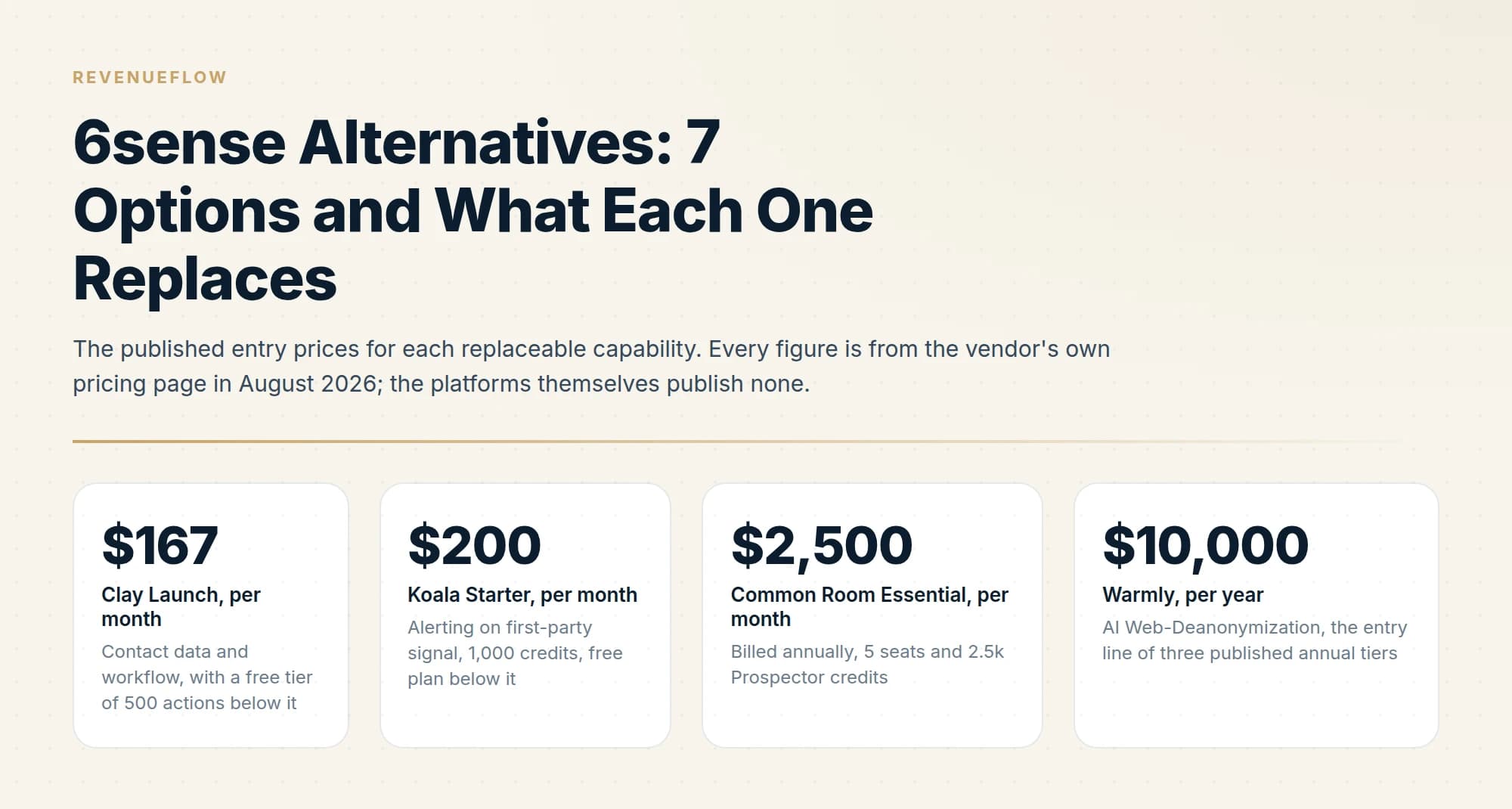
For outbound sales, 6sense is usually replaced by parts rather than a platform: a data and workflow layer such as Clay, from $167 a month on annual billing, a first-party signal tool such as Koala, from $200 a month, and direct outbound. Third-party intent is the one capability with no published-price substitute.
Key takeaways
- 6sense's pricing page sells three packages built from Sales Intelligence, data credits and predictive AI, each ending in a demo request rather than a price.
- Contact data, prioritisation and alerts all have published-price stand-ins: Clay, Koala, Common Room and Warmly publish their entry prices.
- Demandbase and DemandScience are the like-for-like and intelligence-plus-execution alternatives, and neither publishes a price.
- Before cancelling, find the renewal notice date, export what only the platform holds, and run the replacement alongside for a month.
Reviewed and updated September 19, 2026
For outbound sales, the usual 6sense replacement is not another platform but two pieces at published prices: a data and workflow layer such as Clay, from $167 a month on annual billing, and a first-party signal tool such as Koala, from $200 a month, with direct outbound doing the contact work. That covers what an outbound team actually uses 6sense for: contact data, prioritisation and alerts. The one piece with no cheap substitute is third-party intent.
Nobody replaces 6sense with one product, because 6sense is not one product. Its own pricing page sells Sales Intelligence, data credits and predictive AI in three combinations, with credits used to "unlock and export emails, phone numbers and enriched contact and company records" (6sense pricing). No combination carries a published price; each ends in a demo request.
So the useful way to shop for alternatives is to decompose. Work out which parts you actually use, then price a replacement for each one. Below are seven options, each mapped to the part of 6sense it stands in for, with every figure taken from the vendor's own pricing page.
First, Decompose What You Are Replacing
6sense combines four things that are separately purchasable.
Predictive account scoring, ranking accounts by likelihood to buy. Third-party intent, telling you an account has been researching your category somewhere you do not own. Contact data, the emails and phone numbers behind the accounts. Workflow surfaces, the alerts, CRM panels and browser extensions that put all of it where reps work.
That decomposition is also the answer to what 6sense is used for, which is the question most teams arrive with well before they price a replacement. Demand generation uses the scoring and the intent to decide where advertising spend goes, sales development uses the same two signals to decide which accounts get worked this week, and revenue operations uses the workflow surfaces to put both in front of people who would not otherwise open the platform. Paying for all four and using two is the normal state.
Shoppers search this as 6sense software, and there is no single product to line up against a competitor, so the comparison has to be run one capability at a time. Deciding whether contact reach or account intent matters more comes down to comparing 6sense directly against a database vendor, which the ABM platform versus contact database comparison breaks down feature by feature. Renewal conversations are easier once the vendor's own page is read, and three named packages and a credit meter are what appears there instead of a rate.
What To Use Instead Of 6sense For Outbound Sales
An outbound team leaning on 6sense is usually using three of the four parts: contact data to build lists, prioritisation to decide which accounts get worked first, and alerts to know when to move. All three have published-price replacements. The table maps each part to what stands in for it and what its vendor publishes.
| Part of 6sense | Stand-in | Published entry |
|---|---|---|
| Contact data and workflow | Clay plus your CRM | Free, then $167 on annual billing |
| Alerts on first-party signal | Koala | Free, then $200 |
| Signal plus prospecting | Common Room | $2,500, billed annually |
| Visitor identification, routing | Warmly | From $10,000 a year |
| ABM inside Salesforce | Account Engagement Plus+ | $2,750 per org, billed annually |
| Third-party intent and scoring | Demandbase or DemandScience | Quote only |
What none of them does is send. The platform never produced meetings either: it produced a ranked list, and something still had to write to the people on it. An outbound replacement stack only works if the contact work is funded alongside it.
If You Cancel 6sense, Do This First
Cancelling well is mostly sequencing. Find the renewal notice date before doing any evaluation, export what only the platform holds while access is live, then run the replacement alongside the incumbent for a month so the gaps show up while you can still see what the old workflow covered.
Why Teams Switch From 6sense
The reasons that recur are structural rather than about data quality. The bundle is sold whole while most teams use two of its four parts. No package carries a published price, so every renewal is a negotiation from scratch. And the most expensive part, third-party intent, is also the hardest to prove: if no rep worked a different account because of an intent signal last quarter, that line item bought a report. Teams that switch are usually trading one quote for two or three published prices and a sending stack they control.
The Seven Alternatives
1. Demandbase. The like-for-like swap, and the one to run if you want the same shape of purchase from a different vendor. Its pricing page publishes no figures either, describing the model as "a clear platform fee that covers all the essential software and services" plus "a flat fee per user", and it does not split the platform into standalone Marketing and Sales editions (Demandbase pricing). Where the two genuinely differ is intent data provenance and advertising activation, so make those the demo.
2. DemandScience. Terminus merged into DemandScience, announced on November 12, 2024, and the combined company operates under the DemandScience brand (merger announcement). It belongs on this list because of its current positioning, which argues directly against the model 6sense sells: after "spending six figures on a platform, most organizations still have to fund and execute every program required to generate pipeline", in the words of its homepage. That makes it an intelligence-plus-execution purchase, closer to an agency retainer than to a software licence, and it should be compared as one.
3. Clay plus your CRM. Replaces the contact data and workflow layers, and much of the prioritisation. Clay publishes everything: a free tier with 500 actions and 100 data credits a month, Launch at $167 a month and Growth at $446 a month on annual billing, which the page discounts by 10 percent (Clay pricing). Waterfall enrichment across many providers usually beats any single vendor's coverage, and the signal triggers cover a good share of what predictive scoring was doing. It does not replace third-party intent.
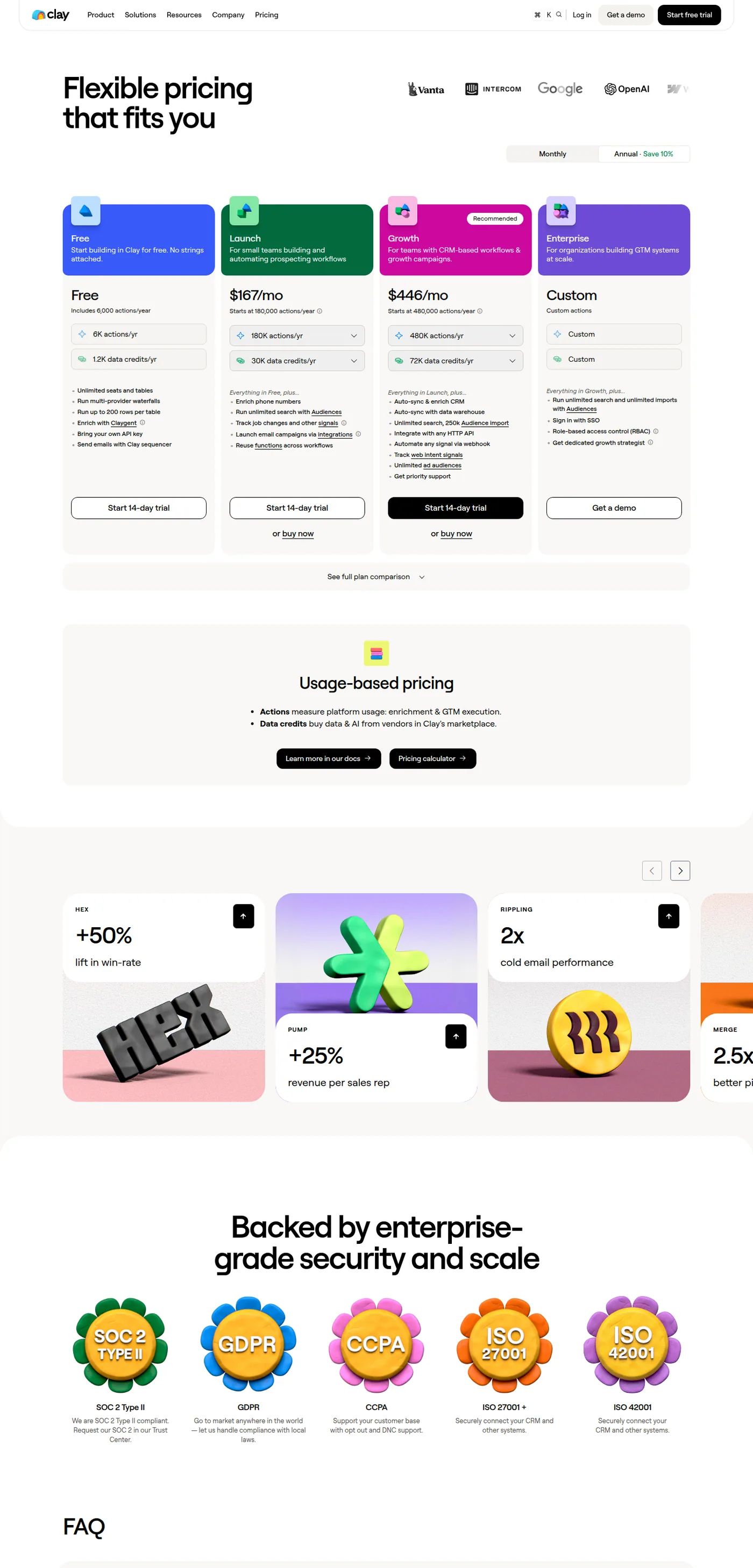
Clay's published pricing page, the source for the figures above.
4. Koala. Replaces the alerting and prioritisation layer with first-party signal from your own properties. A free plan with 2 seats and 100 credits a month, Starter at $200 a month with 1,000 credits, Growth at $1,000 a month with 3 seats and 5,000 credits, Business custom (Koala pricing). Narrower than third-party intent by construction, and far cheaper.
5. Common Room. Replaces prioritisation plus prospecting, capturing signal across owned channels and adding contact discovery. The entry tier, Essential, is published at $2,500 a month billed annually and includes 5 seats and 2.5k Prospector credits, with the two tiers above it quoted rather than listed (Common Room pricing).
6. Warmly. Replaces the visitor identification and inbound routing piece. AI Web-Deanonymization starts at $10,000 a year, Inbound Chat at $20,000 a year and AI Inbound Autopilot at $30,000 a year, each from 10K credits a month (Warmly pricing). The published annual figures make it directly comparable against a platform quote, which is unusual in this category.
7. Salesforce Marketing Cloud Account Engagement, if you already run Salesforce. Not a 6sense substitute in intent terms, and worth knowing about because it may already be in your contract. Salesforce publishes the numbers: Growth+ at $1,250, Plus+ at $2,750, Advanced+ at $4,400 and Premium+ at $15,000 USD per org per month, billed annually, with Plus+ described as the edition adding account-based marketing and 10,000 contacts included below Premium+ (Salesforce pricing).
The Capability With No Cheap Substitute
Be honest about third-party intent, because it is the one thing on this list that a published-price stack does not give you.
Third-party intent means someone at a target account read something about your category on a property you do not own, and knowing that requires access to a data co-operative or a publisher network. First-party signal tools watch your own site, your own community, your own product. Those are different inputs and only one of them tells you about accounts that have never heard of you.
The question worth answering before paying for it again is whether it changes behaviour. If a rep worked a different account this month because of an intent alert, it earns its line item. If it produces a weekly ranked list that nobody treats differently from last week's, you are buying a report. That test is answerable from your own CRM in an afternoon, and it decides more renewals than any competitive comparison.
Timing The Switch
Two dates govern this decision and neither is the day you decide.
The renewal notice deadline. Enterprise contracts in this category are typically annual with a notice period, and the period is frequently sixty or ninety days before renewal. Missing it costs another year at the current price, so find that date in the contract before doing any evaluation work, and work backwards from it.
The point where the data leaves. Scoring history, engagement records and any contact data held only in the platform stop being yours when the contract ends. Export what you need while access is live, and decide explicitly what you are prepared to lose, because a scoring model's history does not migrate to a different vendor in any usable form.
Between those two, allow a genuine overlap. Running the replacement stack alongside the incumbent for a month is the only way to find out whether the new arrangement covers the workflows people actually use, as opposed to the ones the evaluation documented. Budget for the double-paying month. It is cheaper than discovering the gap after access ends.
What Breaks When The Platform Goes
Worth naming plainly, because the honest version of a switch includes losses.
Alerts stop arriving in the places reps look. A platform's browser extension and CRM panel put the intelligence where the work happens, and a replacement stack often puts it in a different place. Whatever you assemble has to write back into the CRM, or it becomes a screen nobody opens.
One shared account view fragments. Marketing looking at one tool and sales looking at another is the state that platforms were sold to fix, and it returns quickly unless something enforces a single account record.
The prioritised list loses its authority. A vendor-produced ranking carries an institutional weight that a spreadsheet produced internally does not, whatever the relative accuracy. That is a political problem rather than a technical one, and it is worth pre-empting by agreeing how accounts get prioritised before the platform leaves rather than after.
What A Replacement Stack Usually Looks Like

The common landing spot for a mid-market team leaving a platform is three pieces: a data and workflow layer at a published price, a first-party signal tool, and direct outbound doing the contact work. Account data and prioritisation come from the first, urgency from the second, and meetings from the third.
Deciding where each replacement signal should land in your workflow gets easier after mapping it against the seven layers of sales tooling.
The part that quietly matters is the last one. Teams that cut the platform and do not fund the contact work end up with a cheaper stack and the same pipeline problem. If the contact work is the piece you would rather buy than build, that is a services decision rather than a software one, and the ABM agency buyer's guide covers the engagement models and what each one attaches its fee to.
For the wider picture across the category, the ABM tools catalogue covers eleven options by job and the platform comparison covers the build-or-buy line. If Demandbase specifically is the alternative you are weighing, the Demandbase review covers who it fits and who overpays.
The Short Version
Decompose before you shop. Contact data and workflow are well served at published prices, alerting is cheap, and third-party intent is the one capability that still costs platform money. Audit whether intent changed anyone's behaviour last quarter, because that single answer decides whether you are shopping for a replacement platform or for two tools and a sending stack.
If direct contact against your target accounts is the piece that has to keep working through the transition, that is what we run, and you can see what a campaign against your list would look like.
Pricing and features are taken from the vendors' own pages. 6sense, Demandbase and DemandScience publish no figures. Verify current terms with the vendor before relying on them.
Sources: 6sense pricing, Demandbase pricing, DemandScience and Terminus merger, DemandScience, Clay pricing, Koala pricing, Common Room pricing, Warmly pricing, Salesforce Account Engagement pricing
Frequently asked questions.
Frequently asked questions- What is the best 6sense replacement for outbound sales?
- Usually a combination rather than one platform: a data and workflow layer such as Clay for contacts and enrichment, a first-party signal tool such as Koala for alerts, and a sending stack for the contact work. Together they cover what outbound teams mostly use 6sense for. Third-party intent is the part they do not replace; Demandbase or DemandScience do, by quote.
- If I cancel 6sense, what should I use instead?
- Map what your team used before choosing. Contact data maps to Clay, from $167 a month on annual billing; first-party alerts to Koala, from $200 a month; visitor identification to Warmly, from $10,000 a year. If third-party intent and scoring changed which accounts reps worked, price Demandbase or DemandScience instead, since neither published-price tool replaces that.
- Why do teams switch from 6sense?
- The recurring reasons are structural. The bundle is sold whole while many teams use two of its four parts, no package carries a published price, and the costliest part, third-party intent, is the hardest to prove. Teams that switch usually trade one quote for two or three published prices and a sending stack they control.
- Does 6sense publish its prices?
- No. Its pricing page lists three packages, combining Sales Intelligence with data credits, predictive AI or both, and each leads to a demo request. The page says data credits unlock and export emails, phone numbers and enriched contact and company records, but it gives no figure for a package or a credit.
About the author.

B2B cold email experts helping companies generate qualified leads through done-for-you outreach campaigns.
RevenueFlow Team
Explore more.
Ready to scale your outreach?
We build GTM engines that book real meetings. See the receipts.
Related articles.
Is Clay Free? The Free Plan, the Trial and Where Each Stops
Clay's free plan, its 14-day trial and the no-charge-on-a-miss rule are three different things. What each holds and where it stops, from clay.com on 19 September 2026.
Video Prospecting Tools by Job: What Each One Is For
Ten video prospecting tools sorted by the job each vendor's own page describes: record and share, personalise at volume, avatars, hosting and interactive demos.
Seamless.AI Email Finder: How It Works, What a Credit Buys
How Seamless.AI's email finder resolves a contact in real time, what one Universal Credit buys, the Total AI score on every address, and what the Chrome extension reads.
Social Selling Tools by Job, and the Account-Risk Line
Fourteen social selling tools sorted into six jobs, split by whether each acts through your LinkedIn account or beside it, from the vendors' own pages.
Autobound Pricing: One-Time Credit Packs, Not Seats
Autobound's pricing page sells one-time credit packs for a signal data API, not seats. The six packs, the per-endpoint meter, and what a company costs.
Sales Training Programs: 13 Providers by What They Teach
Thirteen sales training providers and three free sources, grouped by what each one teaches, from their own pages as read on 18 September 2026. No ranking.