Demandbase Review and Alternatives: Who It Fits
Demandbase prices as a platform fee plus a flat fee per user, sold as one product. Where that model fits, where it wastes money, and what replaces each part.
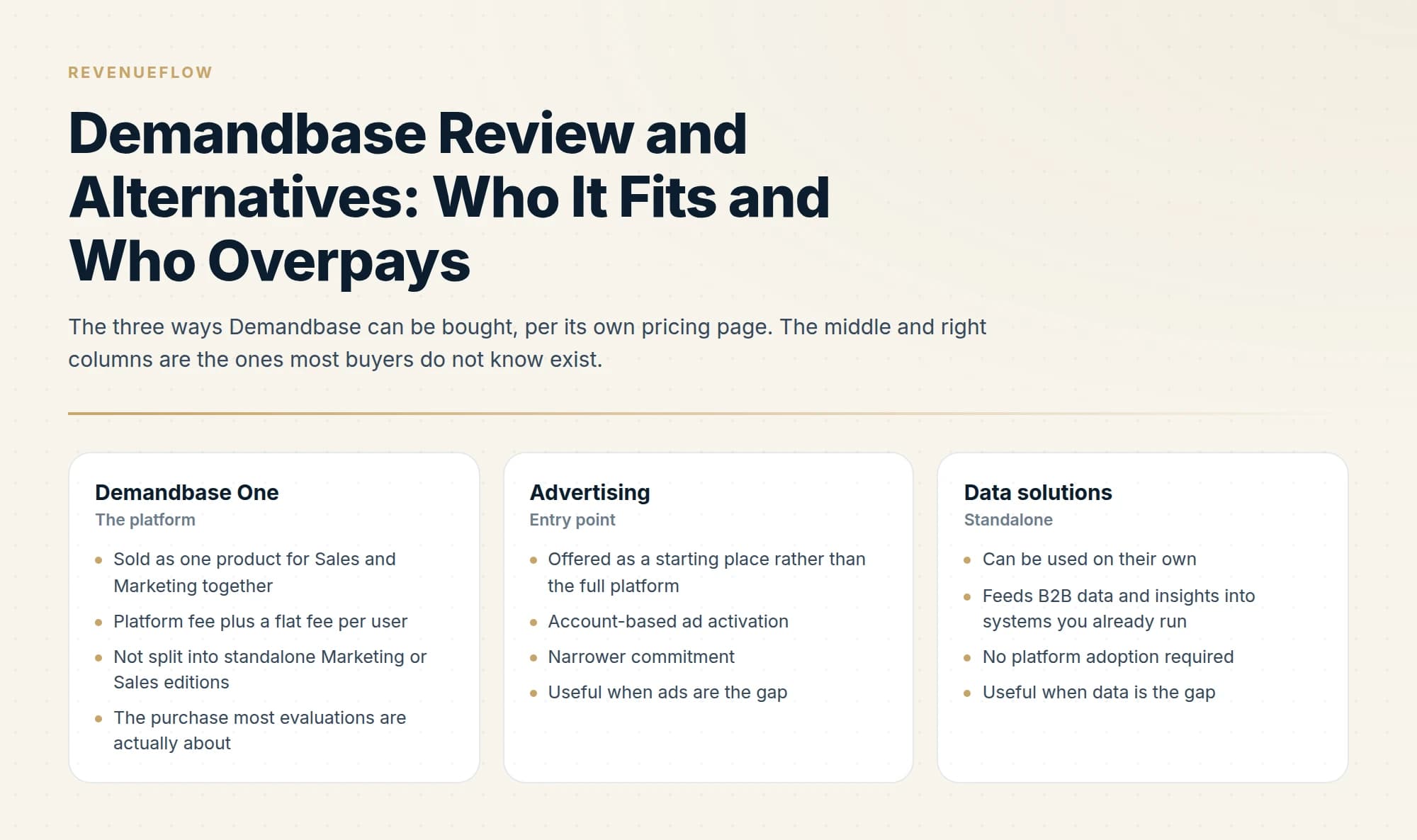
Demandbase sells Demandbase One as a single platform for sales and marketing, priced as a platform fee plus a flat fee per user, with advertising and data available as narrower entry points. It fits organisations sharing one account view daily with real ad budget, and overcharges small lists and pure data problems.
Key takeaways
- Demandbase publishes no prices, describing its model as a clear platform fee plus a flat fee per user, so cost scales with seats rather than with target accounts.
- Demandbase One is deliberately not split into standalone Marketing and Sales editions, though Advertising is offered as an entry point and Data solutions can be bought on their own.
- The platform is hardest to replace for account-based advertising, which is genuinely difficult to assemble yourself at scale.
- Teams under a few hundred target accounts, or whose real gap is contact data rather than coordination, pay a platform fee for coordination they do not need.
Reviewed and updated September 5, 2026
Demandbase's pricing page contains no prices. What it contains is a description of the model, which is more useful than most vendors give you: "a clear platform fee that covers all the essential software and services. In addition, there's a flat fee per user, allowing you to easily scale according to your needs" (Demandbase pricing).
Two words in that sentence decide whether Demandbase is a good purchase for you. Platform and user. The platform fee lands whatever you do with it, and the per-user fee means the cost scales with how many people you put on the tool rather than with how many accounts you target. Get those two facts straight and most of the evaluation resolves itself.
What Demandbase actually sells
The product is Demandbase One, and the company is explicit that it is not sold in pieces. Asked directly whether you can buy standalone Marketing or Sales solutions, the pricing page answers that the platform is "built to change the way B2B organizations go to market by bringing Sales and Marketing together under one roof" and that they therefore "don't split Demandbase One into separate solutions."
There are two narrower entry points. The Advertising solution is offered as "a starting place", and the Data solutions "can be used on their own to integrate our B2B data and AI-driven insights into your existing systems." Both of those are meaningful for a buyer who wants one capability rather than the platform.
Underneath, the platform combines account and contact data, predictive scoring, third-party intent, B2B advertising, and account-level analytics. Demandbase describes its scoring as pulling "proprietary data on 104 million companies", and positions Qualification Score and Pipeline Predict as the mechanisms for ranking accounts (Demandbase for marketing).
- Sold as one product for Sales and Marketing together
- Platform fee plus a flat fee per user
- Not split into standalone Marketing or Sales editions
- The purchase most evaluations are actually about
- Offered as a starting place rather than the full platform
- Account-based ad activation
- Narrower commitment
- Useful when ads are the gap
- Can be used on their own
- Feeds B2B data and insights into systems you already run
- No platform adoption required
- Useful when data is the gap
Who it fits
Demandbase earns a platform fee under conditions that are reasonably specific, and they are mostly about organisational shape rather than company size.
Sales and marketing genuinely have to share one view. The product is built around a unified account record and priced as one platform for both teams. If your sales org works from the CRM and your marketing org works from a marketing automation tool and neither reads the other's reports, you are buying an integration project.
Teams that are still weighing whether a unified CRM could substitute for a separate account platform will find Attio's published seat and object limits a useful gauge of fit.
Account-based advertising is core, not decorative. Serving ads to people at named accounts across display and social is genuinely hard to assemble yourself, and it is Demandbase's oldest strength. If the plan has real ad budget behind it, this is where the platform is least replaceable.
Enough seats to make per-user pricing rational. Per-user pricing rewards deep adoption. A large sales team that lives in the tool gets value from every seat. A small team where two people log in monthly pays a platform fee for the privilege of two logins.
Teams sizing seats for a per-user platform face a similar ceiling problem in CRM tools, as explored in choosing a CRM by its ceiling.
Deal sizes that fund the fee before anything else happens. No published number exists to work with here, so the discipline is to decide your ceiling before the demo, expressed as a share of the pipeline the programme is meant to produce.
Who overpays

The mirror image is just as specific.
Teams under a few hundred target accounts. The platform's advantages are coordination and scale. At fifty accounts, coordination is a shared document and a weekly meeting, and the money is better spent on contact data and someone writing to those accounts.
Teams buying it to fix a data problem. If the actual gap is that you cannot reach buyers at your target accounts, the Data solutions entry point addresses that directly and the full platform does not address it any better.
Teams with no content or production capacity. A platform orchestrates assets. It does not produce them. Buying orchestration before you have anything to orchestrate is the most expensive way to discover your content bottleneck.
Teams that will not act on intent. Intent data justifies its cost when a rep works a different account tomorrow because of it. Where nobody changes behaviour, the signal becomes a weekly report and the platform becomes a subscription to reading it.
- Yes: Sales and marketing will both use the same account records daily
- Yes: You have real advertising budget aimed at named accounts
- Yes: Enough seats that per-user pricing buys broad adoption
- No: Your target list is under a few hundred accounts
- No: The core problem is contact data rather than coordination
- Depends: You can commit to acting on intent signals weekly
The alternatives, by what you are replacing
"Demandbase alternatives" is not one question, because the platform does four separable jobs. Replace the job you need.
If you need the whole platform: 6sense. The closest direct comparison, with the same shape of purchase and the same absence of published pricing. Its pricing page lists packages built around Sales Intelligence, data credits and predictive AI, and routes every request to a demo. Evaluate the two on intent data provenance and on ad activation, since that is where they genuinely differ.
If you need intelligence plus execution: DemandScience. Terminus merged into DemandScience in November 2024 and the brand was retired, and DemandScience now positions explicitly against the platform-licence model. That is a services-inclusive purchase and should be compared with an agency retainer rather than with a software fee.
If you need account-based advertising: the ad platforms directly. LinkedIn Campaign Manager takes company targeting lists natively, with the caveat that a list must match a minimum of 300 member accounts before it can run in an ad set. The mechanics are in our LinkedIn ABM guide.
If you need the data and workflow layer: Clay plus your CRM. Clay publishes its prices, which is itself a differentiator here: a free tier, Launch from $167 a month, Growth from $446 a month (Clay pricing). Waterfall enrichment across many providers, signal triggers, and a push into your sending stack covers the account data and prioritisation jobs at a published cost.
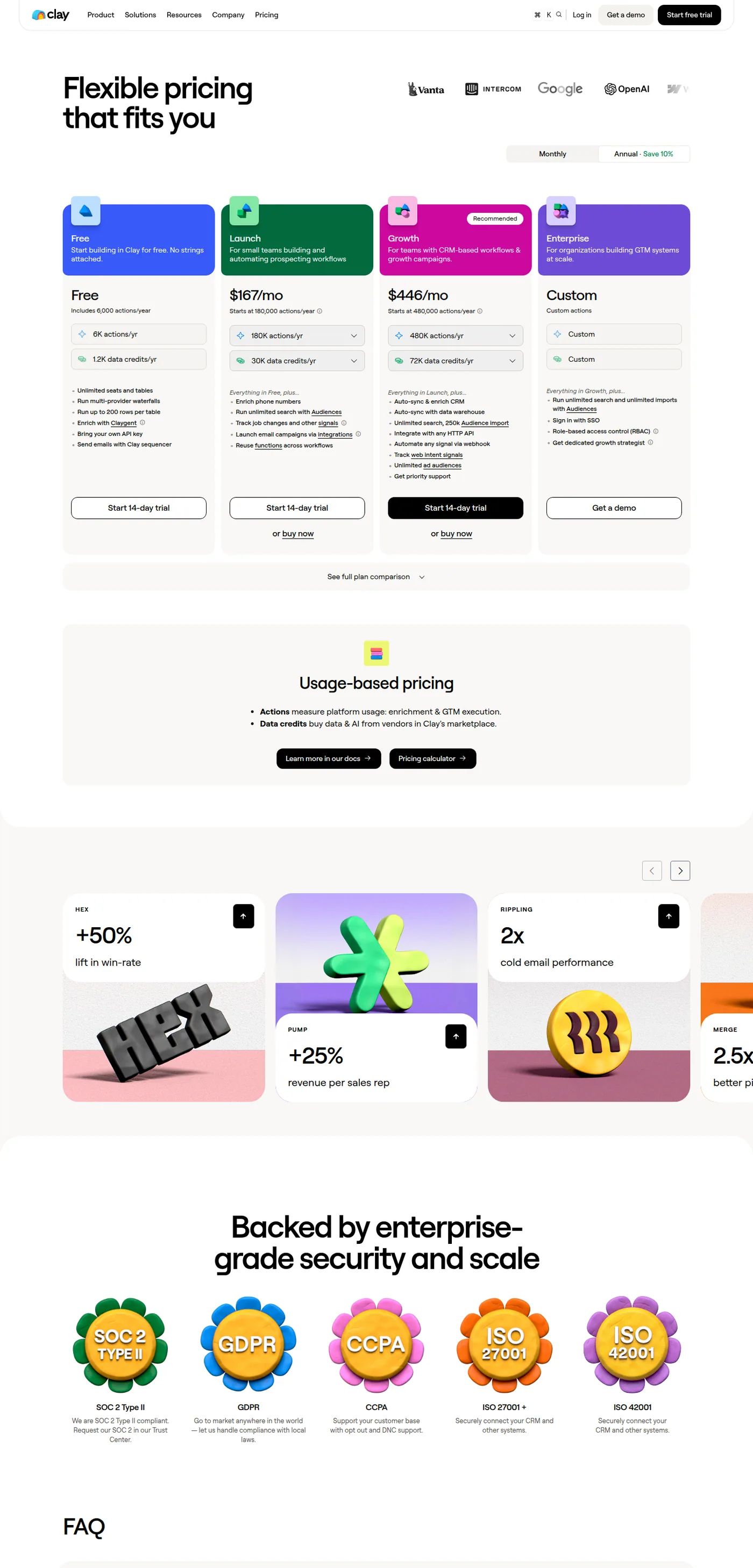
Clay's published pricing, captured mid-2026.
If you need first-party signal rather than third-party intent: the visitor identification and signal tools publish prices too. Koala lists a free plan and paid tiers at $200 and $1,000 a month; Common Room lists Essential at $2,500 a month billed annually. Those watch your own properties rather than the open web, which is a narrower signal and a considerably cheaper one.
If the real gap is capacity rather than software: an agency. Buying the execution is a different purchase from buying a platform, and it is frequently the honest answer when the account list is fine and nobody has time to work it. Our ABM agency buyer's guide covers the engagement models and how to compare quotes.
The full breakdown across the category is in our ABM tools catalogue, and the platform-level comparison is in ABM platforms compared.
What the per-user model does to your total
The pricing model is the most decision-relevant thing Demandbase publishes, and it deserves working through rather than noting.
A platform fee plus a flat fee per user means your total moves with headcount rather than with programme scope. Adding twenty target accounts costs nothing. Adding twenty sales seats costs twenty times the per-user fee, every year, whether those seats log in or not.
That has two consequences worth planning around.
Adoption is the whole return. A seat that goes unused is pure cost, and the pattern in this category is that marketing buys the platform and sales adoption decides whether it was worth it. Decide before signing who is accountable for adoption after the launch quarter, and what the review looks like if the answer is nobody.
Scope creep is cheap and headcount growth is not. Unusually, this model lets you widen the programme without a commercial conversation. Use that. Expand the account list, add clusters, run more campaigns, because the marginal cost of programme scope is zero while the marginal cost of a new seat is not.
Then there is the year-one cost that is not in the fee at all: account data hygiene. The platform reports on accounts, so duplicate account records in your CRM split engagement across them and quietly understate everything the platform tells you. That cleanup lands on your team whatever the onboarding package covers, and it is worth scoping honestly before the first invoice rather than discovering it in month three.
What to ask on the call
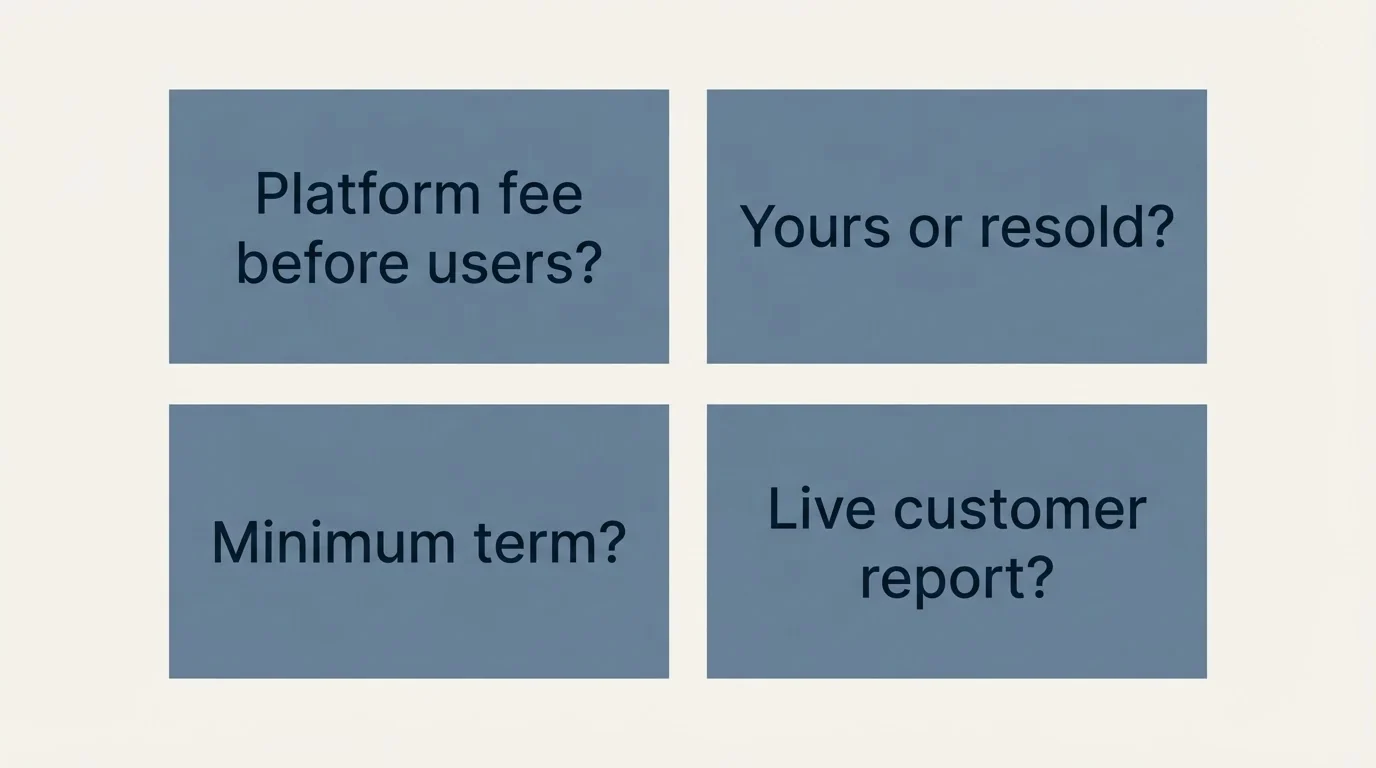
Since no price is published, the first call is where the evaluation actually happens. Four questions do most of the work.
What is the platform fee before any users? This separates the fixed cost from the variable one and makes two vendors comparable.
Which components are yours and which are resold? Intent data especially. Knowing whose data you are buying tells you whether two vendors are differentiated or reselling the same feed.
What is the minimum term? Enterprise contracts here are typically annual, and the answer sets how long a bad fit costs you.
Show me the account report you would send me monthly, from a live customer, with names removed. A dashboard tour is not that. A document is.
- Step 1What is the platform fee before any users?
Separates the fixed cost from the variable one and makes two vendors comparable.
- Step 2Which components are yours and which are resold?
Intent data especially. Knowing whose data you are buying tells you whether two vendors are genuinely differentiated.
- Step 3What is the minimum term?
Contracts here are typically annual, and the answer sets how long a bad fit costs you.
- Step 4Show me a real monthly account report
From a live customer, with names removed. A dashboard tour is not that. A document is.
The short version
Demandbase is a platform-fee-plus-per-user purchase, sold as one product rather than as modules, with an advertising entry point and a standalone data option that most evaluations miss. It fits organisations where sales and marketing share an account view daily and where account-based advertising is a real line item. It is expensive for small lists, for data problems, and for teams without content capacity. Since no price is published, decide your ceiling before the demo.
If the underlying goal is meetings with people at your target accounts rather than a platform, that is a different purchase, and you can see what a campaign against your list would look like.
Pricing models, packaging and product claims verified against each vendor's own pages as of mid-2026. Demandbase and 6sense published no prices at the time of writing. Verify current terms with the vendor before relying on them.
Sources: Demandbase pricing, Demandbase for marketing, 6sense pricing, DemandScience and Terminus merger announcement, Clay pricing, Koala pricing, Common Room pricing
Frequently asked questions.
Frequently asked questions- How much does Demandbase cost?
- Demandbase does not publish figures. Its pricing page describes the model instead: a clear platform fee covering the software and services, plus a flat fee per user. That means cost scales with how many people you put on the tool rather than with how many accounts you target, which is the key fact for sizing a quote before the call.
- Can you buy just part of Demandbase?
- Partly. The company states it does not split Demandbase One into separate Marketing and Sales solutions, so the core platform is bought whole. It does offer its Advertising solution as a starting place and its Data solutions as standalone products that feed B2B data into systems you already run, which most evaluations overlook.
- Demandbase or 6sense?
- They are the same shape of purchase, both quote-only, and the feature lists converge. The differences that matter are intent data provenance and advertising activation, so make those the demo rather than the dashboard. Ask each which components are theirs and which are resold, since a shared underlying data source makes the comparison narrower than it looks.
- What is the cheapest Demandbase alternative?
- For the data and workflow layer, Clay publishes a free tier and paid plans from $167 a month. For alerting on first-party signal, Koala publishes a free plan and paid tiers at $200 and $1,000 a month. Neither replaces third-party intent, which is the one capability with no published-price substitute.
About the author.

B2B cold email experts helping companies generate qualified leads through done-for-you outreach campaigns.
RevenueFlow Team
Explore more.
Ready to scale your outreach?
We build GTM engines that book real meetings. See the receipts.
Related articles.
ABM Platforms: Demandbase, 6sense, DemandScience vs Clay
Terminus now redirects to DemandScience, none of the enterprise vendors publish a price, and the build-or-buy line has moved. What each platform actually sells.
Apollo and Clay Integration: What Connects, Who Meters What
Clay's docs list one Apollo source and eleven actions. How the account connects, which way each action moves data, and which vendor bills each step.
Reply.io Salesforce Integration: The Sixteen Sync Steps
Reply's support article lists sixteen sync steps, two profiles, required field mappings and a two-hour cadence. What the native Salesforce integration moves.
Alta Pricing: No Rate Card, a Quote in Hours
Alta publishes no price. What its plans page, FAQ and blog disclose about how the platform is priced, the inputs that set a quote, and the numbers to ignore.
Gojiberry AI Pricing: One Plan, Then a Quote
Gojiberry AI publishes one plan and quotes the rest. The dated price, the meters it names, the billing terms, and the look-alike domain that is not the vendor.
CRM Setup: The Objects, Stages and Write-Back Loop
A vendor neutral CRM setup for an outbound team: the object model, stage exit criteria, the required field set, ownership rules and the campaign write-back loop.