The Summary Close: Restating What Was Agreed Before the Ask
The summary close restates the buyer's needs, the agreed answer to each and then asks. What the publishers say, the structure, a worked example, and where it fails.
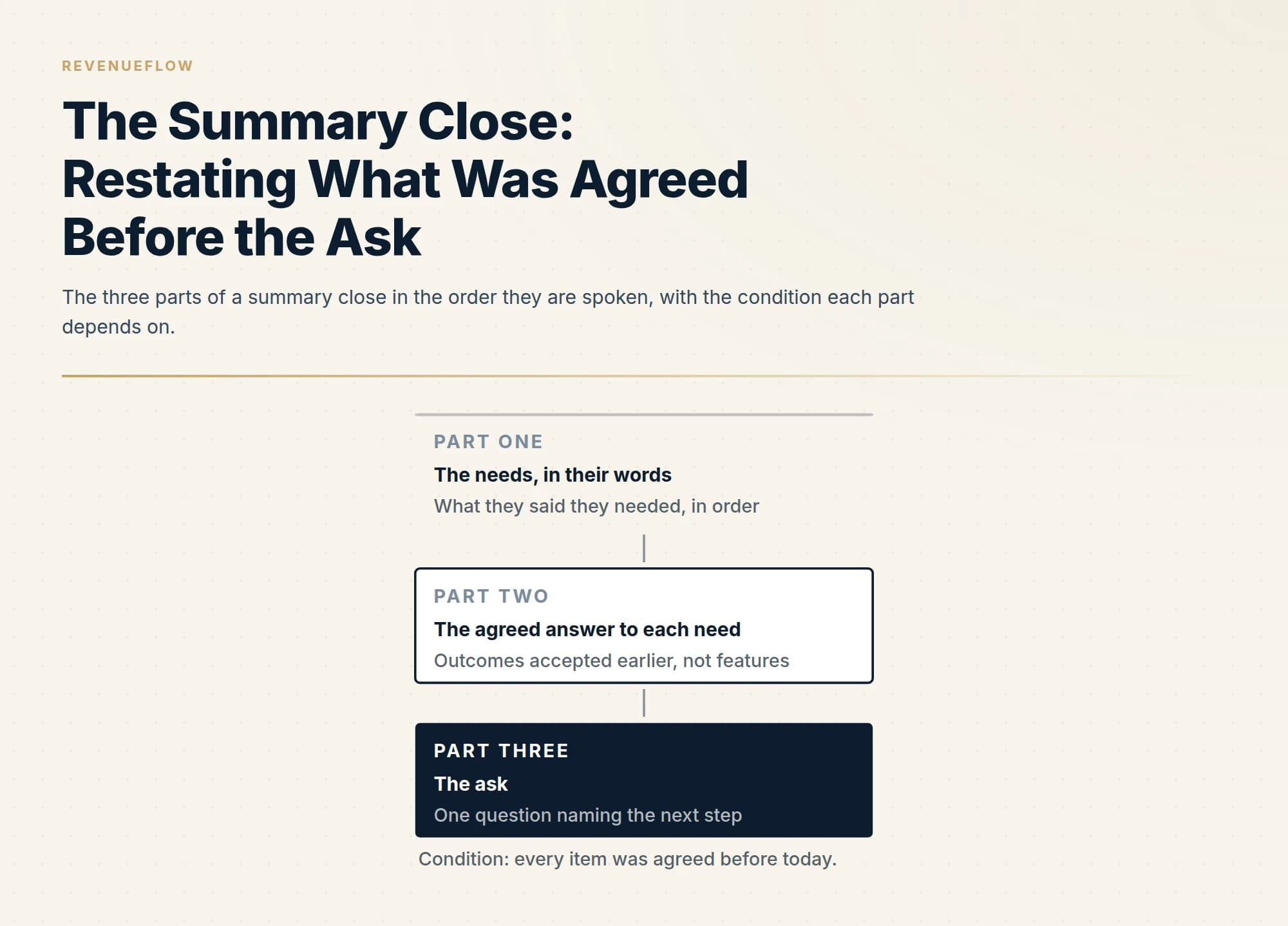
The summary close is a closing technique with three parts: restate the needs in the buyer's own words, state the outcome that was agreed against each, then ask one direct question naming the next step. Publishers place it in long cycles, complex products and multi-stakeholder deals, and warn against summarising features instead of outcomes.
Key takeaways
- Three parts and one condition: the needs in the buyer's words, the agreed outcome per need, one direct ask, and everything restated must have been agreed before the summary is spoken.
- Pipedrive places the technique in long sales cycles, complex products and deals with multiple stakeholders who need to see the value clearly; HubSpot files it with the low-pressure closes that recap rather than demand.
- The mistake every source names is summarising features instead of outcomes; a summary built from the buyer's list is short and in outcomes, one built from the product is long and in features.
- Pipedrive cites trainer James A. Baker's advice to follow any other close with a summary closing conversation, which makes the technique the spoken record of a commitment as well as a way to reach one.
Reviewed and updated September 18, 2026
The fourth call on a mid-sized deal ends the way the second and third did: agreement in the room, warmth on the way out, and no decision. Nothing was objected to. Nothing was decided either, because at no point did anyone put the whole agreement in one place and ask whether it was enough. The summary close is the technique for that moment, and it is the least theatrical entry in the closing canon: you say back what the buyer told you they needed, you say what was agreed about each of those things, and you ask.
This page explains that one technique from the named publishers who teach it: what it is in their words, the structure, a worked example, where it fits and where it does not, the mistake every source warns about, and how it sits inside a motion that books first meetings rather than closes deals. The full library of techniques and what each one assumes is on sales closing techniques, which calls the summary close one of the two worth using constantly. This is the page for the one.
What the technique is, in the publishers' own words
The sources agree on the mechanism and differ on the emphasis. Salesforce's guide to closing techniques, published on 19 September 2023, last modified on 22 January 2024 and fetched on 18 September 2026, defines it by its job in a long cycle: "In a summary sales close, you review the features of the product and how it will help meet their needs. It gives the prospect one more time to really envision what your product might accomplish for them before making a decision."
HubSpot's list of eighteen techniques, a page it says was originally published in October 2019 and updated since, with metadata dating the current version to 13 August 2026, fetched on 18 September 2026, puts the emphasis on agreement rather than features: "A summary close works by recapping the value the buyer has already agreed to. Salespeople who use this closing technique reiterate the items the customer is likely to purchase. They stress the value and benefits of their product to encourage prospects to sign a deal."
Pipedrive's guide to closing a sale, published on 10 March 2026, modified on 13 March 2026 and fetched on 18 September 2026, lists the summary close first of six and explains why the grouping matters: "By describing these value points all at once, you intensify their impact." It also names the reader the technique was written for: long sales cycles, complex products and deals with multiple stakeholders "who need to see the value clearly before making a decision."
The oldest of the four sources, the technique library at changingminds.org, fetched on 18 September 2026 and carrying no date, gives the plainest instruction: "Summarize the list of benefits that the other person will receive, telling them the full extent of what they are getting for their money." and the mechanism: "The Summary Close works by repeating what has already been agreed. Putting it all together makes it seem like an even bigger package."
Read together, the technique has three parts and one condition. The parts are the needs, the agreed answer to each, and the ask. The condition is that the things being summarised were actually agreed.
The structure, line by line
The needs, in their words. The summary opens with what the buyer said they were trying to fix, in the vocabulary they used, in the order they raised it. Not the seller's framing of the problem. If the buyer said the finance team re-keys invoices twice, the summary says re-keys invoices twice. This is the part that proves the seller listened, and it is the part a buyer will correct if it is wrong, which is useful information arriving before the ask rather than after.
The agreed capability against each need. For each need, one sentence on what was agreed the product or service does about it. Agreed is the operative word: it was demonstrated, discussed and accepted in an earlier conversation, not introduced now. Pipedrive's warning belongs here: "A common mistake with the summary close technique is summarizing product features instead of outcomes. Instead of providing a product overview in your recap, remind the buyer of the results they want to achieve." A feature list is a brochure; an outcome list is a record of what the buyer expects to be true afterwards.
The ask. A direct question that follows from the summary rather than changing the subject. HubSpot's own answer to the simplest way to close puts the summary close in this class: "The simplest way to close a sale is to ask a direct, low-pressure question that confirms the prospect is ready to move forward, such as a summary close or a question close." The ask names the next concrete step, whether that is a signature, an order form or a named person's approval, and then stops.
A worked example, entirely invented
The company, the people and the deal below are invented to show the shape; nothing here describes a real engagement. An invented mid-sized distributor, Harrowgate Supply, has spent four conversations with an invented software vendor about order handling. The seller, closing the fourth call, says it back.
Spoken at the end of the fourth call with Harrowgate Supply, an invented company
When we started, you said three things were costing you: orders keyed twice between the web store and the warehouse system, a two-day lag before a customer sees a shipping date, and nobody knowing which orders were stuck until a customer rang. 1
What we agreed on the second and third calls: the integration removes the second keying for the web store orders; shipping dates post the same day the warehouse confirms; and the exceptions view lists a stuck order before anyone has to call. Your operations lead ran the exceptions view in person last week. 2
If that is still the list, the next step is the order form to your operations lead and your finance director for sign-off this week. Is there anything on that list that is not right? 3
- 1The needs in the buyer's own words and order: keyed twice, two-day lag, stuck orders. No new problem is introduced.
- 2One agreed outcome per need, each tied to the call where it was accepted, one of them to the buyer's own test of it. Outcomes, not a feature tour.
- 3The ask names the concrete next step and the two people it needs, then invites correction rather than pressing for a yes.
The last line of the invented example is the part most versions of the technique leave out. A summary close that ends with a closed question about the summary itself, rather than a demand for the signature, gives the buyer a way to say the list is wrong. That is a better outcome than a yes to a wrong list.
Where it fits, and where it does not
Pipedrive names the fit: long cycles, complex products, several stakeholders who need to see the value clearly. The reason is in the structure. Over a long cycle the agreements are spread across weeks and calls, and nobody in the buyer's organisation holds them all in one place; the summary is the first time they exist as a single document. With several stakeholders, the person you are summarising to is usually not the last person who has to agree, and a summary in their own words is the thing they can repeat to whoever is.
Pipedrive also carries a piece of advice from a named trainer that widens the fit: it reports that Baker Communications founder James A. Baker advises that "even if you gain a sales commitment using an alternate technique, you should follow it with a summary closing conversation." reviewing the needs the customer expressed and stating the exact actions to be taken. In that use the summary is not the close at all. It is the record of the close, spoken so that both sides leave with the same list.
It does not fit where its condition fails. If the needs were never captured properly, there is nothing accurate to restate, and the summary exposes that in front of the buyer. That is a discovery problem, and the way to run a first conversation so that the needs come out in the buyer's words is in the discovery call. If objections were deferred rather than surfaced, the summary invites them all at once at the worst moment; the library of standard answers, and the harder question of which ones earn their place, is in objection handlers. And where the agreed answer to a need is a number, the number has to be one the buyer built with you and can defend to their own finance function, which is the whole argument of value-based selling; a summary that restates a seller's figure restates the weakest thing in the deal.
Fits
- A long cycle where agreements are spread across weeks and calls
- A complex product where the buyer needs the whole answer in one place
- Several stakeholders, and the listener has to repeat the case internally
- After any other close, as the spoken record of what was committed
Fails
- The needs were never captured in the buyer's words
- The answers were features the seller presented, not outcomes the buyer accepted
- Objections were deferred and arrive all at once at the ask
- The figure being restated is the seller's, not one the buyer built
The features mistake, and its opposite
Every source touches the same failure. Salesforce frames the summary as a review of features and how they meet needs; Pipedrive calls summarising features instead of outcomes the common mistake; changingminds tells the reader to "Go into detail, separating out as many sub-items and features as you can." while warning in the next breath against boring the listener with excessive detail. The tension between those instructions is the whole craft of the technique.
The resolution is the buyer's list, not the seller's. A summary built from what the buyer said they needed is naturally short, because buyers name three or four things, and naturally in outcomes, because buyers describe problems rather than product modules. A summary built from the product is naturally long and naturally in features, because that is what a product is. The recap Pipedrive suggests, reminding the buyer of the results they want to achieve, is the first shape.
- Web store integration module
- Same-day shipping date sync
- Exceptions dashboard with filters
- Role-based access and audit log
- Onboarding package and support tier
- Orders are no longer keyed twice
- Customers see a shipping date the same day
- A stuck order is visible before anyone calls
The right-hand list is three items because the invented buyer named three problems: orders keyed twice, a shipping date customers wait two days for, and stuck orders nobody sees. The left-hand list is five items because the invented product has five modules, a web store integration, a shipping date sync, an exceptions dashboard, role-based access with an audit log and an onboarding package, and the last two answer nothing the buyer raised.
Where it sits in an outbound motion
A closing technique belongs at the end of a deal, and the meetings an outbound programme books are the beginning of one. RevenueFlow runs cold email and LinkedIn outbound and books first conversations; the client's own people take the deal from there, so what follows is our documented position on the boundary rather than a claim about anyone's close rate.
Two consequences follow for this technique. First, there is no summary close in a first meeting, because nothing has been agreed yet; what a first meeting ends with is a summary of what was heard and a named next step, which is the discovery discipline linked above wearing the same clothes. Second, the summary close has nothing to do with a prospecting sequence. A cold campaign here carries one message on one premise, sent once, and a non-responding audience is approached again only with a new campaign on a new premise, never with a reminder in the same thread. The reasons, and what a fifteen-touch sequence trades away in return for persistence, are worked through against a named example in the Agoge sequence. A summary close is correspondence inside a live deal, spoken to somebody who has been agreeing with you for weeks. It is never a message to somebody who has not replied.
The one place the technique and the outbound motion meet is the definition of a qualified meeting. Meetings here are qualified against criteria agreed with the client in writing before anything sends, and budget, timing and authority are never billing conditions. That is the same instinct the summary close applies to a deal: settle what was agreed, in writing or out loud, before anyone is asked to commit to it.
The short version
The summary close is three parts and one condition. Restate the needs in the buyer's own words and order, state the agreed outcome against each, and ask one direct question that names the next step. The condition is that everything restated was agreed before today; a summary of things the buyer never accepted is a pitch with a recap voice.
The sources place it in long cycles, complex products and multi-stakeholder deals, warn against summarising features instead of outcomes, and, through a trainer Pipedrive cites, recommend it after any other close as the spoken record of what was committed. It fails when discovery was thin, when objections were deferred, or when the number being restated is the seller's.
It belongs at the end of a deal, not in a first meeting and never in a prospecting sequence. If the constraint on your side is the supply of first conversations for anyone to close, we plan the first campaign for free.
The definitions and guidance quoted above are taken from Salesforce's sales closing techniques guide (published 19 September 2023, modified 22 January 2024), Pipedrive's guide to closing a sale (published 10 March 2026, modified 13 March 2026), HubSpot's sales closing techniques page (originally October 2019, current version dated 13 August 2026 in its metadata) and the changingminds.org Summary Close entry (undated), all fetched on 18 September 2026. Publishers revise these pages; confirm the current text before relying on it.
Frequently asked questions.
Frequently asked questions- What is the summary close in sales?
- A closing technique in which the seller restates what the buyer said they needed, states what was agreed the product or service does about each of those things, and then asks for the decision. HubSpot describes it as recapping the value the buyer has already agreed to; Salesforce describes it as giving the prospect one more chance to envision what the product will accomplish before deciding.
- When should you use a summary close?
- Pipedrive names the fit as long sales cycles, complex products and deals with multiple stakeholders who need to see the value clearly before deciding. It works when the agreements are spread across weeks and calls and nobody holds them in one place, and when the person you summarise to has to repeat the case to someone else. It fails when the needs were never captured properly or the answers were never accepted.
- What is an example of a summary close?
- An invented one: at the end of a fourth call, the seller says the buyer named three problems, orders keyed twice, a two-day lag on shipping dates and stuck orders nobody sees, restates the outcome agreed for each on earlier calls, and asks whether the order form should go to the two named approvers this week, inviting the buyer to correct anything on the list before answering.
- What is the most common mistake with the summary close?
- Summarising product features instead of outcomes, which Pipedrive names as the common mistake and advises replacing with a reminder of the results the buyer wants to achieve. A feature recap is built from the product and runs long; an outcome recap is built from what the buyer said and runs to three or four items. The second is the version the buyer can repeat internally.
About the author.

B2B cold email experts helping companies generate qualified leads through done-for-you outreach campaigns.
RevenueFlow Team
Explore more.
Ready to scale your outreach?
We build GTM engines that book real meetings. See the receipts.
Related articles.
The Urgency Close: Real Deadlines and Manufactured Ones
The urgency close from the publishers who teach it, the test that separates a real deadline from a manufactured one, the structure, and why we never invent one.
The Direct Close: Asking Plainly for the Business
The direct close asks for the business with nothing wrapped around the question. The condition the publishers attach, the buyer it suits, where it backfires.
The Columbo Close: One More Thing, and Where It Works
The Columbo close is the question asked from the door once the buyer thinks the selling is over. Its two readings, the buyer it suits, and where it fails.
MEDDIC vs BANT: What Each Qualifies and When to Use Which
MEDDIC and BANT from the originators' own text: IBM's BANT form as a gate after the first call, PTC's six themes as an audit of a live deal, and when to run each.
Objection Handling Frameworks: LAER, AAA and Others Compared
The named objection-handling frameworks with their publishers quoted: Carew's LAER, RAIN Group's four steps, HubSpot's five, Gong's three and both AAAs.
Command of the Sale: Force Management's Process Programme
Command of the Sale is Force Management's sales process and qualification programme, not its messaging one. What the vendor says it is, delivers and how it runs.