The Agoge Sequence: What Sam Nelson Actually Built
A documented 15-touch, 27-day cadence built by Sam Nelson at Outreach. What the primary sources say, which part transfers, and where our own practice differs.
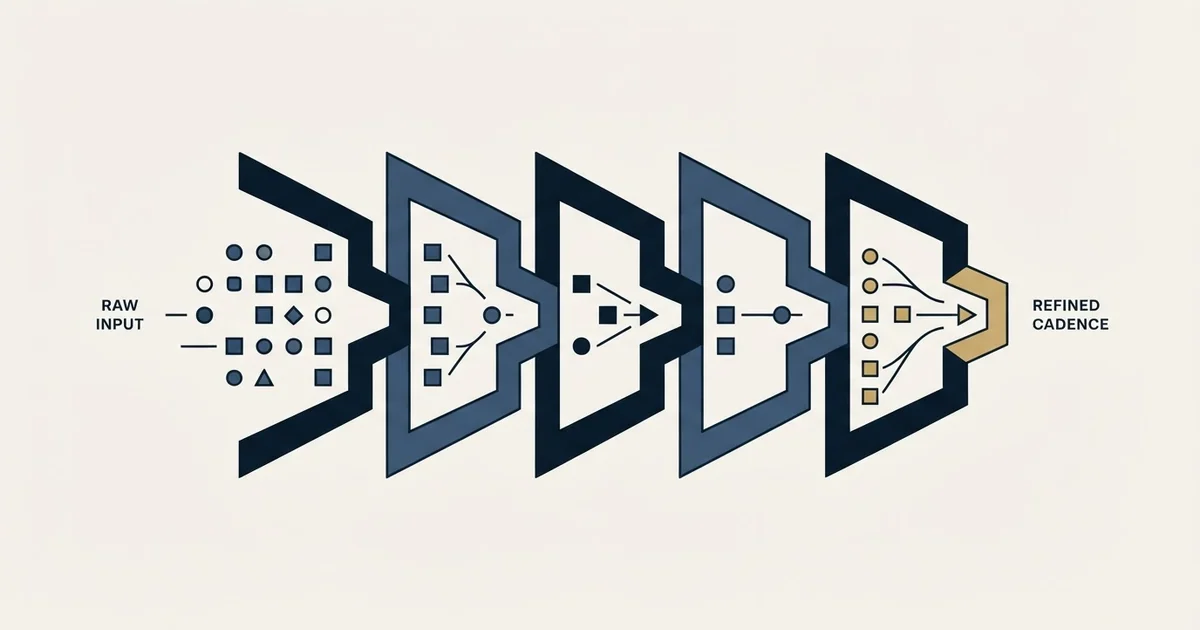
The Agoge sequence is a 15-touch outbound cadence Sam Nelson wrote for new reps at Outreach and published in August 2018. Over 27 days it runs seven emails, six calls and two LinkedIn touches, and the 30MPC table puts eight of the fifteen in the first week. Its research sits in the first email's two opening sentences.
Key takeaways
- The 30MPC PDF sets the Agoge sequence out as 15 steps over 27 days: seven emails, six calls and two LinkedIn touches, with eight of them in the first seven days.
- Nelson's 2018 blueprint has reps customise only the first two sentences of the first email, then reuse them to open the first call, in two reply emails and in the day 7 InMail.
- Four of the seven emails are replies that land under an earlier message, and every email after the first is marked automated in the 30MPC table.
- The most reusable part is the seven-item hierarchy of importance for the research line, which works inside a single message as well as a 15-touch sequence.
Reviewed and updated October 1, 2026
Most outbound frameworks are anonymous. The Agoge sequence is not: it has an author, a date, a company it was built inside, and published copy you can read for yourself. That makes it unusually easy to evaluate, and unusually easy to misrepresent, because the explainers now ranking for it mostly restate each other rather than the primary sources.
The named objection handling frameworks have publishers you can read too, and objection handling frameworks sets them side by side with each publisher quoted.
The version worth having is the one from the primary sources. 30MPC, which distributes the sequence with its author Sam Nelson, describes it as "A 15-touch plan spanning 27 days", "Featuring calls, emails, and social touches", and names him as "founder at SDRLeader.com and Agoge". B2B Hero's explainer, which walks the structure step by step, puts the composition at "7 emails, 2 LinkedIn actions, and 6 calls" and says the method "advises contact your prospects approximately 15 times before giving up". Nelson published the example copy himself in December 2020, more than two years after his own LinkedIn article set out the blueprint.
What is the Agoge sequence?
The Agoge sequence is a 15-touch outbound cadence that Sam Nelson wrote for new sales development reps at Outreach and published as a blueprint in August 2018. It runs over 27 days and mixes seven emails, six phone calls and two LinkedIn touches. The research sits in the first two sentences of the first email, and the first week of touches reuses them.
The fullest statement of the schedule is the PDF 30MPC distributes, which sets the sequence out as a table of 15 steps with a day and a channel for each. Day 1 is a manually written email, a LinkedIn follow and a phone call. Days 3 and 4 each pair a reply email with a call. Day 7 is a LinkedIn InMail and day 10 a call. On day 14 a new email goes out, followed by reply emails on days 15 and 17, calls on days 19 and 21, and a breakup email on day 27. Eight of the fifteen touches land in the first seven days and the other seven are spread over days 10 to 27. The table also marks every email after the first as automated, so the manual work is the first email, the six calls and the two LinkedIn touches. That table is the nearest thing to an Agoge sequence template, and it is worth reading beside the copy rather than a summary of either.
Where the name comes from, and why it matters
The agoge was the Spartan training system that new recruits went through together before they were considered full soldiers. B2B Hero's explainer records that "The Agoge sequence was theorized and created by Sam Nelson", that "The idea came from Sparta, in Greece.", and that when he introduced it at Outreach "they quickly found the need to open up a specific team which they called the" Agoge team, training as a cohort rather than being distributed among tenured representatives.
That origin is not decoration. The sequence was designed for a specific population under specific conditions: new representatives, working a defined and high-priority account list, inside a company selling a product that its own prospects were plausibly evaluating, with a platform that could execute a 27-day multi-channel plan reliably. Every one of those conditions does work in the design, and every one of them is a condition a team copying it may not share.
A licensed programme is sold with its conditions attached, which is what Command of the Sale describes from the vendor's own pages: a three-phase engagement rather than a structure to copy.
The structure, and the design decision inside it
The published copy shows where the effort is concentrated, and it is the opening. The first email is the one carrying the research, and Nelson's own template holds a placeholder that says the quiet part directly: the writer is to insert an observation that "couldn't be written by robot". A second variant in the same document gives reps what it calls a hierarchy of importance for what to look for: whether they are a new hire, whether they are familiar with the company, whether competitors are using it, whether they are hiring sales reps, whether they use a competitor, then the responsibilities and finally the achievements and articles on their LinkedIn profile.
That ordering is the genuinely good idea in the sequence and it survives being separated from everything else. It converts personalisation from an instruction into a procedure. The placeholder asks for one detail, so the practical reading of the ranking is a stopping rule: take the highest-ranked thing you can find and write it down. Nelson's own account of why this matters is about time. He writes that he was once afraid to let reps customise because "it would cause them to spend too much time on individual emails", and that "The key is to make it systematic to prevent misallocation of time." A representative told to personalise can spend twenty minutes and produce something generic; one given a ranked list and one detail to find is doing a lookup.
Teams that still burn twenty minutes on manual lookups will find what AI prospecting actually automates clarifies which research steps a model can compress and which still demand human judgement.
Nelson's 2018 blueprint explains why the effort goes there. Reps customise only the first two sentences: the first is to "Get the prospect's attention, prove you did research", the second to "Tie that into a product value proposition". Doing that once, he writes, lets a rep "reap the rewards of personalization 10 times throughout this sequence without any additional research". In the 30MPC table the same two lines open the first call on day 1, the reply emails on days 3 and 4 bump the original back up so it is still visible below, and the InMail on day 7 rephrases the two sentences. From day 14 the new email is a template, sent automatically.
The later steps are structurally different, and the copy shows this plainly. Steps 4, 6, 12 and 14 are labelled "Reply Email" in Nelson's own document, meaning they land in the thread under the previous message rather than arriving fresh. Step 6's body is "Making sure my last note reached your inbox." Step 10 opens a new thread with a subject line asking whether the prospect got the voicemail. The two documents number their steps differently, and Nelson's copy runs to a step 16 it calls a Hail Mary email, but the proportion is the same in both: four of the seven emails are replies.
So the sequence's shape is one researched email whose two custom sentences are carried through the first week, followed by a second half whose job is persistence. B2B Hero is candid about the arithmetic of that, noting that reply rates fall as the sequence progresses because "you're catering to people that are less and less interested as you go down the sequence".
Where a plain ask for the business belongs once a conversation exists, rather than inside a sequence, is the subject of the direct close.
Where our own practice differs, and why
We do not run sequences. A campaign carries one message, built on one premise, and it is sent once. On LinkedIn we do not send a second message at all, because it arrives directly beneath the one they already chose not to answer.
The first reason is diagnostic. A sequence changes several things at once. When fifteen touches produce nothing, the failure could be the list, the premise, the offer, the timing or the channel, and there is no reading of the result that separates them. When one message on one premise produces nothing, the premise is the thing that failed, and when the next campaign tests a new premise on the same market and produces replies, you have learned something you can use next month.
Reading a campaign as an input, an output and a conversion between them is the discipline the bow tie model applies to every stage of a recurring revenue business.
The second is what the persistence touches actually contain. A message whose entire content is that you sent a previous message is asking the recipient to reward your effort. Step 6 is the honest version of this: it says out loud that its purpose is to make sure the last note arrived. There is no reason for a busy person to answer it that was not already present in the first email.
The third is that the arithmetic has changed since 2018. When Nelson built this, a fifteen-touch plan against a high-priority list was distinctive, because most people were not doing it. The cost of producing a competent personalised-looking message has since collapsed, everyone's version of persistence has scaled with it, and the same finite population of buyers is receiving substantially more of it. Volume-based persistence works less well the more widely it is adopted, which is a property of the tactic rather than of anyone's execution of it.
Manufactured pressure has the same property, and the urgency close separates the deadlines that are real from the ones a seller invents.
Being honest about the trade: we give something up. Some genuinely interested people do not reply to a first message and would have replied to a fourth, and a one-message design does not reach them. What it buys in exchange is that every campaign result means something, which compounds across a programme in a way that individually recovered conversations do not.
The condition nobody copies with it
There is one more thing the primary sources make visible that the summaries drop, and it decides more than the touch count does.
The published copy is templated in a way that assumes an operator behind it. The first email carries a bracketed instruction telling the representative to insert a specific observation and, in the second variant, a numbered hierarchy telling them what kind of observation counts. Step 10 carries a placeholder for a named customer quote at a named account. These are not fill-in-the-blank fields a tool can populate. They are instructions to a person who has been trained to read a profile and pick the one useful thing on it, which is what the Agoge team structure existed to produce.
So the sequence and the training programme were one artefact. A team that adopts the fifteen touches without the cohort, the coaching and the ranked-research discipline has copied the expensive part and left behind the part that made it work, and should expect fifteen generic touches rather than one good one. The later steps were never carrying the weight, and they carry even less when the first one was not properly done.
The same test applies to a licensed methodology such as the ValueSelling Framework, whose vendor sells the manager coaching and the CRM toolset alongside the four stages for exactly that reason.
What to take from it if you are not going to run it
The parts of the sequence that transfer are the parts that are not about persistence.
Take the ranked research hierarchy. Nelson's list of what to look for, in its order of importance, is the most reusable thing in the framework. Read it as a stopping rule, taking the highest-ranked detail you can find, and it works inside any structure including a single message.
A time-boxed version of the same discipline, three facts in three minutes before any first touch, is in the 3x3 research method.
Take the seriousness about which accounts get this treatment. The sequence was built for high-priority prospects specifically, not as a default motion for a whole list, and the version of it that fails hardest is the one applied uniformly to everyone. Deciding which accounts justify a person's attention is a coverage question with real arithmetic behind it, and the answer for most teams is a much smaller number than they expect.
Once a conversation starts, which of those accounts is a real opportunity is a qualification question, and MEDDIC vs BANT sets the two common checklists against each other from their originators' own text.
Take the multi-channel instinct with a caveat. Using more than one channel to reach somebody is sound, and it is why our own programmes run email and LinkedIn rather than email alone. The caveat is that a second channel used to repeat the same unanswered ask is the same bump wearing different clothes.
A question asked from the door of a meeting that is ending is a different object from a second message, and the Columbo close sets out where that technique works and where it does not.
What does not transfer is the touch count. Fifteen was a reasonable number in 2018 inside a company whose product its prospects were plausibly evaluating, and it is a number to derive from your own market rather than to inherit.
Are they a new hire?
Are they familiar with the company?
Are competitors using it?
Are they hiring sales reps?
Do they use a competitor?
Their responsibilities on LinkedIn
Their achievements and articles on LinkedIn
The short version
The Agoge sequence is a documented, attributable 15-touch plan over 27 days, built by Sam Nelson at Outreach for new representatives working a high-priority list, and its best idea is the ranked research hierarchy in the first email rather than the touch count everyone quotes.
We run something different, deliberately: one message, one premise, one send, with the next approach treated as a new campaign. That choice costs us the prospects who only answer on the fourth attempt, and it buys a programme where every result can be read. If you want to see what one message against your own market produces before deciding how many you need, we can put a campaign in front of it and you can read the replies yourself.
And once a conversation exists and weeks of agreement need turning into a decision, the technique for that moment is the summary close.
Two adjacent pages are worth having beside this one: what the sequencing tools themselves are actually built to do, and where a fresh approach to somebody who did not reply belongs if it is not a follow-up in the same thread.
Frequently asked questions.
Frequently asked questions- What is the Agoge sequence?
- It is a 15-touch outbound cadence that Sam Nelson wrote for new sales development reps at Outreach, set out in his own LinkedIn blueprint dated August 2018. It runs over 27 days and combines seven emails, six phone calls and two LinkedIn touches. The research sits in the first two sentences of the first email, and the first week of touches reuses those two sentences.
- Is there an Agoge sequence template I can copy?
- Two primary sources publish it. Nelson's own Substack post of example copy, dated December 2020, gives templates for the first email, the reply emails, the day 14 new email and several Hail Mary emails. The PDF that 30MPC distributes sets the 15 steps out as a table with a day, a channel and an automated flag for each, with templates beside them.
- How many touches are in the Agoge sequence, and over how many days?
- Fifteen touches over 27 days. In the 30MPC table, day 1 carries an email, a LinkedIn follow and a call, days 3 and 4 each pair a reply email with a call, and day 7 is an InMail. The remaining seven touches are spread from day 10 to a breakup email on day 27.
- Does the Agoge sequence still work?
- The research discipline in it does. The persistence half has weakened, because the cost of producing a competent personalised-looking message has collapsed since 2018, everyone's version of persistence scaled with it, and the same finite population of buyers now receives far more of it. That weakening comes from the tactic's wide adoption, whoever is executing it.
About the author.

B2B cold email experts helping companies generate qualified leads through done-for-you outreach campaigns.
RevenueFlow Team
Explore more.
Ready to scale your outreach?
We build GTM engines that book real meetings. See the receipts.
Related articles.
Sales Rep Coaching: The Cadence That Survives a Busy Quarter
Coaching that changes behaviour needs an artifact on the table and one named focus. The weekly loop, and the three layers a flat number can be hiding.
Prospecting Methods: Six Ways In, and What Each One Demands
Six prospecting methods, grouped by economics rather than preference: what each one needs before it works, where it stops scaling, and how to choose.
Cold Calling Prospecting: Start From the Coverage Ceiling
One caller covers accounts in the low hundreds a week, not the low thousands. That ceiling decides whether calling is your coverage channel or a sample.
AI Prospecting: Which Steps It Actually Removes
Prospecting is six jobs with different bottlenecks. A model changes the reading step decisively and leaves the judgement and verification steps where they were.
Virtual SDR: One Term Covering Two Different Purchases
One vendor sells a vetted remote person, another sells software from $250 a month. The term does not separate them, and they fail in opposite directions.
Sales Prospecting: Most of the Job Happens Before You Send
Prospecting is selection, not sending. The five decisions inside the motion, the one most teams never make, and what changes when you buy it as a service.