ValueSelling Framework: The Stages and the Prospect Formula
The ValueSelling Framework is a licensed methodology, not the generic idea. Its four stages, the Qualified Prospect Formula and its delivery, from the vendor's pages.
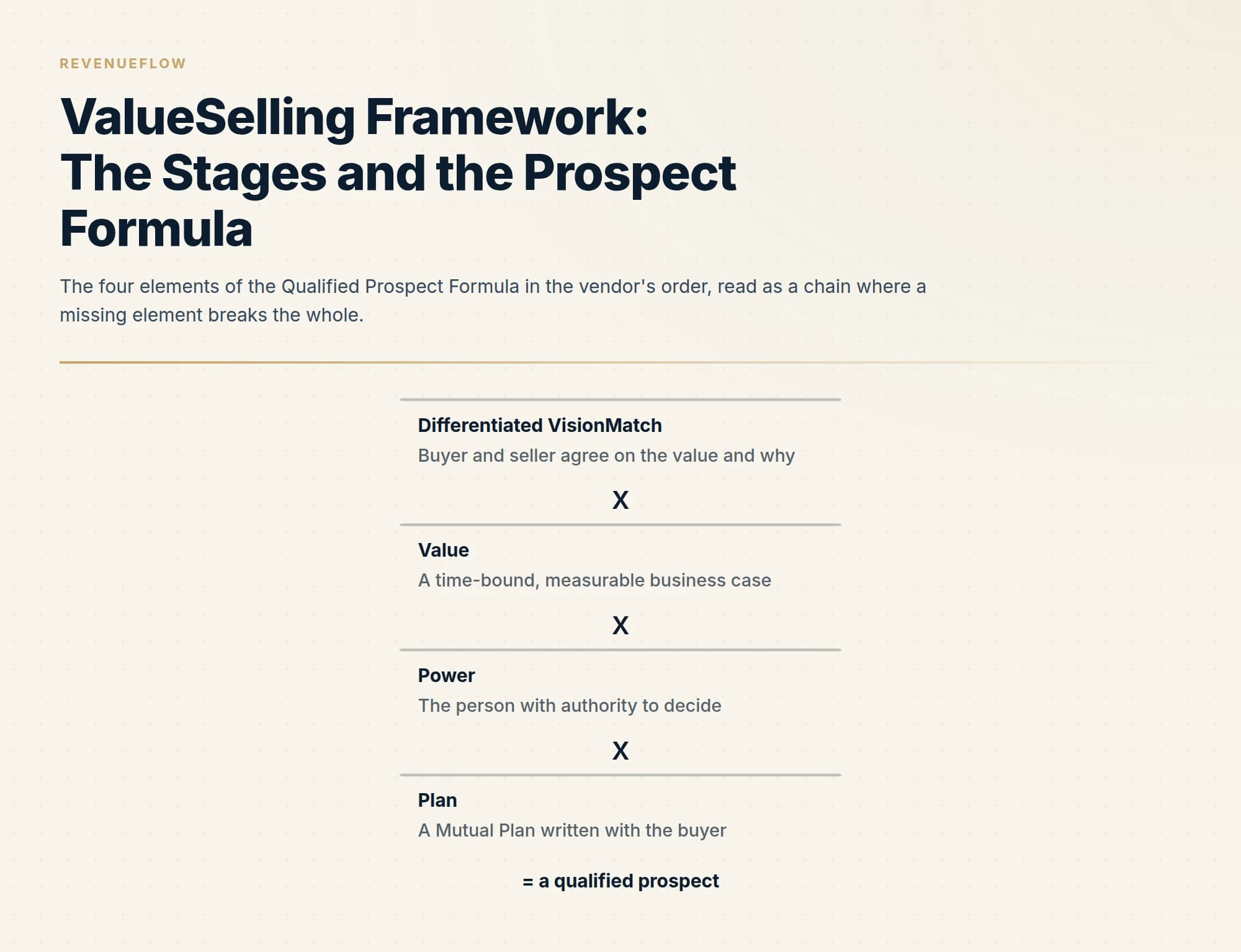
The ValueSelling Framework is a licensed sales methodology from ValueSelling Associates, dating from 1991, with four stages the vendor names engage, qualify, advance and close, and a qualification tool inside it, the Qualified Prospect Formula, whose elements are Differentiated VisionMatch, Value, Power and Plan. A deal missing any one is at risk.
Key takeaways
- ValueSelling with a capital letter is a licensed programme with its own stages, formula and vocabulary; value selling in general is the arithmetic of a business case, covered on a separate page.
- The Qualified Prospect Formula has four elements, Differentiated VisionMatch, Value, Power and Plan, and the vendor's rule is that a deal missing any one of them is at risk of not closing.
- The vendor separates process (yard markers), methodology (playbook) and skills (drills), and says the framework coexists with qualification tools such as MEDDIC rather than replacing them.
- Delivery is a tailored programme in two full days, four half days or eight 90-minute sessions, with microlearning as standard, a manager coaching track and a CRM toolset for Salesforce and Microsoft Dynamics.
Reviewed and updated September 18, 2026
Two things share the name. Value selling, lower case, is the generic idea that a deal is argued in the buyer's business outcomes rather than the seller's features, and it has a page of its own on this site. The ValueSelling Framework, one word and capitalised, is a specific licensed methodology sold by ValueSelling Associates since 1991, with its own stages, its own qualification formula, its own vocabulary and its own CRM toolset. Explainers of the term blur the two, which is a disservice to anyone deciding whether to buy the training.
This page is about the second thing, read from the vendor's own pages: the four stages the framework names, the Qualified Prospect Formula that sits inside it, the distinction the vendor draws between a methodology and a qualification tool, how the programme is delivered, and where it fits an outbound motion and where it does not. For the generic arithmetic of turning a diagnosed problem into a number a finance team will accept, read value-based selling; this page does not repeat it.
What the vendor says the framework is
The vendor's own definition, on its page titled What is ValueSelling, fetched on 18 September 2026 and carrying no publication date, is a process claim rather than a philosophy: "The ValueSelling Framework is a simple, conversational process to manage interactions with prospects and align your solutions with what buyers value most." The same page names the three things the company says the framework produces: "Our proven, value-based methodology creates a common language for greater forecast accuracy, powerful deal reviews and effective sales coaching."
The programme page for the framework, also fetched on 18 September 2026, names the four stages. The programme, it says, "provides all customer-facing professionals with a proven process and tools to engage, qualify, advance and close the sale." Engage, qualify, advance, close: those four words are the framework's own names for its stages, and the vendor's site navigation repeats them as headings. What each stage contains is taught inside the paid programme; the public pages describe the outputs rather than the questions.
Two more claims the vendor makes about itself are worth having verbatim because they shape everything else. On repeatability: "The power of the ValueSelling framework lies in its simplicity, repeatability and applicability to every complex selling situation." On what the training actually installs: "Discover an integrated, questioning process to manage any conversation, along with the tools and skills to execute effectively." The framework is a questioning process. That is the honest one-line description, and it is the vendor's.
The Qualified Prospect Formula
The part of the framework the vendor publishes in most detail is its qualification tool, and it is the part most useful to a reader who will never buy the course. The vendor's page on qualification tools versus methodologies, fetched on 18 September 2026, introduces it: "Developed in 1991, ValueSelling's dynamic sales qualification tool is a multi-dimensional process for driving forecast accuracy." and then states its rule: if any of the four elements is under-developed or missing, there is a risk the customer will not buy.
The four elements, in the vendor's own order and with the question the vendor attaches to each:
Differentiated VisionMatch. "Do you and the buyer agree on the value of your solution and its ability to solve pressing business challenges?" Agreement, not presentation, and differentiated from the alternatives the buyer could choose instead.
Value. "Is your solution worth it? To offer value that motivates change, you must connect to problems worth solving and create a business case that is time-bound and measurable." This is where the framework meets the generic discipline: the business case is the object, and the generic page linked above is about how to build one the buyer will defend.
Power. "Building consensus across the buying group is vital, but are you talking to the person who has the authority to make the final buying decision?" The framework's name for the person with authority is Power, and its test is access rather than a title.
Plan. "Develop a Mutual Plan with the buyer. This collaborative document outlines the business issue, the agreed upon solution and its quantified value, maps the buying steps and outlines the plan for value realization." A document, jointly written, that runs past the signature into what happens after it.
The formula is multiplicative in the vendor's framing: the four are not a checklist where three out of four is a pass, and a deal missing any one of them is not counted as qualified. That is a stricter rule than a pipeline review that counts three elements out of four as a pass, and it is the rule that produces the forecast accuracy the vendor keeps returning to.
Methodology or qualification tool: the vendor's own distinction
The vendor draws a line that many buyers of sales training never draw, and it is the most useful thing on its public pages. Qualification tools and assessment frameworks, it says, are "tremendous for evaluating where opportunities are today and identifying crucial gaps." but they assess the past and present without guiding what to do next. Methodologies, by contrast, "provide both an opportunity assessment and a proactive approach for engaging buyers, advancing opportunities and creating momentum toward closed-won."
The vendor then offers an analogy from American football that separates three things teams routinely conflate: "Your sales process makes up the yard markers on the football field: clearly defined milestones that show progress.", "Your sales methodology is the playbook: how you move the ball down the field." and "Your sales skills are the drills: the blocking, tackling, throwing that make execution consistent and effective."
Qualification tool
- Evaluating where an opportunity is today and identifying the gaps
- An assessment of the past and present
- No guidance on what to do next
- The vendor's example: MEDDIC
Methodology
- An opportunity assessment plus a proactive approach for engaging buyers
- Advancing opportunities and creating momentum toward closed-won
- Carries its own qualification tool inside it
- The vendor's example: the ValueSelling Framework
On that map the ValueSelling Framework is the playbook, the Qualified Prospect Formula is the assessment built into the playbook, and the CRM stages a team already has are the yard markers. The vendor is explicit that the framework is not a rival to a qualification tool the team may already run: "High-performing teams use both together." naming MEDDIC as the example of a tool that coexists with it, and giving BANT as the lighter tool for high-velocity and inbound qualification. Where the sixteen named methodologies sit against each other, and which of them are licensed programmes like this one rather than published frameworks, is mapped in B2B sales methodologies.
How the programme is delivered
The framework is a paid, tailored programme, and the vendor publishes the shape of it. The foundation course, the programme page says, "is available virtually or in person and can be delivered in two full days, four half days, or eight 90-minute sessions." and "Every ValueSelling Framework rollout includes microlearning from ValueSelling@Work as standard". A separate manager track, Coaching the ValueSelling Framework for Managers, exists to keep the vocabulary in use after the workshop, and the vendor's position on what it sells is stated as a heading on the same page: We Do Not Sell Training. We Sell Results.
There is also a CRM layer. The eValuePrompter page, fetched on 18 September 2026, describes a toolset that "transforms Salesforce and Microsoft Dynamics into a deal management engine that reinforces your sales methodology, provides complete pipeline visibility and delivers forecast accuracy you can trust". The pitch is that a methodology living outside the CRM decays, and the toolset puts the formula's four elements into the opportunity record so that a deal review is run on them. The vendor also publishes client case-study figures on these pages; they are the vendor's claims about its own customers, and this page does not repeat them as facts.
- Depends: Differentiated VisionMatch: the buyer agrees on the value and on why it beats the alternatives
- Depends: Value: a business case exists that is time-bound and measurable
- Depends: Power: you are talking to the person with authority to make the final decision
- Depends: Plan: a Mutual Plan document maps the buying steps and the value realization
- No: Any one of the four missing: the vendor says the customer may not buy
Where it fits an outbound motion, and where it does not
The framework was written for a complex sale: a buying group, a business case, a decision that needs a plan to survive. Its own examples on the qualification page are enterprise deals with several stakeholders, and its formula assumes there is a Power to find and a Plan worth writing. A transactional sale with one signer and a short cycle does not need four multiplied elements, and the vendor's own BANT section says as much for high-velocity work.
For an outbound programme the fit is at the seam between a booked meeting and a deal. The framework's first stage is engage, and the vendor sells a separate prospecting product for filling the funnel that it describes as multi-channel and strategically choreographed. That is the point where our practice diverges, and it is worth stating rather than hiding. A cold campaign here carries one message on one premise, sent once; a non-responding audience is approached again only with a new campaign on a new premise, never with a reminder in the same thread. The case for that, argued against a named multi-touch sequence rather than in the abstract, is in the Agoge sequence. Nothing in the framework's public pages depends on a prospecting cadence, so a team can run one message to open and the framework's four stages once a conversation exists.
The second point of contact is the definition of a qualified meeting, and here the framework and our commercial terms pull in the same direction from opposite ends. Meetings booked here are qualified against criteria agreed with the client in writing before anything sends, and budget, timing and authority are never billing conditions, because none of the three is knowable from outside a first conversation. The Qualified Prospect Formula is the discipline that begins after that conversation: it asks the client's own sellers to establish Power, Value and a Plan before a deal is counted, which is the right place for those questions to live. A framework that put them in the first email would produce fewer meetings and no better deals. The same instinct, settling terms before the presentation, is what the Sandler up-front agreement formalises from a different tradition.
The framework does not transfer where the operating conditions around it are missing. The vendor's own pages say the programme is tailored, reinforced by microlearning and coached by managers trained on a separate track, and its CRM toolset exists because a vocabulary nobody reviews deals in stops being used. A team that adopts the four words and the formula without the reviews has copied the cheap part.
The short version
The ValueSelling Framework is a licensed methodology from ValueSelling Associates, dating from 1991, with four named stages, engage, qualify, advance and close, and a qualification tool inside it, the Qualified Prospect Formula, whose four elements are Differentiated VisionMatch, Value, Power and Plan. The vendor's rule is that a deal missing any one of the four is at risk of not closing.
The vendor separates process (the yard markers), methodology (the playbook) and skills (the drills), says the framework coexists with tools like MEDDIC rather than replacing them, delivers the foundation course in two full days, four half days or eight 90-minute sessions with microlearning as standard, and sells a CRM toolset that puts the formula into Salesforce and Microsoft Dynamics.
It is built for complex sales and begins once a conversation exists. If the constraint on your side is the supply of those conversations, we plan the first campaign for free.
Definitions, stage names, the Qualified Prospect Formula and its four questions, the methodology versus qualification tool distinction, the delivery formats and the CRM toolset description are quoted from valueselling.com's What is ValueSelling, ValueSelling Framework, Sales Qualification Tools vs. Sales Methodologies and eValuePrompter pages, all fetched on 18 September 2026; the pages carry no publication dates. The vendor revises these pages; confirm the current text before relying on it.
Frequently asked questions.
Frequently asked questions- What is the ValueSelling Framework?
- A licensed B2B sales methodology from ValueSelling Associates, which its own pages describe as a simple, conversational process to manage interactions with prospects and align solutions with what buyers value most. It names four stages, engage, qualify, advance and close, and carries a built-in qualification tool, the Qualified Prospect Formula, developed in 1991. It is taught as a tailored, instructor-led programme rather than published as a free method.
- What is the Qualified Prospect Formula?
- The qualification tool inside the ValueSelling Framework. It tests four elements: Differentiated VisionMatch, whether buyer and seller agree on the value and why it beats the alternatives; Value, whether a time-bound, measurable business case exists; Power, whether you are talking to the person with authority to decide; and Plan, whether a Mutual Plan document maps the buying steps and value realization. The vendor says a deal missing any one is at risk.
- Is the ValueSelling Framework the same as value-based selling?
- No. Value-based selling is the general practice of arguing a deal in the buyer's business outcomes and building a number the buyer's finance team will accept. The ValueSelling Framework is one vendor's licensed methodology built on that idea, with its own stage names, its Qualified Prospect Formula, a manager coaching track and a CRM toolset. The generic practice can be run without the programme; the programme is a way of installing it.
- How is the ValueSelling Framework different from MEDDIC?
- The vendor's own pages draw the line: a qualification tool such as MEDDIC assesses where an opportunity stands today and identifies gaps, while a methodology also gives a proactive approach for engaging buyers and advancing the deal. The vendor says high-performing teams use both together, and the Qualified Prospect Formula is the assessment built into its methodology, so the two are complementary rather than competing choices.
About the author.

B2B cold email experts helping companies generate qualified leads through done-for-you outreach campaigns.
RevenueFlow Team
Explore more.
Ready to scale your outreach?
We build GTM engines that book real meetings. See the receipts.
Related articles.
MEDDIC vs BANT: What Each Qualifies and When to Use Which
MEDDIC and BANT from the originators' own text: IBM's BANT form as a gate after the first call, PTC's six themes as an audit of a live deal, and when to run each.
Command of the Sale: Force Management's Process Programme
Command of the Sale is Force Management's sales process and qualification programme, not its messaging one. What the vendor says it is, delivers and how it runs.
The Urgency Close: Real Deadlines and Manufactured Ones
The urgency close from the publishers who teach it, the test that separates a real deadline from a manufactured one, the structure, and why we never invent one.
Objection Handling Frameworks: LAER, AAA and Others Compared
The named objection-handling frameworks with their publishers quoted: Carew's LAER, RAIN Group's four steps, HubSpot's five, Gong's three and both AAAs.
The Summary Close: Restating What Was Agreed Before the Ask
The summary close restates the buyer's needs, the agreed answer to each and then asks. What the publishers say, the structure, a worked example, and where it fails.
B2B Sales for Financial Services Companies: Regulated Seller
For the bank, agency, broker-dealer or adviser selling to businesses: the buying group, the credit and renewal windows, and the rules that bind the seller's own message.