3x3 Research: Three Facts in Three Minutes Before Outreach
3x3 research as Funnel Clarity publishes it: three unique facts in three minutes that the prospect would be surprised you know, the variants, and where it fits.
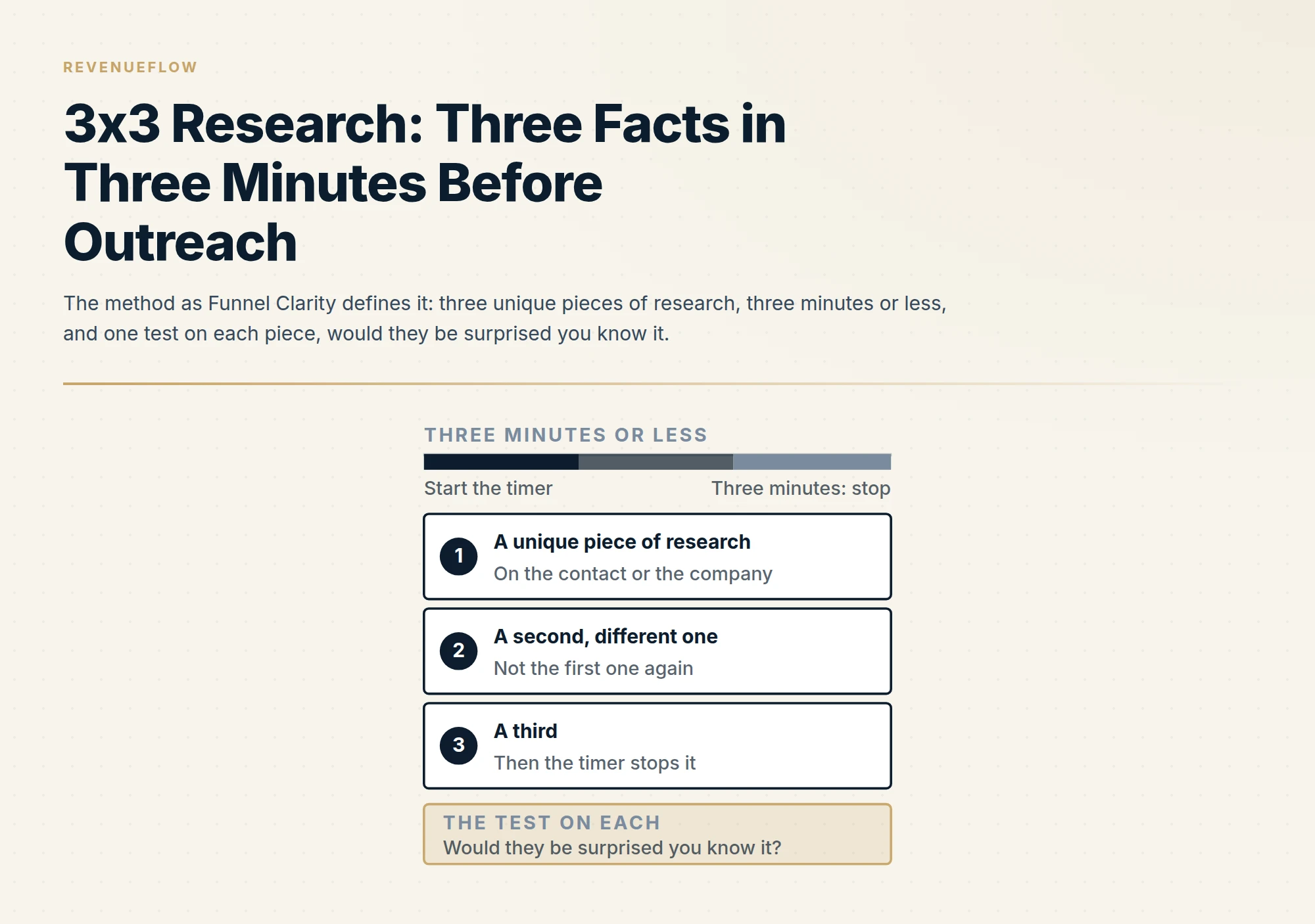
3x3 research is a pre-call preparation rule: find three unique pieces of research on the contact or company in three minutes or less that they would be surprised you know. Funnel Clarity publishes it as its own; Regie credits Steve Richard with coining it. The clock is the discipline and the surprise test is the standard.
Key takeaways
- Funnel Clarity's own definition carries a test most summaries drop: the three facts must be ones the prospect would be surprised you know, so a job title, an industry or a tagline does not count however fast it was found.
- The clock is the method: Regie's seven-step version starts with a three-minute timer and names stopping when it rings as the hard step, and Force Management sorts what to look for into personal, company and industry changes.
- Attribution is split and stated: Funnel Clarity's page says the approach got its start with the company and marks the name as its own, while Regie's guide credits Steve Richard, co-founder of Vorsight, with coining it.
- In a one-message outbound motion the three facts do not spread across a sequence: one opens the message, one makes its premise credible, and one is held back for the reply.
Reviewed and updated September 19, 2026
A representative told to personalise a first message will spend twenty minutes on one profile and produce a compliment. A representative given a rule, three facts in three minutes and stop, produces something specific and moves on. That rule has a name, 3x3 research, and it has a publisher who claims to have started it, a definition in that publisher's own words, and a test built into the definition that most summaries drop. This page sets out the method as its originator publishes it, the variants the market has grown around it, and where it fits an outbound motion that sends one message per person.
The nearest thing to it on this site is the ranked research hierarchy inside the Agoge sequence, Sam Nelson's ordered list of what to look for on a profile with an instruction to stop at the first hit. That list is the sequence's most reusable idea, and 3x3 research is the time-boxed cousin of it: a budget rather than an order.
The method as its originator states it
Funnel Clarity, a sales training company, publishes the method on its prospecting training page, fetched on 19 September 2026, and marks the name as its own. The definition on that page is one sentence, which says that 3x3 Research "is a step to take in your pre-call prep: find 3 unique pieces of research on the contact or company in 3 minutes or less that they are surprised you know." The page then states the purpose, "Doing this step helps you create curiosity in your prospecting outreach.", and the claim of origin: the approach "got its start with Funnel Clarity and it's incorporated into many of our trainings."
The same page's FAQ restates it with the audience named: "This approach is designed to create curiosity in prospecting outreach and is incorporated into many of Funnel Clarity's training programs. It shifts the dynamic from a generic cold approach to one that establishes immediate credibility and common ground before the conversation even begins." The page carries no publication date; its copyright line reads 2026 and it is cited as fetched. Funnel Clarity sells the lesson as a thirty-minute training sample behind a form, so the full lesson is not quoted here; the definition above is what the vendor publishes openly.
The attribution is not undisputed, and the page states the other version rather than choosing. Regie.ai's guide to the method, published on 7 July 2024 and fetched on 19 September 2026, says: "The 3x3 research method was originally coined by Steve Richard", whom it describes as co-founder of Vorsight and SVP of revenue enablement at Mediafly. Funnel Clarity's page names the company as the origin and Regie names a person; neither page contradicts the definition, and the reader should know that a training firm holds the mark and a named individual is credited elsewhere with coining it.
What the originator's sentence contains that the summaries usually lose is the test at the end of it. Three facts in three minutes is the budget. That they are surprised you know is the standard. A fact that passes the budget and fails the standard, the company's headcount, the prospect's job title, the city on the profile, is not a piece of 3x3 research by the originator's own definition, because nobody is surprised that a stranger read the first line of their profile.
The three parts, taken one at a time
Three. The number is a ceiling and a floor at once. Fewer than three and the message has one hook, which reads as a gimmick; more than three and the research has become a dossier that the message cannot carry. Regie's guide puts the instruction as "Keep it to three points max; quality over quantity is key here." Three is also the number that fits a first message with one premise: one fact to open, one to make the premise credible, one in reserve for the reply.
Three minutes. The budget is the point of the method, and every publisher who teaches it says so in the same terms. Regie's first step is the timer, and its reason: "This time constraint is crucial - it forces you to focus and prevents you from falling into research rabbit holes." Force Management's version for sales development representatives, written by Ivan Gomez and fetched on 19 September 2026 with no date on the page, says: "The 3X3 approach says you should spend three minutes finding three relevant pieces of information about a prospect." and adds the reason a time box matters for that reader: "The 3x3 method can help with any prospecting function and ensures you don't fall into the trap of endless research."
Surprised you know. This is the originator's standard and it is the part to keep when everything else is forgotten. A fact passes when the prospect would not expect a stranger to hold it. The company's press release from last week passes; the company's tagline does not. A conference they spoke at passes; the industry they work in does not. Force Management's page names the failure mode from the other side: "Asking a prospect something you could have easily found with a quick google search is a fast way to lose credibility." The surprise test is that sentence turned into a filter.
| The fact found | Surprised you know it? | Why |
|---|---|---|
| Their job title and company | no | The first line of any profile; it proves nothing was read past it |
| Their company opened a Lisbon office last month | yes | Recent, specific, and it implies a decision somebody made |
| The industry they work in | no | A category, shared with thousands of companies |
| Four success roles open on their careers page since June | yes | A count with a date; it names a change, not a state |
| Their company tagline | no | Written to be read by strangers; reading it back is not research |
| A podcast episode where they said the onboarding queue was the problem | yes | In their own words, on a problem you can speak to |
What the market has added, and what to take from it
The method has grown a small literature, mostly on sales-tool blogs, and three additions are worth having because they answer questions the one-sentence definition leaves open.
Where to look. Regie's guide names the sources to have open before the timer starts: "Prioritize 2-3 reliable sources like LinkedIn, the company website, and a recent news search. Having these prepared in advance saves precious seconds once the clock is ticking." Force Management sorts the facts to look for into three categories, personal, company and industry, and lists what belongs in each: "Personal: Promotions, Changes in company, Social media engagement", "Company: Leadership changes, Product launches, Press releases", "Industry: Regulatory changes, New competitors". The common thread is change: every example is something that happened, which is why it passes the surprise test.
A procedure. Regie's guide expands the sentence into seven steps, numbered 1 to 7, with steps 5 and 6 the review and the stop: set a timer for three minutes, choose your research sources, start scanning for relevant information, note down three key insights as you go, review and refine if time allows, stop when the timer rings, organise findings for easy reference. The sixth step is the one the guide flags as hard: "When the 3 minutes are up, stop immediately." That is the whole method in one instruction. Anyone can find three facts given an hour; the discipline is refusing the hour.
A place to put the result. Regie's seventh step sends the three facts into the CRM or the prospecting tool so they are there when the message is written or the call is made. Force Management's version frames the whole exercise around the first call rather than the first email, which is where the method started and where a training firm's clients mostly use it. The adaptation this page makes is to the written first touch, below.
Where it fits a one-message outbound motion
The method was built for pre-call preparation, and the first call is where a training firm's clients mostly run it. For written outbound the question is different, because there is no live conversation in which to use fact number three.
Our own campaigns send one message per person, built on one premise, with nothing scheduled behind it. In that shape the three facts do not spread across a sequence; they have to earn their place in one email or be left out. The useful allocation is one fact in the opening line, chosen because it passes the surprise test hardest; one fact that makes the premise of the message credible, which is usually the change the company is going through; and one held back, unused, because a reply that mentions it will need it and a first message that carries all three reads as surveillance rather than research. A ranked list of what to look for, ordered from most to least useful, with an instruction to stop at the first hit, is the version of this discipline that the Agoge sequence page on this site sets out, and it pairs with the timer: the order tells you what to look for first, the clock tells you when to stop looking.
Where the method does not fit is the second message, and it does not replace the craft of the message itself, which the three facts feed rather than write. A team that runs 3x3 research and then sends three follow-ups each carrying one of the three facts has turned research into a drip, and the recipient reads it as one. The facts are for the first message and the reply thread, and why we stopped using follow-ups carries the reasons we do not schedule anything behind the first send.
The invented example below shows the allocation. The company, Larkwood Software, its head of customer success, and the three facts are made up for this page: on the Ops Table podcast last month the head of customer success said the onboarding queue was the thing keeping them up at night; four success roles have gone up on the careers page since June; and the company opened a Lisbon office last month. The table above uses the same invented facts. The subject line of the example names the thing they mentioned rather than the sender, which is the subject rule for a message built on research.
To: Head of Customer Success, Larkwood Software (invented). Subject: the onboarding queue you mentioned
On the Ops Table podcast last month you said the onboarding queue was the thing keeping you up at night. 1
Four new success roles have gone up on your careers page since June, which usually means the queue is being solved with headcount before it is solved with process. 2
We run onboarding for teams your size on a per-account basis. Worth twenty minutes to see whether the maths works before the new hires start? 3
- 1The fact that passes the surprise test hardest opens the message: their own words, from a source a stranger would not usually have heard.
- 2The company fact makes the premise credible. A count with a date, and a reading of what it usually means, so the recipient has something concrete to disagree with.
- 3The ask, with no third fact spent. The Lisbon office from the research stays in reserve for the reply; a first message that uses everything reads as surveillance.
Where the method fails
Three failure modes are worth naming, because each one keeps the letter of the rule and loses the point.
Three facts, none of them a change. The title, the industry and the headquarters city are three facts found in ninety seconds, and all three fail the surprise test. The clock was honoured and the research did not happen. The cure is Force Management's category list: every example there is an event.
Three minutes that become thirty. The stop is the hard step, as Regie's guide says, and the failure is not laziness but interest. A profile that turns out to be interesting is the one most likely to eat an hour. The timer exists for that profile.
Research that is done and never used. A team that files three good facts and then sends a template has paid for personalisation and shipped none. Regie's seventh step, organising the findings where the message will be written, is the fix, and it is the step most teams skip because the research felt like the work.
One more thing the method cannot do: it cannot make a poor list good. Three surprising facts about a person who does not buy what you sell produce a well-researched message to the wrong person. Deciding who is on the list comes first, and the ideal customer profile is where that decision is made. Research is the last three minutes of a process that started with the list, and if the list is the problem, a first campaign built on a fresh list is a cheaper fix than faster research.
The short version
3x3 research, as Funnel Clarity publishes it, is three unique pieces of research on the contact or company, found in three minutes or less, that the prospect would be surprised you know. The number is a ceiling, the clock is the discipline, and the surprise test is the standard that separates research from reading the first line of a profile. Regie credits Steve Richard of Vorsight with coining it and adds a seven-step procedure whose hard step is stopping; Force Management sorts the facts into personal, company and industry changes. In a one-message motion, one fact opens, one makes the premise credible, and one waits for the reply.
Every quotation above is from the named publisher's own page as fetched on 19 September 2026: Funnel Clarity's prospecting training page, Regie's guide (published 7 July 2024), and Force Management's first-call preparation post (undated). Publishers revise these pages; confirm the current text before relying on it.
Frequently asked questions.
Frequently asked questions- What is the 3x3 research method in sales?
- A pre-call preparation rule published by Funnel Clarity: find three unique pieces of research on the contact or company in three minutes or less that they would be surprised you know, in order to create curiosity in prospecting outreach. Force Management states it as spending three minutes finding three relevant pieces of information about a prospect, and Regie's guide expands it into a seven-step timed procedure.
- Who created 3x3 research?
- The sources disagree and this page states both. Funnel Clarity's prospecting training page, read on 19 September 2026, says the approach got its start with Funnel Clarity and marks 3x3 Research as its own name. Regie's guide, published in July 2024, says the method was originally coined by Steve Richard, whom it describes as co-founder of Vorsight. Neither page disputes the definition itself.
- What counts as a good fact in 3x3 research?
- One that passes the originator's test: the prospect would be surprised a stranger knows it. Recent changes pass, such as a new office, roles posted on a careers page since a given month, or something the person said on a podcast. Facts on the first line of a profile fail: the title, the company, the industry, the city. Force Management's categories are personal, company and industry changes.
- How does 3x3 research fit a cold email that has no follow-ups?
- The three facts have to earn their place in one message. Put the fact that passes the surprise test hardest in the opening line, use the company change to make the message's premise credible, and hold the third back for the reply. A first message that spends all three reads as surveillance, and spreading them across follow-ups turns research into a drip that the recipient reads as one.
About the author.

B2B cold email experts helping companies generate qualified leads through done-for-you outreach campaigns.
RevenueFlow Team
Explore more.
Ready to scale your outreach?
We build GTM engines that book real meetings. See the receipts.
Related articles.
Objection Handling Frameworks: LAER, AAA and Others Compared
The named objection-handling frameworks with their publishers quoted: Carew's LAER, RAIN Group's four steps, HubSpot's five, Gong's three and both AAAs.
The Urgency Close: Real Deadlines and Manufactured Ones
The urgency close from the publishers who teach it, the test that separates a real deadline from a manufactured one, the structure, and why we never invent one.
Command of the Sale: Force Management's Process Programme
Command of the Sale is Force Management's sales process and qualification programme, not its messaging one. What the vendor says it is, delivers and how it runs.
Cold Call Openers: Eleven Lines by Situation, and the Data
Eleven cold call openers sorted by what is true about the call, the four beats every opener has, and what Gong's 2018 opener study actually counted.
MEDDIC vs BANT: What Each Qualifies and When to Use Which
MEDDIC and BANT from the originators' own text: IBM's BANT form as a gate after the first call, PTC's six themes as an audit of a live deal, and when to run each.
Sales Prospecting for Cloud Services: Dated Triggers
How a cloud services company builds a prospect list: co-sell with platform sellers, partner-to-partner routes, and the end-of-support dates Microsoft publishes.