Lead Generation for Digital Agencies: Referral to Outbound
Referrals hide their own risk and take about three months to replace. The sequence, who owns it, what breaks in month one, and how to judge it before meetings arrive.
Add outbound while referrals are still working, because the lag from decision to steady contribution runs about three months. Choose one segment and one bounded service, start infrastructure warming early, and name who answers replies within hours before the first send. Judge early progress on coverage and reply rate by segment.
Key takeaways
- Referral volume is invisible until it stops, and it weakens in exactly the market conditions where you need it most.
- Decision to steady contribution takes around three months, so starting when the pipeline is already thin means spending that whole period short.
- The most damaging early failure is slow reply handling, because replies arrive while everyone is delivering client work.
- Cold prospects need a smaller first step than referred ones, and reducing scope beats discounting to compensate for missing trust.
Reviewed and updated September 1, 2026
Referral-led agencies do not usually decide to start outbound. They discover they need it in a quarter where two referrals did not arrive, a retainer ended, and the pipeline that had always refilled itself did not.
By then the transition takes longer than the gap it needs to fill. This is the operational side of moving from referral-led to outbound-supported growth: what has to exist, in what order, who does it, and what breaks.
Why referral-led growth hides its own risk
Referrals are the best acquisition channel an agency has. They convert faster, close at higher prices, and cost nothing per lead. Nothing below argues for replacing them.
The problem is that they are a lagging function of work you delivered months ago, and they arrive on a schedule you do not control. That produces two failure modes agencies consistently miss.
Volume is invisible until it stops. Nobody counts referrals when they are sufficient, so there is no baseline and no trend, and the first signal is a quarter that came in short. Start counting them now, even while they are plentiful, because a trend line is worth far more than the count itself.
They correlate with the thing they are supposed to protect against. A market slowdown reduces your clients' budgets and their willingness to make introductions at the same time. The channel weakens exactly when you need it.
Outbound is worth building not because it beats referral but because it is the only channel whose volume you control directly.
The transition is a capacity problem before it is a marketing problem
The reason this is hard for agencies specifically: the people who can sell are the people delivering the work.
At most agencies the founder or a senior lead does business development between client commitments. When utilisation is high there is no capacity for outbound; when utilisation drops there is capacity and urgency at the same moment, which is the worst time to start something with a three-month lag.
- Weeks 1 to 2Decide the target and the offer
One segment, one bounded service. This is a positioning decision and it cannot be delegated.
- Weeks 2 to 5Prepare infrastructure
Domains, inboxes and warmup run on their own clock and cannot be compressed.
- Weeks 3 to 5Build the list and the message
Contact data for the segment, and one message that says something specific.
- Week 6First sends
Volume ramps rather than starting at full rate.
- Weeks 8 to 12First held meetings
Reply to booked to held has its own lag. This is when the channel first shows whether it works.
- Month 4 onwardSteady contribution
Enough data to tune the segment and the offer rather than guess.
Three months from decision to steady contribution is normal. An agency that starts when the pipeline is already thin spends that entire period short.
The implication is uncomfortable and simple: build it while referrals are still working. That is the only version of this that does not involve a bad quarter.
The same argument applies to a company that has never prospected at all. A referral-dependent pipeline built entirely on introductions from advisers and professional partners is not a weaker version of this problem, it is the same problem without the earlier experience of having solved it once, and the sequence above is the sequence. Two things change. The first outbound campaign is also the first time anyone has had to write down who the ideal customer is, because a referral arrives pre-qualified by whoever made it and nobody ever needed the criteria in writing. And the exclusion list is longer and matters more, since every referral source is a relationship that a badly aimed message can cost, which is a reason to collect those domains before the build rather than to review the list afterwards.
A custom software development shop that adds the phone to that first campaign meets a buyer trained to shortlist on proof, and cold calling for software development companies covers who takes that call and what it can ask for.
Who does it

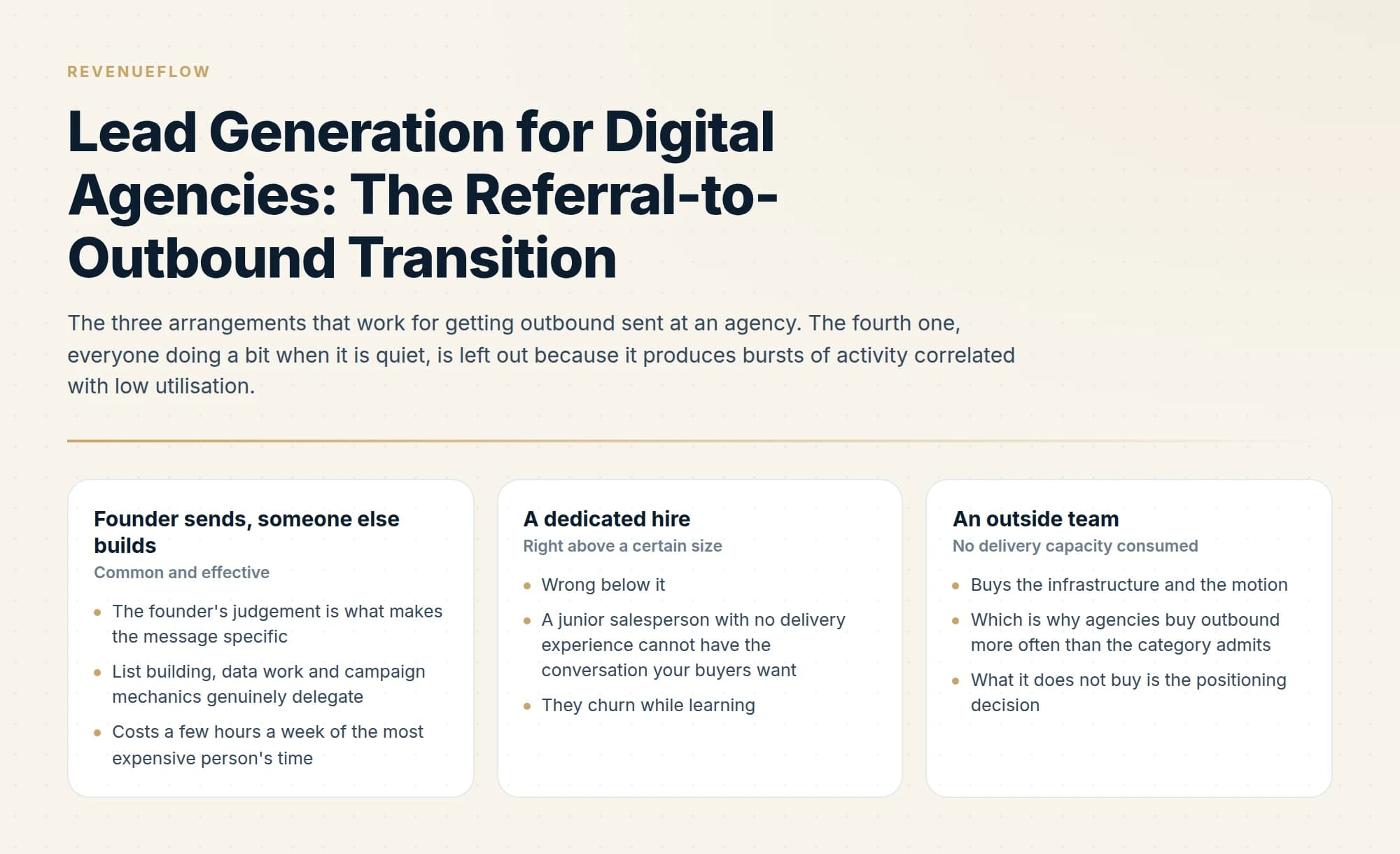
Three arrangements work and one does not.
The founder does the sending, someone else does the building. Common and effective, because the founder's judgement is what makes the message specific, and the list building, data work and campaign mechanics are the parts that genuinely delegate. Cost is a few hours a week of the most expensive person's time.
A dedicated hire. Right above a certain size, wrong below it, because a junior salesperson with no delivery experience cannot have the conversation your buyers want and will churn while learning.
An outside team. Buys the infrastructure and the motion without consuming delivery capacity, which is why agencies buy outbound more often than the category admits. What it does not buy is the positioning decision.
Everyone does a bit when it is quiet is the arrangement that does not work. It produces bursts of activity correlated with low utilisation, which is exactly the pattern that guarantees the lag lands at the wrong moment.
- The founder's judgement is what makes the message specific
- List building, data work and campaign mechanics genuinely delegate
- Costs a few hours a week of the most expensive person's time
- Wrong below it
- A junior salesperson with no delivery experience cannot have the conversation your buyers want
- They churn while learning
- Buys the infrastructure and the motion
- Which is why agencies buy outbound more often than the category admits
- What it does not buy is the positioning decision
What breaks in the first month
Four things, predictably.
The offer is too broad to say anything. Agencies describe themselves by discipline, and "we do paid social" supports no specific sentence. The fix is narrowing the segment until claims get concrete, which is a positioning change rather than a copy change.
For a web shop the narrowing can start from what a prospect's own site shows, which is the subject of outbound sales for web development companies.
Delivery interrupts sending. A big project lands, outbound pauses, and the pipeline gap reappears one lag-length later. Outbound only works as a constant, which is the strongest argument for making the sending itself somebody's actual job.
Replies go unanswered for days. The single most damaging failure, and the most common one at agencies, because replies arrive while everyone is delivering. A reply answered on day four is often a meeting lost. Decide who answers within hours before the first send.
Referral instincts get applied to cold prospects. A referral arrives pre-sold; a cold prospect does not, and running a referral-style conversation with a cold one reads as presumptuous. They are different sales motions and the second one needs a real discovery.
- Yes: One segment and one bounded service chosen
- Yes: Sending domains warmed and separate from your primary domain
- Yes: A named person answers replies within hours
- Yes: Existing clients, partners and live deals loaded as suppression
- No: Outbound is scheduled to pause when delivery gets busy
- Depends: Whether the founder or a hire does the sending
What to measure while it is too early to measure anything
Held meetings are the goal and they arrive too late to steer by in the first two months. Three leading numbers tell you whether it is working before then.
Contact coverage on your chosen segment. The share of target companies where you hold a verified contact for the right person. Low coverage caps everything and is knowable in week one.
Teams that are building this contact-coverage discipline will find HubSpot's fit versus engagement scoring guide useful for deciding which subscription tier actually supports qualifying those contacts.
Reply rate, split by segment. Not the blended figure. If one segment answers and two do not, that is a targeting finding available weeks before any meeting is held.
Time to first response. Yours, not theirs. This is entirely within your control and it is where agencies lose the most winnable meetings.
Judge the channel on the first two, and fix the third immediately whatever the others say.
Cold prospects buy differently, and price differently

The commercial conversation changes, and agencies are often surprised by how much.
A referred prospect arrives with trust transferred from someone they believe. They ask fewer proof questions, move faster, and accept your pricing more readily because a person they respect already validated it.
A cold prospect has none of that. Expect a longer cycle, more proof requests, more scrutiny of the commercial terms, and more comparison against other agencies. None of this means cold prospects are worse; it means the same close rate requires more of a process.
Two adjustments follow.
Have a smaller first step. A paid diagnostic, a scoped pilot, a bounded first project. Referred prospects will sign a retainer off a conversation; cold ones frequently will not, and offering only the large commitment loses deals that a smaller entry point would have won.
Do not discount to compensate for the missing trust. The instinct is to price lower because the prospect is less convinced. That solves the wrong problem and sets your rate for the relationship. Reduce scope instead, which keeps the rate and lowers the commitment.
Agencies reducing scope instead of price still need a way to justify the rate itself, which is the arithmetic covered in quantifying value with buyers.
Knowing whether it is working, and when to stop
Set the review point before starting, because the alternative is deciding during a discouraging week.
A fair first review is around three months from the first send, which is roughly when held meetings first accumulate enough to mean anything. Judge it on held meetings against the target you set at the start, and on cost per held meeting including the internal time.
Three outcomes and what each one indicates. Meetings arriving at acceptable cost means continue and scale volume. Replies arriving but not converting to meetings usually means the offer or the reply handling rather than the list. Very few replies, consistently, across more than one segment, usually means the targeting or the positioning, and more volume will not fix either.
Stopping is a legitimate outcome, and it is much easier to accept when the condition was written down in advance. What is not legitimate is stopping at week five because the pipeline is quiet, which is simply stopping before the lag has run.
Keeping referrals working while you build
The transition is additive, and the referral engine deserves the same deliberateness the new channel is getting.
Ask, at a defined moment in the delivery cycle rather than when you need work. Make the introduction easy by naming the specific kind of company you want rather than asking for anyone. And keep former clients in view: agency relationships end for reasons that expire, so a lapsed client whose champion has moved to a new company is the warmest outbound you will ever send.
That last group deserves its own campaign before any cold list, for the same reason it always does. It is the highest-converting audience you own, and it needs no new infrastructure.
For the message-level problem of selling marketing to marketing buyers, see lead generation for marketing agencies. For what buying the execution costs, B2B lead generation services and the lead generation agency cost guide cover the models.
The short version
Build outbound while referrals are still working, because the lag from decision to steady contribution is around three months and starting during a thin quarter means spending that quarter short. Choose one segment and one bounded service, get infrastructure warming early since it runs on its own clock, and decide before the first send who answers replies within hours. Measure coverage and reply rate by segment while meetings are still too sparse to judge, and run your lapsed clients before any cold list.
If you would rather add the channel without taking delivery capacity to do it, you can see what a campaign would look like for your market.
Frequently asked questions.
Frequently asked questions- How long does it take for agency outbound to work?
- Around three months from decision to steady contribution. Infrastructure warming takes weeks and cannot be compressed, first sends typically land around week six, and held meetings accumulate from weeks eight to twelve. That lag is the reason to build the channel while referrals are still sufficient.
- Who should do outbound at a small agency?
- Usually the founder sends while someone else builds the list and runs the mechanics, because the founder's judgement makes the message specific and the rest genuinely delegates. A junior hire without delivery experience struggles to have the conversation buyers want. What does not work is everyone doing a bit when it is quiet.
- Why do agencies struggle to move from referrals to outbound?
- Because the people who can sell are the people delivering the work. When utilisation is high there is no capacity for outbound, and when it drops there is capacity and urgency simultaneously, which is the worst moment to start something with a three-month lag.
- When should we conclude outbound is not working?
- Set the review point before starting, around three months from first send, and judge on held meetings against the target you set plus cost per held meeting including internal time. Very few replies across more than one segment usually indicates targeting or positioning, and more volume will not fix either.
About the author.

Ben Carden is CRO at RevenueFlow, which builds and operates outbound revenue engines for B2B companies. Previously at Gartner Enterprise. Studied at London School of Economics.
Ben Carden · CRO
Connect on LinkedIn →Explore more.
Ready to scale your outreach?
We build GTM engines that book real meetings. See the receipts.
Related articles.
Cross-Sell vs Upsell: Different Trigger, Different Owner
An upsell has a trigger that arrives on its own. A cross-sell has none and needs a diagnosis somebody funds. That is the difference that decides the work.
Sales Kickoff Meeting: The Decisions It Has to Leave With
A kickoff is the one moment a whole sales organisation can change at once. The four decisions it has to publish, and the week-six check that tests them.
Sales Call Planning: The Plan a Booked Call Needs
A call cannot produce a commitment nobody named in advance. The four fields a call plan carries, and why the ask has to be decided before the meeting opens.
Lifecycle Stage, Lead Status, Deal Stage: Three Fields
Lifecycle stage records position, lead status records activity, and deal stage lives on the deal. Merging them breaks funnel reporting in ways nobody notices for a year.
Time Decay Attribution: Setting the Half-Life
Time decay weights recent touches more heavily, and the half-life that controls how fast credit fades decides more than the choice of model does.
Position-Based Attribution: The U, the W and the Timestamp
U-shaped and W-shaped attribution are one model with a switch, and the switch is whether your CRM can be trusted to stamp lead creation.