Sales Kickoff Meeting: The Decisions It Has to Leave With
A kickoff is the one moment a whole sales organisation can change at once. The four decisions it has to publish, and the week-six check that tests them.

A sales kick off meeting, also written sales kickoff or SKO, is the event at the start of a selling year where the whole sales organisation gathers. It earns its cost by publishing four decisions: the number and the carve including what stays uncovered, what changed about the buyer, one observable behaviour change, and one thing the organisation stops doing.
Key takeaways
- Before booking anything, write the sentence describing what a seller does differently on the Monday after, and name the evidence that would show it happening.
- Announce one behaviour change, never four, because a seller under quota reverts to last quarter's habits the moment any of them becomes inconvenient.
- Half a day covers the four decisions if the material was circulated beforehand; the remaining expensive hours belong to recorded practice.
- Front-line managers need the material a week early, and the behaviour needs a named owner with checks at week two and week six.
Reviewed and updated September 18, 2026
A sales organisation flies to one city in January, sits through two days of keynotes, a product roadmap, an awards dinner and a breakout on a new methodology, and flies home. By the second week of February the pipeline review sounds exactly as it did in December. The event was well produced, the feedback scores were good, and nothing about how anybody sells is different.
That outcome is the normal one for a sales kick off meeting, and it is not caused by a weak agenda. It is caused by an event designed to transmit information and generate energy, in a format that is worse at transmitting information than a document and produces energy with a half-life of about ten days. A sales kickoff is expensive enough that it has to be judged on something else.
The useful frame is narrow. A sales kickoff meeting is the one moment in the year when an entire sales organisation can be made to change at the same time. That property is what the travel budget is buying, and a kickoff earns its cost only to the extent that it leaves with decisions the room could not have received in an email.
What is a sales kick off meeting?
A sales kick off meeting, also written sales kickoff and shortened to SKO, is the event at the start of a selling year where a company brings its whole sales organisation together to publish the year's target and territories, say what changed about the buyer, and practise the one change in how sellers are expected to sell. It runs for anything from an afternoon online to several days in one city.
Most definitions stop at the agenda: leadership keynotes, a product roadmap, training sessions, awards. That list describes what usually happens at one. It does not say what the meeting is for, and the gap between the two is why so many of them change nothing. The rest of this page works from the purpose backwards: what the event has to decide, how the hours divide, what belongs in a document, and what happens in the weeks on either side.
The test to apply before anything is booked
The sentence to produce first is the one describing what a seller does differently on the Monday after, together with the evidence that would show it happening.
If that sentence cannot be written, the event is a broadcast wearing a conference badge, and the honest version costs a fraction as much: a recorded update, a written plan and a set of one-to-one conversations. If it can be written, the agenda follows from it, and the material that usually fills the two days turns out to have nowhere to sit.
The test is unforgiving in a useful way. Motivation fails it, because no evidence distinguishes a motivated seller from an unmotivated one at week four. A product update fails it unless the update changes which accounts get worked or what the first conversation is about. Recognition fails it, and recognition is still worth doing, at dinner rather than in the hours that cost the most.
The four decisions a kickoff has to publish
A kickoff is a publication event more than a discussion one. The decisions below should arrive already made, because a room of two hundred people cannot make any of them, and pretending otherwise turns the agenda into a series of workshops that produce flip charts.
The number, and the carve underneath it
The organisation leaves knowing the target, how it divides, who owns which accounts, and what the organisation has deliberately decided not to cover this year.
That last clause is the one nearly always omitted. Every carve creates accounts inside somebody's boundary and accounts between two boundaries, and the second group is the one nobody works. A plan can show every account owned and zero abandoned while large parts of the market hear nothing all year, because assignment gets recorded as coverage and the two are different facts. The dimensions a carve is drawn along, and the seams each one produces, are set out in territory planning.
Saying out loud what is uncovered, and what motion is supposed to reach it, converts a silent failure into a plan. It is also the least comfortable slide in the deck, which is why it goes early rather than last.
What changed about the buyer, in the buyer's words
Not the product roadmap. What the people you sell to now care about that they did not care about a year ago, expressed in the vocabulary they use rather than the vocabulary of your category.
The material for this exists inside the company already and almost never gets assembled: closed-lost reasons, the questions that recurred in discovery, the objection that appeared late in the year and not early in it. A kickoff session built from that is the only part of the agenda where the room genuinely knows things the leadership team does not, and it is worth structuring to collect as well as to broadcast.
One behaviour change, with its evidence
One. A kickoff that announces four changes produces none, because a seller under quota reverts to what worked last quarter the moment any of them is inconvenient.
The change has to be observable in a named conversation. Something like asking about the current process before naming a product capability, in a first call, is a behaviour a stranger could confirm from a recording. Improving win rates is an outcome rather than a behaviour, and it gives the enablement function nothing to teach and nothing to check. The ordering that makes this work, and the constraint check that sometimes cancels the whole programme, are in the four enablement decisions.
What the organisation stops doing
A decision with no stopping condition is a preference. The kickoff is the cheapest available moment to retire a segment, a report, a stage, a piece of collateral or a motion, because everybody is in one place and the retirement can be announced rather than negotiated eleven times.
Teams that skip this line accumulate. The following January arrives with last year's initiatives still nominally live, and the new ones land on top of them.
Built from the calendar
The common shape
- Agenda assembled from who wants stage time
- Product roadmap occupies the most expensive hours
- A methodology is introduced and never checked again
- Success is measured by feedback scores
- Nothing is retired, so next year lands on top of this year
Built from the Monday
The shape that survives February
- Agenda assembled from four decisions and the practice they need
- Roadmap sent as a document and referenced, never presented
- One behaviour, with the recording it will be checked in
- Success is measured by whether the behaviour appears at week six
- One named thing stops, announced and not negotiated later
Sizing the agenda against the decisions
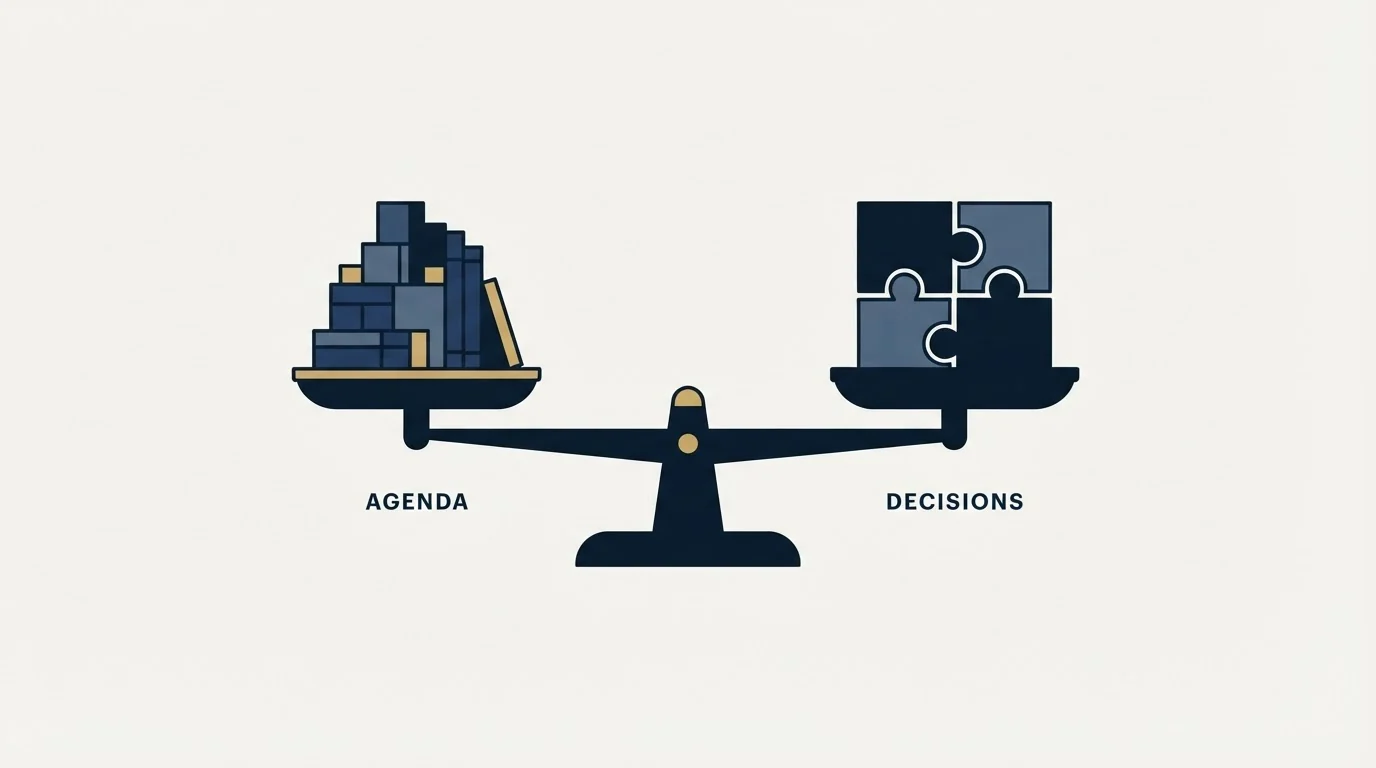
Once the four decisions exist, the hours allocate themselves, and the allocation is uncomfortable because it takes time away from the sessions that are easiest to produce.
The four decisions themselves need less room than anyone expects. Each is a short presentation of something already decided, with questions. Half a day covers all four if the material was circulated beforehand and the room is not being asked to read it live.
The practice takes the rest. Reading and watching produce recognition, and conversations require production, and the gap between the two is where kickoff content quietly dies. A seller who has watched a session on a new discovery question has not asked one. A seller who has asked it four times, badly, in front of a peer who pushed back, has.
That is what the expensive hours are for. Peer roleplay, recorded and reviewed, on the one behaviour that was named. It is the least popular item on any kickoff agenda and the only one that survives the flight home.
A sales kick off meeting agenda, as an illustration
The table below is an illustrative two-day agenda. It is one way to lay out the allocation this section argues for, and the blocks matter more than the clock times, which are left out on purpose.
| When | Block | What happens in it |
|---|---|---|
| Four weeks before | Reading | The four decisions circulated as a document, with the roadmap, the compensation mechanics and the pricing table |
| One week before | Manager briefing | Front-line managers get the material first and agree how they will check for the behaviour |
| Day one, first half | Publish | Four short presentations of decisions already made, with questions. The buyer session collects from the room as well as broadcasting |
| Day one, second half | Practice | Peer roleplay on the one named behaviour, recorded |
| Day one, dinner | Recognition | Awards, where they work better anyway |
| Day two | Practice and review | More recorded roleplay, reviewed with a peer who pushes back. Close on the owner and the dates of the week-two and week-six checks |
A subset session, relevant to one segment team, runs in parallel with practice or moves out of the event altogether. It never takes the whole room.
What the publishers who print their own running orders put in each slot, session by session, is set out in sales kickoff agendas.
What belongs in writing and never in the room
Three categories consume kickoff hours and lose nothing by being read instead.
Anything factual and stable: the roadmap, the compensation plan mechanics, the new pricing table, the tooling changes. People retain more from a document they can re-read than from a slide they saw once, and questions about facts are better answered in writing where the answer persists.
Anything that concerns a subset: a session relevant to one segment team, delivered to the whole organisation, spends everybody's most expensive hours on a minority's material.
Anything congratulatory beyond the awards themselves. Recognition matters and it belongs at dinner, where it works better anyway.
The rule that falls out of those three: if a session could be a document without losing anything, it should be, and the hours it frees belong to practice.
The thirty days after are the event

A kickoff is judged in the weeks around it rather than in the room, and the two edges are where the value is created or lost.
The manager briefing is the piece most often skipped and the piece most predictive of whether anything holds. A front-line manager who first encounters the new behaviour on stage alongside their team has no chance to reinforce something they are still evaluating. A manager briefed a week early, who has agreed how they will check for it, converts an announcement into a standard.
The other edge is the week-six check. Without a named owner and a date, the behaviour is evaluated at the next kickoff, by which point the honest answer is unknowable and the question is not asked.
Where a kickoff is the wrong instrument
Two conditions make the event unable to deliver, whatever the agenda does.
Where the constraint is the number of conversations rather than what happens inside them, no amount of skills work changes the year. The diagnostic is cheap: take five recent losses and ask what would have had to be different. Where most answers are that you never got in front of them, the problem sits upstream of every session on the agenda, and the budget belongs at the top of the funnel. The one-page version of that decision is a go-to-market strategy short enough to hold in your head.
Where the positioning is unresolved, a kickoff produces consistent delivery of a message nobody has validated, and the variation between sellers was the only signal anybody had that it was not landing.
Neither of those is a reason to skip the event. Both are reasons to change what it is for, because a kickoff that publishes a decision to fix the upstream problem is a better use of the room than a kickoff that trains around it.
The short version
A sales kickoff is worth its cost only as the moment a whole organisation changes together. Before booking anything, produce the sentence describing what a seller does differently on the Monday after, together with the evidence that would show it.
Publish four decisions rather than discussing them: the number and the carve including what stays uncovered, what changed about the buyer in the buyer's own words, one observable behaviour change with the conversation it lives in, and one thing the organisation stops doing.
Send the facts as documents, spend the expensive hours on recorded practice, brief the front-line managers a week early, and put a named owner and a week-six date on the behaviour check. The weekly meeting that carries the year afterwards is a different design problem, worked through in the sales meeting agenda template, and the new sellers who arrive after the event need the demonstration-based version covered in the sales onboarding process.
If the honest finding at the kickoff is that the year's number needs more conversations rather than better ones, see what a first campaign produces against your own segment, with the qualification criteria agreed in writing before anything sends.
Frequently asked questions.
Frequently asked questions- What is a sales kick off meeting?
- A sales kick off meeting, also written sales kickoff or SKO, is the event at the start of a selling year where a company brings its whole sales organisation together. Its job is to publish the target and territories, say what changed about the buyer, and practise one change in how sellers sell. It can be an afternoon online or several days in one city.
- What should a sales kick off meeting agenda contain?
- Four short presentations of decisions already made, then practice. The decisions are the number and the territory carve, what changed about the buyer in the buyer's vocabulary, one observable behaviour change with the conversation it lives in, and one thing the organisation stops doing. Half a day covers all four if the material was circulated beforehand.
- How do you measure whether a sales kickoff worked?
- By whether the single named behaviour appears in recorded conversations at week six, checked by front-line managers and not only by the enablement function. Feedback scores measure the event's production quality. Motivation cannot be distinguished from its absence a month later, which is why it fails as a success criterion however good the room felt.
- When is a sales kickoff the wrong investment?
- When the constraint is the number of conversations and not what happens inside them, or when the positioning itself is unresolved. Take five recent losses and ask what would have had to be different. If most answers are that you never got in front of them, no session on the agenda changes the year and the budget belongs upstream.
About the author.

Ben Carden is CRO at RevenueFlow, which builds and operates outbound revenue engines for B2B companies. Previously at Gartner Enterprise. Studied at London School of Economics.
Ben Carden · CRO
Connect on LinkedIn →Explore more.
Ready to scale your outreach?
We build GTM engines that book real meetings. See the receipts.
Related articles.
Sales Enablement: The Four Jobs Hiding Under One Name
Readiness, messaging, materials and process support are four different jobs with four different failure modes, usually resourced in reverse order of impact.
Monthly Sales Meeting Agenda: What the Month Decides
The weekly meeting triages deals in flight. The monthly one closes a period and changes the list. Six blocks, ninety minutes, one output each.
Sales Call Planning: The Plan a Booked Call Needs
A call cannot produce a commitment nobody named in advance. The four fields a call plan carries, and why the ask has to be decided before the meeting opens.
Value-Based Selling: The Arithmetic Step After the Diagnosis
Diagnosis establishes that a problem hurts. Value-based selling is the step that turns it into a figure the buyer's own finance function will defend for you.
Sales Commission: A Plan That Survives a Bad Quarter
The headline rate is the last decision, not the first. How to derive a commission plan from contract value and margin, and the clauses that decide a bad quarter.
Sales Crediting: Who Gets Paid on a Four-Person Deal
Crediting decides who is recorded as earning a sale, and it is a separate decision from the rate. Settle the rule before the quarter, not after the close.