Sales Enablement Strategy: The Four Decisions in Order
A strategy is four decisions made in order, not an inventory of assets. The behaviour, the constraint, one job per cycle, and the evidence chosen up front.

A sales enablement strategy is four decisions made in order: one observable behaviour in one named conversation, the constraint that decides whether enablement is the right purchase, one of the four enablement jobs for this cycle, and the evidence you will look at, fixed before anything is built.
Key takeaways
- Name one observable behaviour in one named conversation first: the test is whether a stranger could watch a recording and say without ambiguity whether it happened.
- Check the constraint before spending. Enablement improves conversations and creates none, so a thin calendar with respectable win rates is a coverage problem that no readiness work touches.
- Choose one of the four jobs per cycle. Materials wins by default because it produces visible artefacts, while process support changes behaviour at the moment of the behaviour.
- Fix the measure before the build, because a measure chosen after results arrive is a justification. Behavioural consistency, ramp spread and time to answer are all obtainable without new tooling.
Reviewed and updated September 2, 2026
A new enablement lead is given a quarter, a budget and a mandate to "build the strategy". Ninety days later there is a content audit, a new repository, a messaging document and a launch meeting. Nothing about the selling has changed, and the honest reason is that none of those four artefacts was a decision. They were inventory.
A sales enablement strategy is a small set of decisions, made in a specific order, that determine what the function will refuse to do. The artefacts come afterwards and are cheap once the decisions exist. Most strategies fail because the order runs backwards: the inventory gets built first, and the decisions get inferred from whatever the inventory turned out to contain.
This page is about that order. What enablement actually is, and the four distinct jobs bundled under the one name, is a separate question that our overview of the function covers on its own.
The decision that has to come first
Before anything else, name the change you expect in a seller's behaviour, and name the conversation where it happens.
That sounds like a planning platitude until you try to write it down for a real programme, because most enablement mandates cannot survive the exercise. "Improve win rates" names an outcome rather than a behaviour. "Roll out the new messaging" names an artefact. Something like "in a discovery call, sellers ask about the current process before naming a product capability" names a behaviour a person could be observed doing or not doing, and everything downstream becomes decidable: you know what to teach, you know what to look at to see whether it landed, and you know which requests to turn down.
The test is whether a stranger could watch a recorded call and tell you, without ambiguity, whether the behaviour happened. If they could not, the strategy has no evidence attached to it and will be evaluated on volume of output instead.
- Step 1Name the behaviour
One observable change, in one named conversation, that a stranger could confirm from a recording
- Step 2Name the constraint
Whether the shortage is conversation quality, conversation volume, or an unresolved position
- Step 3Pick one of the four jobs
Readiness, messaging, materials or process support. One per cycle, not four
- Step 4Fix the evidence and the retirement rule
What you will look at, when, and what gets deleted if it does not move
The constraint check, which is where most programmes should stop
The second decision is whether enablement is the right purchase at all, and it is the one most likely to be skipped because it is the one that can cancel the project.
Enablement improves what happens inside conversations. It creates none of them. A team whose sellers are having good conversations and too few of them has a coverage problem, and every hour spent on messaging consistency is an hour not spent on the thing that is actually short. The symptom is easy to read: if the calendar is thin and the win rate on the meetings that do happen is respectable, the constraint sits upstream of anything enablement can reach.
The second failure is subtler and more expensive. Where the positioning itself is unresolved, an enablement programme produces consistent delivery of a message nobody has validated. Consistency then hides the problem rather than exposing it, because the variation between sellers was the only signal anybody had that the message was not landing.
There is a cheap diagnostic for both. Take five recent losses and ask what would have had to be different. If the answers are mostly "we never got in front of them" the constraint is volume. If they are mostly "they did not believe the premise" the constraint is positioning. Only when the answers are mostly "we handled it badly, and differently each time" is enablement the instrument that fits.
Losses that trace to the buyer's own engineers point somewhere else entirely, and who owns the technical case names the decisions that need an owner in writing.
Choose one job per cycle

The function covers readiness, messaging, materials and process support. A strategy that promises all four in one cycle is a budget request rather than a plan, and it reliably delivers the one that produces the most visible artefacts.
Widening those same four jobs to every customer-facing role is what the revenue enablement scope claim asserts, and it holds only when the authority widens with it.
Materials is the job that absorbs effort fastest and moves outcomes least, which is why it wins by default. It produces things that can be shown in a review. Process support does the opposite: changing a stage definition, an evidence requirement or a handover standard is unglamorous, requires arguing with whoever owns the CRM, and changes behaviour at the moment of the behaviour rather than in a room three months earlier. The criteria that decide when a stage advances are where that work lives.
- Starts with an audit of what exists
- Scope is set by the request queue
- Reports completions, downloads and asset counts
- Ends the cycle with more material and the same behaviour
- Nothing is ever retired, so search across the library degrades
- Starts with one named behaviour in one named conversation
- Scope is set by the constraint, and most requests are declined
- Reports whether the behaviour appears in recorded calls
- Ends the cycle with a smaller library and a changed conversation
- Retirement is scheduled, so what remains is findable
Fix the evidence before you build, not after
The third decision is what you will look at, and it has to be settled while it is still possible to choose an inconvenient measure.
Enablement sits upstream of every result it wants credit for, mediated by pipeline quality, the market, and how much a manager reinforced anything. No attribution model separates those cleanly, and the response to that difficulty is usually to report the things that are easy to count. Course completions and content downloads are measurements of activity. They move whether or not the programme worked.
Three proxies are more honest and all three are obtainable without new tooling.
Behavioural consistency is the primary one: does the named behaviour appear in recorded conversations, in what share of them, before and after. This is the only measure that separates a programme that landed from one that was merely delivered. Ramp spread is the second: the gap between the fastest and slowest new seller reaching a defined competence bar, rather than the average, because the average is dominated by hiring. Time to answer is the third: how long it takes a seller to get a reliable answer to a buyer question they cannot answer themselves, which is the fastest read on whether the materials half is working and is almost never instrumented.
Ramp spread, adherence and the other behavioural measures sit inside a larger map of three classes of enablement metrics, separating mere activity from genuine attribution.
Pick one before the build starts. A measure chosen after the results are in is a justification.
What a sales enablement charter commits the function to, and which published template can actually be inspected, is set out in sales enablement charters.
The retirement rule is part of the strategy

Nothing in an enablement library announces when it stops being true. Material gets commissioned against a felt gap, published, and then kept forever, so the library grows, retrieval degrades, and sellers quietly go back to rebuilding answers from memory. That is the exact outcome the library was built to prevent, and it arrives through accumulation rather than through any single bad decision.
Two rules handle it, and neither needs a platform. Put a named owner and a date on every asset so a reader can tell whether they are looking at something current. Then retire on a schedule: anything unopened for two quarters is either obsolete or undiscoverable, and both cases want the same action.
A strategy document that does not say what gets deleted is a plan for growth in volume only.
- Yes: One observable behaviour, in one named conversation
- Yes: The constraint, stated: quality, volume, or unresolved positioning
- Yes: One of the four jobs, chosen for this cycle
- Yes: The evidence you will look at, chosen before the build
- Yes: A retirement rule with a date on it
- No: An inventory of existing assets as the starting point
- No: A tooling decision made before the behaviour is named
Where practice belongs in the sequence
Reading and watching produce recognition. Conversations require production, and the gap between the two is where most programmes quietly fail. The mechanism that closes it is practice with feedback, which historically meant peer roleplay and a manager's calendar, both of which are cut first in a busy quarter and precisely when a new message is being rolled out.
Simulation tooling addresses that scheduling problem, and the evaluation question stays the same whatever the vendor claims: does the practice resemble the conversation the seller will actually have, and does somebody read the output and act on it. Before any of it is bought, it is worth being clear about which purchase is being made at all, because training and coaching are two different things sold under one heading and the decay problem only one of them addresses.
The clearest case is the material that is already written down and never rehearsed aloud. Objection responses are published as documents more often than any other messaging artefact, and an objection library is usually worth auditing rather than extending.
For outbound specifically, the order of the curriculum matters differently again, and training in the order that protects the list matters more than coverage of the curriculum.
Where we differ from standard practice
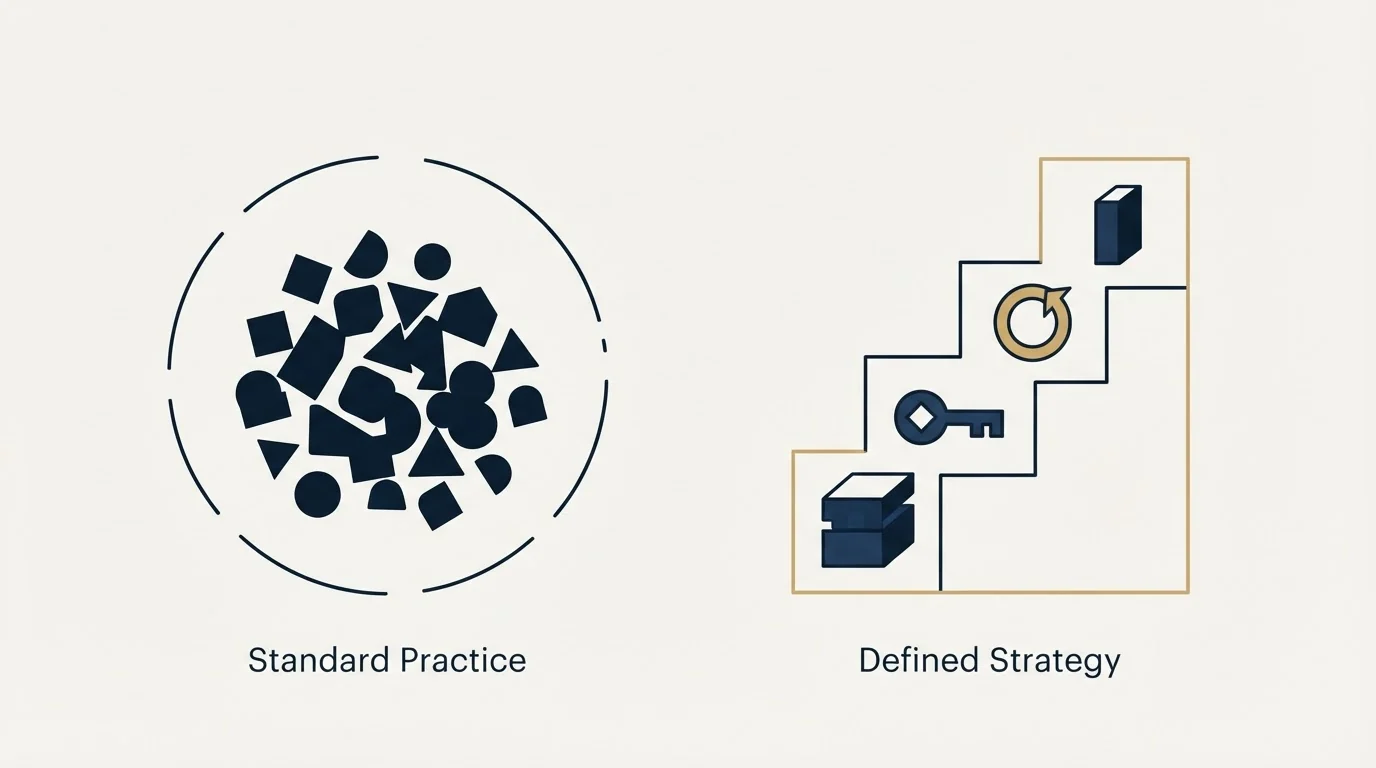
Most enablement material about prospecting assumes a multi-step cadence: several touches per prospect over some number of weeks, later messages landing in the same thread, and a certification exercise built around writing that sequence. Our documented policy is one message per campaign, with no bumps and no thread replies, and where an audience does not answer, the next approach is a separate campaign built on a genuinely different premise rather than a reminder. The reasoning is mechanical rather than stylistic: a repeat message is delivered to the population that already saw the first one and chose not to reply, which is the population most likely to complain, and that cost lands on the sending domain across every campaign running on it.
The practical consequence for a strategy document is that any prospecting-behaviour objective has to be about the single message and the targeting behind it. The other standard we hold to is that meetings are qualified against criteria agreed in writing before launch, which is a definition written before anyone can read a result off it. The full argument, including what the position costs us, is set out in why we stopped using follow-ups.
The short version
A sales enablement strategy is four decisions: one observable behaviour in one named conversation, the constraint that decides whether enablement is the right purchase at all, one of the four jobs for this cycle, and the evidence you will look at, chosen before anything is built.
Check the constraint honestly. If the shortage is conversations rather than their quality, no amount of readiness work changes it, and the money is better spent upstream. If the positioning is unresolved, consistency will hide the problem rather than solve it.
Then write the retirement rule down, because a library that only grows becomes unusable on a schedule of its own. If the constraint turns out to be the number of qualified conversations rather than what happens inside them, that is the half we run: see what a first campaign produces.
Frequently asked questions.
Frequently asked questions- What should a sales enablement strategy actually contain?
- One observable behaviour in one named conversation, the constraint the team is genuinely under, one of the four enablement jobs chosen for this cycle, the evidence you will look at, and a retirement rule with a date on it. That fits on a page. An audit of existing assets is a starting inventory rather than a strategy.
- How do I know whether enablement is the wrong investment?
- Take five recent losses and ask what would have had to be different. If the answers are mostly that you never got in front of them, the constraint is conversation volume. If they are that nobody believed the premise, the constraint is positioning. Enablement fits when the answers are that you handled it badly, and differently each time.
- How should a sales enablement strategy be measured?
- Behavioural consistency is the primary measure: does the named behaviour appear in recorded conversations, and in what share of them. Ramp spread between fastest and slowest new sellers is second, and time to answer a buyer question is third. Completions and downloads move whether or not the programme worked, so they settle nothing.
- Does this apply to prospecting enablement too?
- Partly. Most prospecting enablement material assumes a multi-touch cadence with later messages in the same thread. RevenueFlow policy is one message per campaign, no bumps and no thread replies, so any prospecting objective has to be about the single message and the targeting behind it rather than about sequence discipline.
About the author.

B2B cold email experts helping companies generate qualified leads through done-for-you outreach campaigns.
RevenueFlow Team
Explore more.
Ready to scale your outreach?
We build GTM engines that book real meetings. See the receipts.
Related articles.
Sales Kickoff Agendas: Five Published, Session by Session
Five publishers print a sales kickoff agenda. They agree on four blocks and disagree on session length, rehearsal and where the agenda comes from.
Sales Enablement Charters: What the Published Ones Ask For
Six publishers set out what a sales enablement charter should contain. Five describe a document nobody can check, and one writes a definition with inspection in it.
Objection Handling Frameworks: LAER, AAA and Others Compared
The named objection-handling frameworks with their publishers quoted: Carew's LAER, RAIN Group's four steps, HubSpot's five, Gong's three and both AAAs.
Command of the Sale: Force Management's Process Programme
Command of the Sale is Force Management's sales process and qualification programme, not its messaging one. What the vendor says it is, delivers and how it runs.
B2B Lead Lists for Aviation Companies: Build or Buy
Aviation is one of the few industries whose accounts are published by its regulator, which changes what is worth buying and what is worth downloading yourself.
Cold Calling for Food and Beverage Companies: Three Doors
Cold calling for a food or beverage company: who picks up at a chain, a distributor and an independent grocer, where each publishes its door, and when the phone is wrong.