Revenue Enablement: The Scope Claim Under the Name
Revenue enablement equips every customer-facing team, not only sellers, with the knowledge, content and process support they need at the moment they need it. It re-scopes the enablement function from a seller to a customer journey that runs past the signature into onboarding, renewal and expansion.
Key takeaways
- Revenue enablement is a scope claim rather than a new method: the four enablement jobs stay the same and the audience widens to every customer-facing role.
- It exists because a buyer who hears a different version of the story from five teams learns that the company does not agree with itself, and four of those five voices sit outside a sales-enablement remit.
- The rename is only real when the authority widens with the scope, because a function that can convene teams it cannot direct produces recommendations rather than change.
- Measure it with message consistency, handover completeness, ramp consistency by role and time to a reliable answer, never with a revenue figure the function cannot win an attribution argument over.
Revenue enablement is the discipline of equipping every customer-facing team, not only sellers, with the knowledge, content and process support they need at the moment they need it. It takes the enablement function that was built around a sales rep and re-scopes it around a revenue outcome that marketing, sales development, customer success and account management all contribute to.
That is a scope claim rather than a new method, and the scope claim is the whole argument. Nothing in the toolkit changes. What changes is who the function is accountable to, which teams it is allowed to touch, and which number it gets judged on.
What the term is actually asserting
Read the category's own definitions side by side and the same three moves appear every time.
The unit moves from a person to a journey. Sales enablement asks whether this seller can have a useful conversation. Revenue enablement asks whether the buyer gets a coherent experience from the first advert to the second renewal, which is a question no single seller can answer.
The scope moves past the close. A sales-enablement remit ends at signature. A revenue-enablement remit carries on into onboarding, adoption, renewal and expansion, on the argument that the revenue that matters most in a subscription business is the revenue that arrives after the first invoice. Whether that argument holds for you is a function of how much of your revenue is retention and expansion rather than new logos, which net revenue retention is the number that answers.
The accountability moves from activity to outcome. The classic enablement metrics are completions, downloads and certifications. The revenue framing rejects those in favour of things further downstream, which is honest about the intent and creates an attribution problem the function then has to live with.
- Audience is the sales team
- Ends at the signature
- Measured by ramp, consistency and time to answer
- Owns onboarding, messaging, materials and process support
- Fails as a content library nobody opens
- Audience is every customer-facing role
- Continues through onboarding, renewal and expansion
- Measured by retention, expansion and cross-team consistency
- Owns the same four jobs across more teams
- Fails as a coordination layer with no authority
Why it matters, and what it is a response to
The reason the term exists is a specific and observable failure, and naming that failure is more useful than the definition.
A buyer hears one story in an advert, a second from a development rep, a third from an account executive, a fourth from an implementation consultant and a fifth from whoever handles the renewal. Each version is defensible on its own. Together they teach the buyer that the company does not agree with itself, and the cost lands in two places nobody attributes to messaging: a longer evaluation while the buyer works out which version to believe, and a renewal conversation that opens with a promise the seller made and nobody downstream knew about.
Sales enablement cannot fix that, because four of the five voices sit outside its remit. That is the structural case for the wider scope, and it is a real one.
Two failure modes follow from the same widening.
Authority does not widen with the scope. An enablement function that reported to a sales leader and now supports marketing and customer success usually still reports to the sales leader. It can convene the other teams and it cannot direct them, so its output becomes a set of recommendations, and recommendations decay quietly. This is the version of GTM misalignment that hides inside a function rather than between two of them.
The remit stops being falsifiable. A function accountable for revenue is accountable for something every other function is also accountable for, which means no result attaches to it cleanly in either direction. A good quarter has four owners and a bad one has none.
How it is measured without pretending
Enablement of any kind is mediated by other people, so a direct attribution claim is not available and asserting one is what makes the function look decorative. The wider scope makes that worse, not better, because there are now more intermediaries between the work and the number.
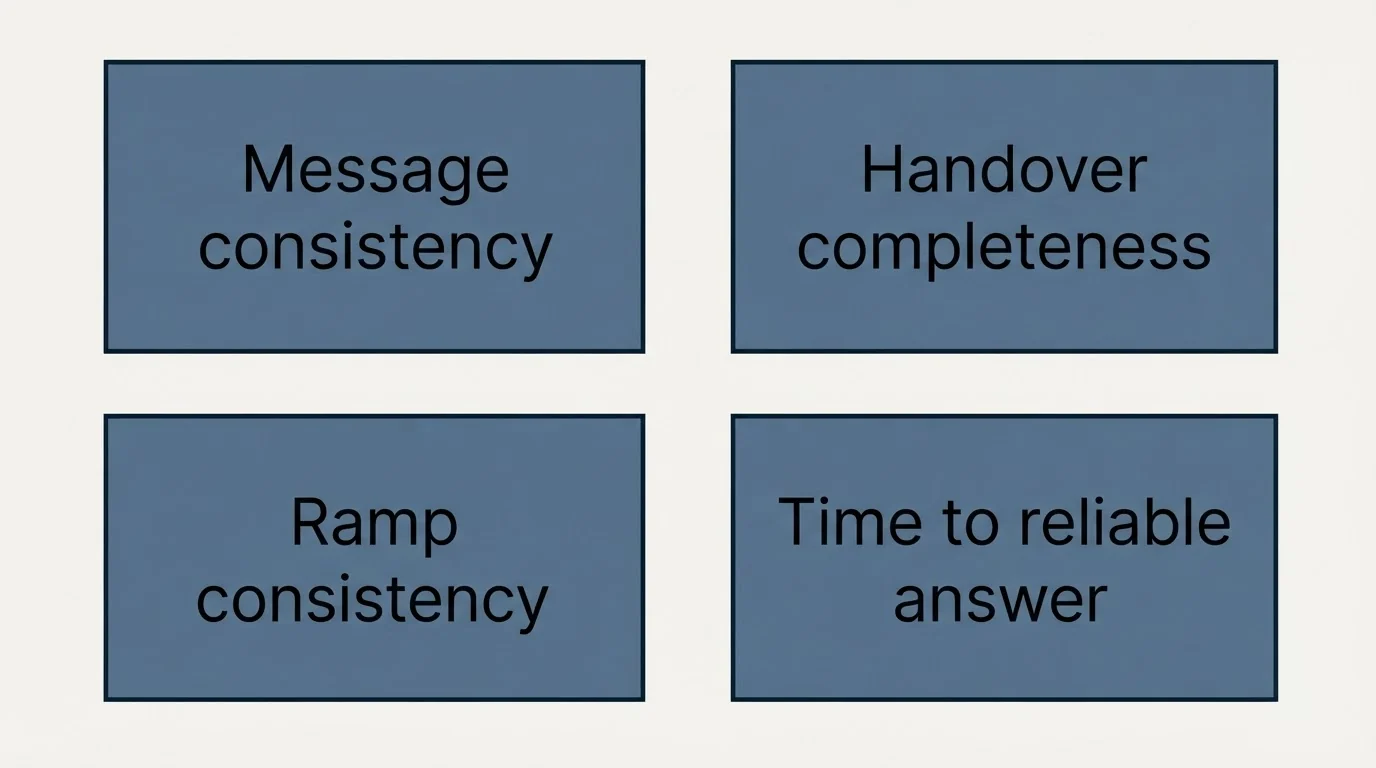
Four measures survive contact with that, and none of them is a revenue figure.
Message consistency across recorded touchpoints. The proportion of recorded calls, sent sequences and published material that describe the problem the same way. This is the only measurement that tests the thing revenue enablement was invented to fix, and it is checkable by hand on a sample of twenty.
Handover completeness. The share of accounts where the receiving team got what it needed without asking the buyer to repeat a conversation. Every seam in the journey has one of these, and they are the seams the function exists to hold.
Ramp consistency, not average ramp. The spread between the fastest and slowest new starter reaching a defined competence bar, in every role the function now covers rather than only in sales. The average is dominated by hiring, and ramp time is the entry the same argument lives in.
Time to a reliable answer. How long anybody in a customer-facing seat takes to get a defensible answer to a question they cannot answer themselves. This tracks the materials half directly and it is almost never instrumented.
- Yes: A meaningful share of revenue is renewal and expansion rather than new logos
- Yes: Buyers meet three or more of your teams before they sign
- Yes: Handovers between teams have a written standard somebody checks
- Yes: The function reports somewhere that can direct all the teams it supports
- Depends: Somebody outside sales has agreed to be enabled
- No: The constraint is that too few qualified conversations start at all
- No: The rename is a way of postponing a decision about positioning
The fifth item is the one that decides whether the rename is real. A remit widened on a slide and not in anybody's objectives is a sales-enablement team with a longer title, and it will spend a year discovering that.
How it is used in outbound

An outbound programme sits at the front of the journey the wider scope is trying to make coherent, and it is the point where the incoherence is cheapest to fix and most often ignored.
Three things a revenue-enablement remit actually owes an outbound team, none of which a seller-facing programme supplies.
The premise, agreed with the people downstream of it. A cold message makes a claim about a situation, and somebody in customer success will eventually be asked to deliver against it. Where the premise is written by a campaign owner who never speaks to the delivery team, the claims drift toward whatever gets replies, and the cost surfaces two quarters later as a renewal conversation about an expectation nobody set deliberately.
One vocabulary for what a qualified conversation is. The definition of an acceptable meeting has to be agreed in writing before anything sends, by the people sourcing meetings and the people taking them. Written afterwards it is a negotiation held with results already on the table. That boundary is the same one B2B appointment setting argues for, and it is the single artefact that stops the front of the journey and the middle of it from reporting different numbers.
The reason each account is on the list, travelling with the record. The trigger that qualified an account is enablement material for the person writing the message and for the person who eventually onboards them. When it stops at the list builder, the message reverts to the generic version and the account arrives at implementation with no history attached.
Our own practice narrows what the front of that journey looks like. We run one message per campaign, with no bumps and no thread replies. The trade is set out in full in why we stopped using follow-ups. For an enablement function the consequence is specific: with a single message there is no later touch to rescue a weak premise, so the premise and the list carry the entire result, and the enablement artefact that matters is the one that checks the premise is true of every row before anything sends.
Where the term misleads
It is read as a bigger budget rather than a different accountability. The rename usually arrives with the same headcount pointed at more teams, which lowers the depth available to each of them. A function that supported one team well and now supports four thinly has made itself worse and reported it as growth.
It is confused with revenue operations. Operations owns the systems, the data and the process definitions. Enablement owns whether people can do the job the process describes. The two are adjacent and the confusion is understandable, and a company that merges them usually ends up with an operations team, because systems work has deadlines and enablement work does not.
It is adopted where the constraint is upstream. A company with excellent cross-team consistency and an empty calendar has an excellent version of a problem it does not have. The pre-conversation part of the motion, which decides whether a conversation happens at all, is a separate remit and is covered in go-to-market enablement.
The four jobs do not change, so neither does the failure mode. Readiness, messaging, materials and process support are still the work, they are still resourced in reverse order of impact, and the library still grows until nobody can find anything in it. Sales enablement sets out those four jobs and how each one fails, and widening the audience does not repair any of them.
The short version
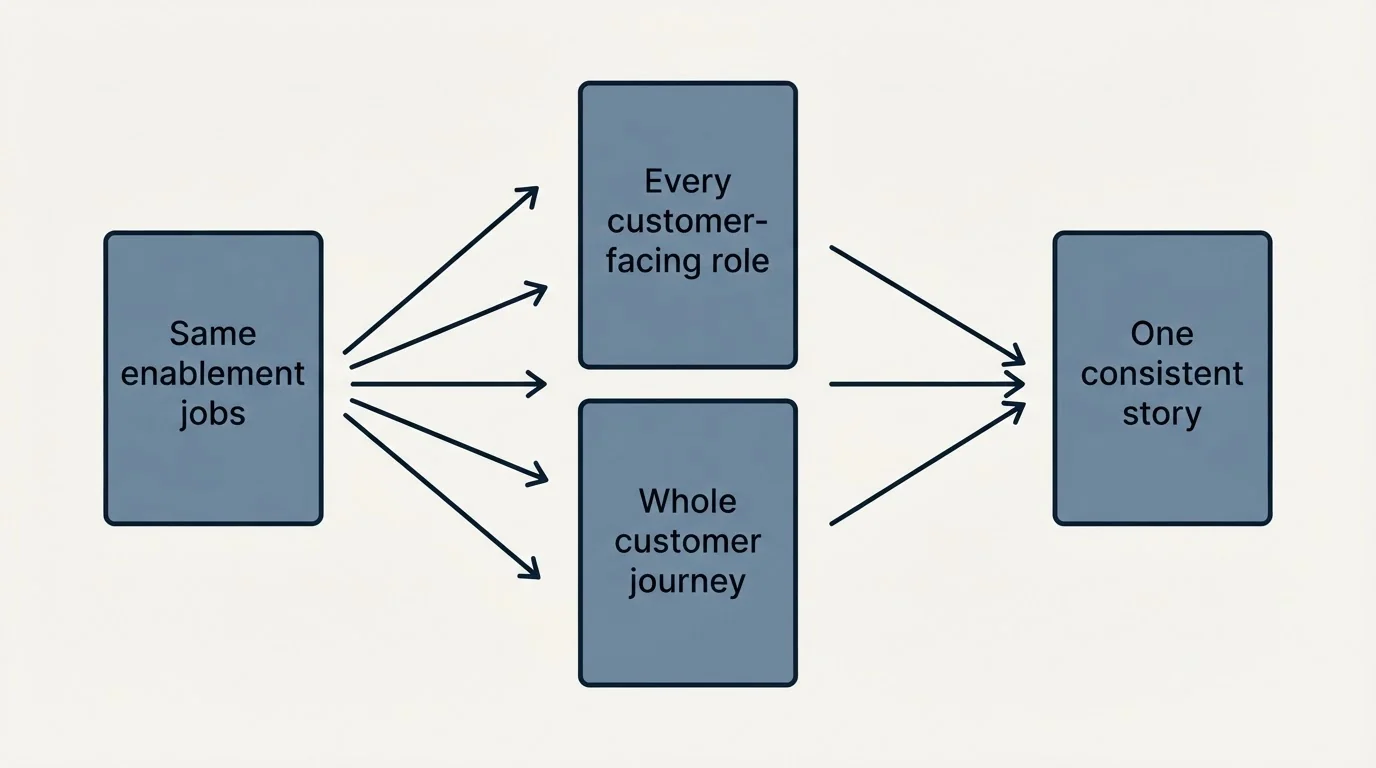
Revenue enablement is a scope claim: the same four enablement jobs, pointed at every customer-facing role and at the whole customer journey rather than at the seller and the deal. It exists because a buyer who hears five versions of one story learns that the company does not agree with itself, and four of those five voices sit outside a sales-enablement remit.
The claim is only real if the authority widens with the scope and somebody outside sales has agreed to be enabled. Measure it with message consistency across recorded touchpoints, handover completeness, ramp consistency by role and time to a reliable answer, and stay out of revenue attribution, which the function cannot win.
Check the constraint before the rename. If the shortage is qualified conversations rather than their coherence, that is the other half of the problem, and we will build one campaign against your list so you can read the replies.
The neighbouring definitions are demand generation, which creates the interest this journey harvests, outbound sales, which starts the conversations it makes coherent, and quota attainment, which is the seller-level number a wider remit is deliberately no longer judged on. The measurement argument in more depth is in separating what happened from what changed.
Frequently asked questions.
Frequently asked questions- What is the difference between revenue enablement and sales enablement?
- Sales enablement is scoped to the seller and ends at the signature. Revenue enablement points the same four jobs, readiness, messaging, materials and process support, at every customer-facing role and carries them through onboarding, renewal and expansion. The toolkit does not change. What changes is who the function serves, which teams it may touch, and which number it is judged on.
- Is revenue enablement the same as revenue operations?
- No, and merging them usually produces an operations team. Operations owns the systems, the data and the process definitions. Enablement owns whether people can actually do the job the process describes. The two are adjacent enough to be confused, and systems work has deadlines while enablement work does not, so the enablement half is the half that quietly disappears.
- How do you measure revenue enablement?
- Not with a revenue figure, because every other function is accountable for that one too. Four measures survive: message consistency across a sample of recorded touchpoints, the share of handovers where the receiving team got what it needed without asking the buyer to repeat themselves, ramp consistency by role, and how long anybody takes to get a defensible answer to a buyer question.
- When is revenue enablement the wrong investment?
- When the constraint sits upstream of every conversation. A company with excellent cross-team consistency and an empty calendar has an excellent version of a problem it does not have, and no amount of coherence work changes how many qualified conversations start. The pre-conversation half of the motion is a separate remit with its own artefacts and its own owner.