GTM Misalignment: The Four Disagreements Underneath It
Misalignment is diagnosed as a relationship problem and treated with meetings. It is a definitions and measurement problem, and there are four of them.
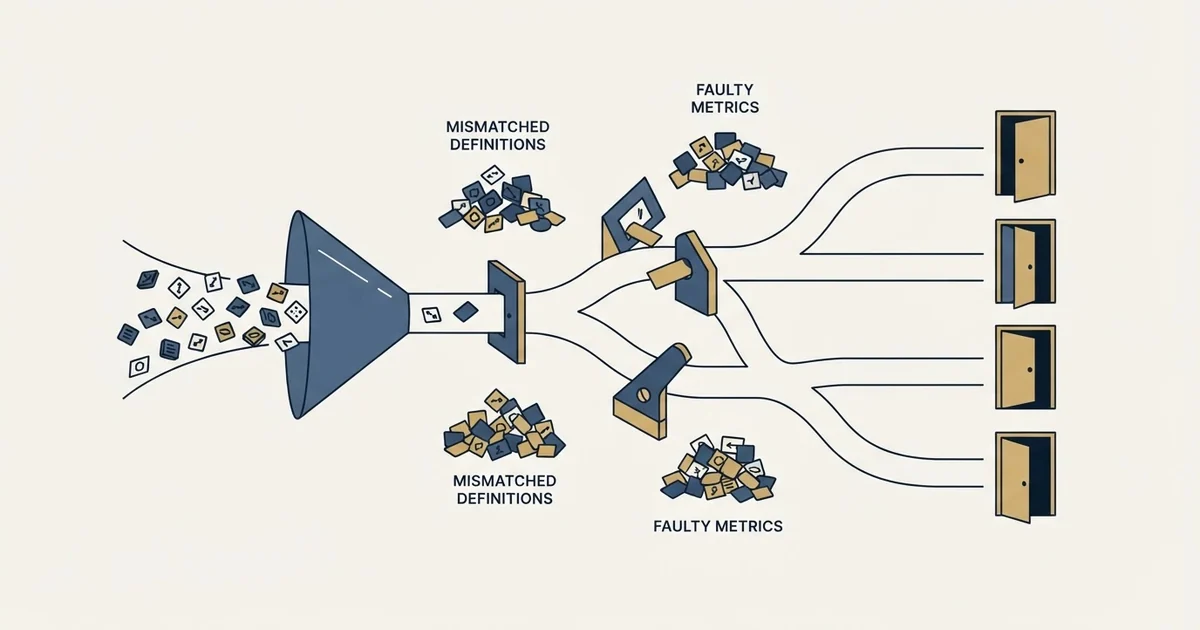
Go-to-market misalignment is the condition where two revenue functions are each correct about their own numbers and still cannot agree on what happened. It comes from four things: one word covering two stage definitions, rates computed over different populations, sourced and influenced attribution reported as one figure, and a campaign calendar planned separately from capacity.
Key takeaways
- The reliable test for misalignment is that the disagreement survives goodwill, which means the cause is in the definitions rather than in the relationship.
- Every rate reported by either function needs the population it was measured over printed beside it, or the two functions are comparing numbers that were never comparable.
- Sourced and influenced pipeline are different claims, and reporting one where the other was asked for is the most common cause of a credit argument.
- Fix in order: agree the criteria, print the denominators, split the attribution claims, plan calendar and capacity together, then name an owner per handoff.
Reviewed and updated August 28, 2026
A quarterly review opens with marketing reporting a strong quarter on leads delivered and sales reporting a weak one on qualified opportunities created. Both numbers came out of the same CRM. Nobody has misread a report, and nobody is lying. The two functions counted different objects over different populations and neither slide says so, which is why the next forty minutes go to arguing about lead quality instead of about the market.
That meeting is what go-to-market misalignment looks like from the inside, and the usual diagnosis is the wrong one. It gets treated as a relationship problem, so the remedy is a standing joint meeting, a shared Slack channel and a workshop. Those change the temperature of the argument without touching the thing generating it, which is that the functions are measured on quantities that were never made comparable.
What misalignment actually is
Marketing and sales misalignment on lead generation execution is almost always one of these four disagreements wearing a relationship costume, and naming which one is what turns an unproductive standing meeting into a decision somebody can make.
Misalignment is the condition where two revenue functions can each be correct about their own numbers and still cannot agree on what happened. It is a property of the definitions and the measurement, not of the people, and the tell is that the disagreement survives goodwill. Put the two most cooperative people in the company in a room with those two slides and the argument still happens, because the slides describe different things.
The consequence of the wrong diagnosis is that the remedy is always social. More communication, better relationships, a shared offsite. All of it is pleasant and none of it survives the next quarter, because in the following review the same two numbers appear and mean the same different things.
Sales and marketing alignment is the name most teams give to the fix, and the four disagreements below are what it has to resolve: one word covering two stage definitions, rates computed over different populations, sourced and influenced reported as a single number, and a campaign calendar planned apart from the capacity to work it.
There are four disagreements underneath almost every version of this, and they are worth separating because the fix for each is different and only one of them is about talking to each other more.
- Depends: Both functions can state the qualification criteria and produce the same answer on a sample of ten accounts
- Depends: Every rate reported by either function has its population printed next to it
- Depends: Sourced and influenced are defined separately and reported separately
- Depends: The campaign calendar and the capacity to work what it produces were planned in the same conversation
- Depends: One named person on each side owns each handoff, and the escalation path is written down
- Depends: There is a scheduled date on which the definitions get revised rather than defended
Disagreement one: the stage definition
The most common version is that the two functions are using one word for two objects. Marketing's qualified lead is a scoring threshold applied to behaviour. Sales's qualified opportunity is a judgement made after a conversation. Both are legitimate and they are not the same event, so a handoff between them loses a large fraction of the volume by construction rather than by failure.
The failure mode is not the gap itself. The gap is expected and healthy. The failure is that neither side has written the criteria down in a form the other can apply, so the rejection is experienced as an opinion. A rep rejecting a lead without a reason code produces no information at all, and marketing tunes the scoring model against nothing. The MQL and SQL boundary is where this gets settled, and settling it needs both a written criteria list and a rejection loop that feeds back into it.
A test that costs an hour: take ten accounts nobody has looked at, have both functions score them independently against the current criteria, and compare. Where the two lists disagree by more than one or two accounts, the criteria are a preference rather than a definition, and every downstream number inherits that. Most of the disagreement resolves once fit and readiness are separated, which is the distinction lead qualification turns on and the one a single scoring threshold cannot express.
Disagreement two: the denominator
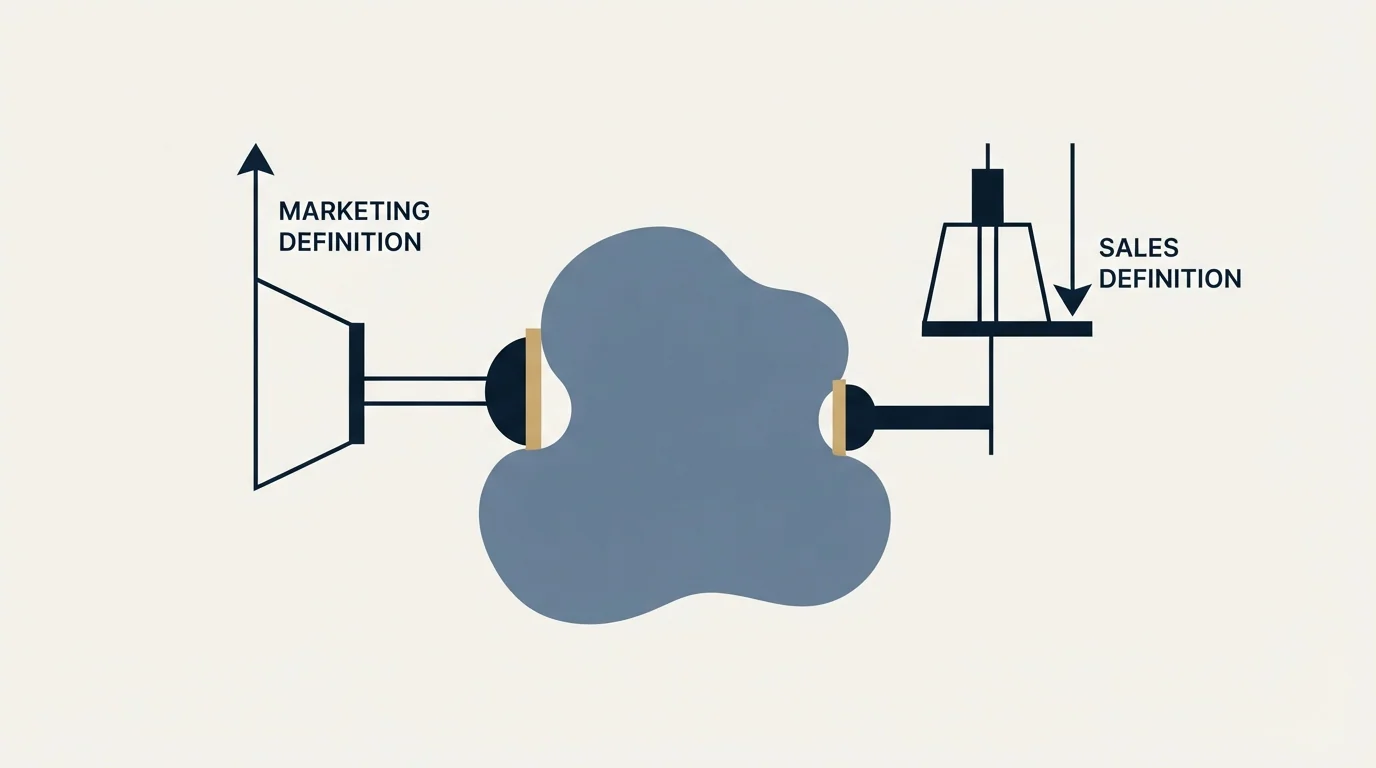
The second version is arithmetic and it is invisible on a slide. Marketing reports a conversion rate over the leads it delivered. Sales reports a conversion rate over the accounts it chose to work. Those are different populations, so the two rates are not comparable, and comparing them anyway is how a quarter produces two irreconcilable readings of the same pipeline.
This is the least discussed of the four and the cheapest to fix. Every reported rate carries the population it was measured over, printed beside it, or it is not a rate anybody can act on. Our own write-up of sales operations key performance indicators makes the denominator a filtering test rather than a formatting preference, and the reason is exactly this: a rate whose population is unstated can be moved by changing the population, and it usually is, without anybody intending to.
Watch for the shape where a function improves a rate by narrowing what goes into it. Nobody is cheating. The filtered set genuinely does convert better. The number just stopped describing the thing the other function is being asked about.
Disagreement three: sourced against influenced
The third is attribution, and it is the one that turns into a credit fight because it is usually run as one. Marketing wants recognition for the deals it touched. Sales wants recognition for the deals it created. Both claims are defensible and the systems answer them badly, because most attribution models were built to allocate credit rather than to describe a motion.
The useful separation is that sourced and influenced are different claims about different things, and reporting only one of them guarantees the argument. A sourced number says where an opportunity originated. An influenced number says which programmes appeared anywhere in its history. Publishing the second while calling it the first is what leaves a marketing team defending a claim on pipeline that a sales team does not recognise.
- The opportunity would not exist without this first action
- One owner per opportunity, by construction
- Answers: which motions create pipeline
- Understates programmes that never start a deal but reliably progress one
- A qualifying interaction occurred somewhere in the account's history
- Many programmes can qualify for one opportunity
- Answers: what is present in deals that progress
- Inflates without limit unless the qualifying touch and the window are defined
- An influenced figure presented where a sourced figure was asked for
- Produces a number nobody can reconcile with the pipeline they work
- Answers: nothing, at the cost of trust in the rest of the dashboard
- The single most common cause of a credit argument
Disagreement four: timing and capacity
The fourth is operational and it is the one nobody writes down. A campaign lands in week two of a quarter. The team that has to work what it produces committed its capacity in week one to a different set of accounts. Neither decision was wrong in isolation and together they waste both.
This is where an alignment problem genuinely does look like a communication problem, and it still is not one, because the missing artefact is a shared plan rather than a shared conversation. The campaign calendar and the coverage capacity belong in the same document, produced at the same time, with the volume each campaign is expected to generate stated next to the number of accounts the team can actually work that month. A go-to-market strategy short enough to hold in your head helps here for a mechanical reason: a plan nobody can recall under pressure cannot be the thing two functions are sequencing against.
The symptom to watch for is a delivered lead ageing before first contact. It shows up on nobody's dashboard because both functions did their jobs, and the value evaporates in the space between them.
Why the meeting does not fix it

Every one of those four is a missing artefact. A criteria document. A denominator printed beside a rate. A separated pair of attribution numbers. A joint calendar. A meeting does not produce any of them, which is why the alignment offsite improves the mood and changes nothing measurable, and why the same discussion recurs the following quarter with fresh energy.
The other reason is ownership. The join between the two functions is usually in nobody's job description, so the artefacts have no author. Somebody has to own the definitions, the data underneath them and the reporting on top, which is the argument for revenue operations existing as a function rather than as a spare afternoon. The moment to create it is when the reconciliation between two functions costs more time than the work it describes.
The order the fixes go in
The order matters more than the content, because each step depends on the one before it and teams almost always start at the end.
- Step 1Agree the definitions
Qualification criteria and stage entry rules, written down, applied by both functions to the same sample until the answers match.
- Step 2Print the denominators
Every rate on every report carries the population it was measured over, so two numbers can be compared or explicitly cannot.
- Step 3Separate the attribution claims
Report sourced and influenced as two numbers with two definitions, never as one figure that answers whichever question is convenient.
- Step 4Plan calendar and capacity together
Campaign volume and the accounts a team can genuinely work in the same month, decided in one conversation.
- Step 5Name an owner per handoff
One person each side, an escalation path, and a scheduled date when the definitions are revised rather than defended.
Step one is the only one that cannot be skipped. A dashboard built on definitions two functions have not agreed produces higher-resolution disagreement, which feels like progress for about a quarter.
GTM alignment is what that sequence produces, so a team asking for it is asking for those five artefacts rather than for a better relationship between the functions.
What it looks like when it is working
Aligned functions still disagree. The difference is that the disagreements are about the market rather than about the numbers, and they resolve in minutes because both parties are looking at the same construction. Somebody says the mid-market segment is converting worse than last quarter, everybody sees the same rate over the same population, and the conversation moves immediately to why.
The other tell is that a bad quarter produces a specific finding rather than a general blame. When definitions hold and denominators are printed, a miss localises: the criteria let too many low-fit accounts through, or coverage fell because the list was assigned late, or the win rate held and the volume did not. Each of those has a different owner and a different fix, and none of them is a workshop.
Where our own outbound sits inside this

Two things are worth stating plainly, since this page sits on our site. Meetings we are paid for are qualified against criteria agreed in writing before launch, which forces disagreement one to be settled at kickoff rather than discovered in a review. And outbound is where the definitions bind hardest, because every input is chosen rather than inherited: the segment is a decision, the list is a decision, and a rate reported over a population somebody selected is only meaningful when that selection is stated.
Where the reconciliation between two functions keeps producing the same argument, the constraint is usually the definitions rather than the reporting on top of them. If the part you actually need is a predictable supply of qualified conversations against criteria agreed up front, you can see what a first campaign produces.
The short version
Go-to-market misalignment is a definitions and measurement condition, not a relationship one, and the reliable sign is that the disagreement survives goodwill. Four things generate almost all of it: one word covering two different stage definitions, rates computed over different populations, sourced and influenced attribution reported as one number, and a campaign calendar planned separately from the capacity to work it.
Fix them in order. Agree the criteria and test them on a sample, print every denominator, split the attribution claims into two named numbers, plan the calendar and the capacity together, then put one owner on each handoff with a date to revise rather than defend. The workshop is the last thing worth booking and usually turns out to be unnecessary once the artefacts exist.
Frequently asked questions.
Frequently asked questions- What is GTM misalignment?
- It is the condition where sales, marketing and the other revenue functions operate against different definitions, populations or assumptions, so each can report accurately and still contradict the others. The distinguishing feature is that it survives cooperation: two people who want to agree still cannot, because their numbers describe different objects.
- Why do alignment workshops not fix it?
- Because the missing things are artefacts rather than conversations. A written qualification criteria list, a denominator printed beside every rate, a separated pair of attribution numbers and a joint campaign and capacity plan are what resolve the disagreements. A workshop produces none of them, so the mood improves and the same argument recurs next quarter.
- Who should own fixing it?
- Whoever owns the join between the functions, which is usually nobody by default. That is the argument for a revenue operations function: definitions, the data underneath them and the reporting on top need a single author. Until someone owns the join, each fix decays back to whichever function last cared about it.
- What is the first thing to fix?
- The qualification criteria, tested rather than agreed. Take ten accounts nobody has looked at, have both functions score them independently against the current criteria, and compare the lists. Disagreement on more than one or two means the criteria are a preference, and every downstream number inherits that ambiguity.
About the author.

Ben Carden is CRO at RevenueFlow, which builds and operates outbound revenue engines for B2B companies. Previously at Gartner Enterprise. Studied at London School of Economics.
Ben Carden · CRO
Connect on LinkedIn →Explore more.
Ready to scale your outreach?
We build GTM engines that book real meetings. See the receipts.
Related articles.
Sales Activity Tracking: What the Record Has to Say
Most activity tracking fails at capture rather than analysis. The unit you count decides what every later number can mean, and no tool fixes a wrong choice.
Lifecycle Stage, Lead Status, Deal Stage: Three Fields
Lifecycle stage records position, lead status records activity, and deal stage lives on the deal. Merging them breaks funnel reporting in ways nobody notices for a year.
Position-Based Attribution: The U, the W and the Timestamp
U-shaped and W-shaped attribution are one model with a switch, and the switch is whether your CRM can be trusted to stamp lead creation.
Is Sales Commission a Period Cost Under ASC 340-40?
The classroom answer is yes, and current filings show commissions capitalised as assets instead. Both are right, and the benefit period decides which applies.
Sales Manager Compensation Plans: Paying for a Team
A manager is paid on other people work, so the aggregate team number hides the job. Which components to weight beside the override, and the player coach trap.
Incentive Plan for a Sales Team: Design It Backwards
A plan is a written specification of the behaviour you will pay for. The design order that produces a defensible one, and the four ways good arithmetic still fails.