Revenue Operations: What the Function Actually Owns
RevOps owns definitions, systems, data quality and routing. Which decisions belong to it, why tooling comes last, and the question that tells you if you need it.

Revenue operations owns the systems, data and process connecting marketing, sales and customer success. In practice that means four things: shared definitions of stages and qualification, the systems and integrations between them, data quality standards, and routing and territory rules. Forecasting tooling comes after those, not before.
Key takeaways
- The remit is four concrete areas: definitions, systems and integrations, data quality, and routing. Campaign strategy, deal coaching, pricing and hiring get misfiled into RevOps and belong to the teams themselves.
- Revenue operations software mostly means forecasting and revenue-intelligence platforms. Buying one before the definitions and data are fixed produces a confident forecast from bad inputs, which is worse than a spreadsheet because it carries more authority.
- The tell that a company needs the function is a question nobody can answer quickly: how many opportunities came from outbound last quarter, and how does that compare to the quarter before.
- A rate computed over an already-filtered population reports on the survivors, so a batch where every record was rejected upstream scores a perfect zero-flags result. Print the denominator beside every reported rate.
Reviewed and updated August 28, 2026
Revenue operations is the function that owns the systems, data and process connecting marketing, sales and customer success, so that the number at the end of the quarter can be explained rather than merely reported. It exists because those three teams each built their own tooling, their own definitions and their own reporting, and the seams between them turned out to be where forecasts go wrong.
The function is written RevOps in most job titles and rev ops in most searches; the two spellings name one function, and this page is the definition for both.
That definition is uncontroversial and it is also where most writing on the subject stops. The part worth arguing about is narrower: what RevOps actually owns day to day, which decisions belong to it rather than to the teams it serves, and how you tell whether a company needs the function or merely needs somebody to fix a report.
Teams that do not want to hire for this often look for a revenue operations agency instead, and the same rule applies to that decision: an agency can build the wiring, and it cannot own the definitions on your behalf, so settle what a qualified opportunity means before anyone external touches the system.
What the function actually owns
Four areas of ownership come up consistently, and they are more concrete than the alignment language the category usually attracts.
Definitions. What counts as a qualified opportunity, when a stage advances, what makes a lead a lead. These sound like semantics until two teams report different pipeline figures for the same quarter and both are correct under their own definitions. Owning the definition centrally is unglamorous and it removes an entire genre of argument. Sales qualified opportunity and lead qualification are the two that cause the most trouble when left to drift.
The systems and the wiring between them. The CRM, the sending and engagement tools, the enrichment sources and the analytics layer, plus the integrations connecting them. Every seam is a place where records fall out and where somebody has to decide which system wins a disagreement. CRM integration covers the engineering side of that, and it is the single largest category of RevOps work at most companies.
A shaped database against a fixed CRM contrasts the flexible-database and fixed-shape approaches to owning that same wiring between systems.
Data quality. Enrichment, deduplication, field standards and the maintenance that keeps a segment query honest. This is where the function is most obviously load-bearing and least obviously valuable to anyone watching, which is why it gets deprioritised until a campaign goes to the wrong population. Data hygiene is the discipline, and CRM enrichment is the process that both repairs fields and, run carelessly, creates new defects at scale.
Process and routing. Territory design, ownership rules, handoffs between teams, and the assignment logic that decides who works what. Lead routing covers the mechanics, and lead routing software covers when the CRM's native version stops being enough.
Forecasting and compensation design sit alongside those four at larger companies and belong to finance at smaller ones. The boundary moves with headcount rather than sitting anywhere principled.
The boundary that causes more argument than any of those is the one with sales ops, and who owns which decision maps the calls to an owner rather than restating which teams each function covers.
Deciding which of these ownership areas need dedicated tooling versus a spreadsheet is easier after mapping the distinct jobs covered in sales operations software.
- Shared definitions of stages, qualification and pipeline
- The systems and the integrations between them
- Data quality standards and the maintenance behind them
- Routing, territories and handoff rules
- The reporting layer everyone argues from
- Campaign strategy and messaging
- Individual deal coaching and pipeline reviews
- Pricing and packaging decisions
- Hiring and ramping reps
- Choosing what to sell to whom
Revenue operations software, and why the tooling question comes second
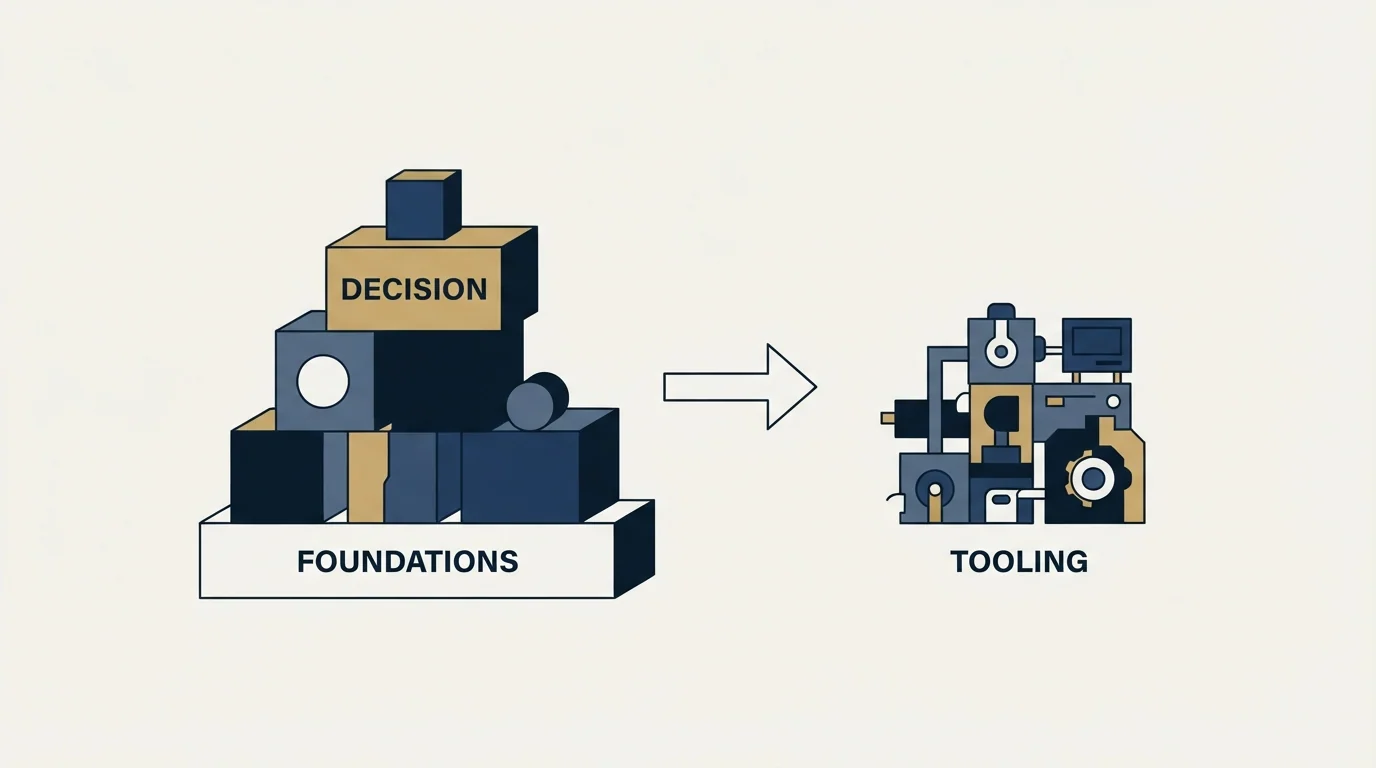
The category called revenue operations software mostly means forecasting and revenue-intelligence platforms: tools that read the CRM plus conversation and activity data and produce pipeline visibility, forecast calls and deal risk scoring. Gong, Clari and Revenue Grid sit in that shape, and the listicles comparing them are numerous.
Buying one before the underlying work is done is the most common expensive mistake in this area, and the mechanism is worth naming precisely. Forecasting tools read your CRM. If stage definitions differ between teams, if half the opportunities carry stale close dates, and if the segment fields are populated inconsistently, then the tool produces a confident forecast from bad inputs. Nothing about it will announce that. The output looks exactly like a good forecast, and it is a more expensive kind of wrong than a spreadsheet, because it carries more authority.
The order that works is definitions, then data quality, then integration, then tooling. A revenue operations platform is a lens; it makes what is already there sharper, and a sharper view of inconsistent data is not an improvement. Whichever tool eventually gets bought, the questions to ask it are what it reads, what it writes back, and what it does when two systems disagree, which is the same CRM integration conversation in different packaging.
Which products sit at each of those layers, and what each vendor's own pricing page discloses before a sales call, is sorted in RevOps tools by the job each one does.
The tell that a company needs the function
Plenty of teams run with no RevOps function at all, and the work does not disappear: it lands on whoever is nearest the systems, usually as manual integration between tools that were bought separately, which is why the question is what the function owns rather than whether the title exists.
Company size is a poor predictor. The reliable signal is a specific kind of question that nobody can answer quickly.
Ask how many opportunities were created last quarter from outbound, and how that compares to the quarter before. In a company with the function, that takes minutes. In a company without it, it takes days, produces two different numbers from two different people, and the reconciliation reveals that outbound is attributed differently in each system.
The underlying condition is that the answer lives in nobody's job description. Marketing knows its side, sales knows its side, and the join between them is owned by whoever last built a spreadsheet. RevOps exists to make that join somebody's responsibility, and the moment to hire for it is when the join is costing more time than the work it describes.
The RevOps role, as the phrase is usually searched, is that responsibility written into one job: the person who owns the definitions at the join and the systems that enforce them.
- Step 1Agree the definitions
Stages, qualification, and what attribution to outbound actually means, written down
- Step 2Fix the data behind them
Deduplicate, standardise the fields the definitions depend on, and keep them maintained
- Step 3Wire the systems once, deliberately
With precedence rules per field, so a disagreement has a documented winner
- Step 4Instrument with denominators
Every reported rate carries the population it was measured over, or it flatters a filtered set
- Step 5Then buy the tooling
A forecasting platform sharpens whatever is underneath it, including the errors
What a first RevOps hire should do first

The first hire into this function arrives to a list of everything everybody wants fixed, and the order they choose determines whether the role establishes itself or becomes a reporting service desk.
The productive first move is an inventory rather than a project. What systems exist, who administers each one, where each field of record actually originates, and which reports the leadership team already treats as authoritative. That last item is the one people skip and the one that matters most politically, because changing a definition underneath a number an executive quotes weekly is how a new function loses its credibility in its first month.
The second move is picking one definition and fixing it completely, end to end, across every system and report. One is the right number. A function that arrives and rewrites six definitions simultaneously produces a quarter where no historical comparison works and every team believes their numbers were broken by the new hire. Fixing one visibly, with the before and after reconciled and explained, buys the mandate for the next five.
That order is also the honest version of a RevOps maturity model: a team's stage is readable from which of those moves it has actually finished and can show the artefacts for, rather than from a level assigned against somebody else's five point scale.
The third move is instrumenting rather than reporting. The temptation is to build the dashboard everybody asked for, because it is visible and it makes people happy. The higher-value work is making the underlying counts trustworthy, since a dashboard on unreliable data is a faster route to a confidently wrong decision. Build the dashboard second.
Which numbers the function itself is held to, and what each one is computed from, is set out in RevOps metrics.
What should not be first is a tooling purchase, for the reason set out above, and neither should a CRM migration. Both are attractive because they feel like decisive action, and both make every other problem harder to diagnose for the six months they take.
The measurement trap worth knowing before any dashboard
One arithmetic failure shows up across every RevOps reporting layer and it is invisible in exactly the situation it should catch.
A rate computed over an already-filtered population reports on the survivors. If an upstream step rejected every record, because a required field arrived blank or an import failed validation, then the set carrying quality flags is empty and the set being measured is empty. Zero flags out of zero records is a flawless score. Every dashboard reads green and the batch is worthless.
The fix is a habit rather than a tool. Print the input count beside the accepted count beside the flagged count, in the report format itself, and treat any rate whose denominator is zero or unnamed as a failure rather than a pass. A check that cannot see anything must say it could not see, because a guard returning fine when it has nothing to look at is not a guard.
That principle generalises past data quality to match rates, pass rates, conversion rates and coverage figures, which is to say most of the numbers a RevOps function publishes.
Where outbound sits inside this
Outbound is the part of the revenue motion that most rewards operational discipline, because it is the one where the inputs are entirely chosen rather than inherited.
The segment is a decision, the copy is a decision, the sending infrastructure is a decision, and every one of them is measurable against a clean population if the definitions hold. That is also why outbound suffers most when the operational layer is weak: a campaign built from a segment query against inconsistent fields reaches a population nobody can reconstruct afterwards, and the result teaches you nothing whether it works or not. Ideal customer profile is where the segment definition has to be written tightly enough to query.
Our own practice is worth stating for the same reason it is stated everywhere else on this site. Every campaign carries exactly one message, with no bumps and no thread replies, so a second contact is a new campaign with a genuinely new angle rather than another step under the first. That has an operational consequence people underestimate: one message per campaign means one clean attribution per contact, so the reporting question of which message produced which reply never requires untangling a thread. Meetings are qualified against criteria agreed in writing before launch, which is the same definitional discipline this whole function is built on.
If a live campaign against a properly defined segment would be more useful than another operating model discussion, see what a first campaign looks like.
Frequently asked questions.
Frequently asked questions- What does a revenue operations team actually do?
- Four things consistently: it owns the shared definitions of pipeline stages and qualification, the systems and the integrations between them, the data quality standards and maintenance behind segment queries, and the routing, territory and handoff rules. Forecasting and compensation design join that list as headcount grows.
- What is revenue operations software?
- The category mostly means forecasting and revenue-intelligence platforms that read your CRM plus activity and conversation data to produce pipeline visibility, forecast calls and deal risk scoring. These tools sharpen whatever is underneath them, so inconsistent stage definitions and stale close dates produce a confident but wrong forecast.
- When should a company hire for RevOps?
- When the join between marketing, sales and customer success data lives in nobody's job description and is costing more time than the work it describes. Company size predicts this poorly. The reliable test is whether a straightforward pipeline-source question takes minutes or takes days and produces two conflicting answers.
- Is RevOps the same as sales operations?
- Sales operations serves the sales team specifically: territories, quotas, CRM administration and sales reporting. Revenue operations covers the same disciplines across marketing, sales and customer success together, so its defining work is the definitions and the handoffs between functions rather than the efficiency of any single one.
About the author.

B2B cold email experts helping companies generate qualified leads through done-for-you outreach campaigns.
RevenueFlow Team
Explore more.
Ready to scale your outreach?
We build GTM engines that book real meetings. See the receipts.
Related articles.
RevOps Agency Pricing: What the One Published Rate Card Says
A published RevOps agency ladder runs from $9,850 to $27,000 a month, priced by hours per week. What that unit tells you, and what to keep in-house anyway.
CRM Integration: Rate Limits, Auth, and What to Cache
Connecting a CRM is easy. Surviving rate limits, record locks, merge ceilings and a field-mapping decision nobody wrote down is the part that fails eighteen months later.
CRM Setup: The Objects, Stages and Write-Back Loop
A vendor neutral CRM setup for an outbound team: the object model, stage exit criteria, the required field set, ownership rules and the campaign write-back loop.
Salesforce API Integration: Pick the Interface, Then Code
Salesforce sells programmatic access as a line item and publishes four interfaces. Which one each job belongs on, and what breaks in production but never in a sandbox.
Salesforce Sales Performance Management: Four Products
Salesforce sells SPM as one phrase and four separate products. Which ones your edition already includes, and the cost test that decides whether you need any.
Airtable vs Pipedrive: A Database You Shape, a CRM You Don't
One product has no opinion about what a deal is and one has it pre-installed. Published prices, the currency trap on the comparison pages, and the test that decides.