RevOps Agency Pricing: What the One Published Rate Card Says
A published RevOps agency ladder runs from $9,850 to $27,000 a month, priced by hours per week. What that unit tells you, and what to keep in-house anyway.

Published RevOps agency retainers price capacity rather than outcomes. One openly published ladder runs from $9,850 a month for up to ten hours a week to $27,000 for thirty, on a six-month initial term with a $5,000 onboarding fee. The implied hourly rate is close to flat across every tier.
Key takeaways
- The published ladder caps by hours per week, not by deliverables, so the retainer buys capacity and the scope stays a separate negotiation.
- Dividing the published figures gives roughly $228 an hour at the entry tier and $208 at the top, so buying more hours is close to a flat rate rather than a volume discount.
- The smallest real commitment at the entry tier is six months plus a $5,000 onboarding fee, which is $64,100 before any scope discussion.
- Agencies deliver systems wiring and data quality well; definitions, territory design and anything feeding a historical series should stay with someone who will still be there.
Reviewed and updated September 2, 2026
A RevOps agency retainer starts, on the one rate card published openly in this category, at $9,850 a month for up to ten hours a week of work, on a six-month initial term, with a $5,000 one-time onboarding fee. The top of the same ladder is $27,000 a month for up to thirty hours a week.
Read those numbers once for the amount and once for the unit. The unit is hours. What a RevOps agency sells, at least in the one place the category shows its arithmetic, is capacity rather than an outcome, and every question worth asking before you sign follows from that.
The figures below come from RevPartners' published pricing page as it rendered on 16 August 2026. Three other pages ranking for the same query, RevOps Global's services page, Hypergen's RevOps agency page and Elefante's roundup of top RevOps agencies, were fetched the same day and publish no rate card at all, which is the normal state of professional services and the reason a published one is worth reading closely.
If you are reading this as one of the RevOps leads it is written for, the persona-specific version of this playbook lives in our guide to outbound for RevOps leads.
What the published ladder actually says
Six-month initial term, meetings every two weeks
Weekly meetings with the account team
Weekly meetings, one tier below the top
Twice-weekly meetings, plus a $5,000 one-time onboarding fee
A twenty-five-hour tier sits between the last two at $23,000 a month. The same page publishes fixed-price implementation work separately: a Sales Hub or Service Hub onboarding starting at $1,500 with a fourteen to thirty day timeline, a Marketing Hub onboarding starting at $3,000 on the same timeline, and a HubSpot and Clay integration with five playbooks at a one-time $25,000 over ninety days. A separate marketing retainer runs $12,900 a month for up to sixty hours a month and $20,500 for up to a hundred.
Now the arithmetic, which is ours rather than the vendor's. A month holds about 4.33 weeks, so ten hours a week is roughly 43 hours and thirty hours a week is roughly 130. That puts the entry tier near $228 an hour and the top tier near $208. The ladder is close to flat: buying three times the capacity does not buy you a materially better rate, it buys you three times the capacity.
That flatness is informative. It tells you the agency is pricing people rather than pricing a result, and it tells you that scaling the engagement up is a linear decision rather than a leveraged one. Add the six-month initial term and the onboarding fee, and the smallest real commitment at the entry tier is six months at $9,850 plus $5,000, which is $64,100 before anyone argues about scope. That figure is our arithmetic on published numbers, not a quoted price.
What the hours get spent on
The work itself is consistent across the category even where the pricing is not. Four areas come up everywhere, and they are more concrete than the alignment language the field attracts.
Definitions. What counts as a qualified opportunity, when a stage advances, what makes a lead a lead. Two teams reporting different pipeline figures for the same quarter, both correct under their own definitions, is the classic symptom.
Systems and the wiring between them. The CRM, the sending and engagement tools, the enrichment sources, the analytics layer, and the integrations connecting them. Every seam is a place where records fall out and where somebody has to decide which system wins a disagreement.
Data quality. Deduplication, field standards, enrichment, and the maintenance that keeps a segment query honest. The waterfall enrichment model is the specific version of this on the contact-data side.
Process and routing. Territory design, ownership rules, handoffs, and the assignment logic deciding who works what.
An agency is good at the middle two and structurally awkward at the first. Wiring systems and cleaning data are bounded technical projects with a visible finish, which is exactly what an hours-based retainer is built to deliver. Definitions are political, they belong to whoever will defend them in a pipeline review six months later, and an outside party cannot hold that job. The practitioner view of all four, written from the operator's seat, is in 48 RevOps rules every operator should know.
What to automate, and what to leave manual

The useful split is not by difficulty. It is by whether being wrong is noisy or silent.
- Field standardisation and deduplication rules
- Routing and assignment once the territory design is settled
- Enrichment refresh on a schedule, with a source of record per field
- Stage-change hygiene: required fields, close-date validation
- Report generation, once the counts underneath are trusted
- Changing a definition anybody quotes in a board pack
- Territory design itself, as opposed to enforcing it
- Deciding which system wins a field-level disagreement
- Anything touching a historical series people compare against
- The first pass of any segment a campaign will actually mail
The measurement trap worth naming before any of it is automated: a rate computed over an already-filtered population reports on the survivors. If an upstream step rejected every record, the flagged set is empty and the measured set is empty, and zero flags out of zero records reads as a flawless score. Every dashboard goes green and the batch is worthless. The fix is a habit rather than a tool: print the input count beside the accepted count beside the flagged count, and treat any rate with an unnamed or zero denominator as a failure rather than a pass.
The signal that you need one at all
Company size is a poor predictor, and so is the length of the list of things people want fixed. The reliable tell is a specific question nobody can answer quickly.
Ask how many opportunities were created last quarter from outbound, and how that compares with the quarter before. In a company with the function working, that takes minutes. In a company without it, it takes days, produces two different numbers from two different people, and the reconciliation reveals that outbound is attributed differently in each system. The underlying condition is that the answer lives in nobody's job description, and an agency is one of three reasonable responses to it. The other two are hiring for it and deciding the question does not matter yet, and the second of those is a legitimate answer for a company still finding its motion.
What should not drive the decision is a tooling purchase, because a forecasting or revenue-intelligence platform reads whatever is underneath it. Bought before the definitions and the data are settled, it produces a confident forecast from bad inputs, and nothing about the output announces that. A retainer that starts by buying and configuring a platform has spent its first month on the step that should have come last.
Tooling in this space rarely shows its arithmetic at all, and LeanData publishes a meter rather than a rate, which at least makes a quote estimable before the call.
Buying one without buying a surprise

- Step 1Write down the outcome, then price the hours against it
An hours cap is not a scope. Name the three things that must be true at the end of the term, and ask how many of the hours each one consumes.
- Step 2Decide who owns definitions before signing
If the answer is the agency, you are renting your own reporting. Name the internal person who will defend each definition after the engagement ends.
- Step 3Ask what happens to unused hours
Capacity pricing means unused hours are the vendor's margin. Whether they roll, expire or convert is a term, not an assumption.
- Step 4Get the exit written down
Documentation standard, admin access, and who holds the credentials on day one after the term. This is cheaper to agree before the first invoice than after the last.
One more question is worth asking out loud, because the rate card invites it: what would it cost to hire instead. At roughly $228 an hour, ten hours a week is a meaningful fraction of a salaried operations hire, and the honest comparison includes the things a retainer genuinely gives you that a first hire does not, which are a bench of specialists, no ramp, and no risk that your only operations person leaves. It also includes the thing a hire gives you that a retainer cannot, which is somebody whose loyalty to the definitions outlasts the contract.
Where outbound sits inside this
Outbound is the part of the revenue motion that most rewards operational discipline, because its inputs are chosen rather than inherited. The segment is a decision, the copy is a decision, and each is measurable against a clean population if the definitions hold. It is also the part that suffers most when the operational layer is weak: a campaign built from a segment query against inconsistent fields reaches a population nobody can reconstruct afterwards, and the result teaches you nothing whether it works or not. Writing the segment tightly enough to query is the subject of ideal customer profile, and the stage definitions it has to agree with sit in sales pipeline stages.
Our own practice is worth stating because it interacts with the reporting layer directly. Every campaign carries exactly one message, with no bumps and no thread replies, so a second contact is a new campaign with a genuinely new angle rather than another step under the first. That has an operational consequence people underestimate: one message per campaign means one clean attribution per contact, and the question of which message produced which reply never requires untangling a thread. Meetings are qualified against criteria agreed in writing before launch, which is the same definitional discipline the whole function is built on. If you would rather see terminal-level RevOps work than buy hours of it, five RevOps workflows you can run from the terminal covers what the smaller version looks like.
The short version
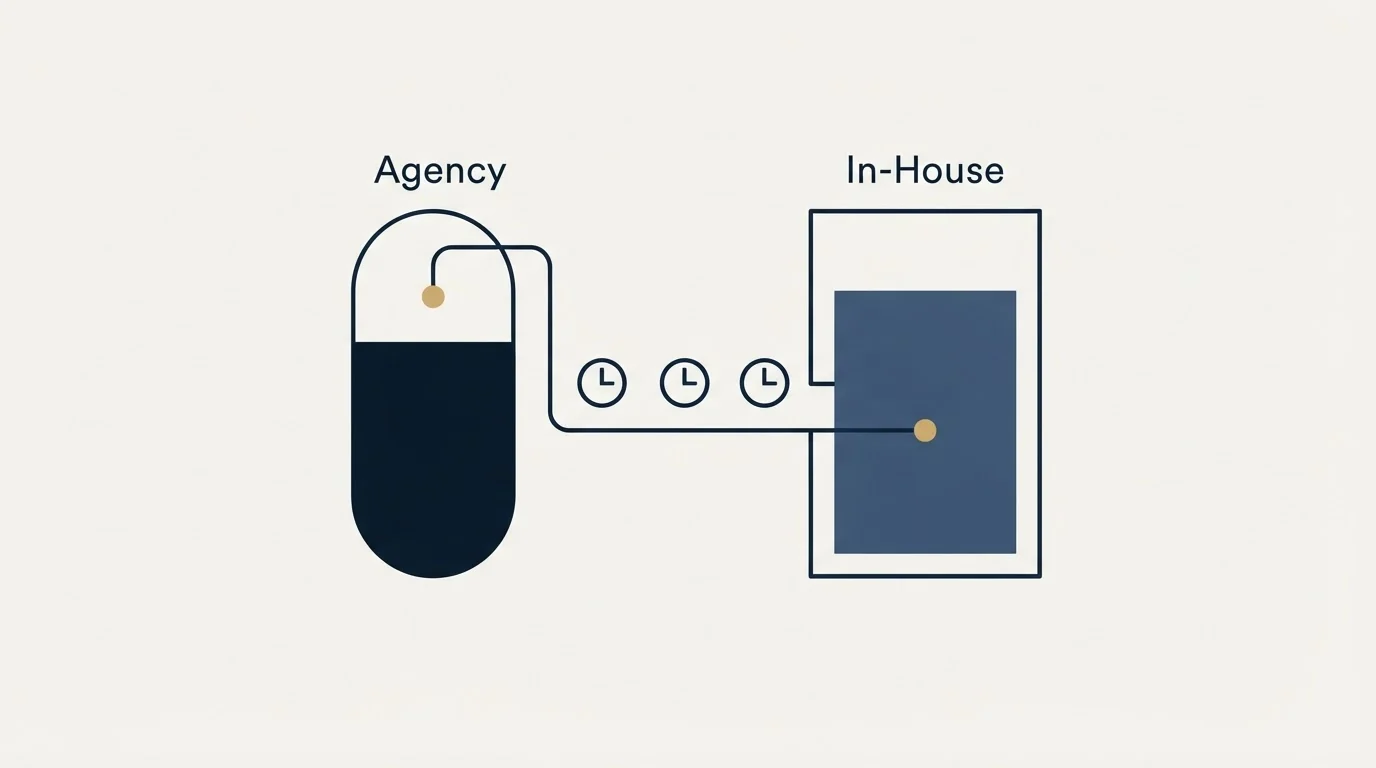
The one published RevOps rate card in this category prices capacity: $9,850 a month for up to ten hours a week, rising to $27,000 for thirty, on a six-month initial term with a $5,000 onboarding fee, plus separate fixed-price implementations from $1,500. The implied hourly rate is close to flat across the ladder, so scale buys volume rather than leverage.
Buy the wiring and the data work, which is what an hours-based engagement delivers well. Keep the definitions, the territory design and the first pass of any segment you will actually mail, because those fail silently and the failure outlives the contract. Ask what happens to unused hours, and get the exit terms written down before the first invoice.
If the outcome you want from all of it is booked meetings, see what a campaign would look like for your market before you buy the operating layer around one.
Agency pricing verified against RevPartners' published pricing page as of mid-2026, with three further ranking pages checked the same day and found to publish no rates. Verify current terms with any vendor before relying on them.
Sources: RevPartners pricing, RevOps Global services, Hypergen RevOps agency
Frequently asked questions.
Frequently asked questions- How much does a RevOps agency cost?
- Published figures are rare in this category. The one openly published ladder starts at $9,850 a month for up to ten hours a week and rises through $14,500, $19,000 and $23,000 to $27,000 a month for thirty hours, with a six-month initial term and a $5,000 one-time onboarding fee. Fixed-price implementation work starts around $1,500.
- What does a RevOps agency actually do?
- Four things come up consistently: agreeing definitions such as what counts as a qualified opportunity, wiring the CRM and surrounding systems together, keeping data quality high through deduplication and field standards, and designing routing and territories. The middle two are bounded technical projects and suit an outside team best.
- Should I hire a RevOps person instead of an agency?
- Compare on what each one gives you that the other cannot. A retainer buys a bench of specialists with no ramp and no key-person risk. A hire buys somebody whose ownership of the definitions outlasts a contract, which matters because definitions are political rather than technical. At around $228 an hour, ten hours a week is already a meaningful fraction of a salary.
- What should stay manual in a RevOps build?
- Anything whose failure is silent. Changing a definition somebody quotes in a board pack, designing territories, deciding which system wins a field-level disagreement, and the first pass of any segment a campaign will mail. Automate field standards, routing enforcement, scheduled enrichment and stage hygiene, where a mistake announces itself quickly.
About the author.

B2B cold email experts helping companies generate qualified leads through done-for-you outreach campaigns.
RevenueFlow Team
Explore more.
Ready to scale your outreach?
We build GTM engines that book real meetings. See the receipts.
Related articles.
Salesforce API Integration: Pick the Interface, Then Code
Salesforce sells programmatic access as a line item and publishes four interfaces. Which one each job belongs on, and what breaks in production but never in a sandbox.
Salesforce Sales Performance Management: Four Products
Salesforce sells SPM as one phrase and four separate products. Which ones your edition already includes, and the cost test that decides whether you need any.
Airtable vs Pipedrive: A Database You Shape, a CRM You Don't
One product has no opinion about what a deal is and one has it pre-installed. Published prices, the currency trap on the comparison pages, and the test that decides.
Apollo and Clay Integration: What Connects, Who Meters What
Clay's docs list one Apollo source and eleven actions. How the account connects, which way each action moves data, and which vendor bills each step.
Reply.io Salesforce Integration: The Sixteen Sync Steps
Reply's support article lists sixteen sync steps, two profiles, required field mappings and a two-hour cadence. What the native Salesforce integration moves.
Alta Pricing: No Rate Card, a Quote in Hours
Alta publishes no price. What its plans page, FAQ and blog disclose about how the platform is priced, the inputs that set a quote, and the numbers to ignore.