Outbound for RevOps Leads: What It Costs the Stack
Records, domain risk, attribution ambiguity and permanent process surface. The four costs outbound puts on the stack that never appear on the invoice.
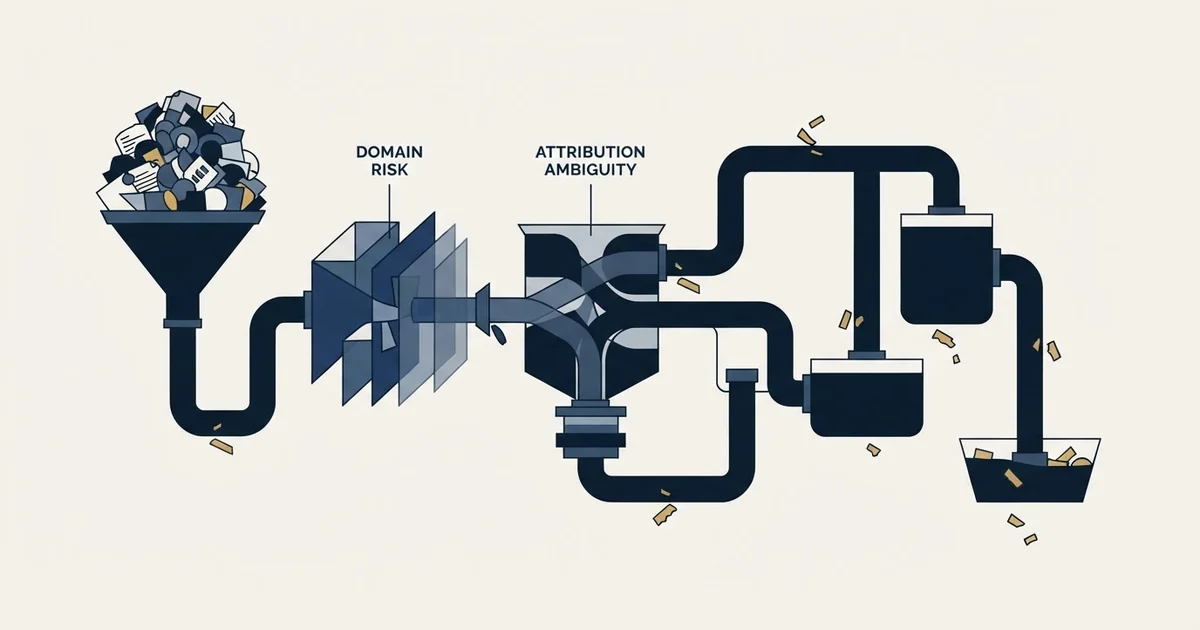
Outbound puts four costs on the stack that never reach the invoice: records the CRM was not sized for, domain reputation risk, attribution ambiguity between channels, and permanent process surface. Separate sending domains, enforced suppression and a written qualification definition are the three things to settle before launch.
Key takeaways
- Cold sending from the domain that carries the company's real email puts an unreplaceable asset behind a campaign nobody senior reviewed, and reputation follows the domain rather than the sending platform.
- A contact touched by outbound and later by a form will be claimed by both channels unless the precedence rule is decided in advance, which makes it a policy question rather than a reporting one.
- Continuous operations attention is the cost most often missing from a build-versus-buy spreadsheet, and it is frequently larger than the difference between the two routes' headline prices.
- A suppression list that lives in a spreadsheet is not enforcement. Setting it up before launch costs an export, and discovering it was missing costs an apology to a paying customer.
Reviewed and updated September 2, 2026
RevOps usually meets an outbound decision late and inherits all of its consequences. Somebody has agreed a plan, a tool has been chosen, and the questions that arrive on the RevOps desk are about field mapping, deduplication, routing rules, attribution and whose domain the sends are going out on. By then the expensive decisions have already been made, and most of them were made without anyone asking what the stack could actually absorb.
This page is for the RevOps lead who owns the data, the systems and the process, and who is being asked to support, integrate or evaluate an outbound motion. It covers what outbound genuinely costs the stack, the build versus buy question as it looks from an operations seat, what an external provider touches, and the diligence questions worth asking before anything is connected.
What outbound actually costs the stack
The line item everyone discusses is the tool or the provider. The costs that land on RevOps are elsewhere, and there are four of them.
Records. A serious outbound motion creates contact and account records at a rate the CRM was not sized for, and most of them will never become opportunities. Whether those live in the CRM at all is a decision worth making deliberately rather than discovering. A CRM full of never-contacted records degrades every report built on it, and the cleanup is always more expensive than the prevention.
Domain risk. This is the one most likely to become a genuine incident. Cold sending from the domain that carries the company's real email puts an asset nobody can replace behind a campaign nobody senior reviewed, and reputation is sticky in a way that survives changing the sending platform. What the receiving side is actually judging, and why there is no single score to monitor, is set out in domain reputation. The layered view of what a sending stack is made of, and which layer fails first, is in cold email infrastructure.
Attribution. Outbound creates a source that overlaps with everything else. A contact who received a cold message and later filled in a form will be claimed by both channels unless somebody decides the precedence rule in advance, and that decision is a policy question rather than a reporting one.
Deciding who sets that rule is the older question, and which function owns a definition separates revenue operations from sales operations more sharply than scope does.
Process surface. Routing, ownership, suppression, do-not-contact handling, and the disagreement path when a meeting is disputed. Each of these is small. Together they are a quarter of somebody's attention, permanently.
HubSpot AI Agents unpacks how the prospecting agent's enrollment decisions quietly extend that same process surface RevOps already carries.
- Yes: Sending domains are separate from the company's primary email domain
- Yes: A suppression list exists and is actually enforced, including current customers
- Yes: There is a written rule for which channel claims a contact touched by both
- Yes: Someone owns do-not-contact handling and can prove it is applied
- No: Outbound-sourced records land in the CRM by default, unreviewed
- No: Meeting disputes are resolved case by case with no written standard
- Depends: Whether reporting can separate created pipeline from captured pipeline
Most of these are cheap to set up before launch and expensive to retrofit. The suppression list is the sharpest example: enforcing it from day one costs an export, and discovering it was missing costs an apology to a customer who was cold-emailed about a product they already pay for.
Build or buy, from an operations seat
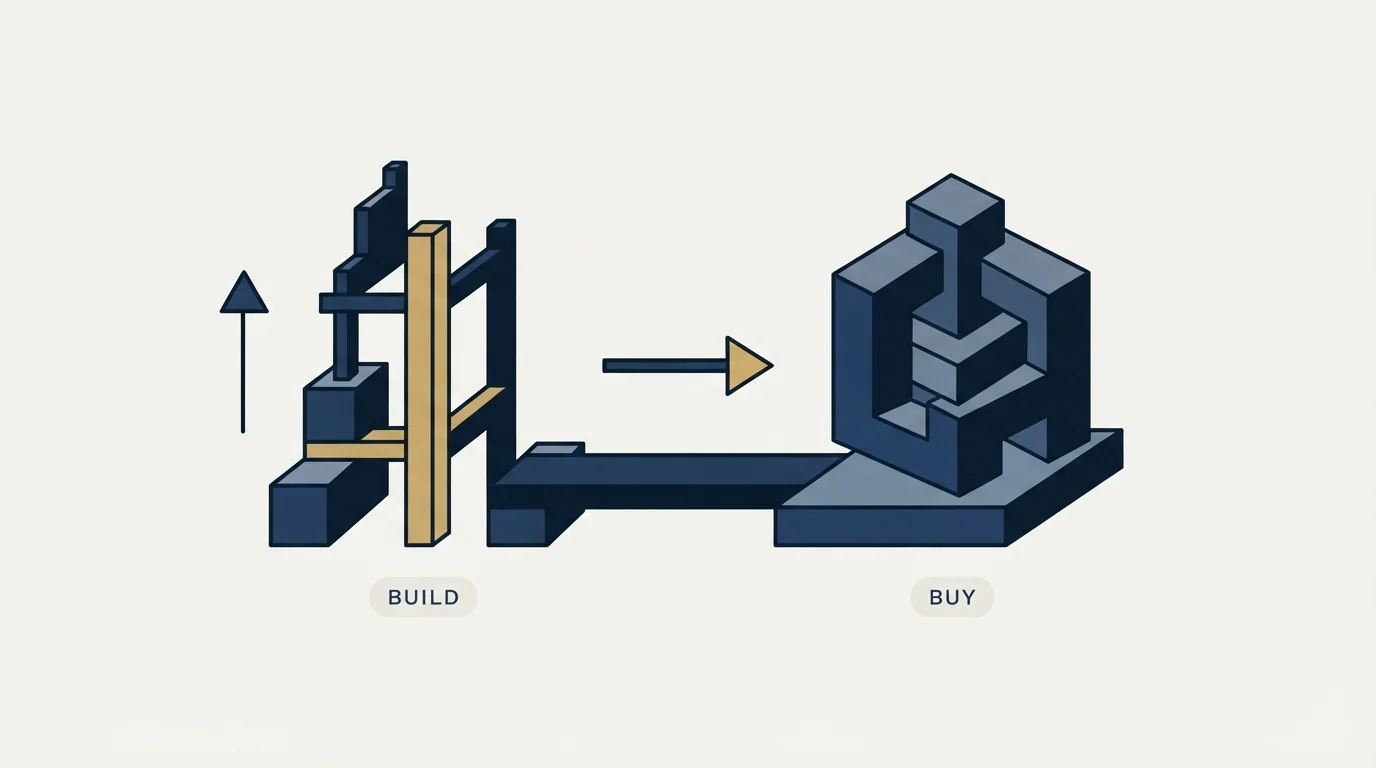
The build versus buy conversation usually gets framed as cost per meeting. From RevOps the more useful frame is which system of record you end up with and how much of the operating surface you own.
Building means the stack is yours. Data sources, enrichment, sending infrastructure, campaign tooling, and the integrations between them all sit inside your estate, and so does every failure. The advantage is real: the data is yours, the logic is inspectable, and nothing is hostage to a vendor's roadmap. The cost is that outbound tooling is a category with high maintenance and fast turnover, and someone has to own it continuously rather than at setup. What a stack that covers the mechanical parts of the role actually contains, stage by stage, is set out in the system fast teams run, and the honest limits of the software category that promises to do the whole job are in AI SDR.
Buying means the operating surface moves outside. The provider owns sourcing, infrastructure and sending, and what crosses your boundary is a smaller, better-defined object: qualified meetings and the records attached to them. That is easier to govern precisely because it is narrower. The trade is that the raw data and the campaign-level detail live somewhere you do not administer, and getting them back at the end of an engagement is a contract question rather than an export.
The comparison method that makes the two commensurable, with the cost lines that hiring plans normally omit, is in outsourced SDR versus in-house.
Every figure in the next paragraph is invented for the worked example. None of it is a benchmark and none of it is a RevenueFlow result.
Suppose the in-house route needs 4 tools, 2 integrations and roughly 5 hours a week of operations attention once it is running, plus a build phase. Suppose that attention costs 100 units an hour. That is about 2,000 units a month of operations load that never appears in the tool budget, and it is load that competes directly with the CRM work RevOps is already behind on. On invented numbers like these, the operations line is frequently larger than the difference between the two routes' headline prices, which is exactly why it should be estimated rather than assumed to be zero. It is also the term most likely to be missing from whatever spreadsheet reaches the decision.
What an external motion touches
Stated as policy rather than as a performance claim, this is how our own motion is structured and where it meets a client's systems.
Sending runs on separate infrastructure. Outbound does not go out on the client's primary domain. This is the single most important operational boundary in the arrangement, and it should be non-negotiable with any provider.
One message per campaign, sent once. Each campaign carries one premise. No bumps, no thread replies. A later approach exists as a separate campaign with its own reason to exist. From a reporting perspective this is unusually convenient, because a response maps to one campaign, one premise and one segment rather than to an accumulation of touches, which removes the hardest attribution problem in the category before it starts.
Qualification agreed in writing before launch. What counts as a qualified meeting is defined before the first send, and budget, timing and authority are not billing conditions. For RevOps this is the definition your reporting will be built on, so it is worth reading the clause rather than delegating it.
Copy approved by the client before anything sends.
Email and LinkedIn, not phone. That is the channel set, which also determines which consent and record-keeping questions apply.
What crosses the boundary into your systems is the meeting, the contact and account it belongs to, and the campaign and segment it came from. Deciding the shape of that object in advance, rather than accepting whatever the first integration produces, is the highest-leverage hour a RevOps lead spends on the whole engagement.
- Step 1Set the boundary
Separate sending domains, and a written decision about which records enter the CRM at all.
- Step 2Load suppression first
Customers, open opportunities, partners and do-not-contact, enforced before the first send.
- Step 3Fix the precedence rule
Decide which channel claims a contact touched by both, in advance and in writing.
- Step 4Define the object that crosses
Meeting, contact, account, campaign and segment, with the field mapping agreed.
- Step 5Report on segments, not totals
Segment-level reply and conversion rates are what let you cut a bad segment early.
Diligence questions worth asking

Provider-neutral, and the answers tell you more than any demo.
Which domains do the sends leave from, and who else sends from them? Shared infrastructure means a reputation you do not control. Ask how many domains your volume is spread across.
How is suppression enforced, and can you prove it on a given record? A suppression list that exists in a spreadsheet is not enforcement. Ask what happens mechanically when a customer domain appears in a source list.
What is the exact definition of the billable outcome, and what happens to a no-show? This becomes your reporting definition whether or not anyone tells you.
What data do we get, in what format, and what happens to it at the end? Campaign-level detail, reply text, bounce and suppression records, and the exit terms for all of it.
How does this integrate, and who maintains that integration when a field changes? The maintenance answer matters more than the initial connection.
When is this the wrong purchase? Ours: a market of a few hundred named accounts where relationship depth beats reach, a company that wants to own the data and the logic end to end as a strategic asset, regulated or consent-only channels, and any situation where the actual constraint is conversion or retention rather than the top of the funnel. Buying pipeline on top of a leaky funnel produces a more expensive version of the same report. The broader operating rules that this sits inside are collected in 48 RevOps rules.
The short version

Outbound costs the stack four things that never appear on the invoice: records, domain risk, attribution ambiguity and permanent process surface. Estimating them before launch is what separates a motion that reports cleanly from one that becomes a cleanup project two quarters later.
Build or buy is a question about which operating surface you own. Building keeps the data and the logic inside your estate and costs continuous attention that the tool budget does not show. Buying narrows what crosses your boundary to a well-defined object, and moves the raw detail somewhere you administer through a contract rather than through a console.
Whichever route, settle the same three things in writing before the first send: separate sending domains, enforced suppression, and the definition of a qualified meeting. Everything else can be adjusted later.
If the operations load is the reason building it in-house does not fit this year, we run outbound end to end and are paid on attended meetings that meet criteria agreed in writing before launch. You can see what a campaign would look like for your market.
Frequently asked questions.
Frequently asked questions- Should outbound contacts go into our CRM?
- Make it a deliberate decision rather than a default. A CRM filling with never-contacted or never-engaged records degrades every report built on it, and the cleanup always costs more than the prevention. Decide which object crosses the boundary, and at what stage, before any integration is connected.
- Can we send cold email from our main company domain?
- Treat that as non-negotiable with any provider: outbound runs on separate sending domains. Reputation is each mailbox provider's private judgment of your From domain, it is sticky, and it survives changing the sending platform. A bad campaign on the primary domain puts transactional and internal email at risk.
- How do we attribute pipeline that outbound and inbound both touched?
- Write the precedence rule before launch and apply it consistently. Structure helps here: where each campaign carries a single message sent once, a response maps to one campaign, one premise and one segment, which removes most of the multi-touch ambiguity before it starts.
- What should I ask an outbound vendor during diligence?
- Which domains sends leave from and who else uses them, how suppression is enforced mechanically rather than on paper, the exact billable outcome definition and no-show handling, what data you receive and in what format, and who maintains the integration when a field changes.
About the author.

B2B cold email experts helping companies generate qualified leads through done-for-you outreach campaigns.
RevenueFlow Team
Explore more.
Ready to scale your outreach?
We build GTM engines that book real meetings. See the receipts.
Related articles.
CRM Setup: The Objects, Stages and Write-Back Loop
A vendor neutral CRM setup for an outbound team: the object model, stage exit criteria, the required field set, ownership rules and the campaign write-back loop.
Cold Outreach Automation: Where the Line Sits
Cold outreach automation is seven decisions, not one purchase. Four stages automate cleanly, two produce confident nonsense, and one is the feature we decline.
RevOps Agency Pricing: What the One Published Rate Card Says
A published RevOps agency ladder runs from $9,850 to $27,000 a month, priced by hours per week. What that unit tells you, and what to keep in-house anyway.
The Pipedrive API: A Daily Token Budget
Pipedrive prices API calls rather than counting them. The published token budget, the cost of each endpoint type, and the two ceilings a sync has to respect.
Pipedrive Sequences: A 250-Item Cap and What the Tool Is For
Ten steps, 250 items and a per-sequence sending authorisation. Pipedrive's caps describe the audience the feature was designed for more clearly than its feature list.
HubSpot Power Dialers: Pooled Minutes Are the Real Cap
HubSpot's calling minutes are pooled across the whole account rather than granted per seat. That changes the arithmetic of a calling programme more than the dialer does.