48 RevOps Rules Every Operator Should Know
All 48 RevOps rules across data, pipeline, forecasting, comp, reporting and alignment, with the reasoning behind the ones operators actually argue about.
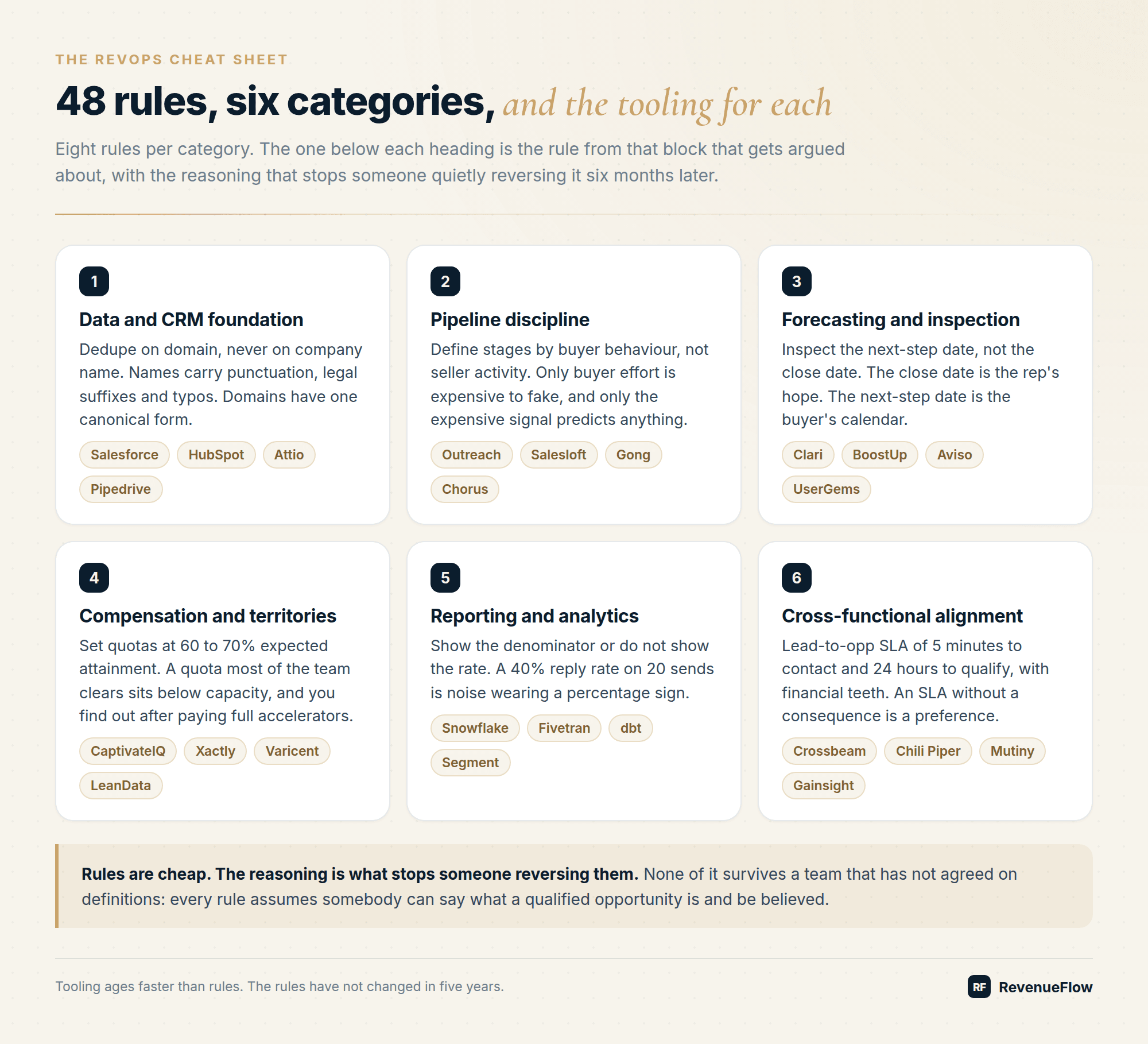
Forty-eight RevOps rules span six areas: CRM and data foundation, pipeline discipline, forecasting and inspection, compensation and territories, reporting and analytics, and cross-functional alignment. The sharpest are defining stages by buyer behaviour rather than seller activity, setting quotas at 60 to 70% expected attainment, and attaching financial consequences to the 5 minute contact SLA.
Key takeaways
- Sales stages defined by buyer behaviour predict outcomes because a rep cannot advance them without the buyer doing something.
- Quotas set at 60 to 70% expected attainment fund the compensation plan correctly and keep accelerators rewarding genuine overperformance.
- The lead-to-opportunity SLA of 5 minutes to contact and 24 hours to qualify only changes behaviour when it carries financial consequences.
- Five KPIs per dashboard, one definition and one owner per metric, and never publish a rate without its denominator.
- Deduplicate CRM records on domain rather than company name, because domains have one canonical form and company names do not.
- 3x pipeline coverage is a floor rather than a ceiling, and pipeline created in weeks one to four predicts the quarter.
Reviewed and updated September 5, 2026
48 RevOps Rules Every Operator Should Know
I posted a RevOps cheat sheet earlier this year: six categories, four rules each, with the tooling that belongs in each. Twenty-four rules made the text, twenty-four more only fitted in the image.
This is the whole set written out, plus the reasoning behind the ones that get argued about. Rules are cheap. The reasoning is what stops someone quietly reversing a rule six months later.
Anyone looking for RevOps best practices is looking for a list like this one, and the six categories below are the places where an operator can actually change an outcome rather than describe one.
- Yes: Data and CRM foundation
- Yes: Pipeline discipline
- Yes: Forecasting and inspection
- Yes: Compensation and territories
- Yes: Reporting and analytics
- Yes: Cross-functional alignment
1. Data and CRM foundation
- One CRM is the source of truth. Not three.
- Required fields beat optional fields.
- Lifecycle stages match revenue stages exactly.
- Reps do not pick account ownership. Rules do.
- Every field has an owner, a definition, and a reason to exist.
- Delete a field before you add a duplicate of it.
- Enrich on write, not on report.
- Dedupe on domain, never on company name.
Tooling: Salesforce, HubSpot, Attio, Pipedrive.
Ownership decided by preference is ownership relitigated every quarter. A rule can be wrong and still beat negotiation, because a wrong rule is visible and fixable while a negotiated exception is neither.
Those eight lines are the CRM best practices worth arguing about, and each is written as a rule rather than an aspiration so a team can tell whether it is being followed.
Deduping on domain rather than name is the cheapest rule here and the most skipped. Company names carry punctuation, legal suffixes and typos; domains have one canonical form. Fix the matching key first. What fits which team is in the best CRM tools for SDR teams.
2. Pipeline discipline
- Define stages by buyer behaviour, not seller activity.
- Every stage needs an exit criterion, not a vibe.
- 3x coverage is a floor, not a ceiling.
- Pipeline created weeks 1 to 4 predicts the quarter.
- No opportunity exists without a named economic buyer.
- A deal with no next meeting booked is not in pipeline.
- Stage regressions get logged, not hidden.
- Kill stale deals on a schedule, not on a mood.
Tooling: Outreach, Salesloft, Gong, Chorus.
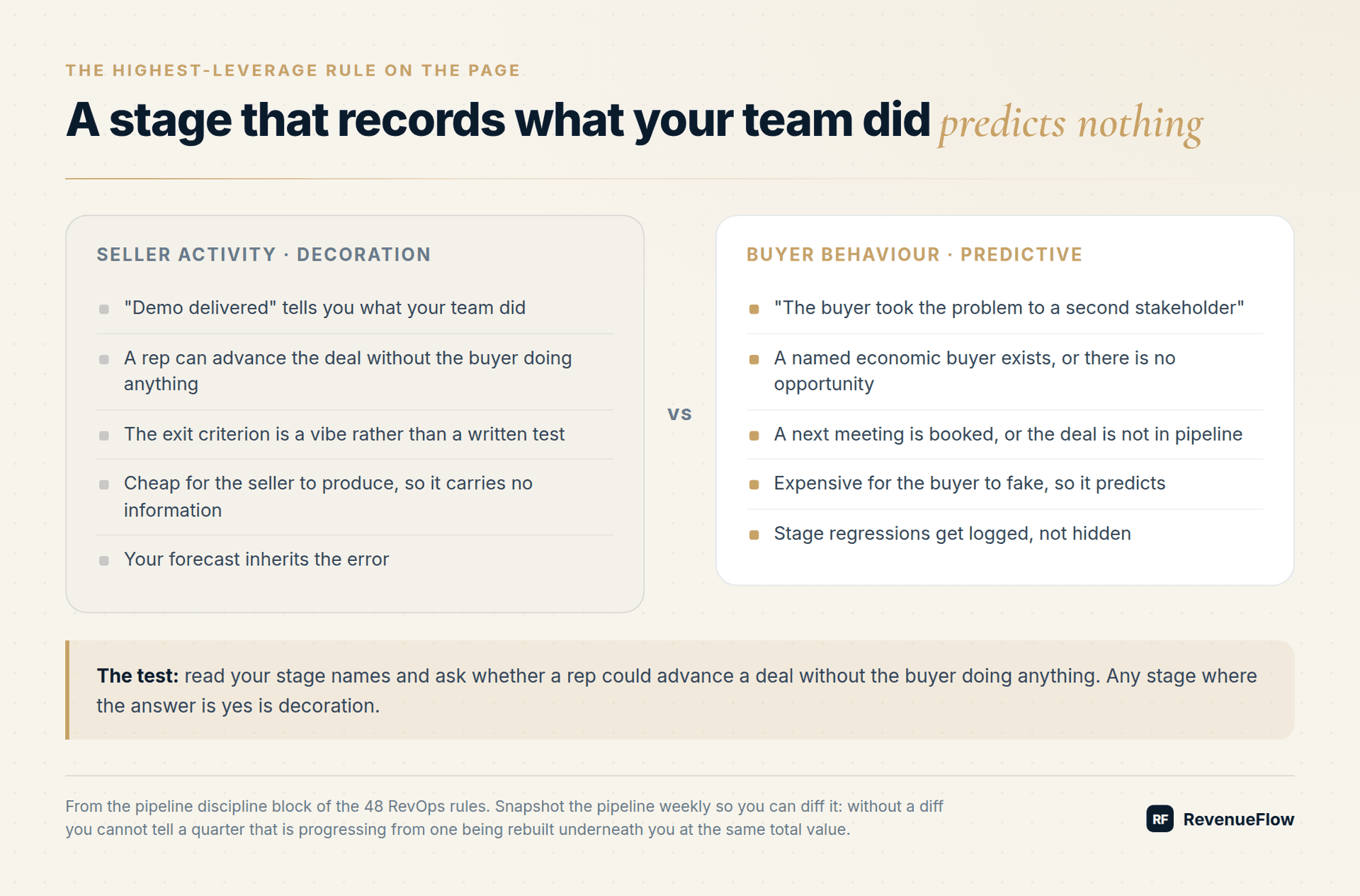
Stages defined by buyer behaviour is the highest-leverage rule on this page. "Demo delivered" tells you what your team did. "The buyer took the problem to a second stakeholder" tells you what the buyer did, and only the second predicts anything, because only the second is expensive for the buyer to fake.
The test: read your stage names and ask whether a rep could advance a deal without the buyer doing anything. Any stage where the answer is yes is decoration, and your forecast inherits the error.
3. Forecasting and inspection
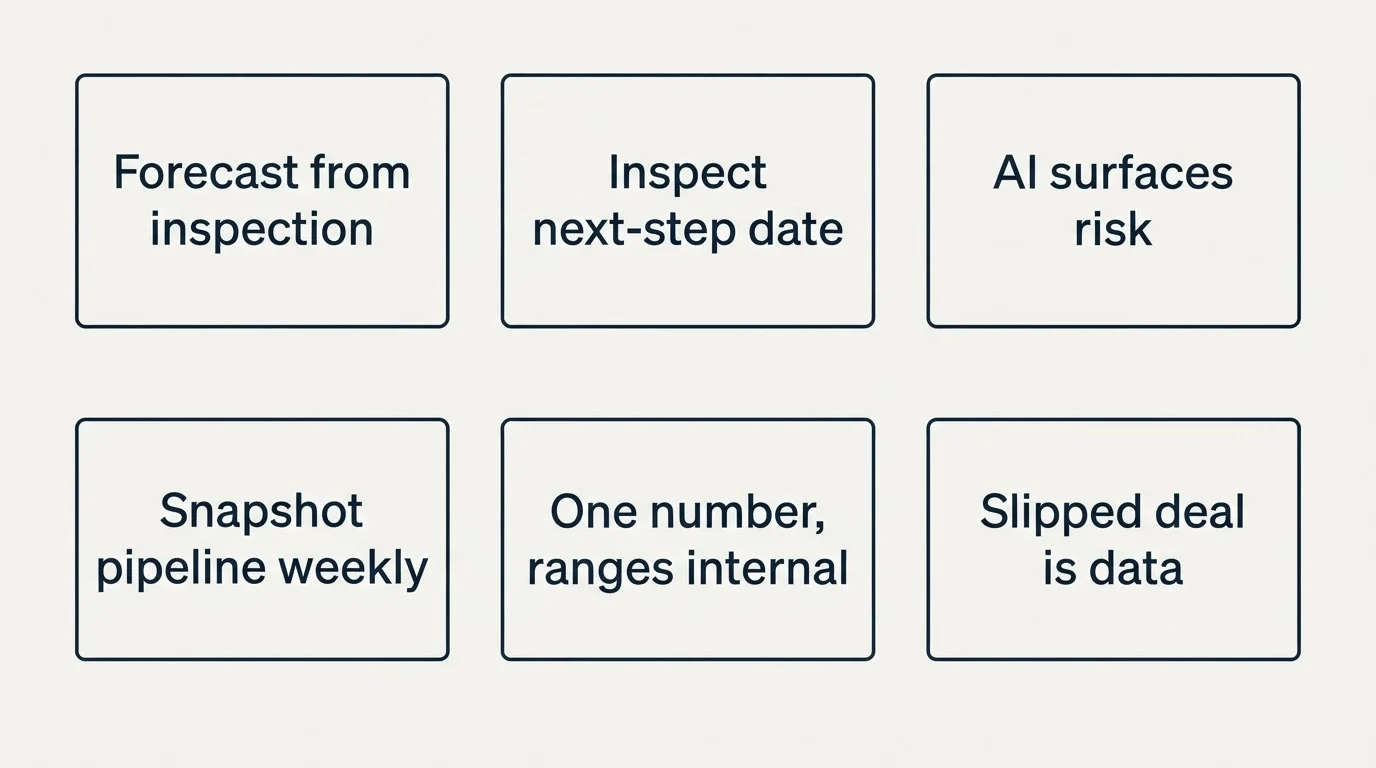
- Forecast from deal inspection, not rep commits.
- Inspect the next-step date, not the close date.
- AI forecasts surface risk. They do not replace judgment.
- The forecast you ship is the forecast you defend.
- Snapshot the pipeline weekly so you can diff it.
- One number goes to the board. Ranges stay internal.
- A slipped deal is a data point, not a moral failing.
- If the forecast is always right, the range is too wide.
Tooling: Clari, BoostUp, Aviso, UserGems.
Inspect the next-step date rather than the close date, because the close date is the rep's hope and the next-step date is the buyer's calendar. Only one is a commitment somebody else made.
Aviso, named in that tooling line, titles its own site an end-to-end AI revenue platform and sells forecasting, deal guidance and pipeline analysis to revenue teams rather than a system of record, and it shares its name with an unrelated Canadian wealth-management firm.
Weekly snapshots matter more than any forecasting tool. Without a diff you cannot tell a quarter that is progressing from one being rebuilt underneath you at the same total value. Several of the jobs in RevOps workflows you can run from the terminal exist to produce that diff on a schedule.
4. Compensation and territories
- Pay on margin and retention, not just bookings.
- Set quotas at 60 to 70% expected attainment.
- Territories balance on TAM dollars, not account count.
- Re-territory annually, not when reps complain.
- Publish the comp plan before the quarter starts, or do not change it.
- No retroactive clawbacks that were not in the plan.
- Accelerators reward overperformance, not sandbagging.
- One plan change per year. Two is a signal something else is broken.
Tooling: CaptivateIQ, Xactly, Varicent, LeanData.
The 60 to 70% attainment target sounds like planning to fail and is the opposite. A quota most of the team clears sits below capacity, and you find out only after paying full accelerators on a year of underperformance. Set it where roughly two thirds of the team lands.
Balancing territories on TAM dollars rather than account count is the same idea one level up: a hundred accounts in a saturated segment and a hundred in an open one are not the same job. That depends on segment definitions being real, which is a job for a written ideal customer profile.
5. Reporting and analytics
- Build dashboards for decisions, not decoration.
- Five KPIs per dashboard, not fifty.
- Source of truth lives in the warehouse, not the BI tool.
- If no one acts on a report, kill it.
- Every metric has one definition and one owner.
- Show the denominator or do not show the rate.
- Weekly operating metrics, quarterly strategic ones. Never the reverse.
- Instrument the signal before you buy the tool that reads it.
Tooling: Snowflake, Fivetran, dbt, Segment.
"Show the denominator or do not show the rate" saves the most arguments. A 40% reply rate on 20 sends is noise wearing a percentage sign, and rates without volumes are how teams talk themselves into scaling something that never worked.
The last rule decides whether intent tooling pays back. Instrument what you can already see, in website visitor identification terms, before buying a third-party feed, and read the B2B intent data guide before that purchase rather than after.
6. Cross-functional alignment
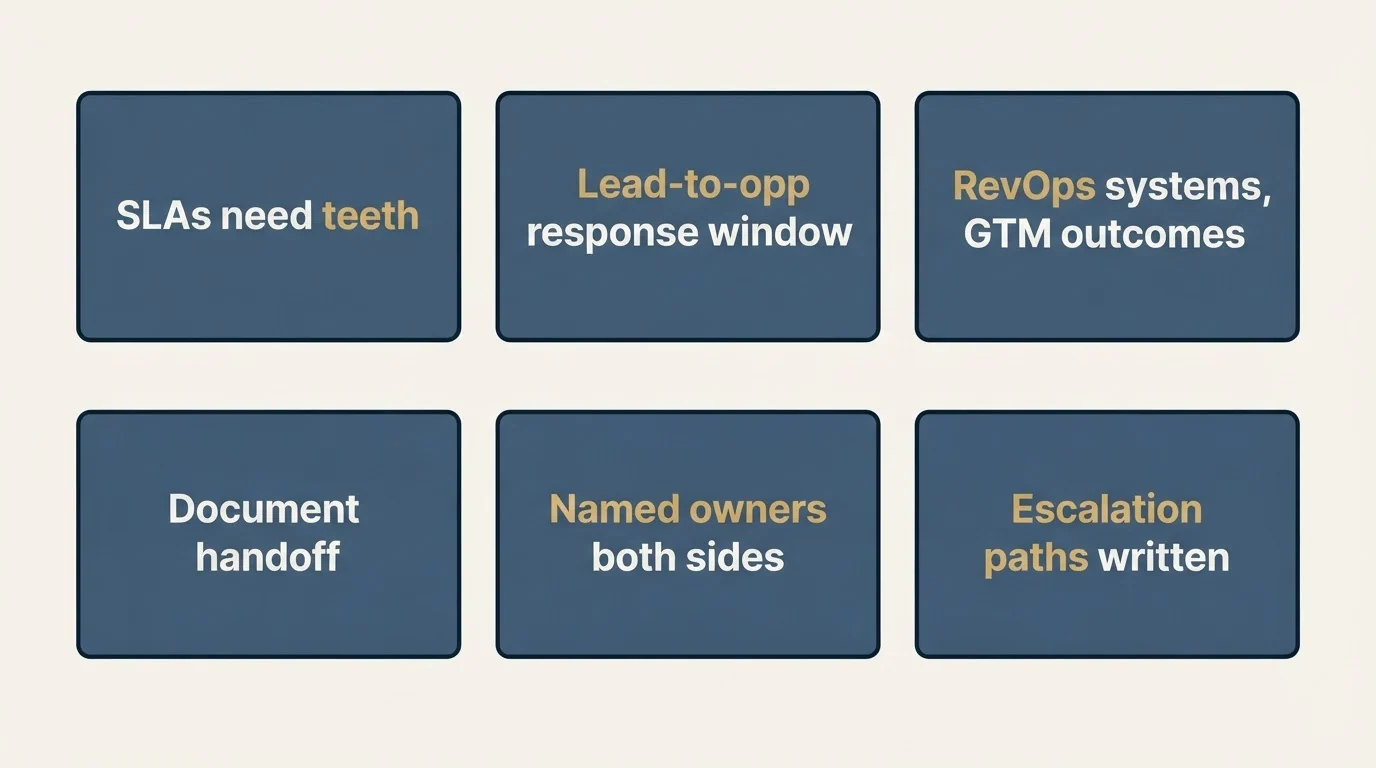
- Marketing and sales SLAs need financial teeth, not promises.
- Lead-to-opp SLA: 5 minutes to contact, 24 hours to qualify.
- RevOps owns the systems. GTM owns the outcomes.
- Document the handoff, or watch revenue leak.
- Every handoff has a named owner on both sides.
- Escalation paths are written down before you need them.
- Product launches get a GTM owner or they do not launch.
- Run a monthly leak review across the full funnel.
Tooling: Crossbeam, Chili Piper, Mutiny, Gainsight.
The five-minute contact SLA is widely quoted and widely ignored, because it has no teeth. An SLA without a financial consequence is a preference. Attach it to the marketing number, so a lead left unworked past the window stops counting as delivered, and behaviour changes inside a week.
"RevOps owns the systems, GTM owns the outcomes" keeps the function from becoming a help desk. Once RevOps is accountable for pipeline, it loses the ability to refuse the request that breaks the data model.
What these rules do not do
They do not survive contact with a team that has not agreed on definitions. Every rule assumes somebody can say what a qualified opportunity is and be believed. If that is not true where you work, start there.
A RevOps playbook is this list plus that agreement, and a team writing one is better served by settling the definitions than by adding a seventh category to the rules.
They also assume a person exists to run them, and automation does not change that. The boundary between owning the systems and owning the number is covered in the GTM engineer versus the SDR and what a GTM engineer actually does. Without that role, this page gets written down and never enforced.
Tooling ages faster than rules. The sequencing layer moves quickest, which is why the best sales engagement tools for SDR teams is worth rechecking annually. The rules have not changed in five years.
Frequently Asked Questions
Why define stages by buyer behaviour instead of seller activity?
Seller activity records what your team did, which a rep can advance alone. Buyer behaviour records effort the buyer spent, which is expensive to fake and therefore predictive.
Why set quotas at 60 to 70% expected attainment?
A quota most of the team clears sits below capacity, and you discover that only after paying full accelerators on a year of underperformance.
What makes a marketing to sales SLA work?
Financial consequences. Until a lead left past the 5 minute window stops counting as delivered against the marketing number, the SLA is a preference.
How many KPIs belong on a dashboard?
Five. Every metric needs one definition and one owner, rates ship with their denominator, and any report nobody acts on gets deleted rather than maintained.
RevenueFlow builds AI-native pipeline systems and you pay per qualified meeting, not a retainer. No paying for activity. You only pay when we book you a qualified sales meeting. See if you qualify.
Frequently asked questions.
Frequently asked questions- Why should sales stages be defined by buyer behaviour instead of seller activity?
- A stage defined by seller activity records what your team did, which a rep can advance without the buyer doing anything. A stage defined by buyer behaviour records something the buyer spent effort on, which is expensive to fake and therefore predictive. Test your stage names by asking whether a deal can move forward with no action from the buyer.
- Why set quotas at 60 to 70% expected attainment?
- A quota most of the team clears is set below capacity, and you find that out only after paying full accelerators on a year of underperformance. Setting it where roughly two thirds of the team lands funds the plan correctly and keeps accelerators rewarding real overperformance rather than a conservative target.
- What makes a marketing to sales SLA actually work?
- Financial consequences. A 5 minute contact and 24 hour qualification window is a preference until a lead that sits past the window stops counting as a delivered lead against the marketing number. Tie the SLA to a figure someone is measured on and the behaviour changes within a week.
- How many KPIs belong on a dashboard?
- Five. Dashboards exist to drive decisions and a fifty metric view drives none of them. Every metric needs one definition and one owner, rates always ship with their denominator, and any report nobody acts on should be deleted rather than maintained.
About the author.

Ben Carden is CRO at RevenueFlow, which builds and operates outbound revenue engines for B2B companies. Previously at Gartner Enterprise. Studied at London School of Economics.
Ben Carden · CRO
Connect on LinkedIn →Explore more.
Ready to scale your outreach?
We build GTM engines that book real meetings. See the receipts.
Related articles.
ZoomInfo Renamed Its Ticker to GTM. It Now Trades Under $1B
ZoomInfo took the ticker GTM in May 2025. By late July 2026 it traded under $1B. Here is what the GTM software category is actually worth, with dates attached.
1.4K to 32K Followers: The Distribution Playbook
A client went from 1.4K to 32K+ followers in 5.5 months and 36.5M impressions. The three-phase distribution playbook, the cadence, and what the numbers omit.
ARR Became a Marketing Metric: How to Vet the Claim
Cluely retracted $7M and admitted to $5.2M. Decagon is valued at 128 times revenue. Here are the six questions that separate real revenue from a headline.
The Tel Aviv AI Map: 24 Companies and a $32B Exit
Google closed a $32B acquisition in Tel Aviv and 23 more AI companies sit within 3km. The map, the exit velocity behind it, and what it means for your stack.
We Burned $430K on Go-To-Market. Here Is What Survived
In 2025 we spent more than $430K testing go-to-market plays. Six survived. Here is what the money bought, what it did not, and what I would do differently.
The European GTM Tool Map: 33 Tools by City
HeyReach hit $10M with 23 people in Skopje. lemlist reached $53M with no primary VC. Here is the European GTM tooling map and what it changes for buyers.