1.4K to 32K Followers: The Distribution Playbook
A client went from 1.4K to 32K+ followers in 5.5 months and 36.5M impressions. The three-phase distribution playbook, the cadence, and what the numbers omit.
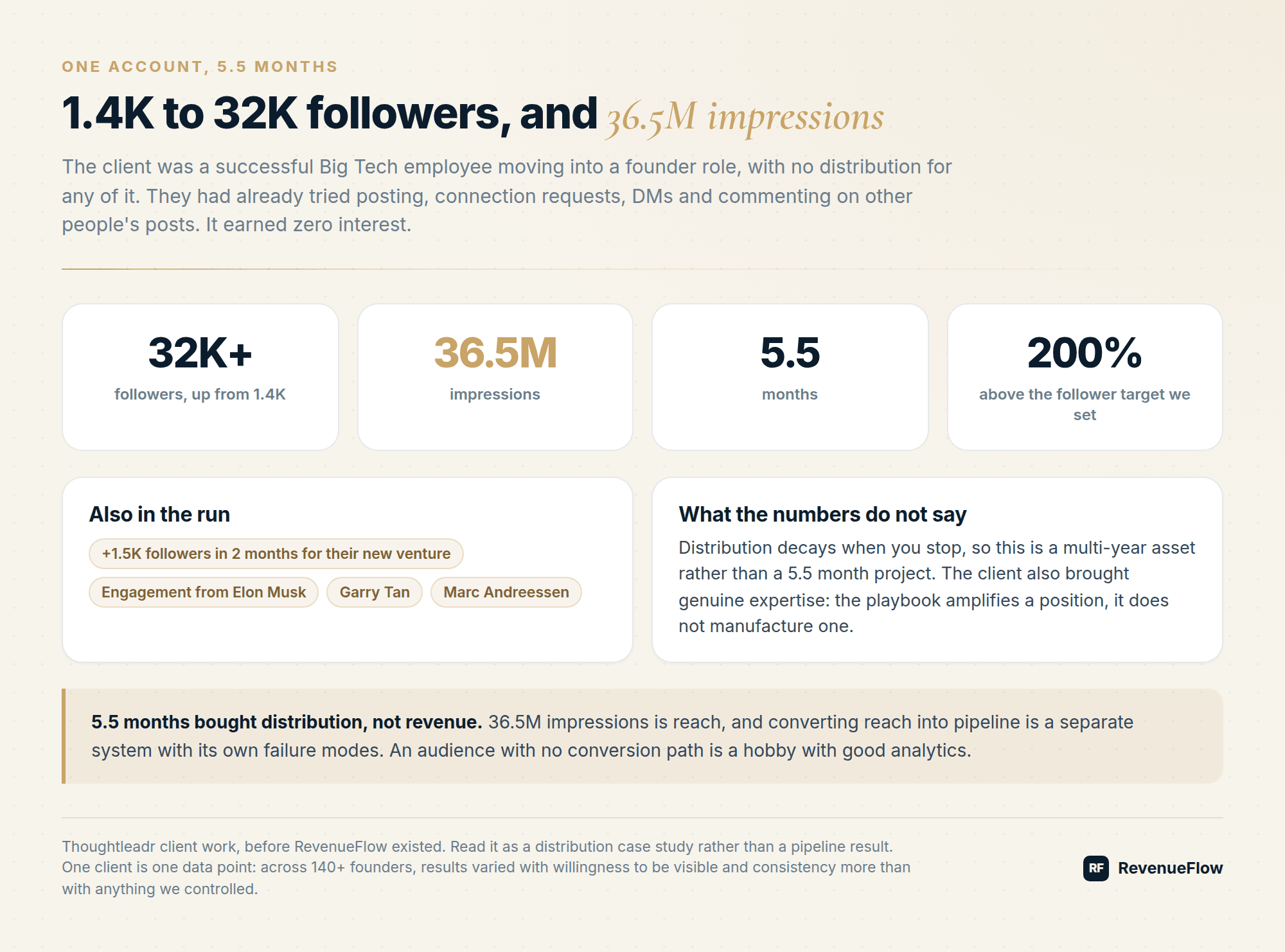
A three-phase playbook took one founder from 1.4K to more than 32K followers in 5.5 months and 36.5M impressions, 200% above target. Phase one defines story, audience, voice and three to four content zones. Phase two builds a research-led ideation, production and publishing workflow. Phase three reviews analytics weekly, monthly and quarterly.
Key takeaways
- The client went from 1.4K to more than 32K followers in 5.5 months, which was 200% above target.
- The account produced 36.5M impressions and drew engagement from Elon Musk, Garry Tan and Marc Andreessen.
- A second account for the client's new venture added 1.5K followers in 2 months on the same playbook.
- Phase one fixes story, audience, voice and three to four content zones before any publishing begins.
- Analytics are reviewed weekly and monthly while strategy is reviewed quarterly, because single-post performance is mostly noise.
- This was Thoughtleadr work, where 140+ founders captured more than 3 billion combined views, rather than a RevenueFlow client result.
Reviewed and updated September 5, 2026
1.4K to 32K Followers in 5.5 Months: The Distribution Playbook Behind 36.5M Impressions
One client went from 1.4K followers to more than 32K in 5.5 months, and one of the new followers was Marc Andreessen.
This was Thoughtleadr work, before RevenueFlow existed, so read it as a distribution case study rather than a pipeline result from our current business. At Thoughtleadr we helped 140+ founders capture more than 3 billion combined views, and this account was one of the cleaner runs.
I am writing it up because the playbook itself has held up, and because the numbers underneath it are more interesting than the follower count.
The starting position
The client was a successful Big Tech employee transitioning into a founder role. The mission was broad: create a movement toward digital freedom using Web3 and AI.
They had no distribution for any of it.
They had already tried the standard advice. Started posting online. Sent connections and DMs. Commented on other people's posts. It earned zero interest.
That failure mode is worth naming, because it is the most common one. Every tactic on that list is a distribution action. None of them is a distribution asset. Posting without a defined position produces content that is competent and forgettable, and commenting on other people's posts borrows an audience without giving them a reason to follow you home.
What came out
- 36.5M impressions
- Followers up from 1.4K to more than 32K, which was 200% above target
- +1.5K followers in 2 months for their new venture
- Engagement from Elon Musk, Garry Tan and Marc Andreessen
The three-phase playbook
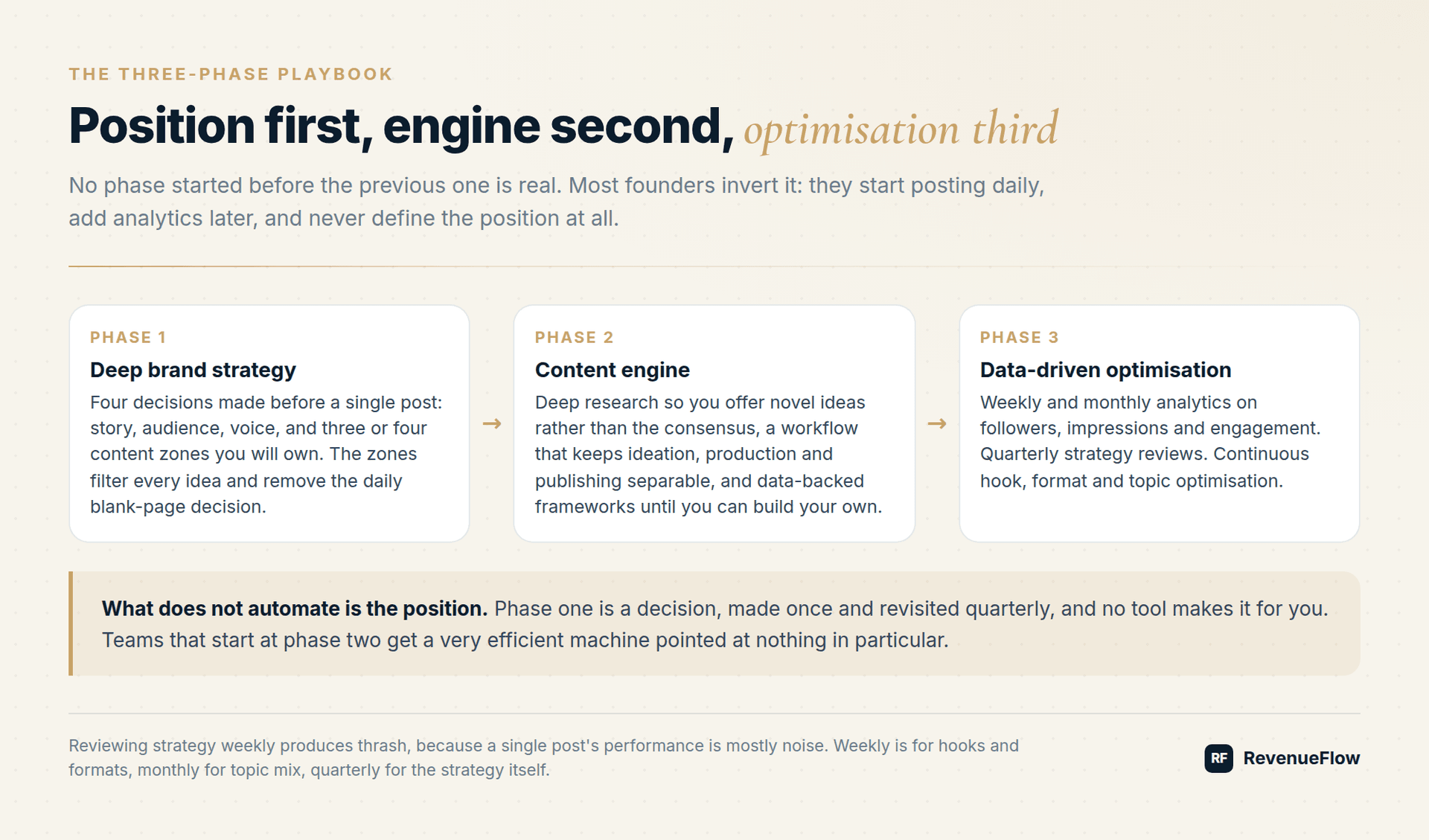
1. Deep brand strategy
Four decisions, made before a single post:
- Story. Where you started, where you are going, how you will get there.
- Audience. What pain you solve, and for whom specifically.
- Voice. Tone, style, and the balance between entertaining and educational.
- Content zones. Three or four focused territories you will own.
The content zones are the part people skip and the part that does the work. Three or four zones sound limiting and function as an engine. Every idea either fits a zone or gets discarded, which removes the daily "what should I post" decision that kills most founder accounts by week six. It also makes you legible: an audience can only follow you for a reason they can articulate.
This phase takes longer than it looks. Getting the story right is a research exercise about the person, not a copywriting exercise.
2. Content engine
Three components:
- Deep research on your topics, so you offer novel ideas rather than a restatement of the consensus.
- A streamlined workflow: ideation, then production, then publishing, as three separable stages.
- Data-backed frameworks at the start, used until you are good enough to build your own.
Separating the three stages is the mechanical trick. Ideation batched weekly, production batched, publishing scheduled. When those three collapse into one act performed daily, output quality tracks the founder's mood and the account dies during the first busy month.
The research component is what distinguishes an engine from a treadmill. Novel ideas require inputs the audience does not already have, which means reading, interviewing, or running experiments and reporting what happened. Volume alone reaches nobody.
3. Data-driven optimisation
- Quarterly strategy reviews to refine the content approach.
- Weekly and monthly analytics tracking on followers, impressions and engagement.
- Continuous hook, format and topic optimisation based on real-time audience feedback.
The cadence matters more than the metrics. Weekly is for tactical reads on hooks and formats. Monthly is for topic mix. Quarterly is for the strategy itself, including whether a content zone should be retired. Reviewing strategy weekly produces thrash, because a single post's performance is mostly noise.
What the numbers do not say
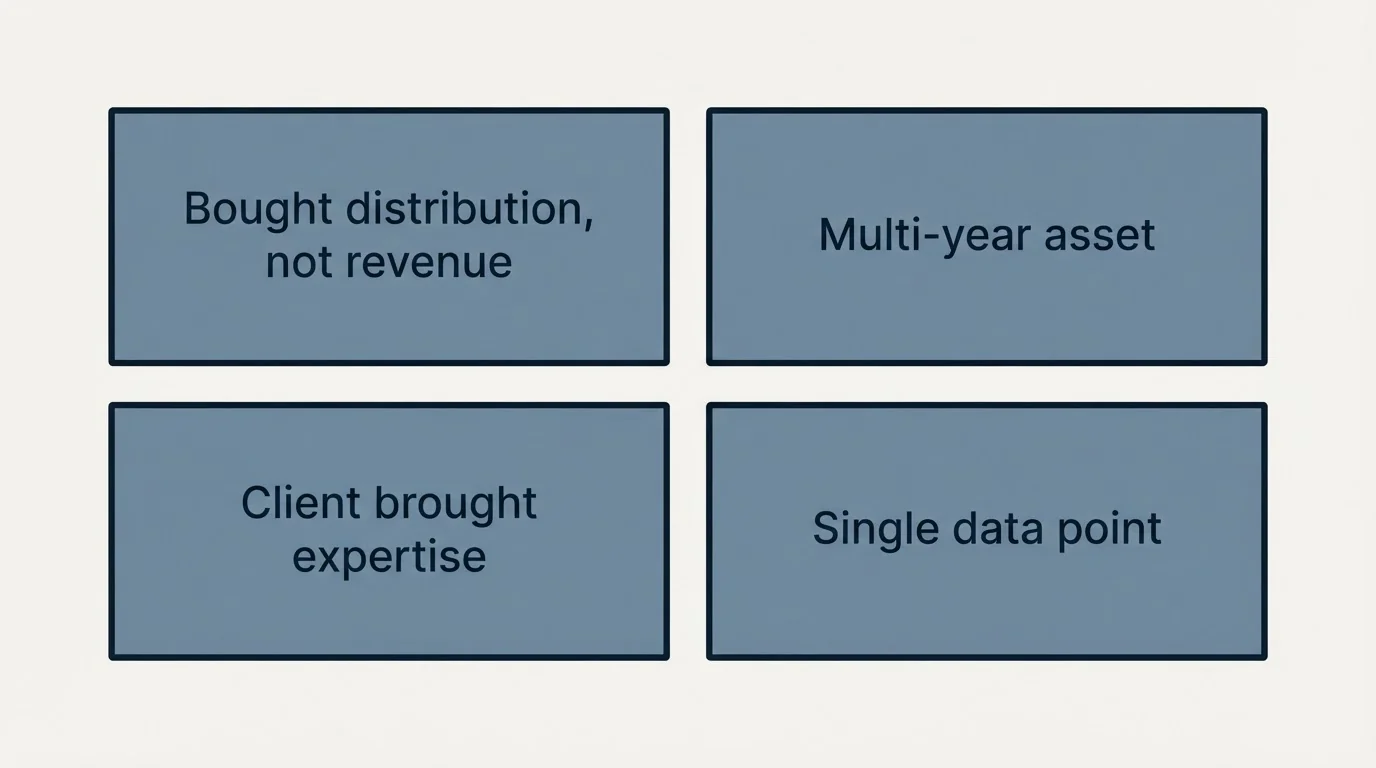
Four caveats I want stated properly, because the post version compressed them into one line.
- No: 5.5 months bought distribution, not revenue.
- No: This is a multi-year asset.
- No: The client brought genuine expertise.
- No: One client is one data point.
5.5 months bought distribution, not revenue. 36.5M impressions is reach. Converting reach into pipeline is a separate system with its own failure modes, which is the entire point of the view-to-value framework and of wiring content into outbound through a content-led outbound motion. An audience with no conversion path is a hobby with good analytics.
This is a multi-year asset. The 5.5 month number describes the growth phase of an account that has to keep publishing to hold its position. Distribution decays when you stop. Budget for the ongoing engine, not the launch.
The client brought genuine expertise. A Big Tech background and a real point of view about digital freedom were the raw material. The playbook amplifies a position. It does not manufacture one, and running it on top of nothing produces a well-organised account with nothing to say.
One client is one data point. We ran this across 140+ founders, and results varied with the founder's willingness to be visible and their consistency more than with anything we controlled. Engagement from named investors is a signal that the content reached the right graph, not a business outcome by itself.
Where automation fits, and where it does not
The engine in phase two is a workflow, and workflows can be tooled. Research aggregation, scheduling, analytics collection and repurposing across platforms all benefit from automation, and there is a real category of LinkedIn automation tools for the mechanical parts.
What does not automate is the position. Phase one is a decision, made once, revisited quarterly, and no tool makes it for you. Teams that start at phase two and skip phase one get a very efficient machine pointed at nothing in particular.
The same ordering shows up in demand generation generally, which is why so many broken lead generation systems turn out to be execution layers sitting on top of an undefined position.
If you are starting from 1.4K followers
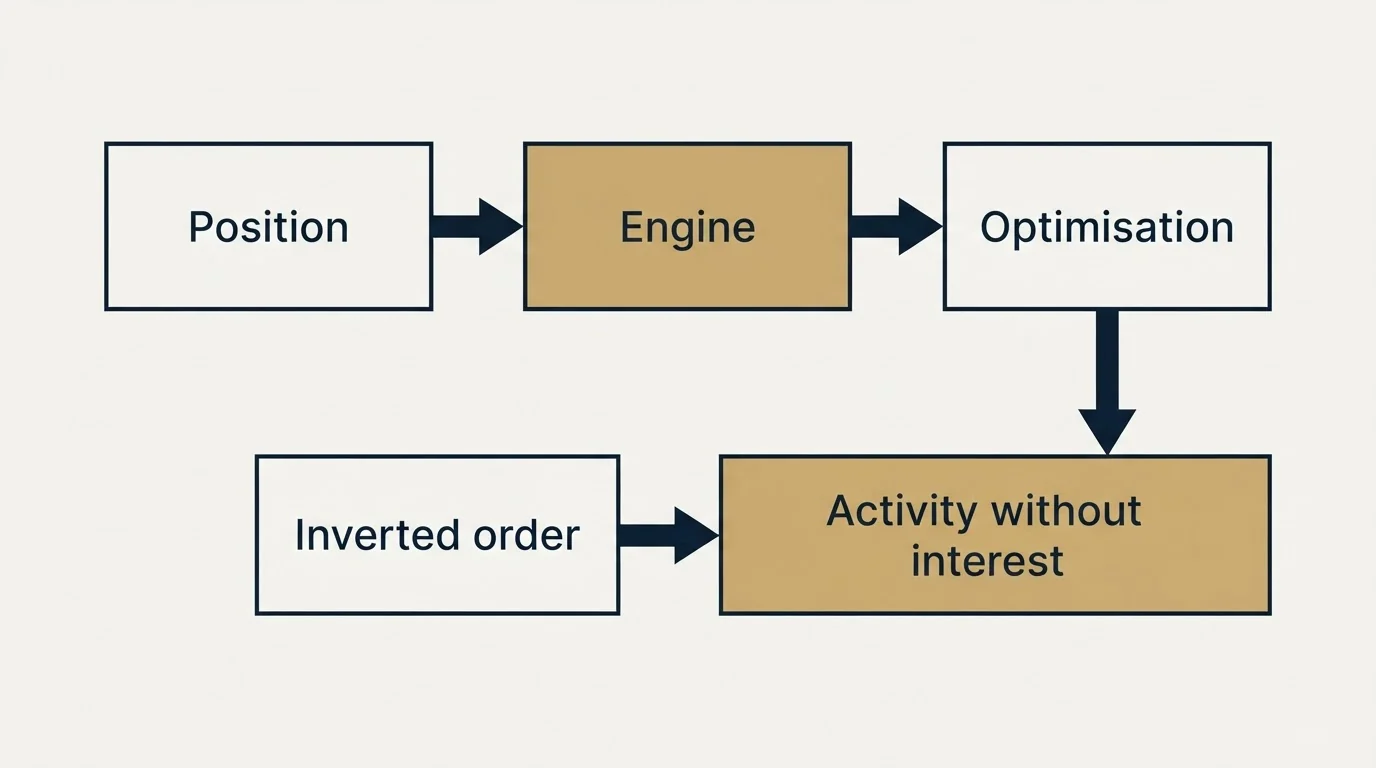
The sequence is the whole method. Position first, engine second, optimisation third, and no phase started before the previous one is real.
Most founders invert it. They start posting daily, add analytics later, and never define the position at all. That produces the exact result this client had before we started: activity, and zero interest. There are more patterns from the growth side in 15 lessons from growing to 100k followers, and if distribution is only half your plan, the outbound engine build is the other half.
It is a simple framework. Executing it is harder than it looks, mostly because phase one requires deciding what you are actually for.
Frequently Asked Questions
How long does it take to grow a LinkedIn following from scratch?
This client went from 1.4K to more than 32K in 5.5 months, which was 200% above the target we set. That pace assumed a founder with genuine domain expertise and consistent publishing. A realistic plan treats the first two months as calibration on hooks and formats, with compounding after that.
Do follower counts translate into revenue?
Not on their own. 36.5M impressions is reach, and converting reach into pipeline needs a separate conversion system: a clear offer, a capture path, and follow up. Distribution and monetisation are two builds, and the second one is the harder of the two.
The go-to-market spend breakdown shows which paid channels actually converted reach into pipeline, and which ones quietly burned budget.
What is a content zone?
One of three or four focused territories you commit to publishing within. The zones filter ideas, remove the daily blank-page decision, and make the account legible so an audience can describe why they follow you. More than four zones and the positioning dissolves.
How often should content strategy be reviewed?
Weekly and monthly for analytics on followers, impressions and engagement, and quarterly for the strategy itself. Reviewing strategy weekly is a mistake, because any single post's performance is mostly noise and reacting to it produces thrash.
Was this a RevenueFlow client?
No. This was Thoughtleadr work, before RevenueFlow, where we helped 140+ founders capture more than 3 billion combined views. The playbook carried over, and it now sits upstream of the outbound systems we build today.
RevenueFlow builds AI-native pipeline systems and you pay per qualified meeting, not a retainer. No paying for activity. You only pay when we book you a qualified sales meeting. See if you qualify.
Frequently asked questions.
Frequently asked questions- How long does it take to grow a LinkedIn following from scratch?
- This client went from 1.4K to more than 32K followers in 5.5 months, 200% above the target we set. That pace assumed a founder with genuine domain expertise publishing consistently. A realistic plan treats the first two months as calibration on hooks and formats, with compounding after that.
- Do follower counts translate into revenue?
- Not on their own. 36.5M impressions is reach, and converting reach into pipeline needs a separate system: a clear offer, a capture path, and follow up. Distribution and monetisation are two different builds, and the second is usually the harder one.
- What is a content zone?
- One of three or four focused territories you commit to publishing within. The zones filter ideas, remove the daily blank-page decision that kills most founder accounts, and make the account legible so an audience can articulate why they follow you. More than four and the positioning dissolves.
- How often should content strategy be reviewed?
- Weekly and monthly for analytics on followers, impressions and engagement, and quarterly for the strategy itself, including whether a content zone should be retired. Reviewing strategy weekly produces thrash, because any single post's performance is mostly noise.
- Was this a RevenueFlow client?
- No. This was Thoughtleadr work, before RevenueFlow, where the team helped 140+ founders capture more than 3 billion combined views. The playbook carried over and now sits upstream of the outbound systems RevenueFlow builds today.
About the author.

Fernando Cao is CEO at RevenueFlow, which builds and operates outbound revenue engines for B2B companies. Previously at Accenture Strategy. Studied at University of Bath.
Fernando Cao · CEO
Connect on LinkedIn →Explore more.
Ready to scale your outreach?
We build GTM engines that book real meetings. See the receipts.
Related articles.
ZoomInfo Renamed Its Ticker to GTM. It Now Trades Under $1B
ZoomInfo took the ticker GTM in May 2025. By late July 2026 it traded under $1B. Here is what the GTM software category is actually worth, with dates attached.
48 RevOps Rules Every Operator Should Know
All 48 RevOps rules across data, pipeline, forecasting, comp, reporting and alignment, with the reasoning behind the ones operators actually argue about.
ARR Became a Marketing Metric: How to Vet the Claim
Cluely retracted $7M and admitted to $5.2M. Decagon is valued at 128 times revenue. Here are the six questions that separate real revenue from a headline.
The Tel Aviv AI Map: 24 Companies and a $32B Exit
Google closed a $32B acquisition in Tel Aviv and 23 more AI companies sit within 3km. The map, the exit velocity behind it, and what it means for your stack.
We Burned $430K on Go-To-Market. Here Is What Survived
In 2025 we spent more than $430K testing go-to-market plays. Six survived. Here is what the money bought, what it did not, and what I would do differently.
The European GTM Tool Map: 33 Tools by City
HeyReach hit $10M with 23 people in Skopje. lemlist reached $53M with no primary VC. Here is the European GTM tooling map and what it changes for buyers.