We Burned $430K on Go-To-Market. Here Is What Survived
In 2025 we spent more than $430K testing go-to-market plays. Six survived. Here is what the money bought, what it did not, and what I would do differently.
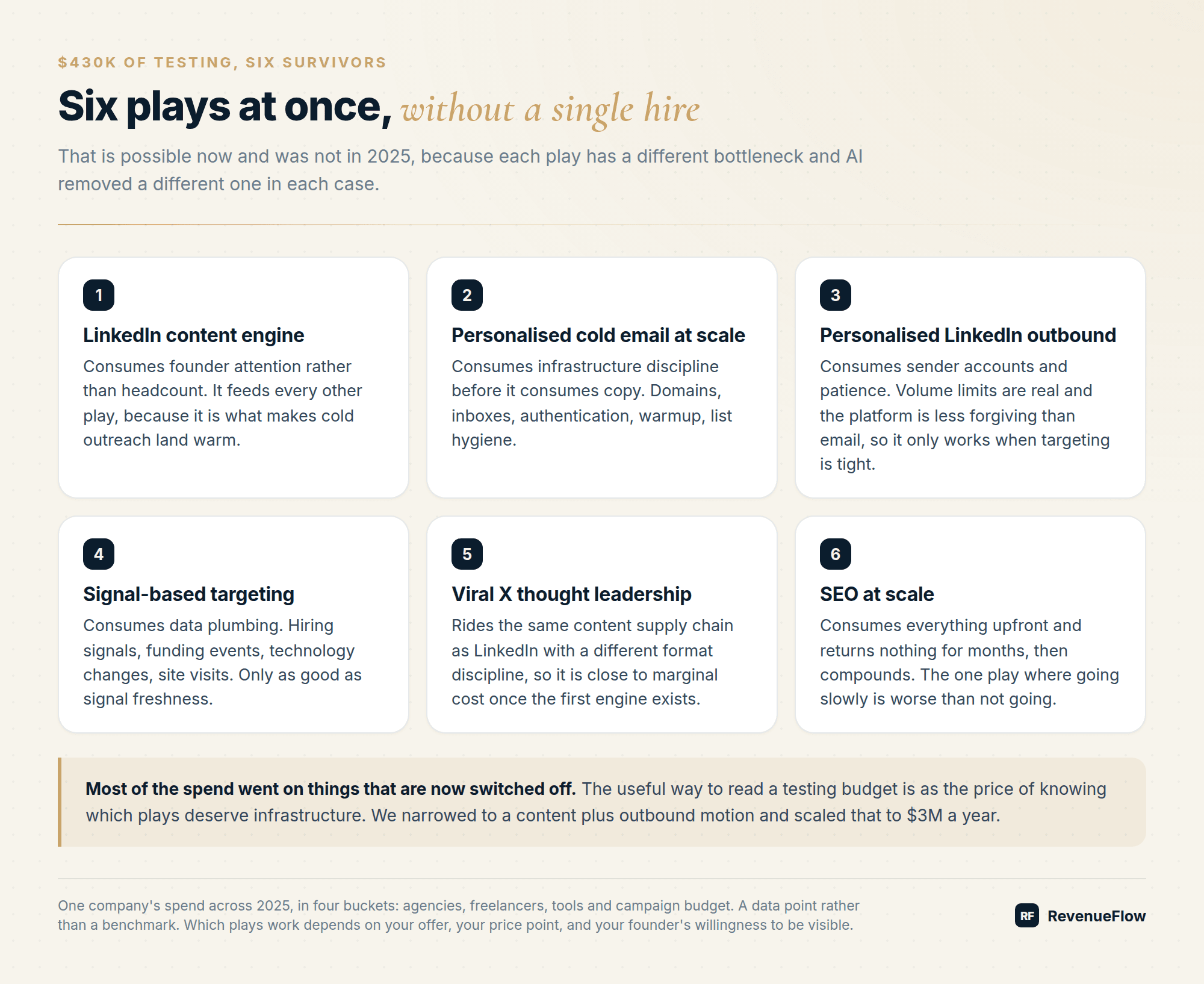
RevenueFlow spent more than $430K in 2025 testing go-to-market plays across agencies, freelancers, tools and campaigns. Six survived: LinkedIn content, personalised cold email, personalised LinkedIn outbound, signal-based targeting, an X thought leadership engine, and SEO at scale. Agencies, freelancers, unproven tools and headcount-led scaling did not.
Key takeaways
- RevenueFlow burned more than $430K on go-to-market testing in 2025 across agencies, freelancers, tools and campaign budget.
- The surviving motion was content plus outbound, which scaled the company to $3M a year in 2.5 years.
- Six plays now run simultaneously with no additional hires: LinkedIn content, cold email, LinkedIn outbound, signal-based targeting, X thought leadership and SEO at scale.
- A 50-person team serving 150+ clients showed that a labour-intensive service scales linearly at best.
- Three or more years of running every play manually was the precondition for automating any of it.
- $430K is one company's spend in one year and should not be treated as a budgeting benchmark.
Reviewed and updated September 5, 2026
We Burned $430K Testing Go-To-Market in One Year. Here Is What Survived.
In 2025 we burned through more than $430K executing go-to-market strategies. Agencies, freelancers, tech tools, campaigns. If it was a play, we tried it.
I am 26. We scaled a $3M a year AI GTM company in 2.5 years. At peak we ran a 50-person team and worked with 150+ clients, and the most expensive lesson in that period was how hard it is to scale a labour-intensive service.
Six plays survived. This is what the money bought, what it did not buy, and what I would do differently with the same budget.
What the $430K actually bought
I am not going to break that number into a tidy pie chart. The categories overlapped, several bets ran at once, and reconstructing a per-line attribution after the fact would be invention rather than accounting. Four buckets absorbed it: agencies, freelancers, tools, and campaign budget.
What we got in return was not a channel. It was a filter.
Most of the spend went on things that are now switched off. That sounds like waste, and part of it was, but the useful way to read a testing budget is as the price of knowing which plays deserve infrastructure. We eventually narrowed to a content plus outbound motion and scaled that to $3M a year. Everything else was the cost of finding it.
You cannot skip to the answer by reading someone else's. Which plays work depends on your offer, your price point, and your founder's willingness to be visible. What transfers is the testing method, not the winner.
The six plays that survived
For the first time, we run every go-to-market play we have ever executed at the same time, without making a single hire:
- A LinkedIn content engine that generates inbound pipeline
- Personalised cold email at scale
- Personalised LinkedIn outbound at scale
- Signal-based targeting
- A viral X thought leadership engine
- SEO at scale
All running simultaneously. That is possible now and was not in 2025 because each play has a different bottleneck, and AI removed a different one in each case.
The content engine consumes founder attention rather than headcount. The constraint is having something true to say and a workflow that publishes it consistently. It feeds every other play, because it is what makes cold outreach land warm. General shape: content-led outbound.
Cold email at scale consumes infrastructure discipline before it consumes copy. Domains, inboxes, authentication, warmup, list hygiene. Skip that layer and you produce a deliverability problem rather than a channel, which is why SPF, DKIM and DMARC is the least glamorous and most load-bearing part of the build.
LinkedIn outbound consumes sender accounts and patience. Volume limits are real and the platform is less forgiving than email, so it only works when targeting is tight. Tooling is the secondary question: see LinkedIn automation tools.
Signal-based targeting consumes data plumbing. Hiring signals, funding events, technology changes, site visits. It is only as good as signal freshness, and most of the work is wiring sources together rather than picking a vendor. Intent data is the entry point.
The X engine rides the same content supply chain as LinkedIn with a different format discipline, so it is close to marginal cost once the first engine exists.
SEO at scale consumes everything upfront and returns nothing for months, then compounds. It is the one play where going slowly is worse than not going.
- Yes: The content engine consumes founder attention rather than headcount
- Yes: Cold email at scale consumes infrastructure discipline before it consumes copy
- Yes: LinkedIn outbound consumes sender accounts and patience
- Yes: Signal-based targeting consumes data plumbing
- Yes: The X engine rides the same content supply chain as LinkedIn with a different format discipline
- Yes: SEO at scale consumes everything upfront and returns nothing for months, then compounds
What did not survive
Four things, and they are the honest half of the story.
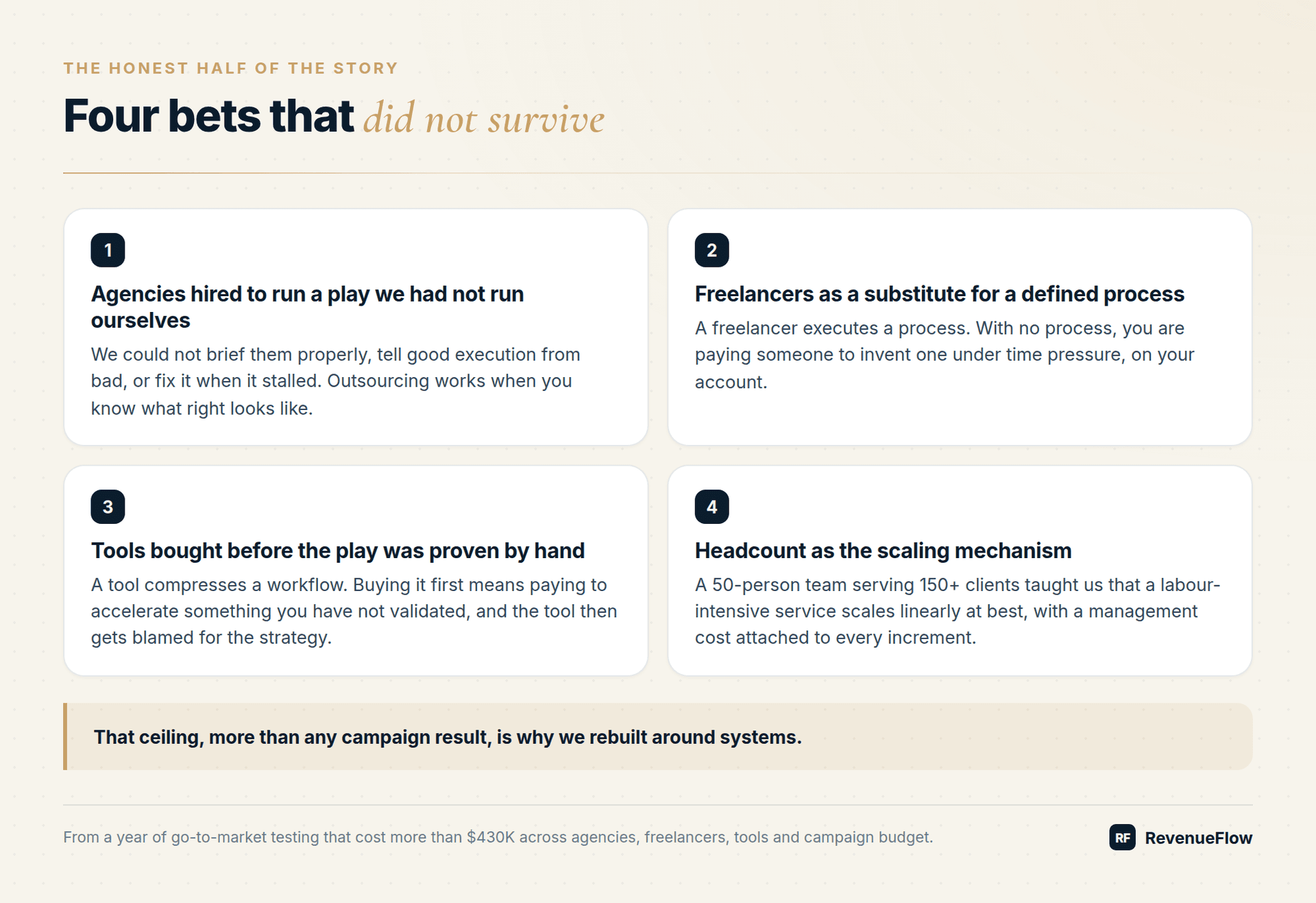
Agencies hired to run a play we had not run ourselves. We could not brief them properly, tell good execution from bad, or fix it when it stalled. Outsourcing works when you know what right looks like. Understand what agencies charge and for what before deciding whether a play should be internal.
Freelancers as a substitute for a defined process. A freelancer executes a process. With no process, you are paying someone to invent one under time pressure, on your account.
Tools bought before the play was proven by hand. A tool compresses a workflow. Buying it first means paying to accelerate something you have not validated, and the tool then gets blamed for the strategy.
Headcount as the scaling mechanism. A 50-person team serving 150+ clients taught us that a labour-intensive service scales linearly at best, with a management cost attached to every increment. That ceiling, more than any campaign result, is why we rebuilt around systems.
Why three years of manual work was the precondition
All of my co-founders, Tim Carden, Ben Carden, Hosun Chung and I, now spend more than 80% of our time living in AI. Vibe coding in terminals, testing new GTM tools, building agents that actually work.
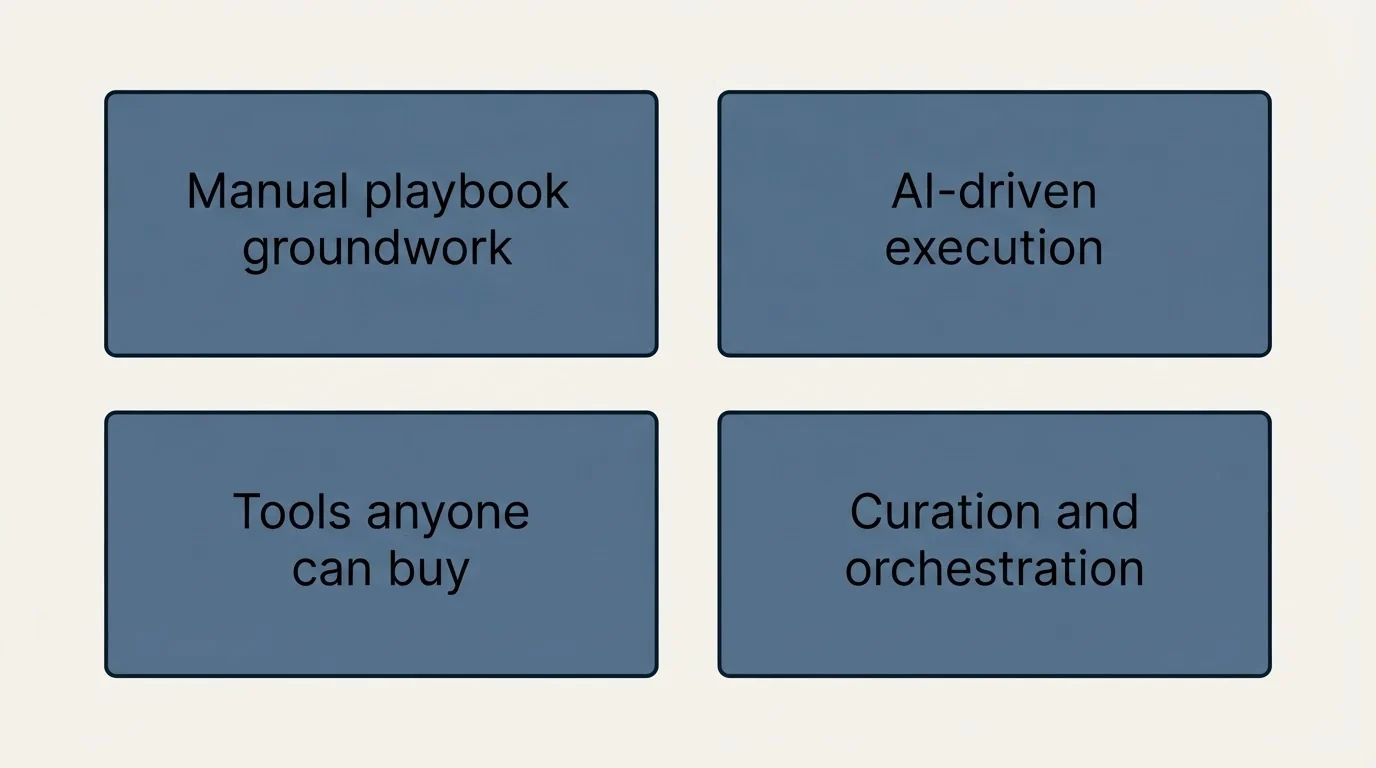
That only functions because we spent 3+ years doing all of it manually first. Countless hours and mistakes. We know what works, what does not, and how to wire it together, because we ruthlessly tested every play by hand before automating it.
Alex Hormozi put the general version of this well: "When there is infinite information, the value is in the selection and curation because no one has the time to consume all of it to figure out what's good."
Y Combinator's recent Request for Startups made the same bet from the other direction, calling for AI-native agencies, on the basis that "agencies of the future will look more like software companies. And they'll scale far bigger than any agencies that exist in these fragmented markets today."
The tools exist and you can buy all of them yourself. The curation and orchestration, knowing how to wire them so the whole thing works, is the part moving too fast for most operators to track alongside their day job. If you would rather buy the assembled version, that is what a cold email agency should be selling you, and it is fair to ask any vendor whether they run their own plays before selling them.
The caveat I want on the record
This is one company's spend in one year. It is not a benchmark and you should not budget against it. Our price point, our ICP and our tolerance for being publicly wrong all shaped where the money went. A team selling a $500 a month product would have burned it differently.
What I would do with $430K again
Four rules, in order.
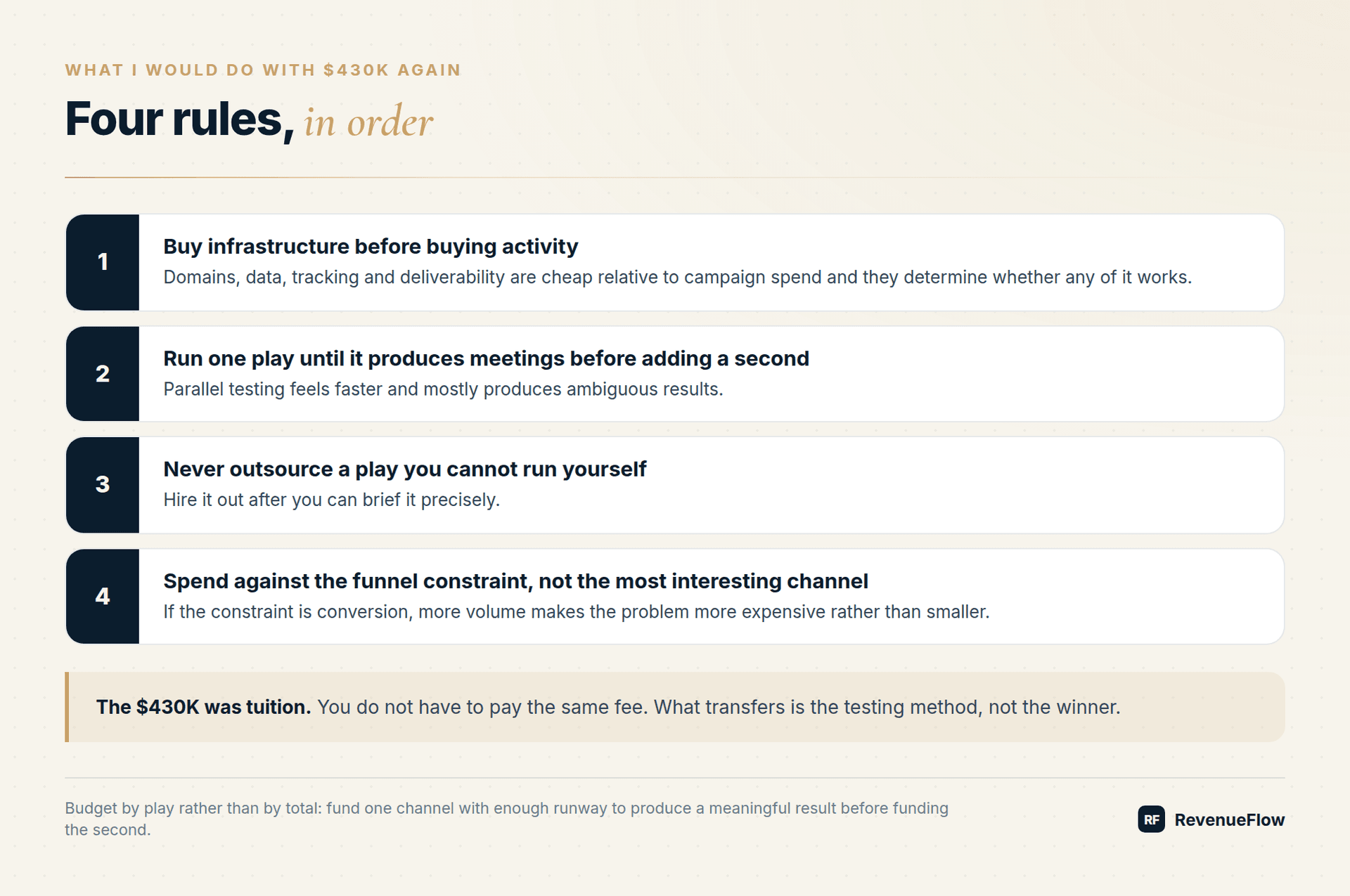
- Buy infrastructure before buying activity. Domains, data, tracking and deliverability are cheap relative to campaign spend and they determine whether any of it works.
- Run one play until it produces meetings before adding a second. Parallel testing feels faster and mostly produces ambiguous results.
- Never outsource a play you cannot run yourself. Hire it out after you can brief it precisely.
- Spend against the funnel constraint, not against the most interesting channel. If the constraint is conversion, more volume makes the problem more expensive rather than smaller.
For what came out the other side, the full outbound engine build and the seven-layer GTM AI stack are the closest things to a blueprint we have published.
The $430K was tuition. You do not have to pay the same fee.
Frequently Asked Questions
How much should a B2B company budget for go-to-market testing?
There is no clean number, and our $430K is a data point rather than a benchmark. Budget by play instead: fund one channel with enough runway to produce a meaningful result, usually a few months of consistent volume, before funding the second. Parallel underfunded tests produce ambiguity.
Did the $430K produce a return?
Indirectly. The direct output was a filter that identified a content plus outbound motion, which then scaled to $3M a year. Most of the individual bets inside that spend are switched off today, which is the normal shape of a testing budget rather than a failure.
Why stop scaling with headcount?
A 50-person team serving 150+ clients showed us that labour-intensive services scale linearly at best, with management overhead on every increment. Systems have a different cost curve, and that point drove the rebuild.
RevenueFlow builds AI-native pipeline systems and you pay per qualified meeting, not a retainer. No paying for activity. You only pay when we book you a qualified sales meeting. See if you qualify.
Frequently asked questions.
Frequently asked questions- How much should a B2B company budget for go-to-market testing?
- There is no clean number, and the $430K figure here is one company's data point rather than a benchmark. A more useful frame is to budget by play: fund one channel with enough runway to produce a meaningful result, usually a few months of consistent volume, before funding a second. Parallel underfunded tests produce ambiguity.
- Did the $430K produce a return?
- Indirectly. The direct output was a filter that identified a content plus outbound motion, which then scaled to $3M a year. Most of the individual bets inside that spend are switched off today, which is the normal shape of a testing budget rather than a failure.
- Why stop scaling a service business with headcount?
- A 50-person team serving 150+ clients showed that labour-intensive services scale linearly at best, with management overhead attached to every increment of growth. Systems have a different cost curve. That structural ceiling, rather than any single campaign result, drove the rebuild around automation.
- Can a small team run six go-to-market plays at once?
- Now, yes, because each play has a different bottleneck and AI removed a different one in each case. The precondition is having run all six manually first. Running six plays you have never executed by hand produces six shallow implementations rather than one working system.
- What was the biggest waste inside the $430K?
- Hiring agencies to run plays we had never run ourselves. Without first-hand experience we could not brief them properly, could not distinguish good execution from bad, and could not fix a stalled campaign. Outsourcing works after you know what right looks like, not before.
About the author.

Fernando Cao is CEO at RevenueFlow, which builds and operates outbound revenue engines for B2B companies. Previously at Accenture Strategy. Studied at University of Bath.
Fernando Cao · CEO
Connect on LinkedIn →Explore more.
Ready to scale your outreach?
We build GTM engines that book real meetings. See the receipts.
Related articles.
Smartlead Hit $20M ARR Bootstrapped After 11 Failures
Smartlead crossed $20M ARR in 2025 with no outside funding. Here is the five-part go-to-market playbook behind it, and the caveat that decides if you can copy it.
ZoomInfo Renamed Its Ticker to GTM. It Now Trades Under $1B
ZoomInfo took the ticker GTM in May 2025. By late July 2026 it traded under $1B. Here is what the GTM software category is actually worth, with dates attached.
The 15 Most Valuable AI Companies Founded After ChatGPT
The 15 most valuable AI companies founded after ChatGPT are worth about $160B. The top sales agent company ranks last at $1.2B, and the gap has a cause.
Per-Seat Pricing Is Dying: The Market Is Pricing the Funeral
Six go-to-market software companies lost $224B in 19 months. Every one ships AI, so AI is not the variable. Seat pricing is, and HubSpot proved it publicly.
The Paris AI Map: 23 Companies and $35B
23 AI companies, more than $35B of reported value, and 10 of them inside one 2km circle. Here is the Paris AI map and why the density is the real asset.
We Spent $100K Testing Sales Tech. 8 Layers Survived
There are 4,664 tools in the sales tech market. We spent about $100,000 testing them and kept eight layers, in a fixed order, with one owner each.