Smartlead Hit $20M ARR Bootstrapped After 11 Failures
Smartlead crossed $20M ARR in 2025 with no outside funding. Here is the five-part go-to-market playbook behind it, and the caveat that decides if you can copy it.
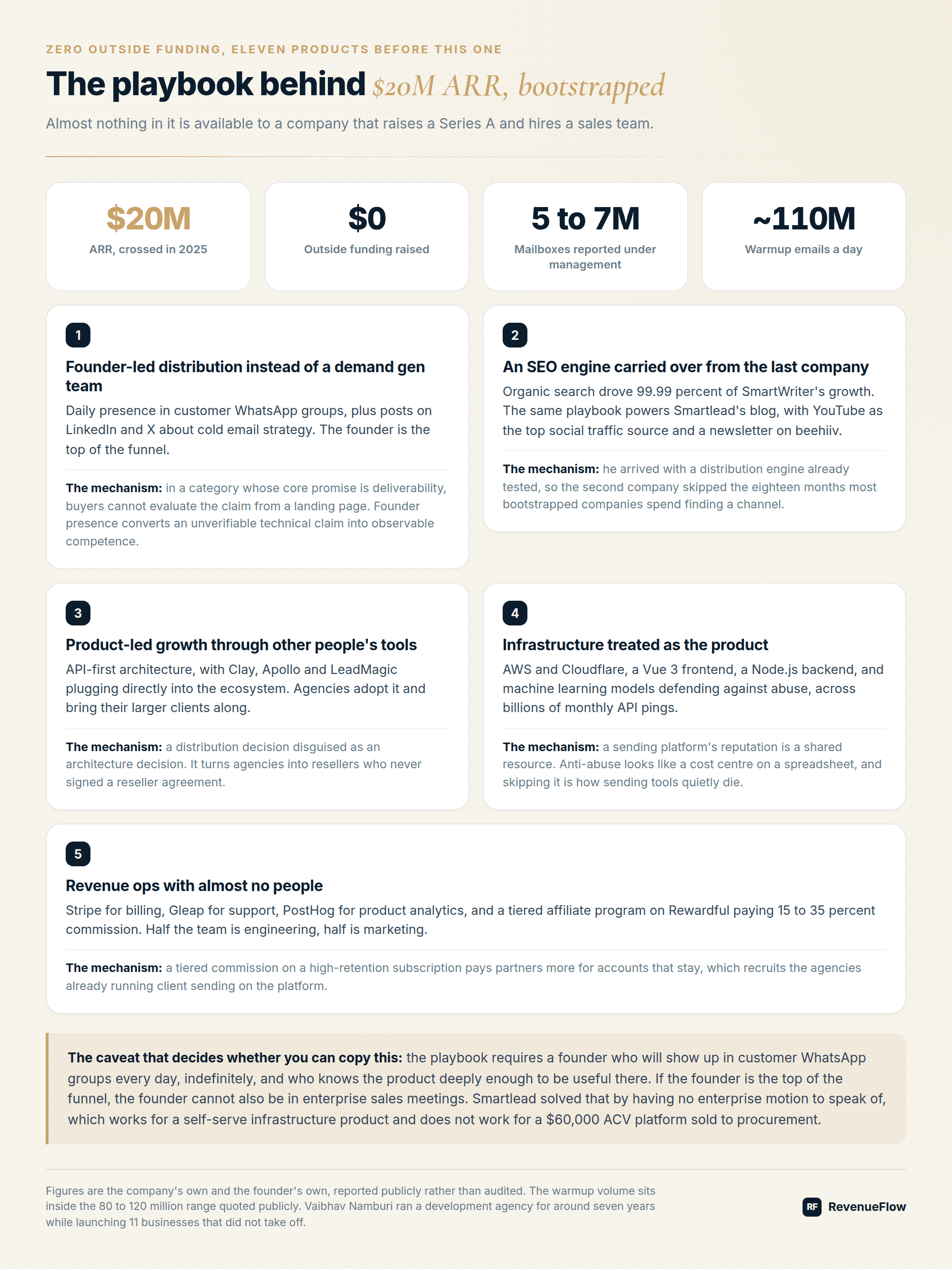
Smartlead reached a reported $20 million ARR in 2025 without outside funding through five moves: daily founder-led distribution in place of a demand gen team, an SEO engine reused from a previous product, API-first architecture that turned adjacent vendors into channels, infrastructure treated as the product, and a tiered affiliate program instead of a sales team.
Key takeaways
- Smartlead crossed a reported $20 million ARR in 2025 with zero outside funding, after founder Vaibhav Namburi launched 11 businesses that did not reach scale.
- The platform reports managing five to seven million mailboxes and sending on the order of 110 million warmup emails a day, inside a publicly quoted 80 to 120 million range.
- Organic search drove 99.99 percent of the growth of SmartWriter, the founder's earlier product, and the same playbook was carried over to Smartlead.
- API-first architecture let Clay, Apollo, and LeadMagic plug in directly, turning adjacent vendors and agencies into a distribution channel with no reseller agreement.
- A tiered affiliate program on Rewardful pays 15 to 35 percent commission, and the team is split roughly half engineering and half marketing.
- The playbook depends on a founder who appears in customer WhatsApp groups daily, which caps the model at whatever the founder's calendar allows and rules out an enterprise motion.
Reviewed and updated September 5, 2026
Smartlead Hit $20M ARR Bootstrapped After 11 Failed Businesses
Zero outside funding. Eleven products that did not reach scale before this one. I mapped the go-to-market playbook behind it, because almost nothing in it is available to a company that raises a Series A and hires a sales team.
The numbers below are the company's own and the founder's own, reported publicly rather than audited. I have kept the self-reported framing because that is what they are.
The scale it operates at
Vaibhav Namburi taught himself to code and ran a development agency for around seven years while launching 11 businesses that did not take off, including recruitment platforms, remote work tools, and e-commerce ventures. Smartlead crossed $20 million in ARR in 2025.
The platform reports managing between five and seven million mailboxes and sending on the order of 110 million warmup emails a day, a figure that sits inside the 80 to 120 million range the company has quoted publicly. Warmup traffic at that volume is a genuine engineering problem before it is a product feature, which turns out to matter for the whole playbook.
- Yes: Founder-led distribution instead of a demand gen team
- Yes: An SEO engine carried over from the last company
- Yes: Product-led growth through other people's tools
- Yes: Infrastructure treated as the product
- Yes: Revenue ops with almost no people
1. Founder-led distribution instead of a demand gen team
Vaibhav shows up in WhatsApp groups with customers daily. He posts on LinkedIn and X about cold email strategy. There is no demand generation team, because the founder is the top of the funnel.
The mechanism underneath is worth naming, because "post more" is not the lesson. In a category where the product's core promise is deliverability, buyers cannot evaluate the claim from a landing page. Every vendor says the same sentence. What a buyer can evaluate is whether the person building it understands the failure modes in detail, live, in a group chat, when something breaks at 2am.
Founder presence substituted for a demand gen team because it was doing a job a demand gen team cannot do: converting an unverifiable technical claim into observable competence. That is also the argument behind content-led outbound, and it is the reason the same tactic fails for founders who post polished summaries rather than specifics.
2. An SEO engine carried over from the last company
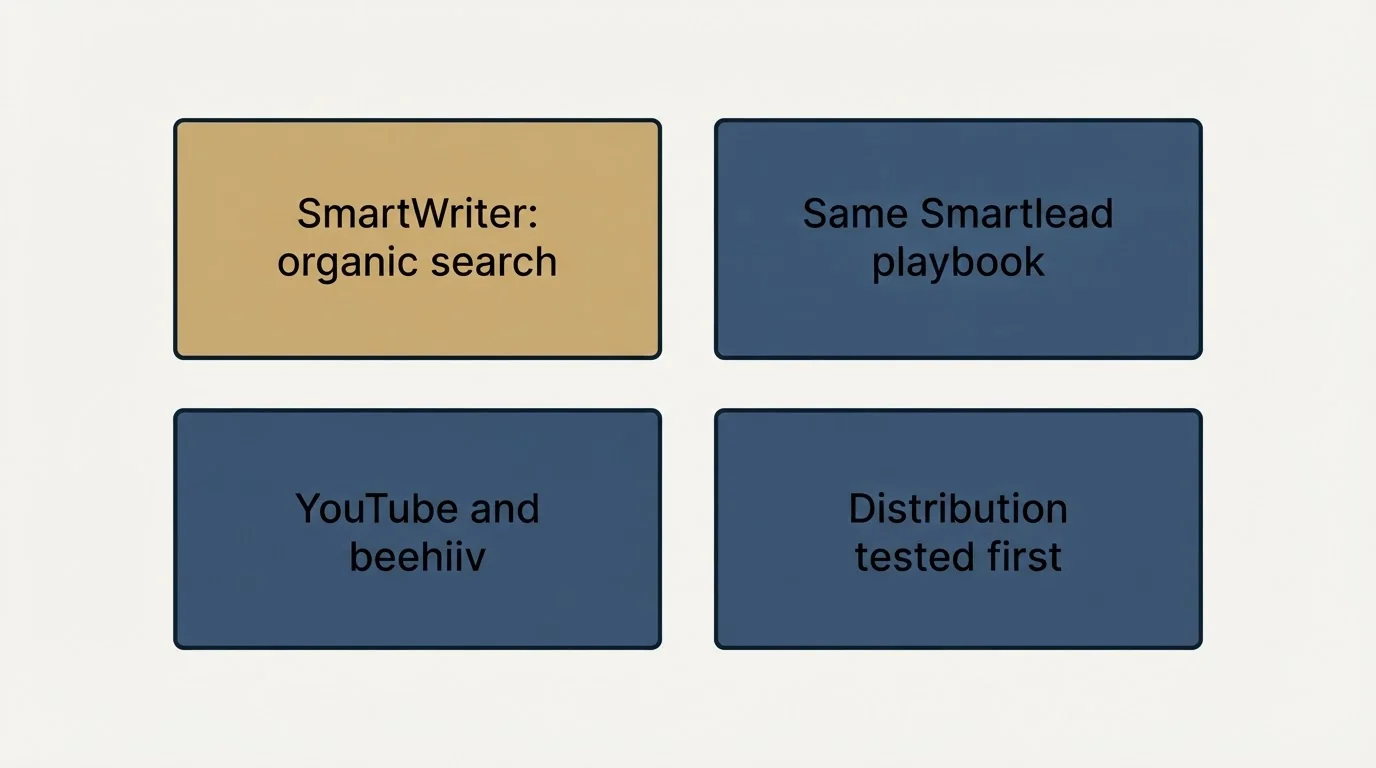
Organic search drove 99.99 percent of SmartWriter's growth, Vaibhav's earlier product. The same playbook powers Smartlead's blog, with YouTube as the top social traffic source and a newsletter on beehiiv.
The reusable part is not the channel. It is that he arrived at Smartlead with a distribution engine already tested on a different product, so the second company skipped the eighteen months most bootstrapped companies spend discovering which channel works. Eleven failures are usually described as a resilience story. Read commercially, they were channel experiments paid for in advance.
3. Product-led growth through other people's tools
API-first architecture, with Clay, Apollo, and LeadMagic plugging directly into the ecosystem. Agencies adopt it and then bring their larger clients along.
This is the piece most cold email platforms miss, and it is a distribution decision disguised as an architecture decision. Being the easiest platform to call from someone else's product turns every adjacent vendor into an unpaid channel, and it turns agencies into resellers who never signed a reseller agreement. An agency that has wired Smartlead into its own delivery process does not switch when a competitor launches a nicer inbox view.
If you are choosing between platforms on features rather than API surface, our comparisons of Instantly and Smartlead and lemlist and Smartlead cover the day-to-day differences, and the alternatives worth testing covers the rest of the category.
4. Infrastructure treated as the product
AWS and Cloudflare, a Vue 3 frontend, a Node.js backend, and machine learning models defending against abuse, across billions of monthly API pings.
Abuse defence deserves a sentence of its own. A sending platform's reputation is a shared resource, so every spammer it fails to catch degrades deliverability for every legitimate customer. Building anti-abuse into the platform is a product feature that looks like a cost centre on a spreadsheet. Skipping it is how sending tools quietly die, and it is the same reason email deliverability in 2026 is mostly a question about infrastructure rather than copy.
5. Revenue ops with almost no people
Stripe for billing, Gleap for support, PostHog for product analytics, and a tiered affiliate program on Rewardful paying 15 to 35 percent commission. Half the team is engineering, half is marketing. That is the whole company.
The affiliate program is the quiet lever. A tiered commission on a subscription product with high retention pays partners more for accounts that stay, which recruits the people best placed to keep them: the agencies already running client sending on the platform. It is a sales team that costs nothing until it produces, which is the same structural logic behind paying a demand generation agency or a cold email agency on outcomes instead of retainer.
The caveat that decides whether you can copy this
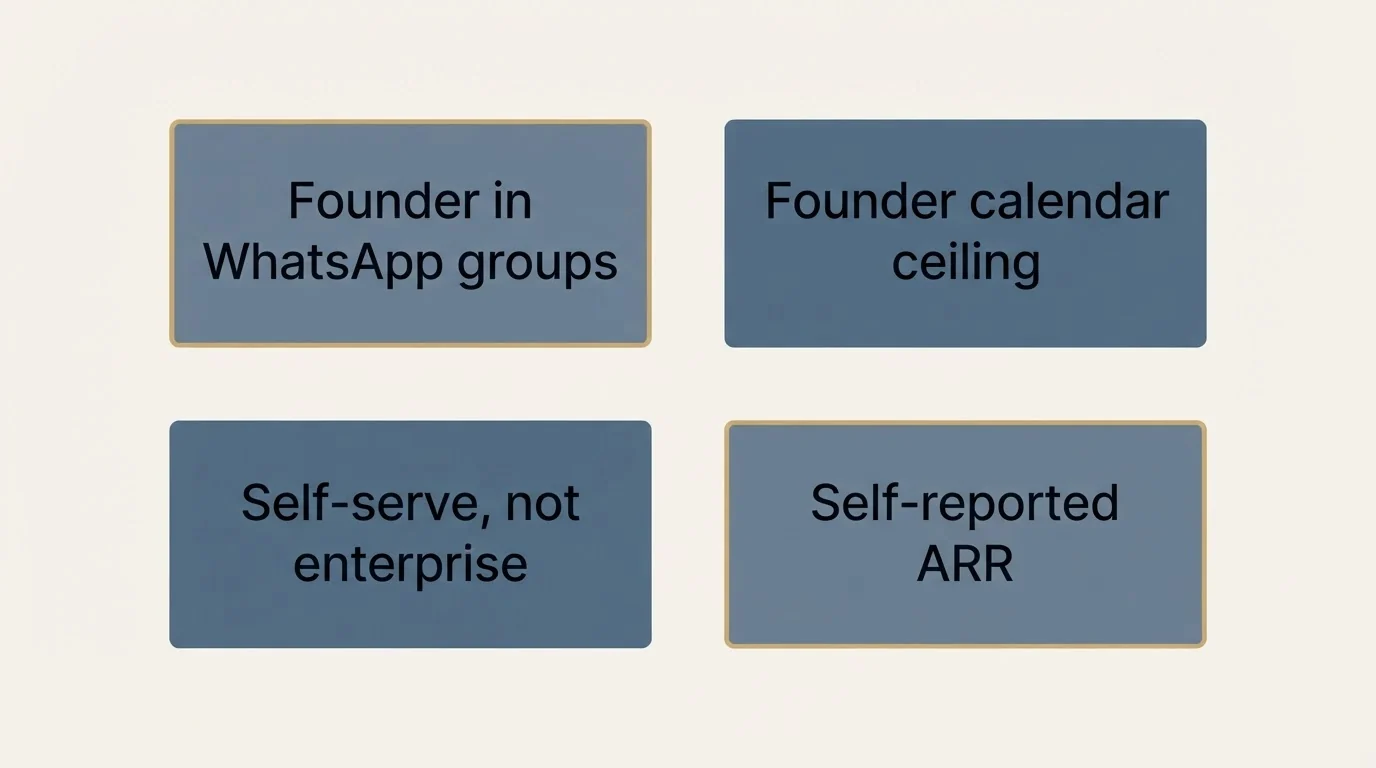
This playbook requires a founder who will show up in customer WhatsApp groups every day, indefinitely, and who knows the product deeply enough to be useful there.
That is not a mindset. It is a real constraint with a real cost. If the founder is the top of the funnel, the founder cannot also be in enterprise sales meetings, and the company inherits a hard ceiling on the founder's calendar. Smartlead solved that by having no enterprise motion to speak of, which works for a self-serve infrastructure product and does not work for a $60,000 ACV platform sold to procurement.
The second caveat is the numbers. Bootstrapped ARR figures are self-reported by definition, with no filing behind them. Nothing here is disputed and the founder has been consistent about it publicly, but treat the whole set as reported rather than verified. That habit is worth keeping generally, since vendor revenue claims are now a marketing surface.
What actually transfers
Three things, in order of usefulness.
Bring a distribution engine with you rather than discovering one. Make your product the easiest thing in your category to call from someone else's software. And pay partners on retention rather than on signups, so the incentive matches the business model.
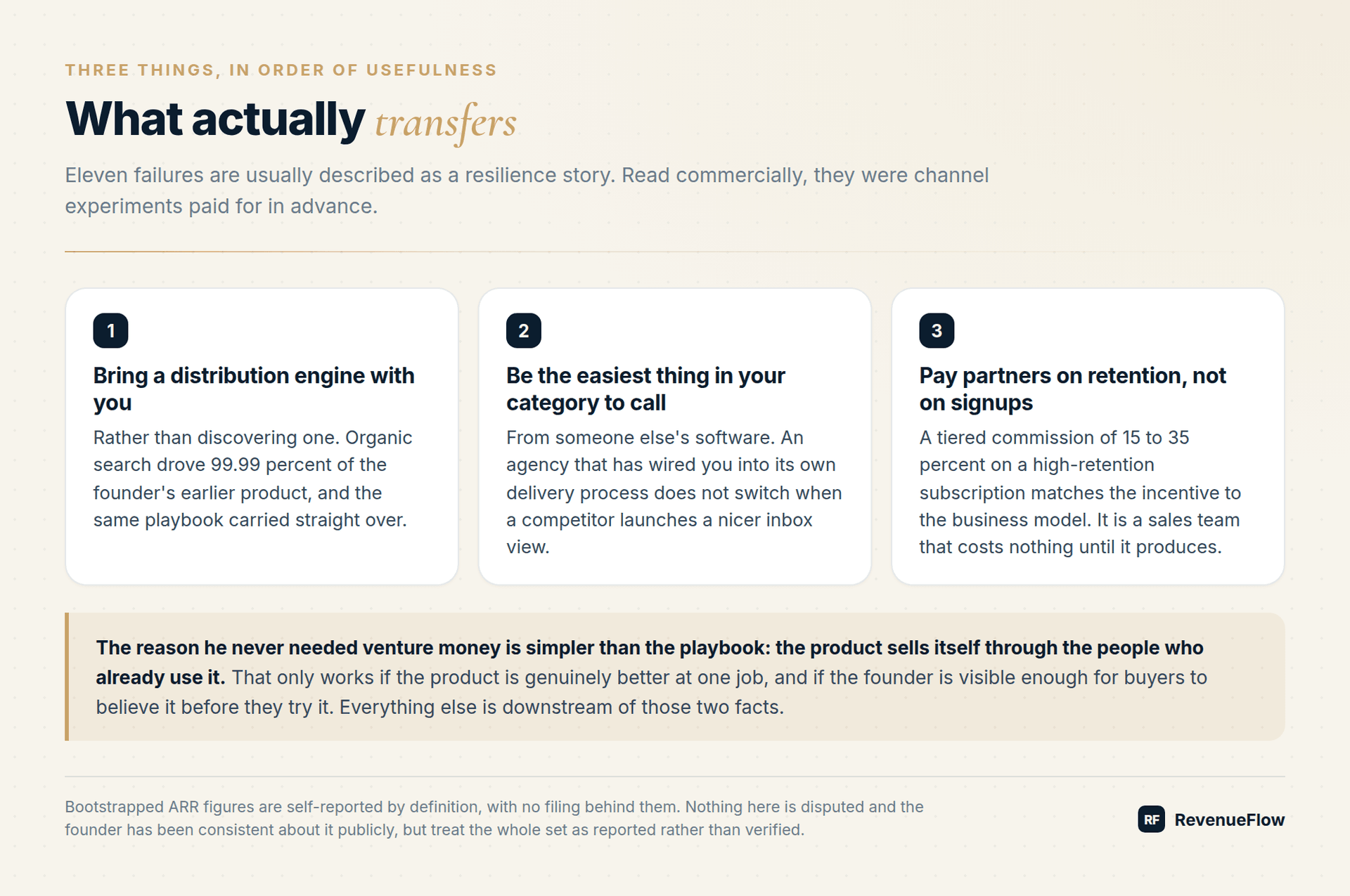
The reason he never needed venture money is simpler than the playbook: the product sells itself through the people who already use it. That only works if the product is genuinely better at one job, and if the founder is visible enough for buyers to believe it before they try it. Everything else on this list is downstream of those two facts. If you are budgeting against it, what every cold email tool costs is the price side of the same picture.
RevenueFlow builds AI-native pipeline systems and you pay per qualified meeting, not a retainer. No paying for activity. You only pay when we book you a qualified sales meeting. See if you qualify.
Frequently asked questions.
Frequently asked questions- How did Smartlead reach $20M ARR without raising money?
- Through founder-led distribution rather than a demand gen team, an SEO engine already proven on the founder's earlier product, API-first architecture that made adjacent tools into channels, heavy investment in sending infrastructure, and a tiered affiliate program paying 15 to 35 percent. The team is roughly half engineering and half marketing.
- Is Smartlead's $20M ARR figure verified?
- No. It is self-reported and consistently stated publicly by the founder, with no filing behind it, which is normal for a bootstrapped private company. Nothing about it is disputed, but treat it as reported rather than audited. The same caution applies to most private vendor revenue claims you will read this year.
- Can a B2B company copy the founder-led distribution playbook?
- Only if the founder will show up in customer conversations daily and knows the product deeply enough to be useful there. That is a real constraint, not a mindset. If the founder is the top of the funnel, the founder cannot also run enterprise sales, so the model suits self-serve products more than high-ACV platforms sold to procurement.
- Why does API-first architecture matter for a cold email platform?
- Because it converts other companies' products into distribution. When Clay, Apollo, and LeadMagic can call your platform directly, every adjacent vendor becomes an unpaid channel and agencies become resellers who never signed an agreement. An agency that has wired your platform into its delivery process does not switch for a nicer interface.
About the author.

Tim Carden is CMO / CTO at RevenueFlow, which builds and operates outbound revenue engines for B2B companies. Studied at McGill University.
Tim Carden · CMO / CTO
Connect on LinkedIn →Explore more.
Ready to scale your outreach?
We build GTM engines that book real meetings. See the receipts.
Related articles.
We Burned $430K on Go-To-Market. Here Is What Survived
In 2025 we spent more than $430K testing go-to-market plays. Six survived. Here is what the money bought, what it did not, and what I would do differently.
ZoomInfo Renamed Its Ticker to GTM. It Now Trades Under $1B
ZoomInfo took the ticker GTM in May 2025. By late July 2026 it traded under $1B. Here is what the GTM software category is actually worth, with dates attached.
The 15 Most Valuable AI Companies Founded After ChatGPT
The 15 most valuable AI companies founded after ChatGPT are worth about $160B. The top sales agent company ranks last at $1.2B, and the gap has a cause.
Per-Seat Pricing Is Dying: The Market Is Pricing the Funeral
Six go-to-market software companies lost $224B in 19 months. Every one ships AI, so AI is not the variable. Seat pricing is, and HubSpot proved it publicly.
The Paris AI Map: 23 Companies and $35B
23 AI companies, more than $35B of reported value, and 10 of them inside one 2km circle. Here is the Paris AI map and why the density is the real asset.
We Spent $100K Testing Sales Tech. 8 Layers Survived
There are 4,664 tools in the sales tech market. We spent about $100,000 testing them and kept eight layers, in a fixed order, with one owner each.