RevOps vs Sales Ops: Who Owns Which Decision
Scope tells you which teams each function may ask questions of. Ownership decides whose answer wins, and that is the distinction worth writing down.
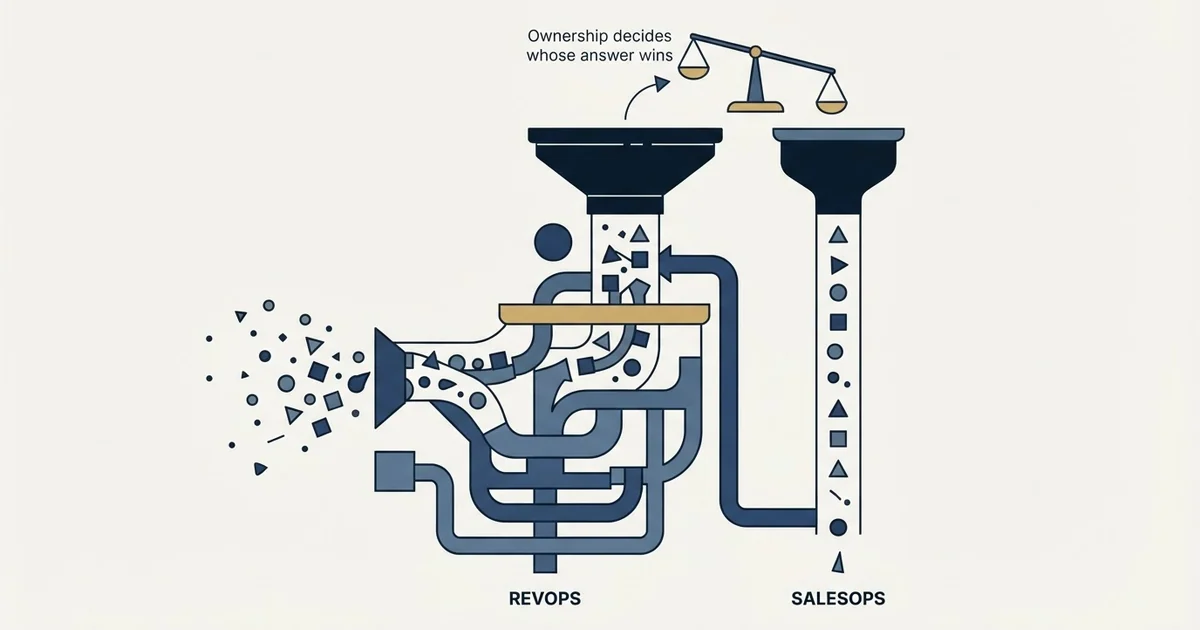
Sales operations sits inside the sales organisation and owns the plan mechanics, stage enforcement and the forecast process. Revenue operations spans marketing, sales and customer success, and owns what crosses a handoff: shared definitions, field contracts, precedence rules and routing. Neither owns the forecast itself, which belongs to the sales leader.
Key takeaways
- Scope language is agreed by everyone and settles nothing, because coverage tells you which teams a function may question while ownership decides whose answer wins.
- The most contested decision is what counts as a qualified lead, and it belongs to the function that spans both sides of the handoff rather than to either side.
- The tell that a company needs the second function is that the figures it argues about cross a boundary, not that it has reached a particular headcount.
- A retitling that widens the remit without widening the authority produces a reporting service desk with a larger catchment and no fixed definitions.
Reviewed and updated September 2, 2026
A marketing team reports 400 qualified leads for the quarter. The sales team says it received 120 worth working. Both counts come out of the same system, both are defensible, and the meeting to reconcile them ends with an agreement to align better next quarter.
Nobody in that meeting is confused about what revenue operations means or what sales operations means. The scope definitions are easy and both teams could recite them. What is missing is an answer to a narrower question: whose decision is it what a qualified lead is, and who is allowed to change that definition once it exists.
That is the real difference between the two functions, and scope language does not reach it.
The definition everybody agrees on, and why it settles nothing
Sales operations sits inside the sales organisation. Revenue operations spans marketing, sales and customer success. Every article on the subject says a version of that, and it is correct.
It is also a statement about coverage rather than about authority, which is why teams can agree on it completely and still have the argument above. Coverage tells you which teams a function is allowed to ask questions of. Ownership tells you whose answer wins when two of them disagree. The second one is the useful distinction, and it is the one that has to be written down.
The functions also produce different artefacts, and reading them by artefact is more reliable than reading them by remit, because an artefact either exists or it does not.
- The quota model and the file that holds it
- Territory boundaries and account assignment
- Credit rules for a deal two sellers touched
- Stage entry criteria and the forecast process behind them
- Deal desk approvals for non-standard terms
- The reporting sales leadership argues from
- The shared definition of a lead, an opportunity and a stage
- Field contracts for the values every function filters on
- Precedence rules deciding which system wins a disagreement
- Routing and ownership rules across the marketing handoff
- The reconciliation between marketing sourced and sales accepted
- The single reporting layer all three functions read
Read down the second column and a pattern shows up. Every revenue operations artefact is about a boundary. That is the whole job. The function exists because the seams between three teams turned out to be where the numbers stop agreeing, and because nobody whose title names a single team is accountable for a seam.
Who owns which decision
The productive version of this comparison is a decision list rather than a responsibility list, because a decision has exactly one owner and a responsibility can be shared until it is nobody's.
The same instrument settles a different pair, since who owns the technical win puts four decisions in writing rather than dividing a remit.
| Decision | Sales operations | Revenue operations |
|---|---|---|
| What a quota is and how it is set | Owns | Consulted on the data behind it |
| How territories are drawn and accounts assigned | Owns | Owns the routing rules across the handoff |
| What a stage means and when a deal advances | Owns enforcement inside the pipeline | Owns the definition where marketing also uses it |
| What counts as a qualified lead | Applies it | Owns it |
| Which system wins when the CRM and the marketing platform disagree | Raises it | Decides it |
| Field standards for the values every team filters on | Consumes them | Owns them |
| The forecast number | Neither, it belongs to the sales leader | Neither |
| The forecast process and its required inputs | Owns | Consulted where inputs cross a function |
| Credit rules when two sellers touched a deal | Owns | Consulted where marketing also claims influence |
| The reporting layer everyone argues from | Owns the sales view | Owns the shared one |
Two rows deserve attention because they are where the argument that opened this piece actually lives.
The qualified-lead row is the most contested line in the table. Marketing applies a threshold, sales applies a judgement, and neither of those is a definition anyone else could re-run. Whoever owns the definition owns the reconciliation, which is why it belongs to the function that spans both sides. The vocabulary underneath it, and the acceptance step that gets skipped, is worked through in MQL against SQL.
The forecast row is the one people get wrong in the other direction. Neither operations function owns the forecast. The sales leader does. What sales operations owns is the process, the schedule and what a seller has to bring, and confusing the two produces a function that gets blamed for a miss it had no authority to prevent. The fuller version of that boundary is in sales operations management.
The four places they collide

Boundaries are cheap to describe and expensive to live with. Four collisions come up repeatedly, and each has a rule that settles it.
The lead definition. Marketing counts a threshold crossing, sales counts an acceptance, and the gap between the two numbers is reported as a quality problem. The rule is that one function owns the definition, it is written in terms a stranger could apply, and it does not change inside a period. Which function matters less than that the answer is singular.
Attribution across the handoff. Marketing claims a sourced pipeline number, sales claims an outbound-sourced number, and the same opportunity appears in both. The rule is to record the list source and the angle on the opportunity itself at creation and stop there. Multi-touch credit allocation between the two functions is expensive to build and rarely changes a budget, because the constraint is usually the size of the reachable market rather than the split of credit.
Routing. Marketing owns the form, sales owns the territory, and a lead arriving from a campaign has to satisfy both. The rule is that the assignment logic lives in one place and one function can change it, which is the point at which lead routing software starts to be worth what it costs.
The reporting layer. Two dashboards, two definitions, two numbers, and an executive quoting whichever arrived first. The rule is that a figure leadership quotes weekly has a named owner and a written definition, and that changing it is a dated, announced act rather than a correction slipped in on a Monday.
Buying software before those owners exist is the expensive version of the same mistake, and nine revenue operations products sorted by job shows how many separate jobs one shopping term covers.
Notice that three of the four rules are about writing something down and one is about deciding to build less. That is a fair summary of what the second function contributes over the first.
Does a company need both
Headcount is a poor predictor, and the question is usually asked at the wrong altitude. A more reliable test is whether the numbers a company argues about cross a function boundary.
Ask how many opportunities were created last quarter from outbound, and how that compares with the quarter before. If the answer takes minutes, somebody already owns the join. If it takes days, produces two figures from two people, and the reconciliation turns up a different attribution rule in each system, the join is owned by nobody and the work has been landing on whoever last built a spreadsheet. Revenue operations covers what the function does once it exists.
There is a second test for the other direction, and it is the one a company with no operations function at all should apply first. Ask whether the quota model, the territory file and the credit rules exist in a form somebody other than their author could apply. If they do not, the first hire is a sales operations hire, whatever the title says, because those three artefacts are load-bearing on payroll and no cross-functional reconciliation is possible while the sales side is still unreconstructed.
- Yes: The quota, territory and credit rules exist in writing and somebody else could apply them
- Yes: Stage criteria are enforced rather than described
- Yes: Two teams report different figures for the same quarter and both are defensible
- Yes: The question of what a qualified lead is has no single written answer
- Yes: An executive quotes a weekly figure that nobody can reconstruct from records
- No: The sales side still carries its plan mechanics in one person's head
- No: The reason for the hire is that a forecasting platform is being bought
The order, and the retitling that skips it
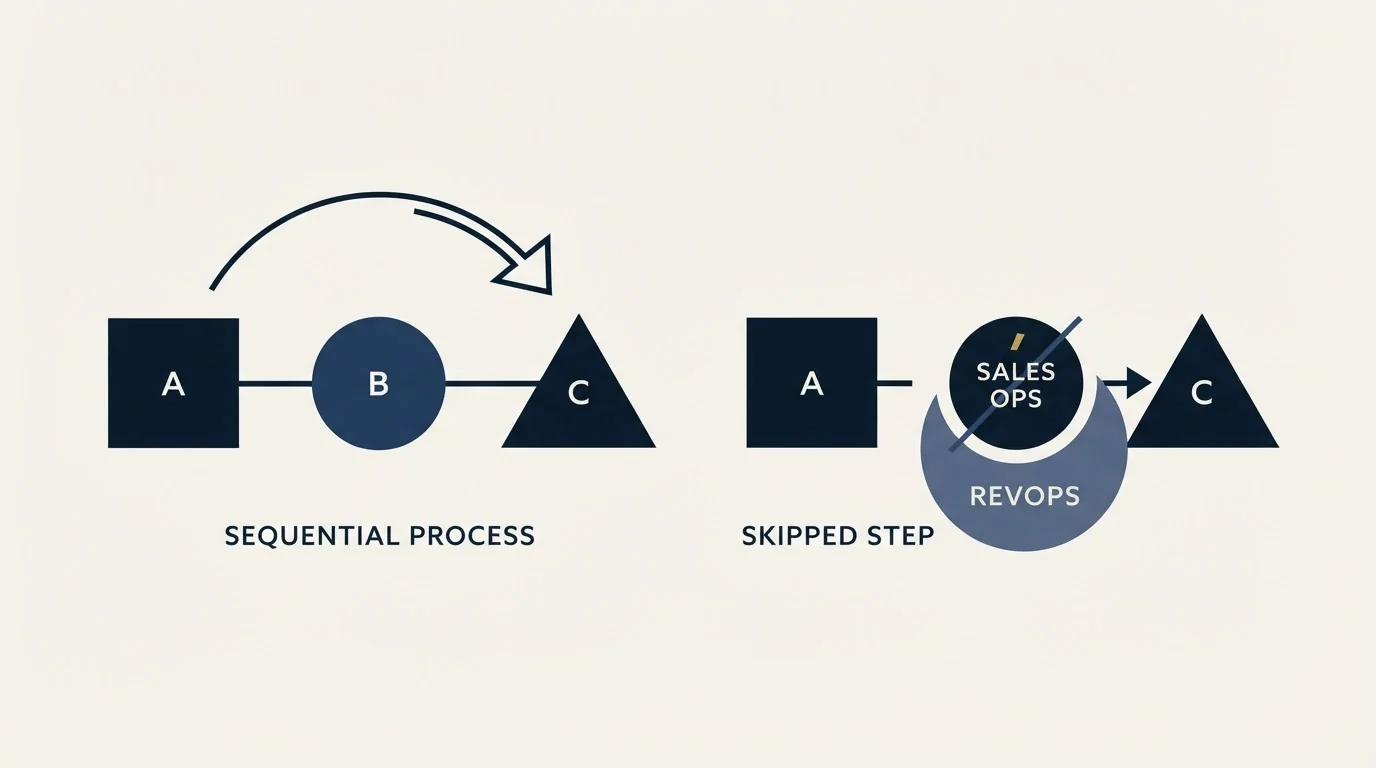
At a company with one operations person, both jobs are done by that person and the boundary is academic. It stops being academic when a second person arrives, because the work that falls between two named functions is the work that reliably goes undone.
The order that works is the artefact order rather than the org-chart order.
- Step 1Fix the plan mechanics
Quota, territory and credit rules written down, so an attainment figure means the same thing twice
- Step 2Enforce the stages
Entry criteria applied at the point of advance rather than described in a document
- Step 3Settle the shared definitions
One written answer for a lead and an opportunity, applied on both sides of the handoff
- Step 4Own the field contracts and precedence
Which system wins per field, so a disagreement has a documented winner
- Step 5Build the joined reporting last
A shared layer on unreconciled definitions produces confident answers nobody can reconstruct
The common failure is a retitling that skips the middle. A sales operations manager is given the revenue operations title because the company wants the function, the remit grows from one team to three, and the authority does not move at all. The result is predictable: a person who was already answering more report requests than they could absorb now answers them for three teams, none of the shared definitions gets fixed, and the title change is read as a promotion that produced nothing.
The authority test separates the two roles more cleanly than the scope does. Can this function decline a request. Can it publish a number that contradicts a favourite report. Can it change a definition an executive quotes. A function that can do none of those is a reporting service desk whichever word is in its title, and hiring for the broader remit without the broader authority buys the coverage and none of the value.
Teams asking who RevOps reports to are asking this same ownership question in an org chart shape, and the reporting line settles far less than the three tests above: a function that cannot decline a request, publish a number that contradicts a favourite report, or change a definition an executive quotes weekly will behave the same way under finance, sales or operations.
The related warning is worth stating because it costs the most. Buying a forecasting or revenue-intelligence platform before the definitions and the data underneath them are settled produces a confident forecast from inconsistent inputs, and nothing about the output announces that. Which of these jobs genuinely needs software is easier to judge after reading sales operations software.
Where outbound sits between them
Outbound rewards this discipline more than any other part of the motion, because every input to it is chosen rather than inherited. The segment is a decision, the message is a decision, and both are measurable against a clean population if the definitions hold.
When they do not hold, a campaign result teaches nothing whether it worked or not, because the population it reached cannot be described afterwards. A segment query run against inconsistent field values returns a set that looks the right size and silently excludes every row stored under a different spelling, which is why data hygiene sits under the reporting rather than beside it.
Two of our own practices exist for the same reason this whole comparison does. Meetings are qualified against criteria agreed in writing before a campaign launches, so the definition exists before anybody has a result to grade against it. And every campaign carries one message, with no bumps and no thread replies, which has an operational consequence that gets underestimated: one message per contact means one clean attribution, so the question of which message produced which reply never requires untangling a thread.
Both are definitional decisions made in advance rather than reporting decisions made afterwards, which is the habit that separates either operations function working from either one producing dashboards.
The short version

Sales operations sits inside the sales organisation and revenue operations spans marketing, sales and customer success. That is coverage. Ownership is the useful distinction, and it is decided by writing down who owns each decision rather than which teams each function may ask questions of.
Sales operations owns the plan mechanics, quota, territory and credit rules, stage enforcement, the deal desk and the forecast process. Revenue operations owns what crosses a boundary: the shared definitions, the field contracts, the precedence rules, routing across the handoff and the reconciliation nobody else is accountable for. Neither owns the forecast itself, which belongs to the sales leader.
They collide over the lead definition, attribution across the handoff, routing and the reporting layer, and three of the four rules that settle those collisions are simply writing the definition down and refusing to change it inside a period.
Hire sales operations first if the quota, territory and credit rules are still carried in somebody's head. Add revenue operations when the figures a company argues about cross a function boundary and the reconciliation costs more than the work it describes. And check that the authority moves with the title, because a broader remit without the authority to decline a request produces a reporting service desk with a wider catchment.
Where the constraint is the number of qualified conversations rather than the machinery around them, no amount of operating discipline creates supply. You can see what a first campaign produces.
Frequently asked questions.
Frequently asked questions- What is the difference between RevOps and sales ops?
- Sales operations owns the artefacts inside the selling motion: the quota model, territory boundaries, credit rules, stage criteria, the deal desk and the forecast process. Revenue operations owns the artefacts that cross a handoff between marketing, sales and customer success: shared definitions, field standards, precedence rules between systems, routing and the reconciliation between what marketing sourced and what sales accepted.
- Does a company need both functions?
- Not at the same time, and usually not in the same order people assume. Sales operations comes first, because the quota, territory and credit rules are load-bearing on payroll and no cross-functional reconciliation is possible while they live in one person's head. Revenue operations earns its place when the numbers being argued about cross a function boundary and the reconciliation costs more than the work it describes.
- Who owns the forecast, RevOps or sales ops?
- Neither. The forecast belongs to the sales leader. Sales operations owns the forecast process: the schedule, what a seller has to bring to the meeting, and the stage criteria that make the inputs mean something. Confusing ownership of the number with ownership of the process produces an operations function that gets blamed for a miss it had no authority to prevent.
- Is RevOps just sales ops with a wider remit?
- Only when the retitling skips the authority. The useful test is whether the function can decline a request, publish a number that contradicts a favourite report, and change a definition an executive quotes weekly. A function that can do none of those is a reporting service desk whichever word appears in its title, and widening its coverage buys more requests rather than more resolved arguments.
About the author.

B2B cold email experts helping companies generate qualified leads through done-for-you outreach campaigns.
RevenueFlow Team
Explore more.
Ready to scale your outreach?
We build GTM engines that book real meetings. See the receipts.
Related articles.
Sales Enablement Charters: What the Published Ones Ask For
Six publishers set out what a sales enablement charter should contain. Five describe a document nobody can check, and one writes a definition with inspection in it.
Sales Prospecting for Utilities: Read the Filings First
Prospecting utilities from the proceedings that announce their spend: rate cases, resource plans and procurement decisions, who owns each, and the supplier gate.
SDR Outsourcing for Commercial Insurance Agencies
What an outsourced sales development team may legally say for a commercial insurance agency, how it may be paid, and the expiration-date calendar it has to work.
Cold Calling for Telecom Companies: A Carrier's Own Rules
What only a telecom company meets on the phone: the FTC exemption that stops at its contractor, the verified carrier change, and the CPNI limit on lists.
B2B Lead Lists for Associations: The Census Is Public
The anatomy of an association list: the IRS master file that enumerates every business league, the Form 990 lines that name officers and dues, and what vendors sell.
Lead Generation for EHR Vendors: A Replacement Market
Adoption is close to complete, so every deal is a switch. Where the incumbent field is published, which rules shape the pitch and who actually signs.