B2B Lead Lists for Associations: The Census Is Public
The anatomy of an association list: the IRS master file that enumerates every business league, the Form 990 lines that name officers and dues, and what vendors sell.
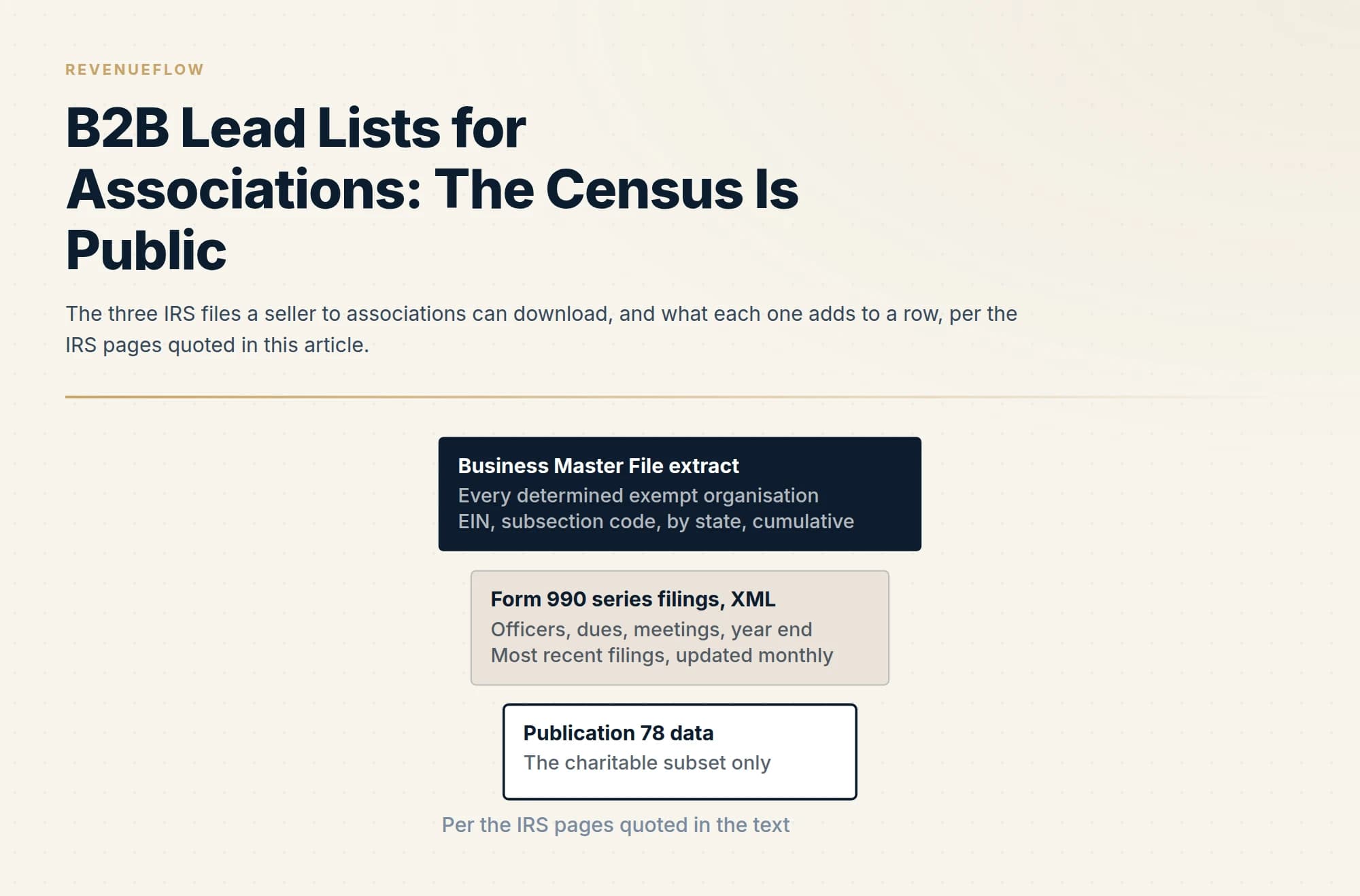
Every association is on the IRS Exempt Organizations Business Master File, which publishes its record count, and the Form 990 names its officers in Part VII, puts dues on Part VIII line 2 and conference spend on Part IX line 19. Vendors sell the email address, which no IRS file holds; one sells association members instead of associations.
Key takeaways
- The IRS defines trade and professional associations as business leagues, and its Exempt Organizations Business Master File Extract, posted 9/8/2026 with 1,964,958 records, is the census every association appears on.
- Form 990 Part VII lists current officers, directors and trustees with no compensation threshold, the instructions put dues comparable to benefits on Part VIII line 2, and Part IX line 19 carries conferences, conventions and meetings.
- The IRS due-date table gives a 31 December year end an initial due date of 15 May and an extended date of 15 November, so the newest public return can describe a year that ended up to twenty-two months earlier.
- The FTC's CAN-SPAM guide says the law makes no exception for business-to-business email, and Publication 78 lists only organisations eligible for tax-deductible charitable contributions, not business leagues.
Reviewed and updated September 21, 2026
A vendor selling event software to trade associations buys an association email list, receives rows of individual members, and discovers that the organisations it wanted are named, typed and sized, one by one, in a federal file it did not know existed. The Internal Revenue Service publishes its Exempt Organizations Business Master File Extract by state, with a posting date and a record count on the page: "Updated data posting date: 9/8/2026 Record count: 1,964,958". (IRS, Exempt Organizations Business Master File Extract, read 21 September 2026.) The list was the wrong object.
This page is for the seller reaching associations, whether software, insurance, events, printing, benefits or consulting, who is deciding what to buy and what to build. It is the anatomy of an association list: the federal files that enumerate associations, the return that names an association's officers and its dues, the calendar on which those returns become public, what the list vendors actually sell, the rules on the message, and how to check a row before a send. What a lead list is in general is the lead list entry's job, and what a verified address means when a vendor sells one is the subject of CMO email list. Selling to charities, with the development director as the buyer, is cold email for nonprofits, which names associations in one section as a different kind of organisation; this page is that section written out. Every outside page below was read on 21 September 2026 and is dated where it publishes a date.
What the IRS means by an association
The IRS defines the object. Its page on business leagues, last reviewed on 28 June 2026, says: "A business league is an association of persons having some common business interest, the purpose of which is to promote such common interest and not to engage in a regular business of a kind ordinarily carried on for profit. Trade associations and professional associations are business leagues." It adds the neighbouring type: "Chambers of commerce and boards of trade are organizations of the same general type as business leagues." (IRS, Business Leagues.) A business league is exempt under section 501(c)(6), and that subsection code is the first field on an association row, because it is what separates a trade association from the charities, foundations and social clubs that share the same master file.
Three federal files, and what each one holds
The Business Master File is the census. The IRS says the extract "provides information about an organization from the Internal Revenue Service's Business Master File. This is a cumulative file, and the data are the most recent information the IRS has for these organizations." It is published as CSV files by state and region, sorted by employer identification number (EIN), with the codes explained in an information sheet the page links. Every organisation with a determination of exempt status is in it, which makes it the only list on which every association appears.
The second file is the return itself. The IRS bulk data page says the Form 990 series download holds "The most recent 990 series filings on record" in XML, with the latest posting on 20 August 2026, and that "The data set files are updated monthly." (IRS, Tax Exempt Organization Search bulk data downloads, page last reviewed 16 September 2026.) The same organisations can be looked up one at a time in the search tool, which the IRS describes as a way to find "information about an organization's tax-exempt status and filings". (IRS, Tax Exempt Organization Search.)
The third file is the one not to confuse with the other two. Publication 78 data is, in the IRS's words, the "List of organizations eligible to receive tax-deductible charitable contributions." It is the charitable list. An association list built from it will be a list of charitable arms and foundations, not of the business leagues that run the conferences and collect the dues.
The row, and the line of the return that fills each field
An association row that can be acted on carries a size, a name at the top, a revenue shape, a meeting and a date, and the Form 990 supplies all five once the organisation is large enough to file it.
Size comes first, because it decides which return exists. The IRS chart of which form an exempt organisation files, last reviewed on 28 June 2026, puts organisations with gross receipts normally at or below 50,000 dollars on the Form 990-N electronic notice, organisations with gross receipts under 200,000 dollars and total assets under 500,000 dollars on the 990-EZ or the 990, and organisations at or above either figure on the full Form 990. (IRS, Form 990 series: which forms do exempt organizations file.) A small association files a notice with almost nothing on it; a large one files everything below.
The name at the top is in Part VII. The Form 990 instructions, read on the IRS site, say organisations must list in Part VII, Section A, "Current officers, directors, and trustees (no minimum compensation threshold)", then key employees and the five highest compensated employees above stated compensation levels, and list them "in order from highest to lowest compensation". (IRS, Instructions for Form 990.) The executive director or chief executive of an association is therefore a public name with a public pay figure, refreshed with every return.
The revenue shape is in Part VIII, and the instructions settle where an association's dues go: "Membership dues that aren't contributions because they compare reasonably with available benefits are reported on line 2", as program service revenue, while dues that are really contributions go on line 1b. For a trade association whose members pay for benefits, the dues figure a seller wants is line 2, not the contributions line a charity-focused reader would look at.
The meeting is in Part IX, line 19, which the instructions define as "the total expenses incurred by the organization in conducting meetings related to its activities", including "facility rentals, speakers' fees and expenses, and printed materials." An association with a large line 19 runs a large conference, and a seller of event technology, venues, printing or sponsorship has found its segment.
| Field on the row | Where it comes from |
|---|---|
| Legal name, EIN, state | Business Master File extract |
| Business league or charity | Subsection code in the master file |
| Size band | Which return is filed: 990-N, 990-EZ or 990 |
| Officers and the chief executive | Form 990 Part VII, Section A |
| Dues as revenue | Form 990 Part VIII, line 2 or line 1b |
| Conference spend | Form 990 Part IX, line 19 |
| Fiscal year end | The return header |
| A working email address | No IRS file; the field vendors sell |
That last row is the product. Everything above it is public, and a vendor that sells the public part as if it were scarce is charging for a download, which is the same shape utilities lead lists found in the federal energy census and physician email lists found in the provider registry.
The calendar on which a row goes stale
The return is old by the time it is public, and the IRS publishes exactly how old. Its due-date table, read on 21 September 2026, gives an organisation whose tax year ends on 31 December an initial due date of 15 May and an extended due date of 15 November; a year ending 30 June is due 15 November and extended to 15 May; a year ending 30 September is due 15 February and extended to 15 August. The page adds that "Instead of filing an annual return, certain small organizations may file an annual electronic notice, the Form 990-N (e-Postcard)" and that for it "Extended due dates do not apply." (IRS, Return due dates for exempt organizations.)
So an officer on the newest public return of a calendar-year association may have been named for a year that ended up to twenty-two months earlier. The return is a census of who held the office, not a directory of who holds it now, and the row's name field is checked against the association's own website before it is written to.
What a search for this actually sells
Three of the pages a search returns name the vertical, and they sell three different things. SalesHive's nonprofit and associations page describes an agency that "books qualified meetings for organizations selling into nonprofits and associations, reaching Executive Directors, Chief Development Officers, and Directors of Membership", and lists the roles its callers work, among them "Directors of Membership & Member Experience" and "COOs & Directors of Operations". (SalesHive, Nonprofit and Associations.) Those titles are one vendor's map of who answers at an association, quoted as its own description of its service.
Introlynk's page sells a marketplace of nonprofit buyers and shows "620+ Nonprofit Organizations" on it. (Introlynk, Nonprofit B2B Leads.) Set that against the master file's record count and the difference is the difference between a marketplace and a census.
LakeB2B's membership and association email list is the other sense of the phrase. Its page, last updated 21 August 2026 by its own line, shows national counts of 4,707,687 records and 3,766,150 emails and describes the product as a list of "Club memberships and associations" whose members "have devoted interests and hobbies ranging from sports and travel to political and social activities." (LakeB2B, Membership and Association Email List.) That is a list of association members, sold as prospects, and a seller who wants the associations themselves has bought the wrong file. Every count in this section is the vendor's own claim, quoted from its page and not verified here.
The association profession has its own body. ASAE describes itself as "the premier source of learning, knowledge, and future-oriented research for the association and nonprofit profession" and says it "engages association professionals and industry partners in a diverse, global, welcoming community". (ASAE, About Us.) An association whose executive holds an ASAE membership is an association that buys the things ASAE's members buy, which is a segmenting signal no IRS file carries.
The rules on the message
The IRS files exist because the law requires the return to be public. The IRS page on documents subject to public disclosure says "an exempt organization must make available for public inspection and copying its annual return" and that "Returns must be available for a three-year period beginning with the due date of the return". (IRS, Public disclosure and availability of exempt organizations returns.) Nothing in that disclosure changes the rules on writing to the people named.
For the email, the FTC's CAN-SPAM guide states the position in one sentence: "The law makes no exception for business-to-business email." (FTC, CAN-SPAM Act compliance guide.) An association is a business for that purpose, and its executive director's inbox is covered by the same header, subject, address and opt-out requirements as any other. For the phone, the federal position on business calls is in the calling rules pages on this site. None of this is legal advice.
How to check a row before a send
Three reasons to write, each from a line of the return
Each opener below rests on one IRS-defined line, names no real organisation or person, and claims no result. The associations described are invented for illustration.
Grounded in Part IX, line 19. An invented example: a state contractors' association whose newest return shows a large conferences, conventions and meetings expense is an association that runs a large meeting, and a seller of registration software, venues or sponsorship packages has a reason to write that its own return supplied.
Your latest return lists conferences and meetings as one of your larger expense lines, which usually means one annual event carrying most of the budget. We work with associations of your size on the registration side of that event. Worth a short call before the next one is planned?
Grounded in Part VII, Section A. An invented example: an association whose Part VII shows a chief executive not on the previous year's return has a new leader, and a new leader reviews vendors.
Your most recent filing lists a new executive director, and a new leader usually inherits the association's contracts before choosing them. We help associations review their insurance programme in that first year. Would a one-page summary of what other associations changed be useful?
Grounded in the due-date table. An invented example: an association with a 30 June year end files in November and plans its next year in the spring, so a message in February arrives while the budget is open.
Your fiscal year ends in June, which puts your budget build in the spring. We supply the member management system for associations your size, and the useful moment is before the request goes to the board. Could we send the comparison your finance committee would ask for?
When this list is the wrong tool
When the buyer is the members and not the association, where LakeB2B's file is the right object and this page is not. When the associations are small enough to file the 990-N, where no officer, dues or meeting line is public and the row has to be built from the association's own site. When the target is a chamber of commerce whose purchasing runs through a city or county, where the return names an executive but the money is public procurement. And when the seller has no reason to write beyond the organisation's existence, where a census produces a large list and a small reply.
If you would rather have the master file joined to the returns, the officers checked against the websites and the first message built on a line of the return, see what a first campaign would look like.
The short version
Associations are business leagues in the IRS's own definition, and every one of them is on a federal file that publishes its record count. The master file names and types them, the Form 990 names their officers and prices their dues and their conference, and the due-date table says how old that picture is. The list vendors sell the address, which no IRS file holds, and one of them sells the members instead of the organisations. Buy the address if you must, build everything else, and check the officer against the website before you write.
Every page quoted above was read on 21 September 2026 from stored snapshots. Thresholds, due dates and vendor counts change; read the current pages before relying on them. Nothing here is legal or tax advice.
Frequently asked questions.
Frequently asked questions- Where can I get a complete list of trade associations?
- From the IRS. Its Exempt Organizations Business Master File Extract is a cumulative file of every organisation with a determination of exempt status, published as CSV files by state with a posting date and record count on the page. The subsection code separates business leagues, which the IRS says trade and professional associations are, from charities and foundations on the same file. The address is the one field it does not hold.
- What does a Form 990 tell me about an association?
- The instructions require Part VII, Section A to list current officers, directors and trustees with no compensation threshold and the highest paid employees above stated levels, in order of compensation. Dues that compare reasonably with benefits are reported on Part VIII line 2 as program service revenue, and Part IX line 19 carries the total spent conducting meetings, including facility rentals and speakers' fees. The header carries the fiscal year end.
- How current is the officer named on an association's public return?
- Often not very. The IRS due-date table gives an organisation with a 31 December year end an initial due date of 15 May and an extended due date of 15 November, and the 990 series bulk file is updated monthly. The newest public return can therefore describe a year that ended up to twenty-two months earlier, so the name in Part VII is checked against the association's own website before anyone writes to it.
- Is an association email list the same as a list of associations?
- Not always. One vendor's membership and association email list, by its own page, is a list of club and association members with interests ranging from sports and travel to political and social activities, sold as prospects. A seller who wants the organisations themselves, their executives and their conferences needs the IRS files and the Form 990, plus an address the vendors sell.
About the author.

B2B cold email experts helping companies generate qualified leads through done-for-you outreach campaigns.
RevenueFlow Team
Explore more.
Ready to scale your outreach?
We build GTM engines that book real meetings. See the receipts.
Related articles.
B2B Lead Lists for Telehealth Companies: Four Partial Doors
No federal file enumerates telehealth companies. The anatomy of the list: the certification, the state registration, the SEC filings and the association.
Commercial Insurance Lead Lists: Four Fields, Four Records
The anatomy of a commercial insurance lead list for an agency: class, exposure, renewal month and carrier, the public records that hold each, and what vendors sell.
B2B Lead Lists for Utilities: Three Registries, One Gap
The anatomy of a utilities lead list: the EIA-861 census, PHMSA annual reports and SDWIS enumerate electric, gas and water utilities; vendors sell the field they lack.
Physician Email Lists: The Row, Its Sources and Its Gaps
The anatomy of a physician email list: the six field groups, which CMS, AMA and state board records hold each, what vendors claim, the rules, and the order to verify.
B2B Lead Lists for Collection Agencies: Fields and Sources
What a creditor prospect list needs for a collection agency: the fields that matter, the FDIC, NCUA, CMS and court sources behind them, and the rules that apply.
Cold Calling for Consulting Firms: The Partner's Hour
Cold calling for a consulting firm: who it dials and who picks up, why partner-led economics argue against the phone, the client's fiscal year, and when to skip it.