Cold Email for Nonprofits: Reaching Development Directors
Nonprofits have unique budget constraints and mission-driven priorities. Here's how to approach cold email outreach to foundations, NGOs, and charitable organizations.
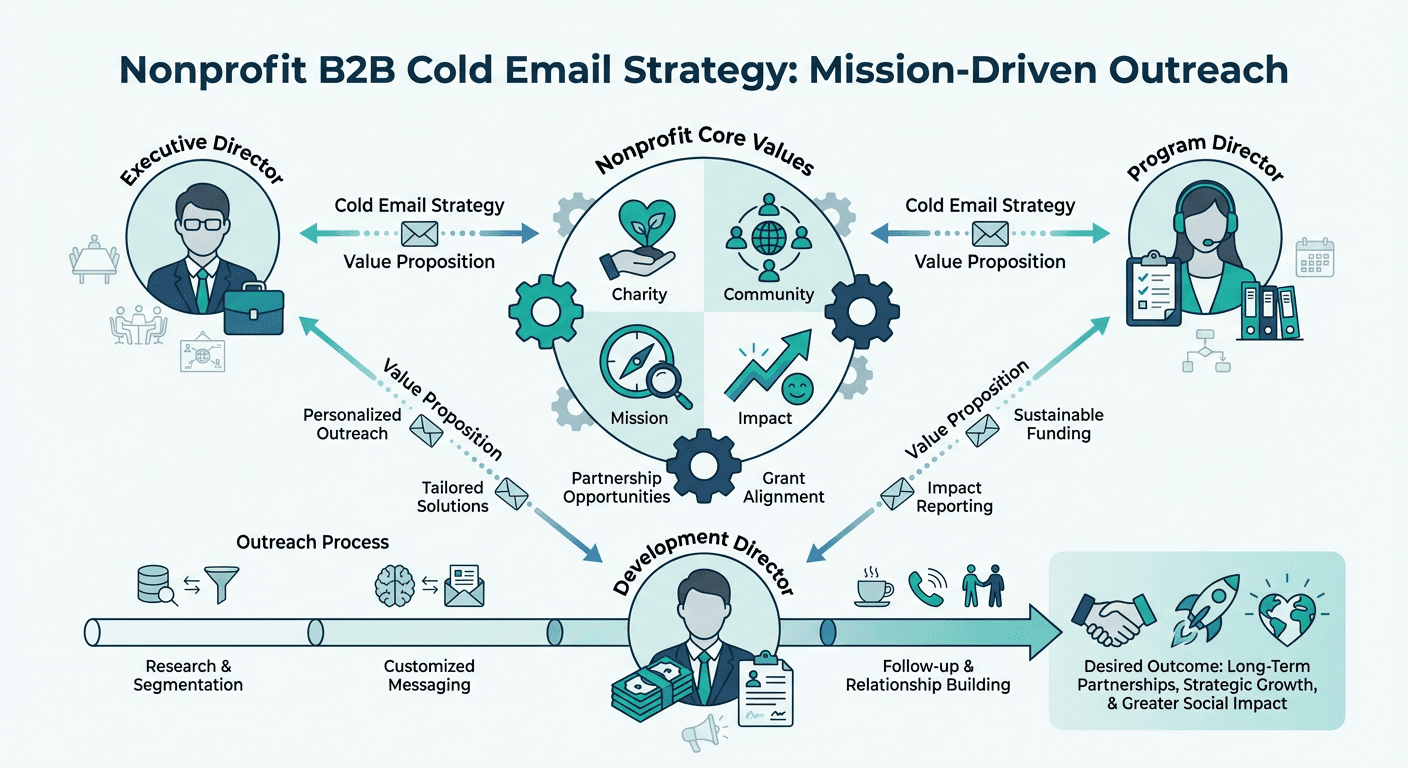
Cold email to nonprofits requires acknowledging budget constraints, demonstrating mission alignment, and targeting the correct decision-maker. Operating nonprofits, private foundations, community foundations, and membership organizations each have distinct purchasing behaviors. Executive directors prioritize mission impact, development directors focus on donor retention metrics, and program directors need outcome measurement tools. Standard nonprofit discounts range from 10-50%, and decision cycles align with grant periods and fiscal years rather than traditional quarterly sales patterns.
Key takeaways
- Operating nonprofits receive revenue from grants, donations, program fees, and government contracts, with purchasing decisions tied to specific program needs and grant requirements.
- Private foundations have smaller staff sizes relative to their grantmaking volume, and program officers often have significant purchasing autonomy for operational tools.
- Development directors focus on donor retention metrics, grant management capabilities, and measurable ROI on fundraising investments when evaluating new tools.
- Budget decisions in nonprofits often require board approval and align with grant cycles and fiscal years rather than standard quarterly business cycles.
- Associations and membership organizations funded by member dues are less cost-sensitive than charitable nonprofits and have more predictable revenue streams.
Reviewed and updated September 1, 2026
Cold Email for Nonprofits: Reaching Development Directors and Foundation Leaders
Selling to nonprofits and foundations requires a fundamentally different approach than standard B2B sales. These organizations operate with limited budgets, mission-driven priorities, and stakeholders who are deeply skeptical of vendors who treat them like commercial accounts.
Teams selling technical products face a parallel challenge, needing to earn credibility with skeptical engineers rather than mission-driven boards, a dynamic covered in cold email strategies for web development.
Vendors who apply standard B2B cold email tactics to nonprofit outreach often fail because they miss what makes this sector unique. Development directors receive hundreds of pitches from companies that claim to understand the nonprofit world but clearly do not. Foundation program officers have seen countless proposals that prioritize vendor revenue over charitable impact.
This guide covers how to structure cold email outreach to nonprofits, foundations, and charitable organizations. We will examine the different buyer types, budget realities, and decision-making processes that shape purchasing in this sector.
Understanding the Nonprofit Landscape
The nonprofit sector encompasses a diverse range of organizations with different structures, funding sources, and purchasing behaviors. Before launching cold email campaigns, you need to understand these distinctions.
Operating Nonprofits
Operating nonprofits are organizations that deliver programs and services directly. This includes social service agencies, healthcare organizations, educational institutions, environmental groups, and community development organizations.
Key characteristics:
- Revenue comes from grants, donations, program fees, and government contracts
- Budget decisions involve executive leadership and often board approval
- Purchasing is tied to specific program needs and grant requirements
- Cost sensitivity is high, with strong preference for nonprofit discounts
- Decision cycles often align with grant cycles and fiscal years
Private Foundations
Private foundations are grantmaking organizations that fund other nonprofits. They include family foundations, corporate foundations, and independent foundations. These organizations have endowments or ongoing funding sources that support their grantmaking.
Key characteristics:
- Smaller staff sizes relative to grantmaking volume
- Program officers specialize in specific issue areas
- Purchasing decisions focus on operational efficiency
- Investment returns and donor restrictions affect budgets
- Professional staff often have significant purchasing autonomy
Community Foundations
Community foundations serve specific geographic regions and manage donor-advised funds alongside their own grantmaking. They function as both grantmakers and public charities.
Key characteristics:
- Multiple revenue streams (fees, endowment, donations)
- Complex stakeholder environment (donors, grantees, community)
- Technology needs for donor management and grantmaking
- Regional focus affects vendor selection preferences
- Staff expertise varies widely by foundation size
Associations and Membership Organizations
Trade associations, professional societies, and membership organizations operate differently from charitable nonprofits. They are funded primarily by member dues and event revenue.
Both of those figures are on each association's own public return, and B2B lead lists for associations sets out which IRS file enumerates the associations and which Form 990 line holds the dues, the officers and the conference.
Key characteristics:
- More predictable revenue from membership dues
- Purchasing decisions often involve member input
- Technology needs center on member management and events
- Budget cycles typically align with calendar or fiscal year
- Less cost-sensitive than charitable nonprofits
Nonprofit Decision Makers and Their Priorities
Effective cold email outreach requires understanding who makes purchasing decisions and what they care about. Nonprofit decision makers have distinct priorities shaped by their roles and the organizations they serve.
Teams pivoting between sectors can compare tactics with the guide to technical audience outreach, which breaks down messaging for CTOs, engineering managers, and developers.
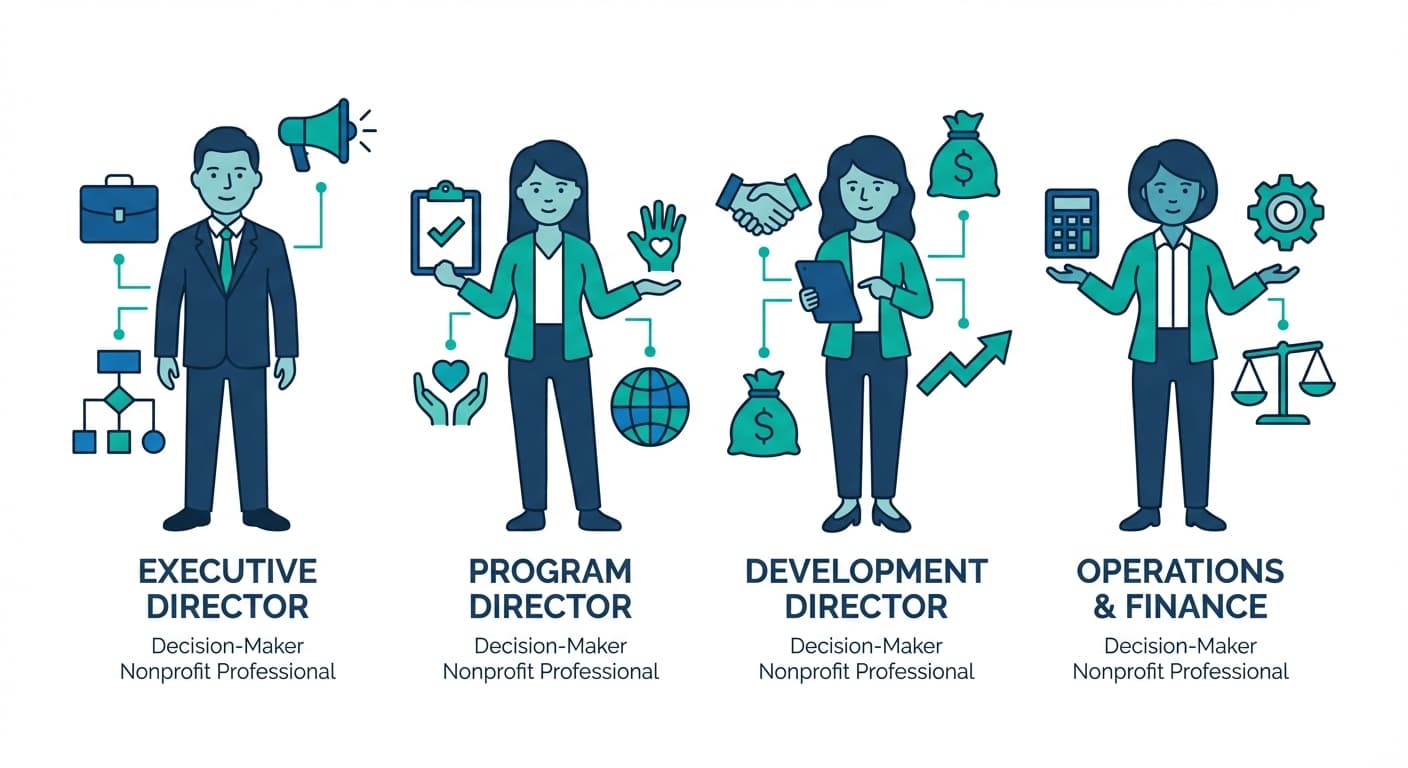
Executive Directors and CEOs
Executive directors lead nonprofit organizations and have final authority on significant purchases. They balance program delivery, fundraising, and organizational sustainability.
When emailing executive directors, focus on:
- Mission impact and program effectiveness
- Cost savings and operational efficiency
- Risk mitigation and organizational stability
- Board-level concerns and strategic priorities
- Time savings for already stretched staff
Development Directors
Development directors manage fundraising operations including donor relations, grant writing, and campaigns. They purchase tools related to donor management, prospect research, and fundraising communications.
When emailing development directors, focus on:
- Donor retention and acquisition metrics
- Grant management and compliance capabilities
- ROI on fundraising investments
- Integration with existing donor databases
- Time savings for development staff
Program Directors
Program directors manage specific programs and services. They purchase tools and services that support program delivery and measurement.
When emailing program directors, focus on:
- Program outcomes and impact measurement
- Client or beneficiary experience
- Staff efficiency in program delivery
- Grant reporting and compliance
- Integration with program management systems
Operations and Finance Directors
Operations directors (COOs, Directors of Administration) manage organizational infrastructure. Finance directors (CFOs) oversee budgets, accounting, and financial compliance.
When emailing operations and finance leaders, focus on:
- Cost reduction and budget efficiency
- Compliance with nonprofit accounting standards
- Audit preparation and financial reporting
- Workflow automation and staff productivity
- Risk management and internal controls
IT Directors and Technology Staff
Larger nonprofits have dedicated IT staff who evaluate technology purchases. Many smaller nonprofits handle technology decisions through operations or executive leadership.
When emailing IT leaders at nonprofits, focus on:
- Security and data privacy compliance
- Integration with existing systems
- Total cost of ownership (including staff time)
- Support and training resources
- Scalability for organizational growth
Foundation Program Officers
Program officers at foundations manage grantmaking portfolios and evaluate grant applications. They also influence operational purchases within their program areas.
When emailing program officers, focus on:
- Grantee support and capacity building
- Impact measurement and evaluation
- Portfolio management efficiency
- Field knowledge and best practices
- Collaboration with peer funders
Budget Realities and Purchasing Constraints
Understanding nonprofit budget constraints is essential for effective outreach. These organizations face financial limitations that shape every purchasing decision.
Limited Budgets and Cost Sensitivity
Most nonprofits operate with constrained budgets and significant pressure to minimize overhead costs. Donors, boards, and watchdog organizations scrutinize administrative spending.
This means:
- Price is always a factor in purchasing decisions
- Nonprofit discounts are expected, often required
- Multi-year commitments are difficult to make
- New purchases often require eliminating existing costs
- Free pilots and trials are common before commitment
Grant-Funded Purchasing
Many nonprofit purchases are funded by grants with specific requirements and timelines.
Implications for your outreach:
- Purchasing may be tied to grant award dates
- Budget categories may be restricted (capital vs. operating)
- Grant reporting requirements affect what solutions are viable
- Multi-year grants may enable larger purchases
- Grant compliance may require specific features or documentation
Board Approval Requirements
Significant purchases at nonprofits often require board approval, particularly for technology investments, multi-year contracts, and purchases above certain thresholds.
This affects your sales process:
- Decision timelines may align with board meeting schedules
- Executive staff must build internal cases for board presentation
- Board members may have specific concerns or requirements
- Approval processes can add weeks or months to decisions
Fiscal Year Timing
Nonprofit fiscal years vary. Many align with the calendar year (January to December), while others follow state government fiscal years (July to June) or academic years.
Understanding fiscal year timing helps you:
- Time outreach to align with budget planning
- Identify end-of-year spending opportunities
- Plan a separate approach for each budget cycle, timed to its planning window
- Anticipate grant-driven purchasing windows
Nonprofit Pricing and Discounts
Your pricing strategy for nonprofits should acknowledge the sector's budget realities while protecting your business sustainability.
Standard Nonprofit Discounts
Most B2B vendors offer nonprofit discounts, typically ranging from 15% to 50% off commercial pricing. Nonprofits expect these discounts and often ask about them immediately.
Best practices:
- Display nonprofit pricing prominently on your website
- Be clear about what qualifies (501(c)(3) status, etc.)
- Consider tiered discounts based on organization size
- Make the discount request process simple
Foundation Pricing
Private foundations often have larger budgets than operating nonprofits. Some vendors price foundations at commercial rates or with smaller discounts. This approach can work, but be aware that many foundations expect nonprofit pricing regardless of their resources.
Sliding Scale and Revenue-Based Pricing
Some vendors use sliding scale pricing based on nonprofit budget size. This approach can make your solution accessible to smaller organizations while capturing appropriate value from larger ones.
Demonstrating ROI
Even with discounts, nonprofits need to justify purchases to boards and funders. Help them build the case by clearly articulating ROI in terms they can use: time saved, donors retained, costs reduced, compliance achieved.
Justifying ROI to boards mirrors how training buyers must tie programs to measurable business outcomes, a dynamic explored in cold email for training companies.
Subject Lines for Nonprofit Outreach
Nonprofit leaders receive significant cold email volume. Your subject lines must signal immediate relevance to their mission and organizational needs.
For Executive Directors
Examples that work:
- "[Organization]'s donor retention question"
- "Nonprofit operations at [Organization Name]"
- "Question about [Organization]'s strategic plan"
- "[Similar Organization]'s approach to [challenge]"
- "Following your [conference talk/interview]"
Why these work: They reference the specific organization and focus on nonprofit-relevant challenges rather than generic sales language.
For Development Directors
Examples that work:
- "[Organization]'s year-end campaign"
- "Donor data question for [Name]"
- "[Foundation Name] grant tracking"
- "[Similar Organization]'s retention results"
- "Following your [CASE/AFP conference] session"
Why these work: They reference fundraising-specific concerns and show awareness of the development function.
For Foundation Program Officers
Examples that work:
- "[Foundation]'s [issue area] portfolio"
- "Grantee capacity building at [Foundation]"
- "Question about [Foundation]'s RFP process"
- "[Similar Foundation]'s impact approach"
- "Following your [publication/webinar]"
Why these work: They demonstrate understanding of foundation work and specific program areas.
What to Avoid
- "Partnership opportunity" (signals unclear value)
- "Helping nonprofits succeed" (generic and meaningless)
- "Increase donations by 300%" (unrealistic claims trigger skepticism)
- "Quick call about your organization" (too vague)
- "Nonprofit solutions for [Organization]" (obvious sales pitch)
Email Copy Strategies for Nonprofits
Nonprofit leaders are mission-driven. They evaluate vendors based on alignment with their values and understanding of their sector. Your email copy must reflect this reality.
Lead with Mission Understanding
Show that you understand their organization's mission and the challenges they face in pursuing it. Generic nonprofit messaging signals that you treat all nonprofits the same.
Acknowledge Budget Constraints
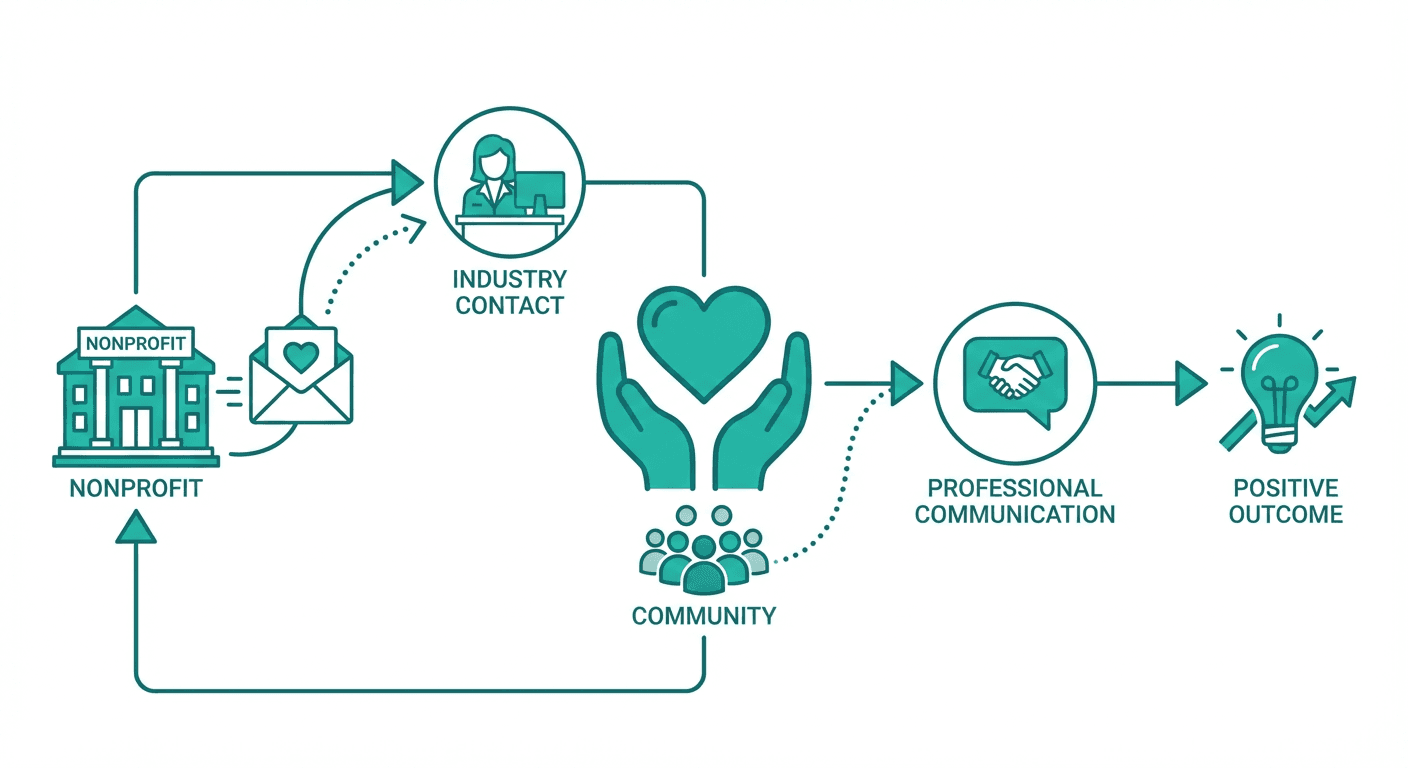
Nonprofits appreciate vendors who understand their financial realities without requiring extensive justification. Mentioning nonprofit pricing or cost-effectiveness early can keep prospects reading.
Use Nonprofit-Relevant Proof Points
Case studies and testimonials from similar nonprofits carry more weight than commercial references. Highlight results from organizations with similar missions, sizes, or challenges.
Focus on Outcomes, Not Features
Nonprofit buyers care about what your solution enables them to accomplish. Frame your value in terms of mission impact, operational efficiency, or compliance achievement.
Structure That Works
- Relevant opening: Reference their specific organization, mission, or recent activity
- Problem acknowledgment: Show understanding of a challenge they likely face
- Solution indication: Briefly explain how you help similar organizations
- Nonprofit-relevant proof: Include a result from a comparable nonprofit
- Clear next step: Make the CTA specific and low-pressure
Keep emails under 125 words. Nonprofit staff are stretched thin and will not read long pitches.
Real Nonprofit Cold Email Examples
Here are complete examples for different nonprofit buyer types.
Example 1: Executive Director at an Operating Nonprofit
Scenario: You sell a nonprofit CRM and you are reaching out to the executive director of a mid-sized social service organization.
Subject: [Organization]'s client data management
"Hi [Name],
Saw [Organization] expanded to three new locations this year. Growing nonprofits often struggle to maintain consistent client data across multiple sites.
Our CRM helps organizations like [Similar Organization] centralize client information while maintaining site-specific access controls. [Similar Organization] reduced duplicate data entry by 60% and improved their grant reporting accuracy significantly.
We offer a 40% nonprofit discount and a 30-day pilot.
Worth a 15-minute call to discuss your data management challenges?
[Your name]"
Why it works:
- References their specific growth context
- Articulates a challenge that comes with growth
- Provides relevant proof from a similar organization
- Mentions nonprofit discount upfront
- Low-commitment CTA
Example 2: Development Director at a Foundation
Scenario: You sell a grants management system and you are reaching out to the development director at a community foundation.
Subject: [Foundation]'s scholarship program administration
"Hi [Name],
Community foundations managing scholarship programs often spend significant staff time on application review and recipient tracking. Saw [Foundation] administers 40+ scholarship funds.
Our platform helps foundations like [Similar Foundation] automate scholarship workflows while maintaining donor fund restrictions. [Similar Foundation] reduced their application processing time by 50% and eliminated manual tracking spreadsheets.
Would a brief call be useful to discuss how you are managing scholarship administration?
[Your name]"
Why it works:
- References their specific program scale
- Identifies a common pain point
- Provides relevant foundation proof
- Frames conversation around their current approach
Example 3: Program Officer at a Private Foundation
Scenario: You sell an impact measurement platform and you are reaching out to a program officer at a private foundation focused on education.
Subject: [Foundation]'s education grantee outcomes
"Hi [Name],
Saw [Foundation]'s focus on early literacy in [region]. Funders investing in education outcomes often struggle to aggregate impact data across grantee portfolios.
Our platform helps foundations like [Similar Foundation] standardize outcome reporting while reducing burden on grantees. [Similar Foundation] increased grantee reporting compliance to 95% and can now show portfolio-wide literacy gains.
Worth a conversation about how you are currently tracking grantee outcomes?
[Your name]"
Why it works:
- References their specific program focus
- Addresses a common foundation challenge
- Shows understanding of grantee burden concerns
- Provides relevant proof from a peer funder
Example 4: Operations Director at a Nonprofit
Scenario: You sell HR and payroll software and you are reaching out to the operations director at a growing nonprofit.
Subject: [Organization]'s payroll and benefits question
"Hi [Name],
Nonprofits growing past 50 employees often find their payroll and benefits processes breaking down. Manual systems that worked with a smaller team become compliance risks at scale.
Our platform helps nonprofits like [Similar Organization] automate payroll, benefits administration, and compliance reporting. [Similar Organization] reduced their payroll processing time from 2 days to 2 hours and eliminated manual compliance tracking.
We offer 35% nonprofit pricing.
Would a 15-minute call be useful to discuss your HR operations?
[Your name]"
Why it works:
- References their growth stage challenge
- Articulates a specific pain point
- Provides relevant proof with time savings
- Mentions nonprofit pricing
When A Nonprofit Prospect Does Not Reply
In this sector, silence is usually a calendar fact rather than a decision. There may be no budget line for your category until the fiscal year turns. The purchase may need a board that meets quarterly. The development director may be four weeks from the year-end campaign that funds the organization. None of those change because a second email arrives.
So do not chase. A follow-up in the same thread reads as a bump and, to a buyer who is genuinely under-resourced, as one more demand on a day that has too many. Send one message per approach, and put the effort into timing the next one.
What To Do Instead
Put the next approach on their calendar, not yours. Nonprofit timing is unusually knowable, which makes this sector the easiest one to run without follow-ups. Fiscal year start (January, July, or an academic year), budget planning season roughly a quarter before it, board meeting months, grant award announcement dates, and the lull after the year-end campaign are all published or easy to establish. Pick the window that matters for your category and approach then, with a message about that.
Bring the object they actually need. Nonprofit buyers rarely have the authority to say yes alone. They have to build a case for a board, an executive director, or a funder. An ROI one-pager they can attach to a board packet, a sector benchmark, or a case study from an organization of their size and mission is a genuinely new reason to write, and it is the artifact that moves the decision when they do want you.
Stay out of the crunch. Year-end fundraising, grant deadlines, audit season, and program launches are periods when good prospects cannot respond to anyone. Choosing not to send then is a targeting decision, not a waiting game before a bump.
- Fiscal year start (January, July, or an academic year)
- budget planning season roughly a quarter before it
- board meeting months
- grant award announcement dates
- the lull after the year-end campaign
- Year-end fundraising
- grant deadlines
- audit season
- program launches
Widen the segment. More organizations of the right type, approached once each, will outperform repeated approaches to a shortlist, and this sector is small enough that a reputation for pestering travels.
Take the door when it opens. "Reconnect in September", a request for pricing to put in a budget, or a referral to the operations director are all invitations. Answer them, and treat the reconnection as its own campaign with its own subject line rather than a revival of an old thread.
Re-Approach Example
A later approach is a new first message: its own subject line, its own premise, no reference to an earlier email.
Subject: [Organization]'s [next fiscal year] budget planning
"Hi [Name],
Most [organization type] boards approve next year's operating budget around [month]. If [solution area] is on the list this cycle, two things are usually useful at this stage: current nonprofit pricing, and a one-page cost case you can drop into a board packet.
I have both for organizations your size. [Similar Organization] used the same materials and [specific outcome].
Want me to send them over? No call required.
[Your name]"
Addressing Common Nonprofit Objections
Anticipate and address objections that frequently arise in nonprofit sales.
"We do not have budget for this."
Response approach: Acknowledge budget constraints directly. Ask about grant funding eligibility for the purchase. Suggest connecting at a different point in the budget cycle. Offer to provide ROI documentation they can use internally.
"We are happy with our current solution."
Response approach: Ask what is working well and what could be better. Focus on specific improvements rather than complete replacement. Offer a comparison or audit rather than a sales pitch.
"We need to get board approval."
Response approach: Offer to provide materials they can present to the board. Ask about the board meeting schedule and decision criteria. Provide case studies from similar organizations the board would find credible.
"Can you match [competitor]'s pricing?"
Response approach: Focus on total cost of ownership, not just list price. Highlight implementation, training, and support costs. Emphasize ROI and value rather than winning on price alone.
"We are too small for this kind of solution."
Response approach: Share examples of similar-sized organizations using your solution. Offer scaled pricing or feature sets for smaller organizations. Address implementation complexity concerns directly.
Building Long-Term Nonprofit Relationships
Successful nonprofit vendors build relationships that extend beyond initial sales. The nonprofit sector is highly networked, and reputation matters.
Sector Involvement
Participate in nonprofit conferences (AFP, NTEN, Council on Foundations). Contribute to sector publications and conversations. This builds credibility and generates inbound interest.
Referral Networks
Satisfied nonprofit customers often refer other organizations. Build referral programs and make it easy for customers to recommend you.
Thought Leadership
Share expertise on nonprofit challenges through content, webinars, and community involvement. Position your company as a sector partner, not just a vendor.
Implementation Checklist
Before launching nonprofit cold email campaigns, work through this checklist.
Targeting and Research
- Identified target nonprofit segment (operating, foundation, association)
- Defined organization size and type criteria
- Identified target personas and their priorities
- Researched budget cycles and grant timing
- Built organization-specific personalization points
Pricing and Positioning
- Established nonprofit pricing or discount structure
- Created nonprofit-specific pricing page or materials
- Developed ROI documentation for nonprofit buyers
- Prepared case studies from nonprofit customers
Message Development
- Created segment-specific email templates
- Included organization-specific personalization
- Focused on mission impact and operational efficiency
- Included proof from similar nonprofits
- Created clear, low-pressure CTAs
- Prepared later-cycle campaigns, each led by a new reason to write
Compliance and Best Practices
- Ensured CAN-SPAM compliance (physical address, unsubscribe)
- Reviewed sending practices for nonprofit audiences
- Mapped fiscal year, board and grant windows, and the crunch periods to avoid
- Set expectations for longer decision cycles
Next Steps: Getting Started
Cold email for nonprofits requires understanding a sector with unique budget constraints, mission-driven priorities, and purchasing processes that differ from commercial B2B. When done well, it builds relationships with organizations that value long-term vendor partnerships and refer others in their networks.
The nonprofit sector rewards vendors who demonstrate genuine understanding of the organizations they serve. Generic B2B tactics fail because nonprofit leaders can immediately identify vendors who do not understand their world.
Where nonprofit outreach demands mission fluency, biotech outreach demands scientific rigor, as explored in this guide to reaching scientists and life sciences buyers.
If you are looking to implement cold email for your nonprofit-focused business and want help with strategy, messaging, and execution, we offer a done-for-you service designed for B2B companies selling to specialized markets.
Schedule a free strategy call to discuss:
- Whether cold email is the right channel for your nonprofit sales
- How to time your outreach to budget and grant cycles
- Targeting and messaging for your specific nonprofit segment
- Expected results and timeline
Schedule your free strategy call here.
No pressure, no obligation. We will help you understand whether cold email makes sense for your specific nonprofit market and what it would take to implement effectively.
Frequently asked questions.
Frequently asked questions- How do nonprofit purchasing decisions differ from standard B2B sales?
- Nonprofit purchasing involves limited budgets, mission-driven priorities, and skeptical stakeholders who reject generic commercial approaches. Budget decisions often require board approval and align with grant cycles and fiscal years. Cost sensitivity is high, with strong preference for nonprofit discounts. Decision-makers prioritize mission impact and operational efficiency over features, and purchasing is frequently tied to specific program needs and grant requirements rather than traditional sales cycles.
- Who are the key decision-makers when selling to nonprofits?
- Executive directors have final authority on significant purchases and focus on mission impact and organizational sustainability. Development directors manage fundraising operations and evaluate tools based on donor retention metrics and ROI. Program directors oversee service delivery and need outcome measurement capabilities. Operations and finance directors prioritize cost reduction and compliance. In larger nonprofits, IT directors evaluate technology purchases, while smaller organizations handle technology decisions through operations or executive leadership.
- What should I focus on when emailing nonprofit development directors?
- Development directors prioritize donor retention and acquisition metrics, grant management and compliance capabilities, and measurable ROI on fundraising investments. They need tools that integrate with existing donor databases and save time for development staff. Focus your message on these outcomes rather than generic features. Acknowledge their budget constraints and demonstrate understanding of fundraising operations through nonprofit-relevant proof points and case studies from similar organizations.
- How do private foundations differ from operating nonprofits as customers?
- Private foundations are grantmaking organizations with smaller staff sizes relative to their grantmaking volume, unlike operating nonprofits that deliver programs directly. Program officers at foundations specialize in specific issue areas and often have significant purchasing autonomy for operational efficiency tools. Their purchasing decisions focus on supporting grantmaking operations rather than program delivery. Investment returns and donor restrictions affect their budgets differently than the grant-dependent revenue of operating nonprofits.
About the author.

Fernando Cao is CEO at RevenueFlow, which builds and operates outbound revenue engines for B2B companies. Previously at Accenture Strategy. Studied at University of Bath.
Fernando Cao · CEO
Connect on LinkedIn →Explore more.
Ready to scale your outreach?
We build GTM engines that book real meetings. See the receipts.
Related articles.
Cold Email for Telecom: Reaching Carriers and MSPs
Telecom companies face rapid technology changes and competitive pressures. Here's how to approach cold email outreach to carriers, MSPs, and UCaaS providers.
Cold Email for Architecture Firms: 2026 Strategy Guide
Architecture firms buy on project phases rather than fiscal quarters. How to build a list, time the spec window, and write cold emails principals answer.
Cold Email for Trucking and Fleet Companies: 2026 Guide
How to reach carriers, fleet operators, and safety buyers with cold email: FMCSA-driven list building, trigger timing, four templates, and compliance.
Cold Email for Cannabis Companies: 2026 Strategy Guide
The April 2026 rescheduling order split cannabis buyers into two tax realities. Here is how to segment, list-build, and write cold email for each.
Cold Email for Private Equity Firms: 2026 Strategy Guide
How to run cold email into private equity: mapping fund-level and portfolio-level buyers, list sources, four templates, and PE-specific deliverability rules.
Cold Email for Wealth Management Firms: 2026 Strategy Guide
RIAs are 16,500+ mostly small firms with public Form ADV data, small buying committees, and a compliance gate. How to run cold email into wealth management.