B2B Lead Lists for Telehealth Companies: Four Partial Doors
No federal file enumerates telehealth companies. The anatomy of the list: the certification, the state registration, the SEC filings and the association.
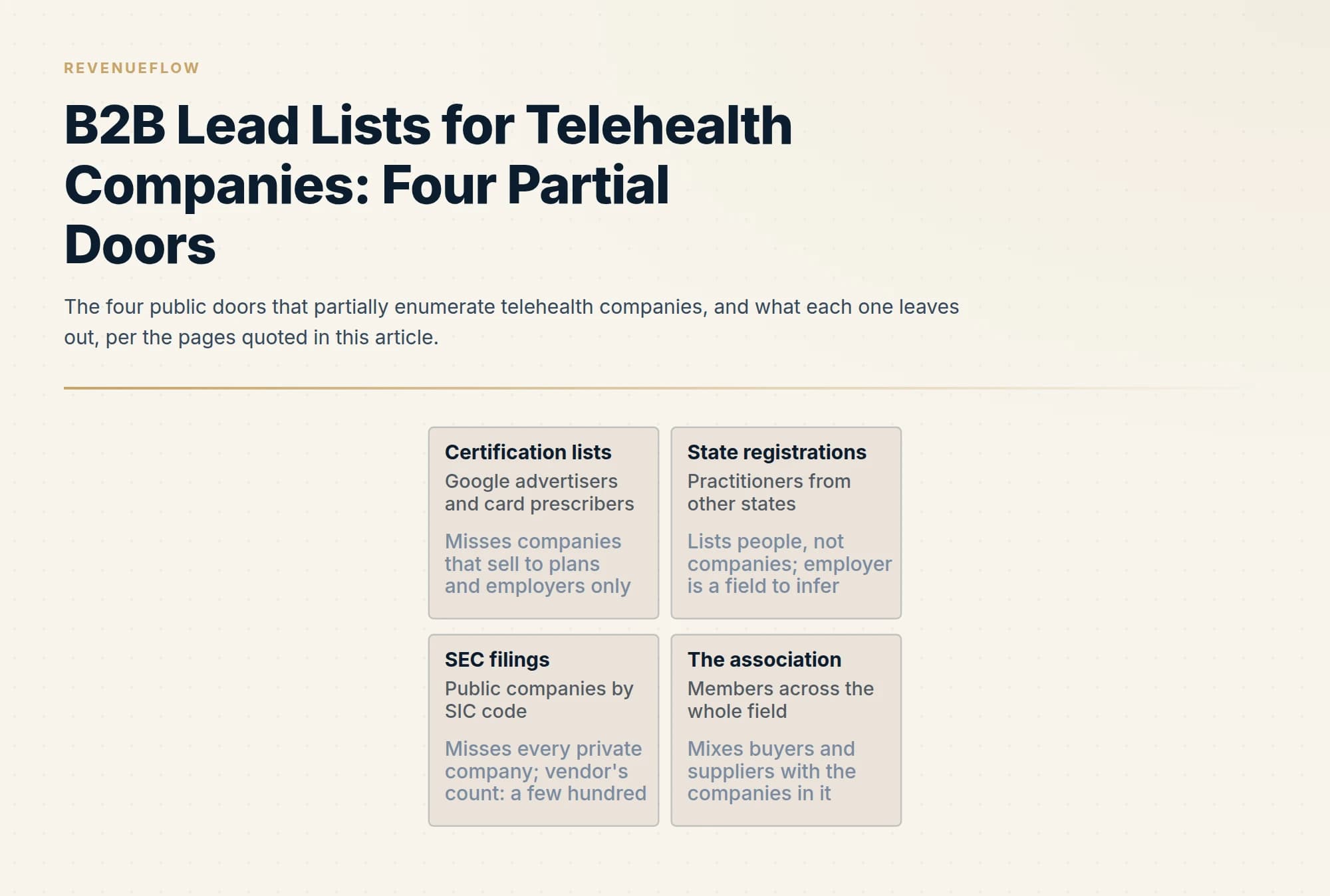
No federal record enumerates telehealth companies, so a list is built from four partial doors: the LegitScript certification Google requires of telemedicine advertisers, state registrations such as Florida's for out-of-state practitioners, SEC filings for the listed companies, and the industry association. Vendors sell the address, which no door holds.
Key takeaways
- Google's healthcare policy allows telemedicine providers in the United States only if they are accredited by LegitScript's Healthcare Merchant Certification Program, which covers websites that provide virtual care and facilitate prescribing, so certification status is a checkable field.
- Florida's section 456.47, effective 1 July 2019, requires out-of-state health care practitioners to register with the Department of Health to perform telehealth for Florida patients, and the registration names practitioners, not companies.
- The SEC's SIC code list says the code on an EDGAR filing indicates the company's type of business, which enumerates the listed telehealth companies and none of the private ones.
- LakeB2B's telemedicine companies list page shows 5,240 contacts and describes a sector of over 260 companies in the USA, by its own claim, which is the shape of the market: few companies, many contacts, no census.
Reviewed and updated September 21, 2026
A list vendor's page for telemedicine companies carries two numbers that do not belong together. LakeB2B's telemedicine companies email list shows "Total no. of contacts 5,240" with a line reading "last updated : August 21, 2026", and its copy says the sector has "over 260 companies in the USA itself." (LakeB2B, Telemedicine Companies Email List, read 21 September 2026.) Both figures are the vendor's own, quoted as its claims, and the gap between them is the shape of this market: a few hundred companies, many contacts per company, and no public file that says which companies they are.
This page is for the seller reaching telehealth companies, whether software, billing, staffing, security, licensing or devices, who is deciding what to buy and what to build. It is the anatomy of a telehealth company list: why no federal record enumerates the companies, the four partial doors that do, what a row can carry from each, what the vendor's own numbers mean, the rules on the message, and how to check a row before a send. What a lead list is in general is the lead list entry's job; what a verified address means when a vendor sells one is CMO email list. The buyers inside a telehealth company, their trigger events and the signals a list is built from are in our guide to cold email for telehealth companies, which is written for this reader and is not repeated here. Every outside page below was read on 21 September 2026 and is dated where it publishes a date.
Why there is no census
Most healthcare lists start from the federal provider registry, and the walk through it is in healthcare sales prospecting, with the physician version in physician email lists. Those files enumerate clinicians and the groups they bill through. A telehealth company is a business that employs or contracts clinicians who are individually licensed, and the public records attach to the people, not the company. The four doors below each enumerate a piece of the segment, and none enumerates the whole.
Door one: the certification a consumer-facing telehealth company cannot avoid
Google's healthcare and medicines policy, read on 21 September 2026, lists telemedicine as allowed with limitations in the United States and states the limitation: "Google allows telemedicine providers if they're accredited by LegitScript's Healthcare Merchant Certification Program, which offers telemedicine certification to websites that provide virtual healthcare services and facilitate prescribing." (Google Ads policy, Healthcare and medicines.) LegitScript's own page on the Google recognition says its certification includes "Telemedicine providers that facilitate prescribing" and adds the card networks' version of the same gate: "In June 2017, Visa announced that all pharmacy merchants and telemedicine providers that process card-not-present transactions had to be certified and monitored by a recognized certification organization, such as LegitScript." (LegitScript, certification recognized by Google.)
So a telehealth company that advertises prescribing services on Google or takes cards online is certified, and certification is a status a seller can check per company. It is the best enumeration of the consumer-facing, prescribing end of the market and says nothing about a telehealth company that sells to employers or health plans and never runs an ad.
Door two: the state registration a practitioner cannot avoid
Florida's Department of Health explains its telehealth law, section 456.47 of the Florida Statutes, on the page for the registration it created: the law "established standards of practice for telehealth services, including patient evaluations, record-keeping, and controlled substances prescribing", and "The law also authorizes out-of-state health care practitioners to perform telehealth services for patients in Florida." The date and the duty follow: "Signed by the Governor on June 25, 2019, this law became effective on July 1, 2019. Out-of-state health care practitioners must be registered with the Florida Department of Health to perform telehealth services for patients in Florida." The page is explicit about who registers: "Out-of-State Telehealth Provider Registration in Florida is for health care practitioners licensed outside of Florida ONLY." (Florida Department of Health, Telehealth.)
A registration that names practitioners is a list of people, and a telehealth company appears in it only as the employer behind a cluster of names. The federal telehealth site describes the wider regime a seller is reading: "Telehealth licensure requirements vary at the federal, state, and cross-state levels for health care providers." (HHS, Telehealth policy.) Which states a company's clinicians are registered in is therefore a field a list can carry, state by state, and it is a field no vendor's row shows.
Door three: the filings of the public ones
The SEC's list of Standard Industrial Classification codes, dated 3 June 2021 on the page, explains what the code on a filing means: "The Standard Industrial Classification Codes that appear in a company's disseminated EDGAR filings indicate the company's type of business." The codes a telehealth company files under sit in the services range, including 8090, "SERVICES-MISC HEALTH & ALLIED SERVICES, NEC", and 8093, "SERVICES-SPECIALTY OUTPATIENT FACILITIES, NEC". (SEC, Standard Industrial Classification Code List.) A public telehealth company's size, states, payer mix and headcount are in its own filings, in its own words. That door enumerates the listed companies only, and the vendor's own count of the segment says the listed ones are a small minority.
Door four: the association
The American Telemedicine Association describes its membership on its own page: "We are the largest network of academic medical centers, hospitals, delivery systems, health insurance organizations, employer organizations, researchers, and technology suppliers focused on catalyzing telehealth." (ATA, Membership.) That sentence is the reason the member list is not a list of telehealth companies: it names the buyers, the payers, the employers and the suppliers in one network. For a seller the association is a segmenting signal, since a company on it has chosen to be in the room, and a conference roster, not a census.
| Field on the row | Where it comes from |
|---|---|
| Legal name and public filings | EDGAR, for the listed companies |
| Certified to advertise and take cards | LegitScript certification status |
| Facilitates prescribing | The certification category |
| States its clinicians are registered in | State registrations such as Florida's |
| In the room at the industry body | ATA membership |
| Funding, licensure expansion, hiring | The signals in the buyer guide |
| A working email address | No public file; the field vendors sell |
What the vendor's numbers mean
Set LakeB2B's two figures against the doors. Its page offers 5,240 contacts and describes a sector of over 260 companies, which is about twenty contacts per company if the two numbers describe the same population. The company count is close to what a seller would assemble from the four doors by hand; the contact count is the product, because no door above holds an email address. Every count in this section is the vendor's own claim, quoted from its page and not verified here.
The buyer guide named at the top lists the signals a list is actually built from, funding rounds, licensure and state expansion announcements, job postings, conference rosters, and certified provider listings, and this page adds the record behind two of them: the certification is a checkable status, and the state expansion is a registration.
The rules on the message
The FTC's CAN-SPAM guide, read on 21 September 2026, says: "Despite its name, the CAN-SPAM Act doesn't apply just to bulk email." It applies to a commercial message to a telehealth company's chief commercial officer as it does to any other, with the header, subject, address and opt-out requirements the guide sets out. (FTC, CAN-SPAM Act compliance guide.) The rules on business calls and on mobile numbers are on the calling rules pages on this site. Two things a seller to this market should not confuse: HIPAA is the buyer's regime and the reason a telehealth company reads every vendor email as a security question, which the buyer guide covers; it is not a rule on writing to the company. None of this is legal advice.
How to check a row before a send
A public door can confirm
- The company is certified, and for which category
- Its clinicians are registered in a given state
- It files with the SEC, and under which code
- It is a member of the industry association
Only the company or a vendor can
- The person's name and title today
- A working email address
- Whether it sells to consumers, employers or plans
- Whether it is still operating
Read the two panels in order. A row whose public fields all confirm is a company that exists, is certified for what it does, serves states it says it serves, and files what it must; the vendor's field is then the only one left to buy. A row whose public fields fail is a row to remove, whatever the vendor's verification badge says.
Three reasons to write, each from a door
Each reason rests on one page above, names no real company or person, and claims no result. The companies described are invented for illustration.
Grounded in the Google policy. An invented example: a virtual dermatology company that has just become certified is a company that can now advertise prescribing services on Google, and a seller of paid-search or patient-acquisition services has a reason the company's own status supplied.
Your certification means you can run search ads for prescribing services now, which usually means the acquisition budget is about to move. We run paid search for two virtual care companies at that stage. Worth fifteen minutes before the first campaign goes live?
Grounded in Florida's registration page. An invented example: a virtual behavioural health company whose clinicians have registered in a new state has a credentialing, payer and scheduling problem in that state this quarter.
Your clinicians registered in Florida this month, and a new state usually arrives with a credentialing and payer-enrolment queue. We handle that queue for virtual care companies expanding state by state. Could we send the one-page checklist your operations lead would use?
Grounded in the SEC list. An invented example: a listed telehealth company whose filing describes a new payer contract has told its investors what it will need next.
Your latest filing describes the new plan contract, and a plan contract usually means claims volume the billing team was not sized for. We work with two listed virtual care companies on that exact step. Would a short call with your revenue cycle lead be useful?
When this list is the wrong tool
When the buyer is the patient, where the certification and registration doors describe a consumer business and a consumer list is a different law and a different page. When the company sells only to employers and plans and never advertises, where the certification door is empty and the row has to come from the buyer guide's signals. When the target is the clinicians rather than the company, where the state registration is the list and the physician list page is the guide. And when the seller has no reason to write beyond the company's existence, where two hundred and sixty companies is a small list and a small reply.
If you would rather have the four doors joined, the public fields checked and the first message built on a certification, a registration or a filing, see what a first campaign would look like.
The short version
No federal file enumerates telehealth companies, and a vendor's own page says the segment is a few hundred companies deep. What does exist is four partial doors: a certification that any company advertising or taking cards for prescribing services must hold, state registrations that name its clinicians, SEC filings for the listed few, and an association whose members are the whole field. The vendors sell the address, which no door holds. Build the rest, check the public fields first, and write to the company for a reason one of those doors supplied.
Every page quoted above was read on 21 September 2026 from stored snapshots. Policies, registrations and vendor counts change; read the current pages before relying on them. Nothing here is legal advice.
Frequently asked questions.
Frequently asked questions- Is there a public list of telehealth companies?
- Not a complete one. The federal provider files enumerate clinicians and billing groups, and a telehealth company is a business behind individually licensed clinicians. What exists is partial: LegitScript's certification, which Google's policy requires of telemedicine advertisers that facilitate prescribing; state registrations such as Florida's for out-of-state practitioners; SEC filings for public companies; and the American Telemedicine Association, whose members span buyers, payers, employers and suppliers.
- What does LegitScript certification tell a seller about a telehealth company?
- That it advertises or takes cards for prescribing services. Google's healthcare policy allows telemedicine providers in the United States only if they are accredited by LegitScript's Healthcare Merchant Certification Program, and LegitScript's page says Visa announced in June 2017 that telemedicine providers processing card-not-present transactions had to be certified. A company selling only to employers or health plans may never need it, so an empty certification field does not mean the company is absent.
- What does a state telehealth registration add to a row?
- The states a company's clinicians serve from outside. Florida's Department of Health says its 2019 law, section 456.47, authorises out-of-state practitioners to perform telehealth for Florida patients and requires them to register, and that the registration is for practitioners licensed outside Florida only. The record names people, so the company is the employer behind a cluster of names, and a new state's registrations are a reason to write.
- How do I check a telehealth company row before emailing it?
- Confirm the public fields first: whether the company is certified and for which category, whether its clinicians are registered in the states it claims, whether it files with the SEC and under which code, and whether it belongs to the industry association. Then buy or verify the fields no public door holds, the person's current title and a working address. A row whose public fields fail is removed whatever the vendor's badge says.
About the author.

B2B cold email experts helping companies generate qualified leads through done-for-you outreach campaigns.
RevenueFlow Team
Explore more.
Ready to scale your outreach?
We build GTM engines that book real meetings. See the receipts.
Related articles.
B2B Lead Lists for Associations: The Census Is Public
The anatomy of an association list: the IRS master file that enumerates every business league, the Form 990 lines that name officers and dues, and what vendors sell.
Commercial Insurance Lead Lists: Four Fields, Four Records
The anatomy of a commercial insurance lead list for an agency: class, exposure, renewal month and carrier, the public records that hold each, and what vendors sell.
B2B Lead Lists for Utilities: Three Registries, One Gap
The anatomy of a utilities lead list: the EIA-861 census, PHMSA annual reports and SDWIS enumerate electric, gas and water utilities; vendors sell the field they lack.
Physician Email Lists: The Row, Its Sources and Its Gaps
The anatomy of a physician email list: the six field groups, which CMS, AMA and state board records hold each, what vendors claim, the rules, and the order to verify.
B2B Lead Lists for Collection Agencies: Fields and Sources
What a creditor prospect list needs for a collection agency: the fields that matter, the FDIC, NCUA, CMS and court sources behind them, and the rules that apply.
Cold Calling for Consulting Firms: The Partner's Hour
Cold calling for a consulting firm: who it dials and who picks up, why partner-led economics argue against the phone, the client's fiscal year, and when to skip it.