Cold Calling for Software Development Companies: Proof First
What changes when a custom software development shop cold calls: how buyers shortlist on proof, what a call should ask for, and the UK and US calling rules.
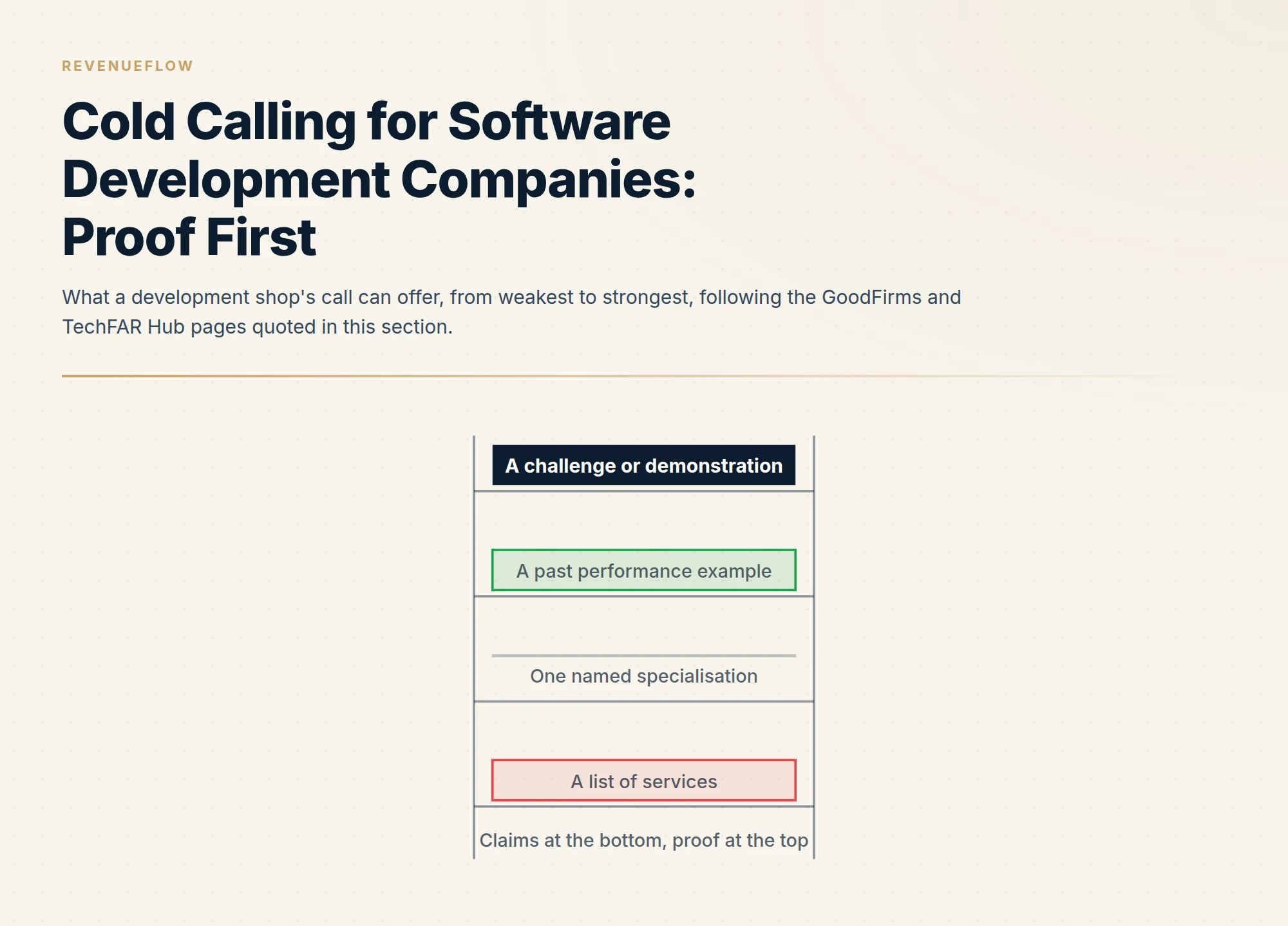
Buyers of development services shortlist on specialisation and evidence of delivery, so a cold call that lists services offers nothing they value. A development shop's call should reach whoever runs engineering, rest on a public fact such as an open role, and ask only to send one past performance example or take a small paid challenge.
Key takeaways
- A recorded software development cold call critiqued by SalesScripter on July 31, 2023 opens with a list of services, which the critique says is likely to trigger guardedness and objections.
- GoodFirms says it ranks firms on two axes, Core Competencies, meaning how specialized a firm is in a service, and 360-Performance View, meaning how well it executes.
- The US government's TechFAR Hub tells buyers the only way to know a vendor is well versed in agile development is to have them prove it through past performance examples, challenges or demonstrations.
- The UK ICO says business-to-business callers need to screen numbers against both the TPS and the CTPS registers, as well as their own do not call list.
Reviewed and updated September 18, 2026
A recorded cold call from a software development company opens like this: "We are from a software development company based in Michigan." The caller then lists services. Michael Halper of SalesScripter, who published the recording with his critique on July 31, 2023, names the problem with that opening in one line: it "makes you sound like a salesperson trying to sell something, and that is likely to trigger guardedness and objections" (SalesScripter, read 18 September 2026). Every development shop can say the same sentence, and the person hearing it knows that.
This guide is for a software development company that sells its engineers' time: custom development shops, outsourced and nearshore engineering firms, agencies that build products for clients. It is not about selling a software product by phone, which is a different call with a demo at the end of it. It is also not for vendors selling to development firms. The mechanics of cold calling are covered elsewhere on this site. What follows is what this market changes: how buyers of development services actually shortlist, what that means for who a call should reach and what it can ask for, the calling rules when the seller sits in another country, the objections on record, and when the phone is the wrong play.
How buyers shortlist a development vendor
Two published descriptions of the buying process, one from a directory and one from a very large buyer, agree on the point that matters for a caller.
The directory is GoodFirms, which documents how it ranks development companies. Its methodology page, last reviewed on May 13, 2026, says every ranking is produced by "a two-axis scoring system that plots each firm by Core Competencies (how specialized they are in the service you're browsing) and 360-Performance View (how well they execute)" (GoodFirms research methodology, read 18 September 2026). Set aside whether any one directory's scores are right. The structure tells you what a buyer browsing it is asking: is this firm specialised in the thing I need, and is there evidence it delivers.
The buyer is the United States government. Its TechFAR Hub, written for officials who buy agile software development, is blunt about vendor claims: "Companies may say they follow agile development methods", it says, and "The only way to truly know if a vendor is well-versed in agile development is to have them prove it, whether through past performance examples or innovative methods like challenges and demonstrations." (TechFAR Hub, market research, read 18 September 2026.) A public buyer follows formal steps a private one does not, but the instinct is the same everywhere: claims are free, so proof is what counts.
Put those next to Halper's recording. A call that lists services is offering the one thing the buyer has been told to ignore. A call can carry something better, and the ladder below is the order of what is worth asking for.
Who the call should reach, and what it should ask for
The person who owns a build-or-buy engineering decision is whoever runs engineering: a founder or chief technology officer at a small company, an engineering leader at a larger one, with procurement arriving later. Our guide to selling to IT buyers makes the point that technology buyers evaluate outbound for a living, because they or their colleagues run it too. A development shop's prospect is that reader exactly.
Halper's critique includes the questions he would have the caller ask, and they show what a first conversation in this market is for: "Do you currently have software development projects?", "Are you using in-house or outsource developers?" and "How is everything going with your developers and projects?" Those are questions about the state of the work, and he adds a point worth keeping: when the prospect says they already use someone, that "is not a valid reason to stop talking because you are not trying to sell anything."
That last clause is the design principle. A cold call for a services firm should not try to win a project. It should try to earn a place on the shortlist the next time one is drawn up, and the ask that does that is small and concrete: permission to send one past performance example in the prospect's own technology, or an offer to take a small paid challenge. Both are rungs from the figure above.
The reason to call a particular company on a particular day has to come from the company. Public engineering job postings are the richest source. A posting that has been open for months, or a cluster of postings for one skill, suggests the team cannot hire fast enough, which is the condition under which outside engineers get considered. The method for judging a signal like that is in our B2B prospecting guide.
The calling rules when the seller is in another country
Development shops sell across borders more than most service firms, so the caller's location and the prospect's location are often under different rules. The United States position on business calls, including the separate rules for dialers and mobile numbers, is set out in what cold calling is and which rules apply and whether cold calling is against the law. They are not repeated here.
The United Kingdom is the case that catches sellers out, because it treats business numbers differently. The Information Commissioner's Office summarises the rule on live marketing calls: "you must not make unsolicited live calls: to anyone who has told you they don't want your calls; to any number registered with the TPS or CTPS, unless the person has specifically consented to your calls". It then explains why a business list needs two registers: "some businesses (sole traders and some partnerships) register with the TPS, and others (companies, some partnerships and government bodies) register with the CTPS. For business-to-business (B2B) calls, you will therefore need to screen against both the TPS and the CTPS registers, as well as your own 'do not call' list." (ICO, telephone marketing, read 18 September 2026.)
| You are calling | Check first | Source |
|---|---|---|
| A UK company or government body | The CTPS register, and your own do not call list | ICO guide to PECR |
| A UK sole trader or partnership | The TPS register as well, since some register there | ICO guide to PECR |
| A US business line | The federal business call position and your state's rules | Our cold calling rules guide |
| A US mobile number | The dialer and mobile rules, which ignore the B2B question | Our cold calling and the law guide |
We tried to read the Canadian regulator's page on business calls and could not fetch it, so Canada is not covered; check the CRTC's own rules before calling there. This section reports what the cited pages say and is not legal advice.
Time zones are the practical side of the same problem. A team calling North America from Eastern Europe or South Asia is working its own evening or night to reach a prospect's morning. That is a staffing cost to plan for, and it is a reason to put writing first and keep calls for prospects who have already replied.
The objections on record
The first is in Halper's recording: a list of services triggers guardedness. His fix is to replace the list with what the firm helps clients do, and he gives examples: "Improve the speed of their software development projects" and "Augment their team with niche developers". That is better, and the buyer guidance above suggests going one step further, from a benefit to a specific example the prospect can check.
The second is the incumbent. Halper's answer, that an existing vendor is no reason to stop talking when you are not selling anything yet, fits a market where the realistic goal is the next shortlist.
The third is scepticism about claims, and the TechFAR Hub states it for every buyer: companies may say they follow a method, and the only way to know is to have them prove it. A caller who offers proof unprompted has answered the objection before it is raised. The general craft of handling objections live is in cold call objection handling.
Three openers, each tied to a public fact
None names a real person or claims a result.
The open role.
This is {{name}} at {{company}}. Your posting for {{role}} has been open since {{month}}. We are a {{technology}} shop, and we are not pitching a project. If it would help while you hire, we can send one example of a {{technology}} build for a team your size. Is that worth thirty seconds of your inbox?
The source is the prospect's own job posting.
The proof offer.
This is {{name}} at {{company}}. Buyers of development work are told the only way to know a vendor is good is to make them prove it. We agree, so our first step with a new client is a small paid task with a fixed scope. If a backlog item has been sitting for a quarter, would you try us on it?
The source is the TechFAR Hub's advice to buyers.
The UK introduction.
This is {{name}} at {{company}}. Before calling we checked this number against the CTPS register and our own do not call list, as the ICO asks. We build {{specialisation}} for {{sector}} firms. May we send one example and leave it there?
The source is the ICO's screening rule, stated plainly because a UK buyer will respect that it was followed.
When the phone is the wrong play
The phone is the wrong play for a shop that grows by referral and is at capacity, and our guide to lead generation for digital agencies covers why referral-led firms should build outbound before they need it and what breaks when they do. It is the wrong play for a generalist with no specialisation to name, since the first rung of the ladder is all it can offer. It is the wrong play across a time gap your team cannot staff. And it is the wrong play for UK numbers nobody has screened.
Where calling sits next to written outreach is a matter of policy for us, not a result. RevenueFlow runs email and LinkedIn and does not make cold calls. For a development firm the written channel has a specific advantage: a past performance example travels better as a link than as a sentence spoken to someone in the middle of a sprint. Our doctrine is one message per campaign with nothing scheduled behind it, and a new campaign when a new posting or a new release gives a new reason to write. If you want that built for your specialisation, see what a first campaign looks like.
The short version
Buyers of development services shortlist on specialisation and evidence of delivery, which is how GoodFirms says it ranks firms and what the TechFAR Hub tells government buyers to demand. A cold call that lists services offers neither, as a published recording of one shows. The call should reach whoever runs engineering, rest on a public fact such as an open role, and ask for something small: permission to send one relevant example, or a small paid challenge. Sellers calling the United Kingdom must screen business numbers against both the TPS and the CTPS. Referral-led shops at capacity, generalists, and teams that cannot staff the time gap should not be dialling.
SalesScripter, GoodFirms, TechFAR Hub and ICO pages quoted above were read on 18 September 2026. Rules and methodologies change. Confirm them at the source before relying on them.
Frequently asked questions.
Frequently asked questions- Does cold calling work for software development companies?
- Only when the call offers proof. Buyers shortlist development vendors on specialisation and evidence of delivery, which is how GoodFirms ranks firms and what the TechFAR Hub tells government buyers to demand. A call that lists services fails. A call that rests on a public fact and asks to send one relevant past performance example can earn a place on the next shortlist.
- What should a software development company say on a cold call?
- Name one specialisation, give a public reason for calling, such as the prospect's open engineering role, and ask for something small: permission to send one example in the prospect's own technology, or a small paid challenge with a fixed scope. SalesScripter's critique of a recorded call warns that opening with a list of services triggers guardedness and objections.
- Can an offshore development company cold call UK businesses?
- The UK Information Commissioner's Office says you must not make unsolicited live calls to anyone who has objected or to any number registered with the TPS or CTPS without specific consent. Because sole traders and some partnerships register with the TPS and companies with the CTPS, it says business-to-business callers need to screen against both registers and their own do not call list.
- When should a development shop not use cold calling?
- When it grows by referral and is at capacity, when it is a generalist with no specialisation to name, when the time gap to the prospect's working day cannot be staffed, and when UK numbers have not been screened. In those cases written outreach carrying a link to a relevant example is the better first step.
About the author.

B2B cold email experts helping companies generate qualified leads through done-for-you outreach campaigns.
RevenueFlow Team
Explore more.
Ready to scale your outreach?
We build GTM engines that book real meetings. See the receipts.
Related articles.
Cold Calling for Legal Tech Companies: Who Answers at a Firm
What changes when a legal tech company cold calls a law firm: which desks answer, why the billable hour hurts the pitch, the 2027 show dates, and what not to ask.
Cold Calling for EdTech Companies: Who Answers at a School
What changes when an edtech company cold calls a school: who picks up, the fiscal and testing calendars, district vendor contact rules, and when not to dial.
Cold Call Openers: Eleven Lines by Situation, and the Data
Eleven cold call openers sorted by what is true about the call, the four beats every opener has, and what Gong's 2018 opener study actually counted.
B2B Lead Lists for Collection Agencies: Fields and Sources
What a creditor prospect list needs for a collection agency: the fields that matter, the FDIC, NCUA, CMS and court sources behind them, and the rules that apply.
Outbound Sales for Food and Beverage Companies: Who to Reach
Outbound sales for food and beverage brands: the four buyers behind a yes, the public show calendar, what a message may claim, and when outbound is the wrong play.
Cold Calling for SaaS Companies: What Changes on the Call
The two calls a software company makes, who picks up in crowded and uncrowded categories, how the first thirty seconds go, and why a SaaS list is a mobile-number list.