Cold Calling for SaaS Companies: What Changes on the Call
The two calls a software company makes, who picks up in crowded and uncrowded categories, how the first thirty seconds go, and why a SaaS list is a mobile-number list.
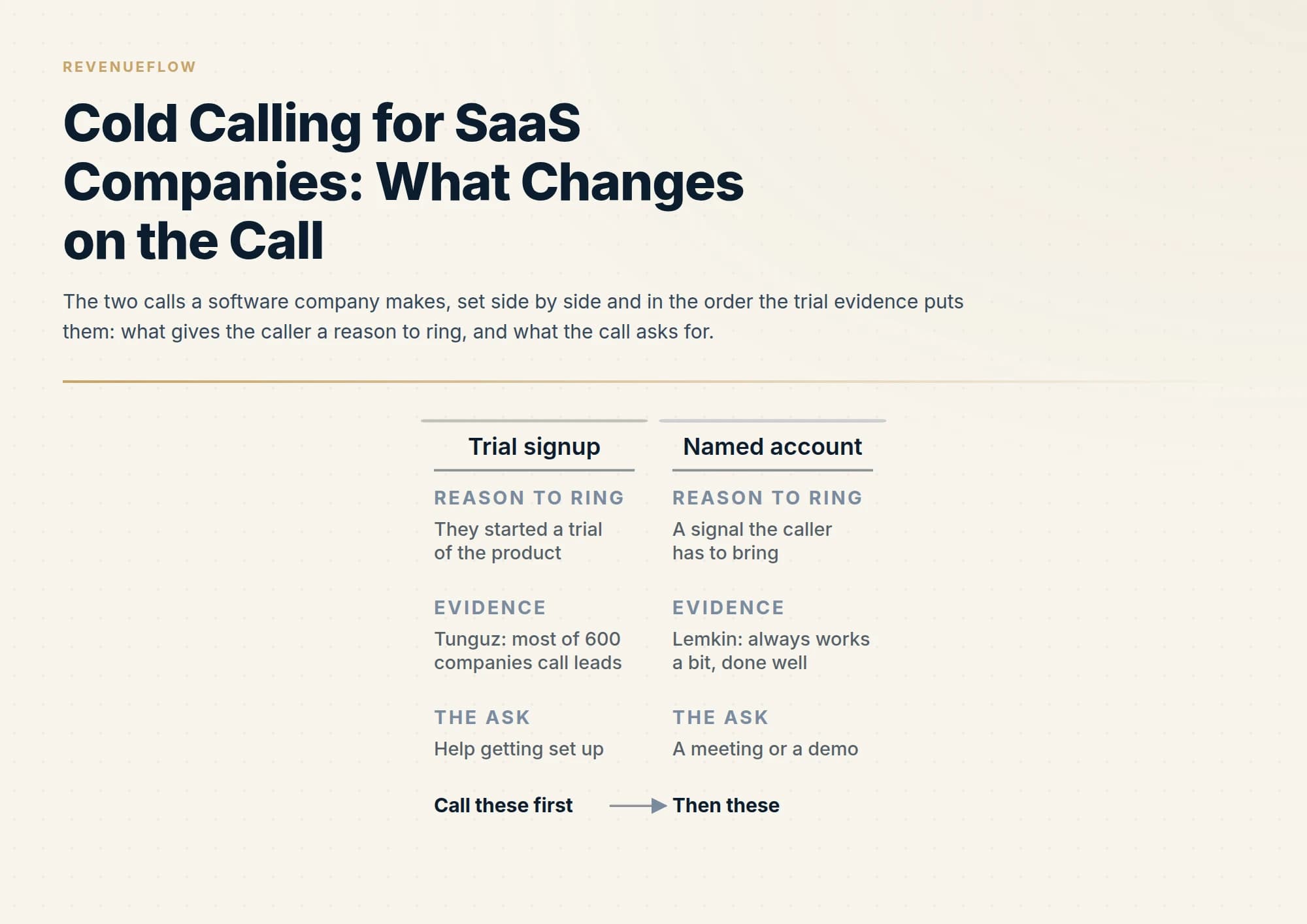
A software company makes two calls. The call to trial signups has survey evidence behind it: in Tomasz Tunguz's study of 600 companies, 75% used salespeople to call leads. The cold call to a named account connects more often in categories with few vendors and high budgets. State the purpose immediately and ask for the demo.
Key takeaways
- SaaStr's write-up of Tomasz Tunguz's study of 600 freemium and free trial companies reports that 75% use salespeople to call leads, with conversion targets of 4% unassisted and 15% assisted.
- The same write-up says activity scoring is not effective in the SMB market and decreases conversion in mid-market and enterprise, so calling only promising-looking signups can backfire.
- Jason Lemkin writes on SaaStr that segments with hundreds of vendors, such as sales and marketing automation and analytics, have lower connect rates until the caller has a brand.
- A sales trainer in a 21 January 2026 r/salesdevelopment thread writes that if your first sentence could be said to anyone, the call is already dead; both camps in the thread ask for the meeting, never the sale.
Reviewed and updated September 18, 2026
Cold Calling for SaaS Companies: What Changes on the Call
Jason Lemkin, whose byline sits on SaaStr's Dear SaaStr replies to founders, opened one reply about cold calling with a confession: "Look, I hate getting those calls." Two sentences later he gave the verdict most software founders do not want to hear: "cold calling, done by folks who have done it well before, always works a bit." Both sentences are true at once in SaaS, and the distance between them is the subject of this page.
This page is for the software company whose own reps or founders make the calls. It does not re-argue whether the phone pays back at a given contract value. The live guide to outbound lead generation for B2B SaaS settles that by deal size, and this page agrees with it: under the lowest band the phone almost never pays back, and above it the phone belongs on accounts already showing signal. What follows is the call itself in a software market: the two different calls a SaaS company makes, who picks up, what the first thirty seconds have to do, and what the rules say about the numbers on a SaaS prospect list. Every outside source was fetched on 18 September 2026.
A SaaS company makes two different calls
Most industries have one cold call. Software has two, and they behave so differently that running them on one script is the commonest mistake.
The first is the call to a stranger at a named account. The second is the call to someone who has started a free trial or signed up for a free tier. It is unsolicited in the sense that the person did not ask to be phoned, but the reason for the call sits in the caller's own product.
The second call has evidence behind it. SaaStr's write-up of Tomasz Tunguz's analysis of free trials, a study he presented at a SaaStr Annual covering 600 freemium and free trial companies, reports that "75% of respondents use salespeople to call leads, which increases the conversion rate from 4% to 15%", and gives those two figures as the targets for unassisted and assisted conversion. The same write-up carries a warning for teams that want to call only the signups whose usage looks promising: activity scoring, meaning the use of product metrics to qualify leads, is described as not effective in the SMB market and as actually decreasing conversion rates in the mid-market and enterprise. Those are one investor's survey findings as SaaStr reports them, and a company's own trial data outranks them.
The practical reading is that a software company with a trial should make sure every signup in its target segment gets a human call before it spends a dial on a stranger. Which signups earn a person and which named accounts earn outbound regardless is the routing rule the live guide to B2B SaaS lead generation says has to be set in advance.
Who picks up, and why the category decides
Lemkin's reply, In B2B startups, how useful is cold calling?, makes two observations about who answers. The first is about company size: cold calling "seems to work especially well with very small businesses. If the pitch rocks." The second is about the category the caller sells in, and it is the most SaaS-specific fact on this page. Some markets, he writes, have higher connect rates than others however well the team is trained. Segments with hundreds of vendors, and he names sales automation, marketing automation, business intelligence and analytics, typically have lower connect rates, at least until the caller has a brand. "Verticals and segments with (x) relatively few vendors and (y) relatively high budgets, tend to have higher connect rates." He attaches rough percentages to both ends, offered as experience with no method behind them, so they are left out here.
The mechanism is easy to see from the buyer's chair. A head of marketing operations is called by every tool in a crowded category, recognises the opening inside a sentence, and stops answering unknown numbers. A buyer in a category with three vendors is called by almost nobody. Same skill on the phone, different market. Lemkin's test for whether the channel deserves a team is equally blunt: can cold calling really deliver a meaningful share of new bookings, and has the person running it done it before. His advice to founders is to back a VP of Sales who has, and to "Listen to the calls."
The first thirty seconds, from people who make these calls
An r/salesdevelopment thread from 21 January 2026, How do you earn the first 30 seconds on a cold call in B2B SaaS?, is a good record of the argument inside the trade. The poster sells software to mid-to-senior stakeholders on a three to four month cycle, and reports that prospects disengage as soon as they work out it is a cold call, that qualifying questions asked early trigger resistance, and that politely asking whether it is a good time does not help.
The replies split into two camps. A commenter who trains sales teams writes: "If your first sentence could be said to anyone, the call is already dead." The first half minute, the same reply says, is a threat assessment, and the structure it recommends is permission, a pattern, one check question and an exit. The other camp is led by a rep who writes that bookings tripled once the calls stopped being run like mini discovery calls: say who you are, give a thirty second pitch, ask for the meeting. A third commenter explains why the question-led opener fails with software buyers in particular: nobody wants to answer questions from a stranger who has just rung.
The camps agree on more than they admit. Neither asks the prospect to do discovery for the caller. Both state the purpose inside the first breath. And in both the ask is the meeting or the demo, never the sale, which suits a product the buyer can only judge by seeing it.
Named account, the first thirty seconds
{{first_name}}, {{name}} at {{company}}. One sentence on why we called, and you say whether it is relevant? 1
Teams running {{adjacent_tool}} tend to hit {{problem}} when {{trigger}}, and you posted a role for {{job_title}} last month. 2
Is that on your list this quarter or not at all? 3
- 1Permission for one sentence, with the purpose stated in the first breath. The pitch-and-ask camp skips the permission: say who you are, then a thirty second pitch.
- 2A pattern seen in their role, not a question. The trainer's test is that a first sentence which could be said to anyone has already killed the call.
- 3One check question that is also the exit. Neither camp asks a stranger to do discovery, and in both the ask is a meeting or a demo, never the sale.
The numbers on a SaaS list are mostly mobiles
A SaaS prospect list is usually bought as direct dials, and the live page on calling law observes that a large share of the direct-dial numbers on any current prospect list are mobile numbers. That changes which rule matters. The Federal Communications Commission's consumer guide on unwanted robocalls and texts defines robocalls as calls "made using an autodialer or a prerecorded or artificial voice message", and the restrictions that attach to wireless numbers under that regime do not ask whether the call was business-to-business. The statute and the rule are quoted in is cold calling against the law. A SaaS team that buys a parallel dialer or a voicemail drop is buying technology that sits inside that definition, and the purchase is broken down in the cold calling stack. This page gives no legal reading; the practical point is that a SaaS calling programme has a data question, which numbers are mobiles, before it has a script question.
Objections, in the trade's own words
The thread supplies the common ones. The incumbent answer, which one reply renders as already using "x or y for that", is nearly always true in software, because every category has a tool in it. The reply that a stranger gets "who are you" and a hang-up is the dismissive answer. And Lemkin supplies the founder's own objection to the whole channel: everyone hates receiving these calls. His answer is one sentence long: "But we aren't always our buyers." The response shapes for each kind of answer are set out in cold call objections sort into three buckets.
When the phone is the wrong play for a software company
Three cases. Below the lowest contract value band the live channel guide is unambiguous, and nothing here softens it. In a category with hundreds of vendors and no brand yet, Lemkin's observation says the connect rate will be poor whatever the script, and the cheap channel should find the accounts first. And where a trial exists and signups in the target segment are not yet being called, the stranger can wait, because the better call is going unmade.
Three openers, each tied to a source
These are shapes. They name no real recipient, claim no results, and every bracket is the caller's to fill with something true.
From the Tunguz finding, for the trial signup:
Hi {{first_name}}, this is {{name}} at {{product}}. You started a trial on {{day}}, and we call everyone who does, once. Did you get as far as {{first_milestone}}? If you are stuck we can fix it now, and if you are just looking, say so and the call ends here.
From the trainer's structure in the thread, for a named account:
{{first_name}}, {{name}} at {{company}}. One sentence on why we called, and you say whether it is relevant? Teams running {{adjacent_tool}} tend to hit {{problem}} when {{trigger}}, and you posted a role for {{job_title}} last month. Is that on your list this quarter or not at all?
From the pitch-and-ask camp:
{{first_name}}, this is {{name}} with {{company}}. We make {{one_line_product}} for {{segment}} teams. The call is to set up a twenty minute demo with {{ae_name}}, because {{specific_reason}}. Would Thursday at eleven or three work?
Where calling sits next to written outreach
RevenueFlow runs email and LinkedIn for clients and does not cold-call, so this page describes the phone as many software companies' practice and takes no revenue from recommending it. The live channel guide's sequencing principle is the one we work to: use the cheap channel to find out where to spend the expensive one. Our written campaigns carry one message each, with no bumps and no LinkedIn retargets of people who did not reply, and the accounts and titles that answer are the ones a calling team should ring first. How email and cold calling each fail compares the two. If the written half is the part you would rather have run for you, see what a first campaign would target.
The short version
A software company makes two calls. The call to trial signups has survey evidence behind it and should be fully staffed before any stranger is dialled. The cold call to a named account connects more often in categories with few vendors and high budgets and less often in crowded ones, by SaaStr's account. State the purpose in the first breath, ask for the demo, find out which numbers are mobiles before choosing a dialer, and let deal size, as the channel guide sets out, decide whether to call at all.
Frequently asked questions.
Frequently asked questions- Does cold calling work for SaaS companies?
- Jason Lemkin's answer on SaaStr is that cold calling done by people who have done it well before always works a bit, and works especially well with very small businesses. He adds that connect rates depend on the category: lower where hundreds of vendors call the same buyers, higher where vendors are few and budgets high. Whether it pays back at a given deal size is a separate question the channel guide covers.
- Should a SaaS company call its free trial signups?
- The survey evidence says yes. SaaStr's write-up of Tomasz Tunguz's study of 600 freemium and free trial companies reports that 75% of respondents use salespeople to call leads, and gives conversion targets of 4% unassisted and 15% assisted. It also warns that scoring signups by product activity was not effective for SMB and lowered conversion for larger buyers.
- What should the first 30 seconds of a SaaS cold call do?
- Show the name was not picked at random and state the purpose at once. A sales trainer in a January 2026 r/salesdevelopment thread calls the first half minute a threat assessment and recommends permission, a pattern, one check question and an exit. A rep in the same thread tripled bookings by dropping discovery questions, pitching for thirty seconds and asking for the meeting.
- Do calling rules treat SaaS prospect lists differently?
- The rules are the same for every seller, but a SaaS list is usually direct dials, many of them mobiles. The FCC defines robocalls as calls made using an autodialer or a prerecorded or artificial voice message, and the restrictions on calls to wireless numbers do not turn on whether the call was business-to-business. Knowing which numbers are mobiles comes before choosing a dialer.
About the author.

B2B cold email experts helping companies generate qualified leads through done-for-you outreach campaigns.
RevenueFlow Team
Explore more.
Ready to scale your outreach?
We build GTM engines that book real meetings. See the receipts.
Related articles.
Cold Call Openers: Eleven Lines by Situation, and the Data
Eleven cold call openers sorted by what is true about the call, the four beats every opener has, and what Gong's 2018 opener study actually counted.
Sales Outsourcing for SaaS Companies: What to Hand Over
For SaaS companies weighing an outside sales team: what the industry's own survey found, what a third party cannot hold in a software sale, and what can go out.
Cold Calling Scripts for SEO Agencies: After Google's Warning
Six call scripts for SEO agencies calling local businesses, written around what Google and the FTC tell owners about this call: no Google tie, no ranking guarantee.
Lead Generation for Telecommunications Companies: Four Lead Sources
For carriers, ISPs, UCaaS providers and MSPs: the installed base, the advisor channel, dated outbound and the funded network map as lead sources, with FCC rules.
Cold Calling Scripts for 3PL Companies: One Lane at a Time
Six call scripts for brokers and 3PLs calling shippers: the front office line, the one-lane opener, the incumbent answer, the email brush-off and the voicemail.
LinkedIn Outreach for Machine Shops
How a job shop or CNC machine shop uses LinkedIn to win OEM work: the four buyer titles, the RFQ gate, the ISO, AS9100 and ITAR facts, and LinkedIn's own rules.