Cold Calling for EdTech Companies: Who Answers at a School
What changes when an edtech company cold calls a school: who picks up, the fiscal and testing calendars, district vendor contact rules, and when not to dial.
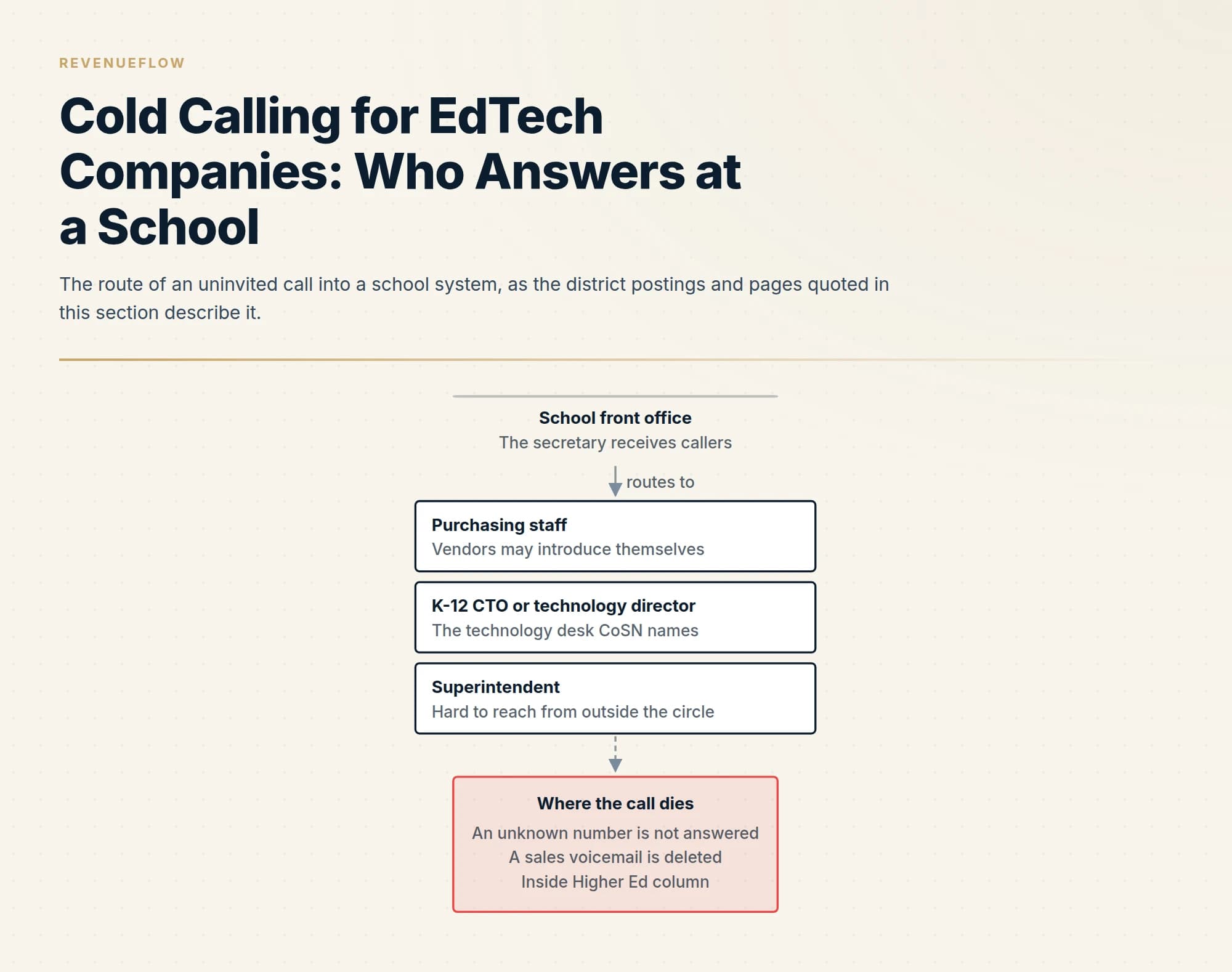
A cold call into a school reaches a secretary whose published job is to route callers, usually toward purchasing, the technology director or the principal. District fiscal years and state testing windows decide when anyone can talk, district procurement pages restrict vendor contact during open solicitations, and educators say in print that unknown numbers go unanswered.
Key takeaways
- A school secretary's job description includes receiving callers and scheduling appointments, so the first person on the line is a trained router, not a buyer.
- The Texas Education Agency lets each district choose a fiscal year that starts on July 1 or on September 1, so budget timing has to be looked up per district.
- Broward County Public Schools bars proposers from communicating about an open solicitation with anyone except the designated Purchasing Agent until the contract is awarded.
- Seattle Public Schools tells vendors they may introduce themselves to Purchasing staff and that email is the best method, which makes writing the invited channel.
Reviewed and updated September 18, 2026
A higher education technology leader once told every edtech seller in the country what happens to their calls. "If I don't recognize the caller's number, I will not answer the phone," Joshua Kim wrote in his Inside Higher Ed column on April 11, 2017, speaking for people in leadership and decision-making roles in higher ed IT. "And voicemails from sales people are summarily deleted." (Inside Higher Ed, read 18 September 2026.)
This guide is for the people making those calls: an edtech company phoning school districts, schools, colleges and universities to start a sales conversation. If you sell services or software to edtech companies themselves, the reader is a different one and cold email for edtech companies is the page for it. What follows is what changes about a cold call when the other end of the line is a school: who picks up, when anyone can talk, what the institution's own rules let a caller say, what educators say about being called, and when the phone is the wrong tool.
Who picks up, and who they route to
A call to a school's published number reaches the front office, and the front office has a job description that includes you. New Haven Unified School District's entry-level School Secretary job description lists the duty in plain words: the secretary "Receives callers in person and over the telephone, answering questions regarding school matters or scheduling appointments with a principal, assistant principal, or other staff members" (New Haven Unified job description, read 18 September 2026). The person who answers is a trained router, and the routes they know are the principal's calendar and the district office.
For a vendor, the district office is usually the better destination, because K-12 buying is centralised there. Our guide to lead generation in education covers the committee behind a purchase, so it is not repeated here. What matters on the phone is which desks a front office can transfer you to, and the vertical's own associations name them. The Consortium for School Networking describes itself as "the premier professional association for school system technology leaders" and publishes a "Framework of Essential Skills of the K-12 CTO" (CoSN, read 18 September 2026), so the technology desk has a recognised title: the K-12 chief technology officer, or the technology director in a smaller system. AASA, The School Superintendents Association, calls itself "A professional community of more than 10,000 educational leaders" on its About page (AASA, read 18 September 2026), which is the superintendent's desk. The third desk is the one districts themselves point vendors to, and that is purchasing.
Seattle Public Schools answers the vendor's question directly in its procurement FAQ. To the question of how to contact school-based customers, the district replies: "Vendors are asked to be mindful of the primary mission of schools, which is to educate students." It continues: "Vendor representatives are welcome to contact Purchasing staff to introduce themselves and share information about available products and services." And it names the channel it prefers: "The best method is by an email to the appropriate Procurement department" (Seattle Public Schools vendor FAQ, read 18 September 2026).
Higher education routes differently. Kim's column describes decisions that "are made by consensus at universities and colleges", so a campus call that reaches the right person has reached one voice in a group. It is also where a call to a campus IT leader dies, for the reason he gave at the top.
When a school can talk
Two calendars decide whether anyone has time for you, and both are published.
The first is the fiscal year, and it is not the same everywhere. The Texas Education Agency's page on the subject opens with the rule: "A school district or a charter school may choose a fiscal year from the following two options." One option starts the year on July 1 and the other on September 1, and the agency keeps a list of the districts and charter schools that use the July 1 start (Texas Education Agency, read 18 September 2026). Look the start date up per district, because the agency publishes it.
The second is the testing calendar. Florida's Department of Education posts its Statewide Assessment Schedules years ahead, and states the legal basis on the page: "Statewide Assessment Schedules are established according to Florida Statute 1008.22". The department adds that the schedules "also contain testing dates and windows for other statewide assessments" (Florida Department of Education, read 18 September 2026). Each assessment on the schedule has its own window, so the figure below is a schematic and not a count. During a testing window the people you want are proctoring, troubleshooting devices and answering to the state. Open your own state's schedule before you build a calling week, and leave the windows empty.
What the call is allowed to say
The federal and state rules that apply to any business call are set out in what cold calling is and which rules apply and in our reading of whether cold calling is against the law. They are not repeated here. Schools add a layer of their own, written by the institutions and posted on their procurement pages.
The first is access. Seattle's FAQ says "All visitors to schools, programs, or classrooms must obtain prior permission from the principal, program manager, or supervisor in charge, and are required to sign in at the main office." The second is the vendor list that does not exist: "The Seattle School District does not maintain special lists of prospective vendors for regular competitive solicitations or procurement activities." A call asking to be added to the vendor list has asked for something the district says it does not keep.
The third matters most, because it can cost you a contract. Many districts impose a quiet period once a solicitation is out. Broward County Public Schools calls it the Cone of Silence and defines it as "a period of limitation made effective from the time of the release of a solicitation and remains in effect until the contract is awarded by the School Board." During it, the rule reads: "Any proposer, or lobbyist for a proposer, is prohibited from having any communications (except as provided in this rule) concerning any solicitation for competitive procurements with any School Board member, the Superintendent, any Evaluation Committee Member, or any other School District employee after the Procurement & Logistic Operations Department releases a solicitation." One channel stays open: "All communications regarding the solicitation shall be directed to the designated Purchasing Agent" (Broward County Public Schools, read 18 September 2026). Florida Virtual School's version states the penalty, saying violators "may be disqualified or barred from participating in the solicitation process" (FLVS, read 18 September 2026).
Put that next to a calling list. A rep who phones a technology director about a category the district has an open solicitation for may have just broken the district's rule on behalf of the company. Check the district's open solicitations before any call, and if one touches your category, the only number to dial is the purchasing agent named in it. This is a description of what those pages say, not legal advice, and each district's own policy is the one that binds.
| Situation | What the district page says | What the caller does |
|---|---|---|
| No solicitation open | Seattle: vendors may contact Purchasing staff to introduce themselves; email is the best method | Call purchasing, or write first |
| Visitors to schools | Seattle: prior permission from the principal, sign in at the main office | Ask the front office for the route |
| Solicitation released in your category | Broward: no communications with any board member, the superintendent, a committee member or any employee | Only the designated Purchasing Agent |
What educators say about being called
The objections in this market are on the record, from the buyers.
Kim's column is the higher education version. His summary: "What edtech companies need to realize is that cold contacting is toxic." He does not blame the callers, writing that they follow policies they did not create. His alternative is slow by design: join the community, show up where edtech people gather, and accept the clock. "You need to work on higher ed time, which moves slowly." The payoff he offers a patient vendor is real: "Once you are a vendor partner, we are likely to stick with you for a long time."
The K-12 version comes from superintendents. NewSchools Venture Fund convened a group of current and former superintendents and published what they said on June 30, 2020. "Superintendents are currently receiving a deluge of outreach from ed tech companies," the summary reads, and the group was candid that "if a vendor isn't already in their circle, it will be hard to break through." They also named the way in: "Ed tech companies shouldn't be afraid to ask their customers for recommendations or advice on who to reach out to" (NewSchools Venture Fund, read 18 September 2026). The post dates from the first months of the pandemic, so read the volume as a snapshot. The point about circles is the durable one.
So the objection a caller hears is rarely about the product. It is that the caller is a stranger. The general craft of answering objections on a call is in cold call objection handling. The specific answer here is to stop being a stranger before you dial: a referral from a customer in a neighbouring district, a conversation started at a conference, or an introduction to purchasing that the district invited.
Three openers, each tied to a published page
Each opener below rests on one of the sources above, names no real person, carries no contact details and claims no results. The district and product are placeholders.
To purchasing, grounded in the Seattle FAQ.
Good morning, this is {{name}} from {{company}}. Your procurement page says vendors are welcome to introduce themselves to purchasing staff, and that email is the best method. We would rather do this the way you prefer. Who on your team covers {{category}}, and may we send them a short introduction?
It is legitimate because the district published the invitation, and it asks for a route instead of a meeting.
To a technology director, grounded in the state testing schedule.
This is {{name}} from {{company}}. We checked the state assessment schedule and your next testing window opens on {{date}}, so we are calling now and not then. One question about {{system}}: is it something your team reviews before the fiscal year turns over on {{fiscal_year_start}}, or has that decision already been made?
It is legitimate because both dates are public, and it shows the caller looked.
To the front office, grounded in the secretary's job description.
Hello, this is {{name}} from {{company}}. We are a vendor, so this will be quick. We are trying to find out whether questions about {{category}} go to the district office or stay with the principal. Could you point us to the right office?
It is legitimate because routing callers is the published duty of the person who answered, and because it says the word vendor in the first sentence.
Call to a district purchasing office
Your procurement page says vendors are welcome to introduce themselves to purchasing staff. 1
It also says email is the best method, so this can happen the way you prefer. 2
Who on your team covers this category, and may we send them a short introduction? 3
- 1Rests on the Seattle Public Schools vendor FAQ, which invites vendors to contact Purchasing staff.
- 2The same FAQ names email to the Procurement department as the best method, so the caller offers it.
- 3The ask is a route and permission to write. No meeting, no claim about results.
When the phone is the wrong play
The honest reading of the sources is that the phone is the weakest channel in this market for a first contact with a decision maker. The higher education buyer quoted above does not answer unknown numbers. The superintendents say a vendor outside their circle will struggle to break through. The district that tells vendors how to reach it names email.
The phone still earns a place in three situations the sources support: routing questions to a front office whose job is routing, introductions to purchasing where the district invites them, and conversations with people who already know you. It is the wrong play during a testing window, during an open solicitation in your category, and as a volume tactic against superintendents or campus IT leaders.
Where calling sits next to written outreach is a question we have a position on, and it is a policy, not a result. RevenueFlow runs email and LinkedIn for clients and does not run phone outreach, and our comparison of email and cold calling sets out how each channel fails. In education the written channel has one structural advantage: the district's own pages ask for it. Our doctrine there is one message per campaign, with no bumps behind it, and a new campaign only when the institution's calendar gives a new reason to write. If you want a calendar-aware list and a first message built for your districts, see what a first campaign looks like.
The short version
A cold call into a school reaches a secretary whose job is to route callers, and the useful routes are purchasing, the technology desk and, rarely, the superintendent. Two published calendars decide when anyone can talk: the district's fiscal year start, which varies even inside one state, and the state testing windows. District procurement pages add rules of their own, and the quiet period around an open solicitation is the one that can disqualify a vendor. Educators have said in print that unknown numbers go unanswered and that strangers struggle to break through, so the work that makes a call land happens before it: a referral, an invitation, or a reason taken from the institution's own public pages.
District, state and association pages quoted above were read on 18 September 2026. Policies differ by district and change. Read the current policy of the district you are calling before relying on any of this.
Frequently asked questions.
Frequently asked questions- Who answers when an edtech company cold calls a school?
- Usually the front office. New Haven Unified's School Secretary job description says the secretary receives callers in person and over the telephone and schedules appointments with the principal or other staff. From there the realistic routes are district purchasing, the technology director or K-12 CTO, and occasionally the superintendent. Teachers and principals are with students for most of the day.
- Is it okay to call a school district during an open RFP?
- Check the district's policy first. Broward County Public Schools applies a Cone of Silence from the release of a solicitation until the School Board awards the contract, and directs all communications to the designated Purchasing Agent. Florida Virtual School says violators may be disqualified or barred. Policies differ by district, so read the one that applies to the district you are calling.
- When is the best time to call a school district?
- Work from two published calendars. The fiscal year start varies, and in Texas a district may choose July 1 or September 1. State testing windows are posted in advance, as Florida's Department of Education does with its Statewide Assessment Schedules, and staff are tied up during them. Look both up for each district and keep calls out of testing windows.
- Do school and university buyers respond to cold calls?
- Their own published comments say rarely. Joshua Kim wrote in Inside Higher Ed in 2017 that he does not answer unrecognised numbers and deletes sales voicemails. Superintendents convened by NewSchools Venture Fund in 2020 said a vendor outside their circle will find it hard to break through, and suggested asking existing customers for recommendations instead.
About the author.

B2B cold email experts helping companies generate qualified leads through done-for-you outreach campaigns.
RevenueFlow Team
Explore more.
Ready to scale your outreach?
We build GTM engines that book real meetings. See the receipts.
Related articles.
Cold Calling for Legal Tech Companies: Who Answers at a Firm
What changes when a legal tech company cold calls a law firm: which desks answer, why the billable hour hurts the pitch, the 2027 show dates, and what not to ask.
Cold Calling for Payroll Companies: The Employer's Calendar
What changes when a payroll company cold calls employers: who picks up, the IRS quarterly calendar, what a caller may claim about tax liability, and when not to dial.
Cold Call Openers: Eleven Lines by Situation, and the Data
Eleven cold call openers sorted by what is true about the call, the four beats every opener has, and what Gong's 2018 opener study actually counted.
B2B Lead Lists for Collection Agencies: Fields and Sources
What a creditor prospect list needs for a collection agency: the fields that matter, the FDIC, NCUA, CMS and court sources behind them, and the rules that apply.
Outbound Sales for Food and Beverage Companies: Who to Reach
Outbound sales for food and beverage brands: the four buyers behind a yes, the public show calendar, what a message may claim, and when outbound is the wrong play.
Cold Calling for SaaS Companies: What Changes on the Call
The two calls a software company makes, who picks up in crowded and uncrowded categories, how the first thirty seconds go, and why a SaaS list is a mobile-number list.